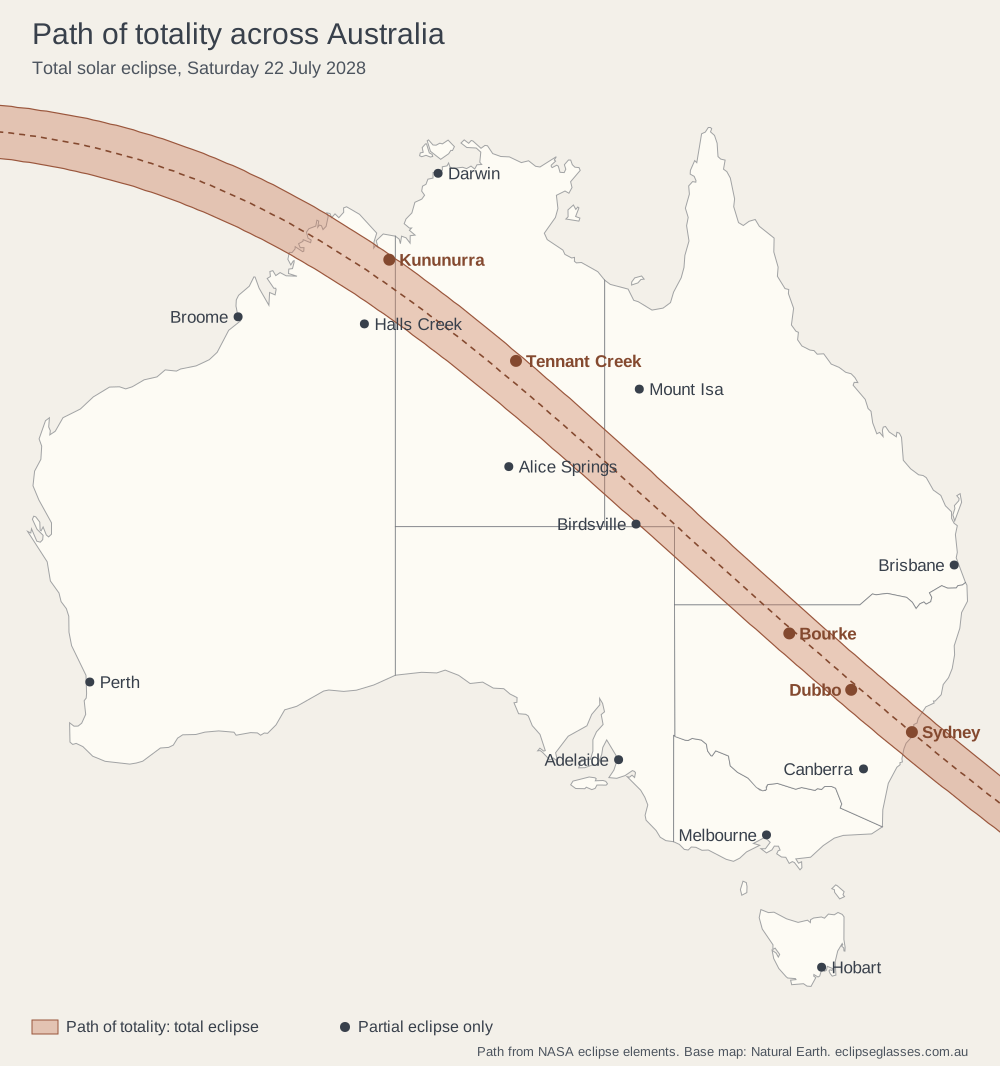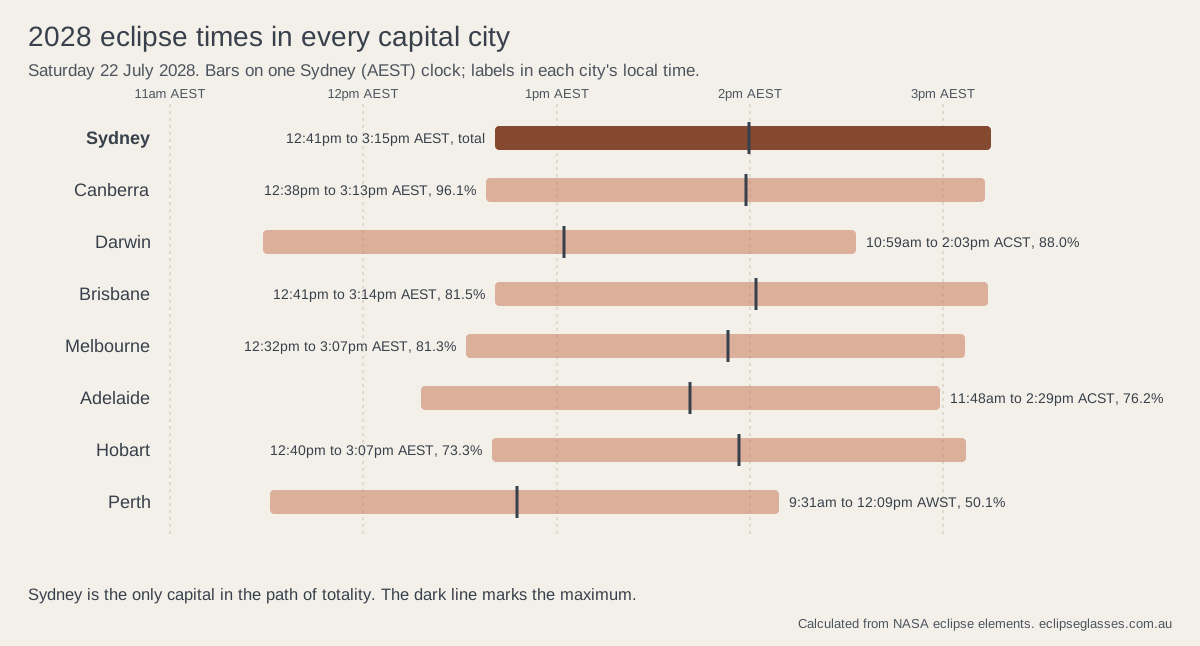
The five numbers that matter
For the path itself, see the interactive 2028 eclipse map. For the whole story of the day, read our 2028 total solar eclipse guide.
Every town's times, totality and Sun covered
Times are local on Saturday 22 July 2028, with the time zone in its own column. Totality and maximum are to the second; the start and end of the eclipse are to the minute. Rows marked Partial are outside the path. Each place links to its town guide or regional guide. Height at maximum is how high the eclipse sits above the horizon, which matters if hills, trees or buildings are close by.
| Place | State | Zone | Eclipse begins | Totality | Length of totality | Sun covered | Maximum | Eclipse ends | Height at maximum | July clear days |
|---|---|---|---|---|---|---|---|---|---|---|
| Perth | WA | AWST | 9:31am | Partial | n/a | 50.1% | 10:47:40am | 12:09pm | 33° | n/a |
| Broome | WA | AWST | 9:16am | Partial | n/a | 91.2% | 10:46:32am | 12:20pm | 48° | n/a |
| Central Kimberley (greatest eclipse) | WA | AWST | 9:23am | 10:52:58am to 10:58:08am | 5m 10s | 100% | 10:55:33am | 12:28pm | 53° | n/a |
| Halls Creek | WA | AWST | 9:29am | Partial | n/a | 98.3% | 11:01:32am | 12:33pm | 51° | n/a |
| Wyndham | WA | AWST | 9:26am | 10:57:31am to 11:00:53am | 3m 22s | 100% | 10:59:12am | 12:32pm | 53° | n/a |
| Kununurra | WA | AWST | 9:28am | 10:59:46am to 11:02:38am | 2m 52s | 100% | 11:01:13am | 12:33pm | 53° | n/a |
| Darwin | NT | ACST | 10:59am | Partial | n/a | 88.0% | 12:32:20pm | 2:03pm | 57° | n/a |
| Alice Springs | NT | ACST | 11:22am | Partial | n/a | 95.3% | 12:53:26pm | 2:20pm | 46° | n/a |
| Tennant Creek | NT | ACST | 11:17am | 12:48:07pm to 12:51:28pm | 3m 21s | 100% | 12:49:48pm | 2:18pm | 50° | n/a |
| Adelaide | SA | ACST | 11:48am | Partial | n/a | 76.2% | 1:11:27pm | 2:29pm | 34° | n/a |
| Birdsville | QLD | AEST | 12:08pm | Partial | n/a | 99.9% | 1:37:25pm | 3:00pm | 42° | n/a |
| Mount Isa | QLD | AEST | 12:02pm | Partial | n/a | 93.4% | 1:33:00pm | 2:57pm | 48° | n/a |
| Thargomindah | QLD | AEST | 12:21pm | 1:45:21pm to 1:49:36pm | 4m 15s | 100% | 1:47:29pm | 3:06pm | 38° | n/a |
| Melbourne | VIC | AEST | 12:32pm | Partial | n/a | 81.3% | 1:53:02pm | 3:07pm | 29° | n/a |
| Cairns | QLD | AEST | 12:16pm | Partial | n/a | 66.9% | 1:41:49pm | 2:59pm | 48° | n/a |
| Bourke | NSW | AEST | 12:27pm | 1:50:14pm to 1:54:19pm | 4m 05s | 100% | 1:52:17pm | 3:09pm | 35° | 17.5 |
| Hobart | TAS | AEST | 12:40pm | Partial | n/a | 73.3% | 1:56:26pm | 3:07pm | 23° | n/a |
| Dubbo | NSW | AEST | 12:35pm | 1:55:27pm to 1:59:17pm | 3m 50s | 100% | 1:57:22pm | 3:12pm | 32° | 11.5 |
| Orange | NSW | AEST | 12:36pm | 1:57:18pm to 1:59:32pm | 2m 14s | 100% | 1:58:25pm | 3:13pm | 31° | 7.0 |
| Canberra | ACT | AEST | 12:38pm | Partial | n/a | 96.1% | 1:58:51pm | 3:13pm | 29° | n/a |
| Bathurst | NSW | AEST | 12:37pm | 1:57:36pm to 2:00:38pm | 3m 02s | 100% | 1:59:07pm | 3:13pm | 30° | 6.6 |
| Mudgee | NSW | AEST | 12:37pm | 1:56:58pm to 2:00:52pm | 3m 54s | 100% | 1:58:55pm | 3:13pm | 31° | 9.4 |
| Lithgow | NSW | AEST | 12:38pm | 1:58:08pm to 2:01:48pm | 3m 40s | 100% | 1:59:58pm | 3:14pm | 30° | n/a |
| Katoomba | NSW | AEST | 12:39pm | 1:58:31pm to 2:02:00pm | 3m 29s | 100% | 2:00:15pm | 3:14pm | 30° | 8.0 |
| Penrith | NSW | AEST | 12:40pm | 1:58:54pm to 2:02:40pm | 3m 46s | 100% | 2:00:47pm | 3:14pm | 29° | n/a |
| Windsor | NSW | AEST | 12:40pm | 1:59:01pm to 2:02:51pm | 3m 50s | 100% | 2:00:56pm | 3:14pm | 29° | n/a |
| Scone | NSW | AEST | 12:39pm | Partial | n/a | 99.3% | 2:00:38pm | 3:14pm | 31° | n/a |
| Muswellbrook | NSW | AEST | 12:39pm | Partial | n/a | 99.68% | 2:00:43pm | 3:14pm | 30° | n/a |
| Wollongong | NSW | AEST | 12:40pm | 1:59:45pm to 2:02:37pm | 2m 52s | 100% | 2:01:11pm | 3:14pm | 29° | n/a |
| Blacktown | NSW | AEST | 12:40pm | 1:59:11pm to 2:03:00pm | 3m 49s | 100% | 2:01:05pm | 3:14pm | 29° | n/a |
| Parramatta CBD | NSW | AEST | 12:40pm | 1:59:19pm to 2:03:08pm | 3m 49s | 100% | 2:01:13pm | 3:15pm | 29° | n/a |
| Singleton | NSW | AEST | 12:40pm | Partial | n/a | 99.83% | 2:01:12pm | 3:15pm | 30° | n/a |
| Sydney CBD | NSW | AEST | 12:41pm | 1:59:37pm to 2:03:26pm | 3m 48s | 100% | 2:01:32pm | 3:15pm | 29° | 12.0 |
| Pokolbin (Hunter Valley Gardens) | NSW | AEST | 12:40pm | Partial | n/a | 99.96% | 2:01:25pm | 3:15pm | 30° | n/a |
| Gosford | NSW | AEST | 12:41pm | 1:59:59pm to 2:03:15pm | 3m 16s | 100% | 2:01:37pm | 3:15pm | 29° | n/a |
| Cessnock | NSW | AEST | 12:40pm | Partial | n/a | 99.98% | 2:01:31pm | 3:15pm | 30° | n/a |
| Morisset | NSW | AEST | 12:41pm | 2:00:55pm to 2:02:36pm | 1m 40s | 100% | 2:01:45pm | 3:15pm | 29° | n/a |
| Maitland | NSW | AEST | 12:41pm | Partial | n/a | 99.62% | 2:01:46pm | 3:15pm | 30° | n/a |
| Newcastle | NSW | AEST | 12:41pm | Partial | n/a | 99.7% | 2:02:08pm | 3:15pm | 29° | n/a |
| Brisbane | QLD | AEST | 12:41pm | Partial | n/a | 81.5% | 2:02:00pm | 3:14pm | 33° | n/a |
Download the table as a CSV file → Times in the file are local, with the zone in its own column.
You can reuse this table and CSV with credit to Aura Sight (CC BY 4.0). Words, images and brand: all rights reserved. Licence terms.
How long totality lasts in each town
20 places in the table are inside the path. Thargomindah gets the longest totality of the towns in the table, 4 min 15 s, then Bourke with 4 min 05 s and Mudgee with 3 min 54 s. The shortest is Morisset, with 1 min 40 s, close to the edge of the path. Near the edge, a few kilometres can change totality by a minute or more: each town guide has the times for the villages around it.

How much of the Sun is covered in each capital city
Sydney is the only capital city in the path. Outside it, Canberra gets the deepest partial eclipse, 96.1% of the Sun covered, and Perth the least, 50.1%. At 96.1% the sky stays light: it is still a partial eclipse, and glasses stay on from start to finish. Our guide to eclipse times for every capital city has the nearest totality from each one.

July weather odds
The Bureau of Meteorology's average number of clear days in July, for the towns where our guides have a figure: Bourke 17.5, Sydney 12.0, Dubbo 11.5, Mudgee 9.4, Katoomba 8.0, Orange 7.0, Bathurst 6.6. Further west it is clearer still. Our 2028 eclipse weather odds post has the satellite cloud record along the whole path, and the July record for each region.
Do you need eclipse glasses for every minute?
Yes. Even in a deep partial eclipse, the part of the Sun that is left is bright enough to burn the retina, and the retina has no pain sensors, so there is no warning. Ordinary sunglasses are never safe. Everyone needs ISO 12312-2 certified eclipse glasses for the whole eclipse, from the first contact to the last, totality included.
Our certified eclipse glasses ship Australia-wide. Read why you need eclipse glasses and the eclipse glasses checklist for 22 July 2028 before the day.
- Never use eclipse glasses with binoculars, a telescope, a camera or a phone. Optics need their own solar filter on the front: see solar filters for cameras, phones and binoculars.
- Check every pair before use, and throw out any that are scratched, torn or punctured.
- Supervise children closely, and fit their glasses before the eclipse starts.
FAQ
How long does totality last in Sydney?
In the Sydney CBD totality lasts 3 min 48 s, from 1:59:37pm to 2:03:26pm AEST on Saturday 22 July 2028. Parramatta CBD gets 3 min 49 s and Penrith 3 min 46 s.
Where is the longest totality in Australia in 2028?
At the point of greatest eclipse in the central Kimberley, WA: 5 min 10 s, at 10:55:33am AWST. Of the towns in our table, Thargomindah gets the longest, 4 min 15 s, then Bourke with 4 min 05 s.
Will Melbourne, Brisbane, Adelaide or Perth get totality?
No. They get a partial eclipse: Melbourne 81.3%, Brisbane 81.5%, Adelaide 76.2% and Perth 50.1% of the Sun covered. Sydney is the only capital city in the path of totality.
What time is the eclipse in each capital city?
Local times, from start to finish: Sydney 12:41pm to 3:15pm AEST, total; Canberra 12:38pm to 3:13pm AEST; Darwin 10:59am to 2:03pm ACST; Brisbane 12:41pm to 3:14pm AEST; Melbourne 12:32pm to 3:07pm AEST; Adelaide 11:48am to 2:29pm ACST; Hobart 12:40pm to 3:07pm AEST; Perth 9:31am to 12:09pm AWST.
Which towns only just miss totality?
Cessnock 99.98%, Pokolbin (Hunter Valley Gardens) 99.96%, Birdsville 99.9%, Singleton 99.83%, Newcastle 99.7%, Muswellbrook 99.68%, Maitland 99.62%, Scone 99.3% of the Sun covered. They are close to the path, but the eclipse there is partial, and glasses stay on for the whole eclipse.
Do I need eclipse glasses if my town only gets a partial eclipse?
Yes. Any part of the Sun left uncovered can burn the retina. Everyone needs ISO 12312-2 certified eclipse glasses for the whole eclipse, from start to finish.
Sources
All checked 15.11.2026.
- Times calculated from NASA's Besselian elements for the 22 July 2028 eclipse, Fred Espenak, NASA GSFC, with Delta T of 69.2 s, as on our eclipse map and in the 2028 eclipse guide. Near the edge of the path, real durations can differ from the calculation by 10 seconds or more.
- Places on the eclipse map use the map's figures. The other towns use the headline place of their town guide, calculated the same way for that spot.
- July clear days: Bureau of Meteorology climate statistics, as in our 2028 eclipse weather odds post.
- ARPANSA, Solar eclipse; American Astronomical Society, Solar eclipse eye safety; NASA, Eclipse safety.

Aura Sight glasses for everyone watching
ISO 12312-2 certified and lab-tested, with a QR batch certificate on every pair. The family kit has four pairs and a printed viewing guide.