The short version. Sydney is the only capital city in the path of totality, with 3 minutes 48 seconds just before 2pm AEST. Every other capital gets a partial eclipse, from 96.1% of the Sun covered in Canberra to 50.1% in Perth. It is the middle of the day everywhere, on Saturday 22 July 2028, and everyone needs certified eclipse glasses for the whole eclipse.
What time is the eclipse in each capital city?
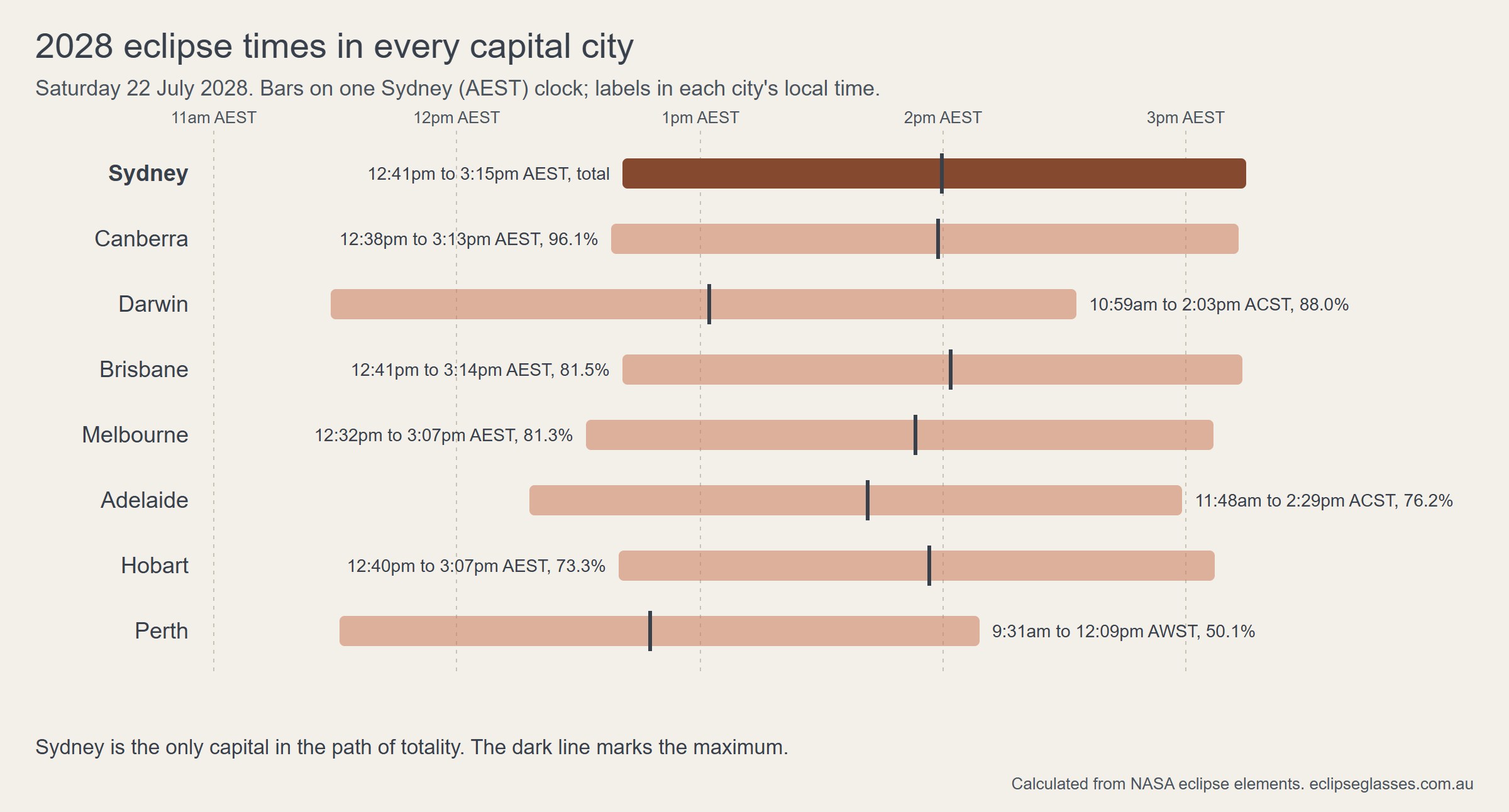
Times are local. There is no daylight saving in July, so the east coast is on AEST, Adelaide and Darwin on ACST and Perth on AWST. They come from the same NASA eclipse elements as our 2028 eclipse map.
| City | Eclipse begins | Maximum | Sun covered | Eclipse ends |
|---|---|---|---|---|
| Sydney | 12:41pm AEST | Totality 1:59:37pm to 2:03:26pm | 100%, 3 min 48 s of totality | 3:15pm |
| Canberra | 12:38pm AEST | 1:58:51pm | 96.1% | 3:13pm |
| Darwin | 10:59am ACST | 12:32:20pm | 88.0% | 2:03pm |
| Brisbane | 12:41pm AEST | 2:02:00pm | 81.5% | 3:14pm |
| Melbourne | 12:32pm AEST | 1:53:02pm | 81.3% | 3:07pm |
| Adelaide | 11:48am ACST | 1:11:27pm | 76.2% | 2:29pm |
| Hobart | 12:40pm AEST | 1:56:26pm | 73.3% | 3:07pm |
| Perth | 9:31am AWST | 10:47:40am | 50.1% | 12:09pm |
Times are to the minute for the city centre, and maximum to the second. A partial eclipse is still a partial eclipse at 96%: the sky stays light, and glasses stay on from start to finish.
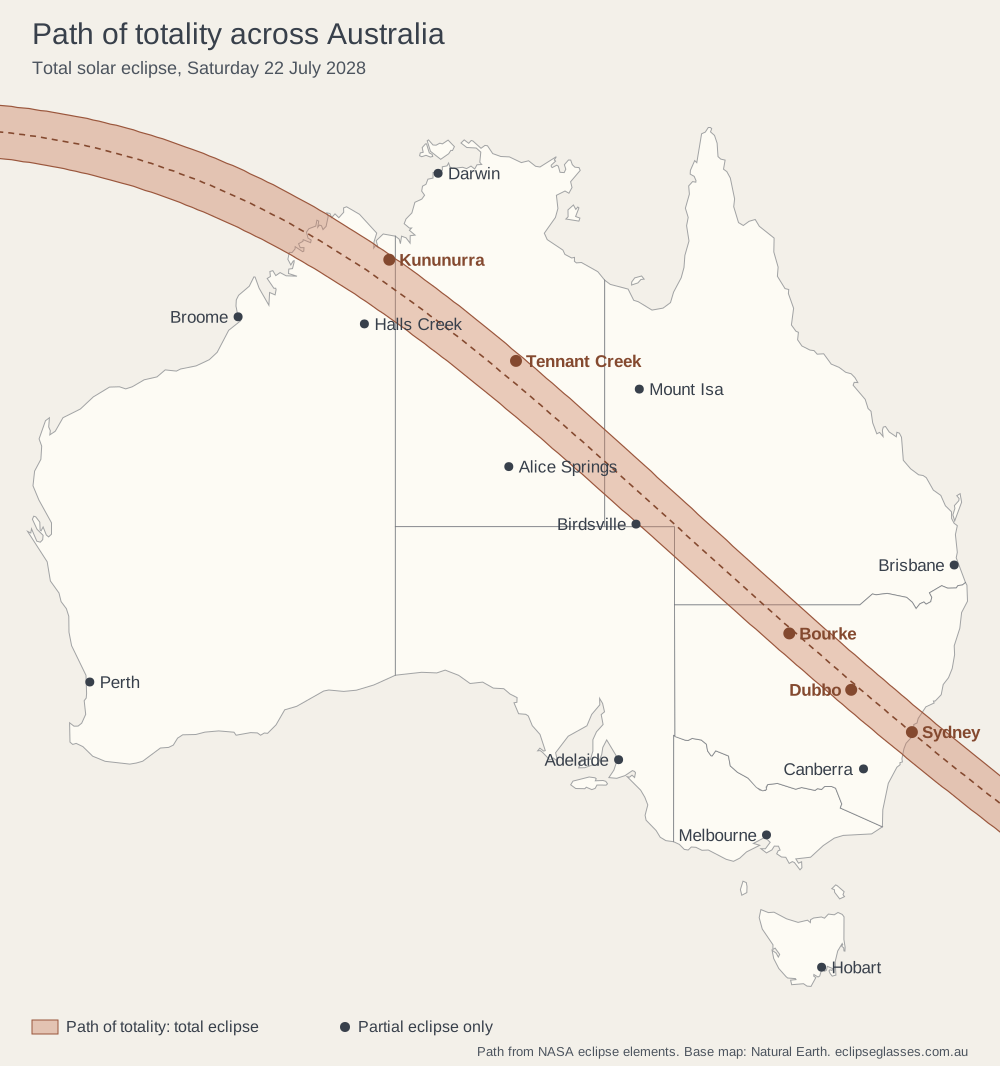
2028 eclipse path map for Australia
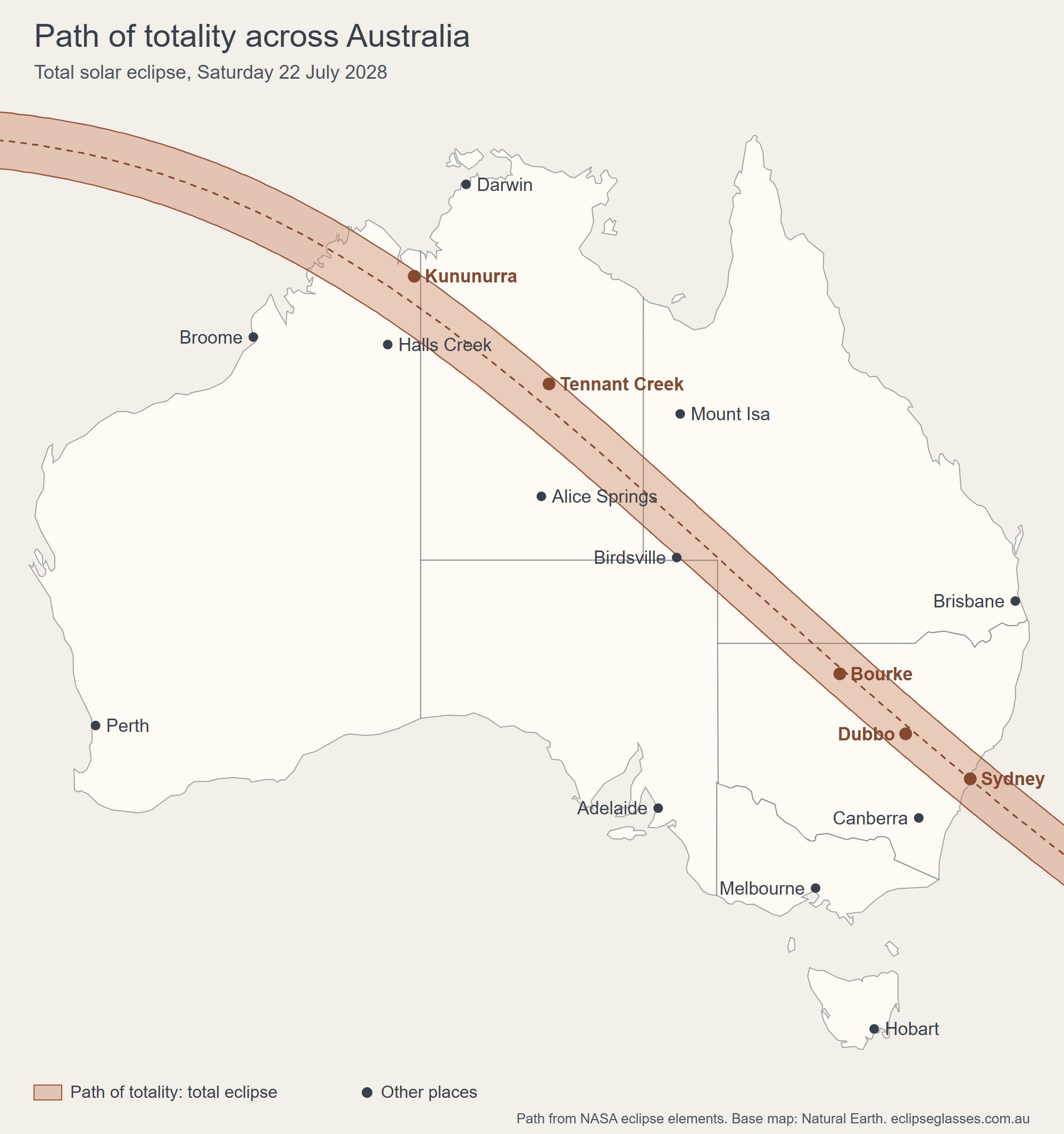
Sydney: the only capital in the path
The Sydney CBD gets 3 minutes 48 seconds of totality, from 1:59:37pm to 2:03:26pm AEST, with the eclipse running from 12:41pm to 3:15pm. Most of greater Sydney is inside the path, from Penrith and Parramatta to the beaches. Sydney's last total eclipse was in 1857. See our guides to the eclipse in Sydney and the 10 best places to watch in Sydney, and plan the trip with Sydney eclipse-day transport and parking.
Canberra
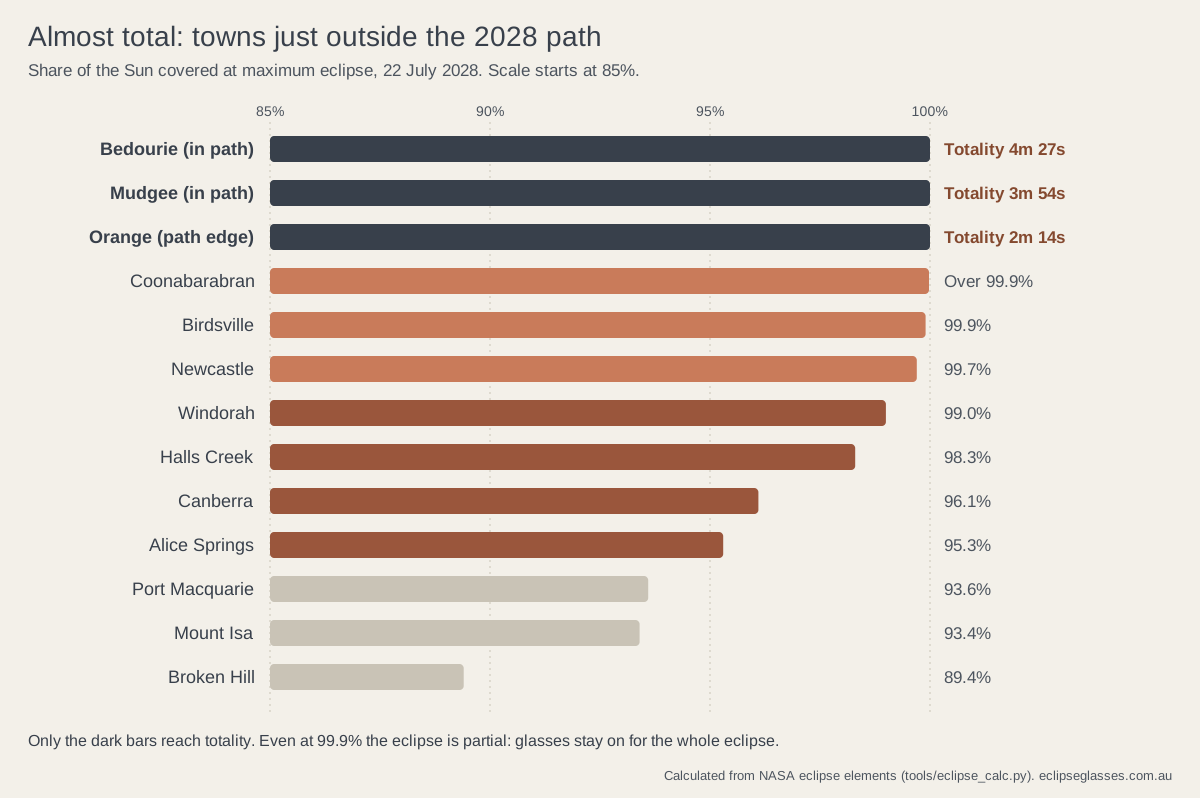
Canberra gets 96.1% of the Sun covered at 1:58pm AEST, the deepest partial eclipse of any capital outside Sydney. The path starts about 147 km to the north-east. For totality, Wollongong (2 minutes 52 seconds) and Katoomba (3 minutes 29 seconds) are the nearest big centres.
Brisbane
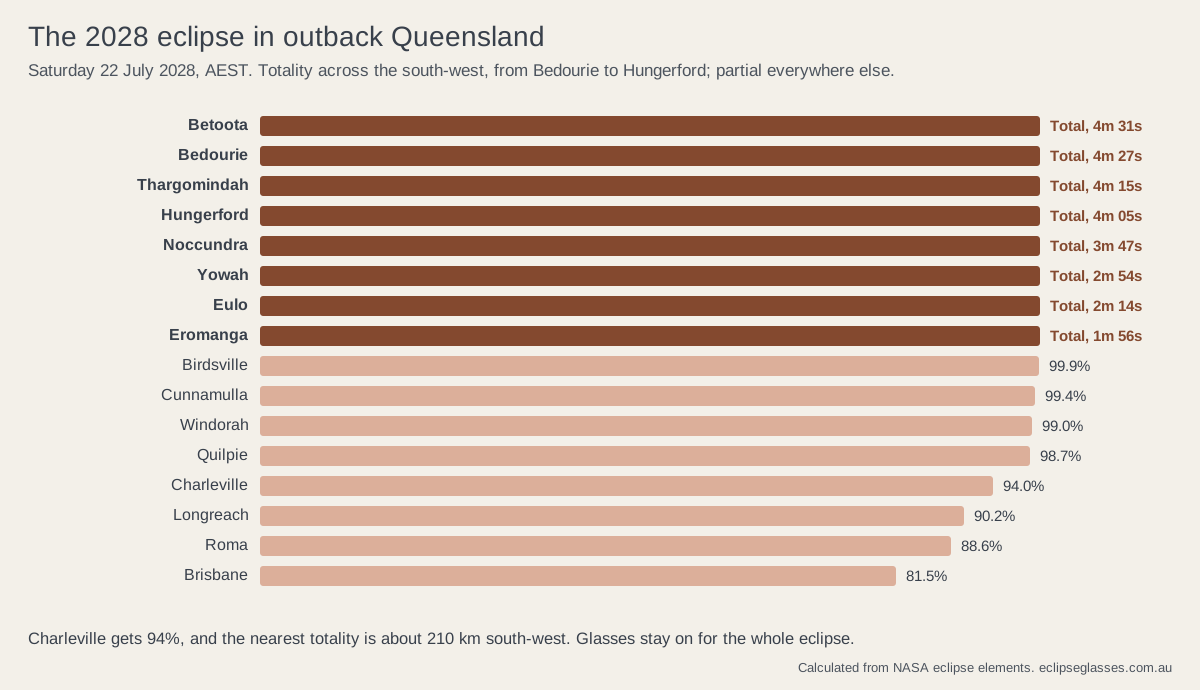
Brisbane gets 81.5% at 2:02pm AEST. The nearest totality is a long way off: the Central Coast and Sydney to the south, or south-west Queensland around Thargomindah. Our guide to the eclipse in outback Queensland has the towns and times.
Melbourne
Melbourne gets 81.3% at 1:53pm AEST. The nearest totality is in New South Wales: Wollongong, Sydney and the Blue Mountains to the north-east, or inland at Orange, Bathurst and Dubbo.
Adelaide
Adelaide gets 76.2% at 1:11pm ACST. Totality only clips the remote far north-east corner of South Australia, near the Queensland border; Innamincka just misses out at 98.6%. The nearest towns in the path are in south-west Queensland and around Bourke in New South Wales.
Hobart
Hobart gets 73.3% at 1:56pm AEST. For totality, Tasmanians need to fly north: Sydney is the easiest choice, with the eclipse in the city itself.
Darwin
Darwin gets 88.0% at 12:32pm ACST. Totality is a long drive south down the Stuart Highway, at Tennant Creek and Karlu Karlu (Devils Marbles). Our guide to the eclipse in Alice Springs and the NT has the details.
Perth
Perth gets about half the Sun covered, 50.1% at 10:47am AWST, in the middle of the morning. Totality in Western Australia is in the Kimberley, at Wyndham and Kununurra. See our Perth and WA guide.
Do you need eclipse glasses in a partial eclipse?
Yes. Even with 96% of the Sun covered, the part that is left is bright enough to burn the retina, and the retina has no pain sensors, so there is no warning. Ordinary sunglasses are never safe. Everyone needs ISO 12312-2 certified eclipse glasses for the whole eclipse, from the first contact to the last.
Our certified eclipse glasses are A$5.45 a pair, delivered Australia-wide, and the family eclipse kit has four pairs for A$19.25. Online orders ship until 31 May 2028. Our guide to towns just outside the path explains the difference between 99% and totality.
- Never use eclipse glasses with binoculars, a telescope, a camera or a phone. Optics need their own solar filter on the front.
- Check every pair before use, and throw out any that are scratched, torn or punctured.
- Supervise children closely, and fit their glasses before the eclipse starts.
FAQ
Which capital cities get a total eclipse in 2028?
Only Sydney. The Sydney CBD gets 3 minutes 48 seconds of totality, from 1:59:37pm to 2:03:26pm AEST on Saturday 22 July 2028.
What time is the eclipse in Brisbane?
The eclipse runs from 12:41pm to 3:14pm AEST, with 81.5% of the Sun covered at 2:02pm. It is a partial eclipse, so glasses stay on the whole time.
What time is the eclipse in Melbourne?
The eclipse runs from 12:32pm to 3:07pm AEST, with 81.3% of the Sun covered at 1:53pm.
What time is the eclipse in Perth?
The eclipse runs from 9:31am to 12:09pm AWST, with 50.1% of the Sun covered at 10:47am.
What time is the eclipse in Adelaide?
The eclipse runs from 11:48am to 2:29pm ACST, with 76.2% of the Sun covered at 1:11pm.
Do I need eclipse glasses if my city only gets a partial eclipse?
Yes. Any part of the Sun left uncovered can burn the retina. Everyone needs ISO 12312-2 certified eclipse glasses for the whole eclipse, from start to finish.
Sources
All checked 12.11.2026.
- Times calculated from NASA's Besselian elements for the 22 July 2028 eclipse, Fred Espenak, NASA GSFC, with Delta T of 69.2 s, for each town centre. Near the edge of the path, real durations can differ from the calculation by 10 seconds or more.
- Distances to the path are straight-line distances to the nearest point of totality, as in our guide to towns just outside the path.
- ARPANSA, Solar eclipse; American Astronomical Society, Solar eclipse eye safety; NASA, Eclipse safety.
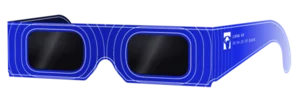
Certified eclipse glasses from Aura Sight
ISO 12312-2 certified, lab-tested and made by Rainbow Symphony, with a QR batch certificate on every pair. A$5.45 a pair from NSW stock, delivered Australia-wide (New Zealand too).