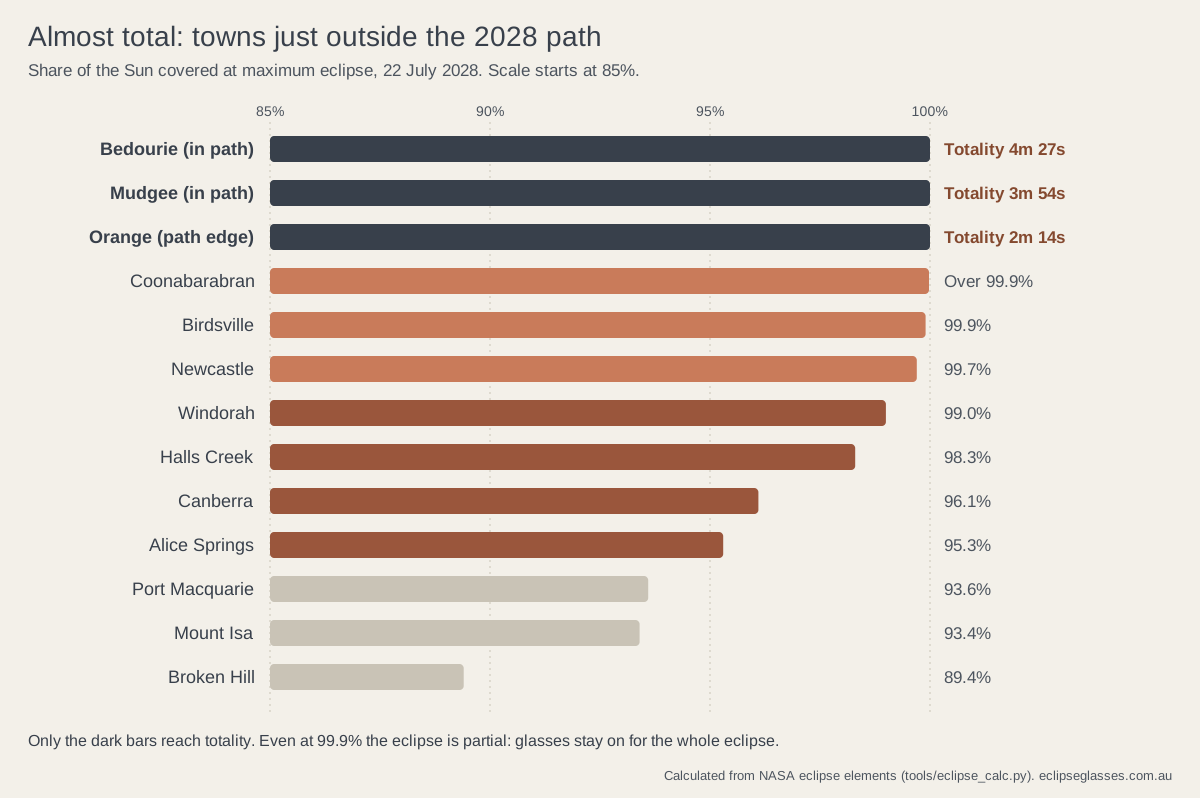
The short version. Totality: Milford Sound, Queenstown, Alexandra, Wanaka, Ranfurly and Dunedin, for about 2 to 3 minutes around 4:17pm NZST. Everywhere else: a partial eclipse, from 93% of the Sun covered in Christchurch to 68% in Auckland. The eclipse sits low in the north-west, close to sunset, so pick a spot with a clear, low view in that direction. Wear certified ISO 12312-2 glasses for the whole eclipse.
What happens in New Zealand on 22 July 2028?
The Moon's shadow crosses Australia from the Kimberley to Sydney, then the Tasman Sea, and leaves land over the lower South Island. RNZ reported that it will be the first total eclipse visible from New Zealand since 1965, when only a small part of Northland saw one. Otago Museum astronomer Dr Ian Griffin told RNZ that places from Milford to Dunedin will see totality, at around 4:15pm.
The Otago Daily Times reported in June 2026 that Dunedin and Queenstown will be the only major centres in the country to see the full eclipse. The Dunedin City Council's events plan expects 5,000 international and 30,000 domestic visitors, and Dunedin hotels already had bookings for eclipse week two years out. For the Australian side of the eclipse, see our 2028 eclipse guide.
Where to watch: totality in Otago and Southland
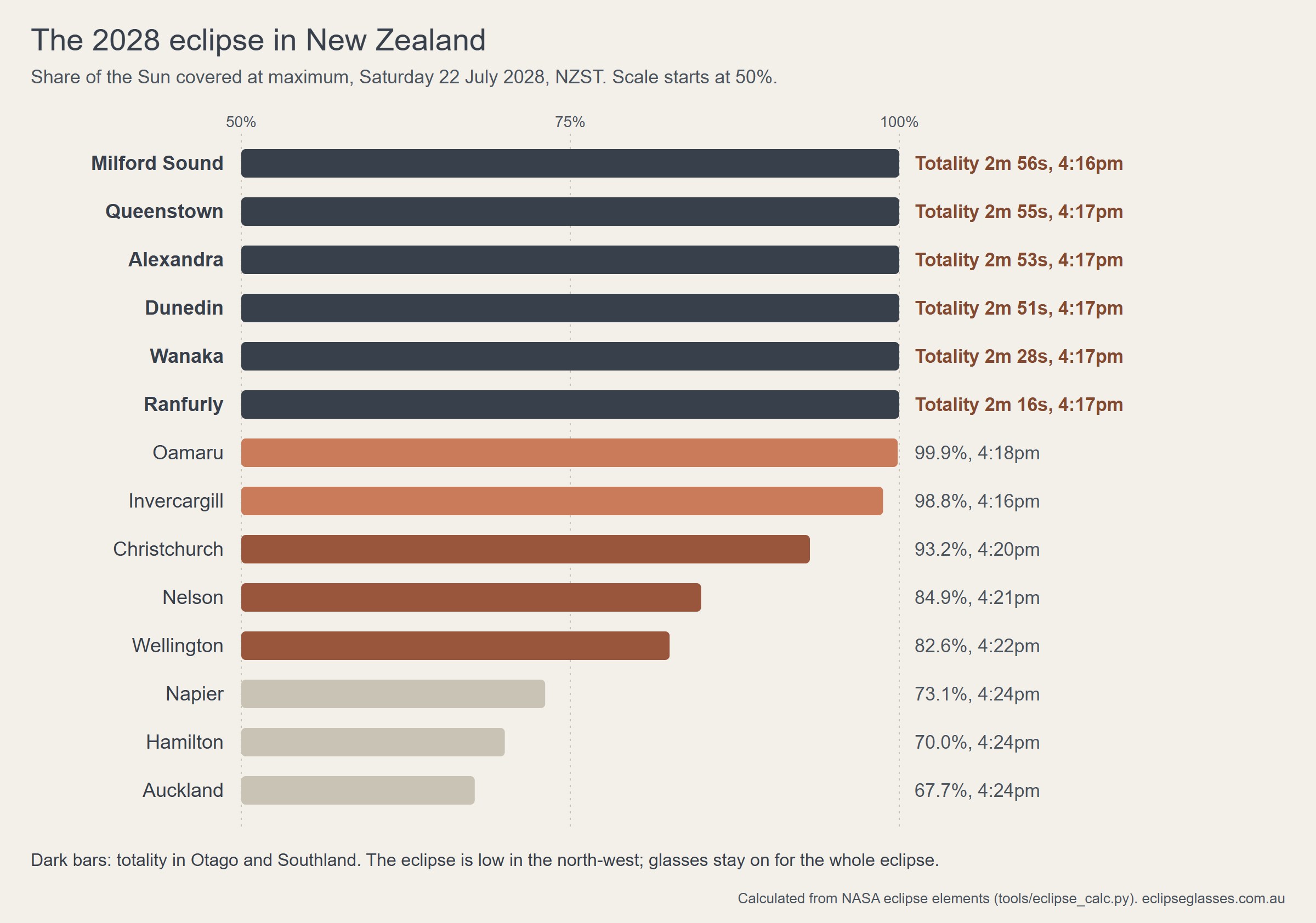
The chart shows how much of the Sun is covered in towns across New Zealand, with the local time of maximum eclipse.
| Place | On 22 July 2028 | Maximum (NZST) |
|---|---|---|
| Milford Sound | Totality, 2m 56s | 4:16pm |
| Queenstown | Totality, 2m 55s | 4:17pm |
| Alexandra | Totality, 2m 53s | 4:17pm |
| Dunedin | Totality, 2m 51s | 4:17pm |
| Wanaka | Totality, 2m 28s | 4:17pm |
| Ranfurly | Totality, 2m 16s | 4:17pm |
| Oamaru | 99.9% covered, just outside the path | 4:18pm |
| Invercargill | 98.8% covered | 4:16pm |
| Christchurch | 93.2% covered | 4:20pm |
| Nelson | 84.9% covered | 4:21pm |
| Wellington | 82.6% covered | 4:22pm |
| Napier | 73.1% covered | 4:24pm |
| Hamilton | 70.0% covered | 4:24pm |
| Auckland | 67.7% covered | 4:24pm |
Calculated by Aura Sight from NASA eclipse elements for each town centre. Totality is longest near the centre line and shortens towards the edges of the path, so it varies across a town.
Oamaru and Invercargill show how close "almost" can be: 99.9% and 98.8%, yet still a partial eclipse. Our guide to towns just outside the path explains why 99% is not totality, and why a short drive into the path is worth it.
Pick a spot with a low view to the north-west
In New Zealand the eclipse happens late on a winter afternoon. At totality the eclipse sits only about 8 to 10 degrees above the horizon, in the north-west, roughly where the Sun sets in July. That changes how you choose a spot:
- A clear, low horizon matters most. Hills, mountains, buildings and trees in the north-west can hide an eclipse this low. In the mountains around Queenstown, Wanaka and Milford Sound, check your spot in the late afternoon in the weeks before.
- The eclipse may set before it ends. The partial eclipse starts a little after 3pm and is due to finish around 5:20pm, close to sunset. By our calculations the Sun sets while still partly eclipsed in Dunedin, Christchurch and Wellington.
- Have a back-up. It is winter, so be ready to move to another spot if cloud sits in the north-west.
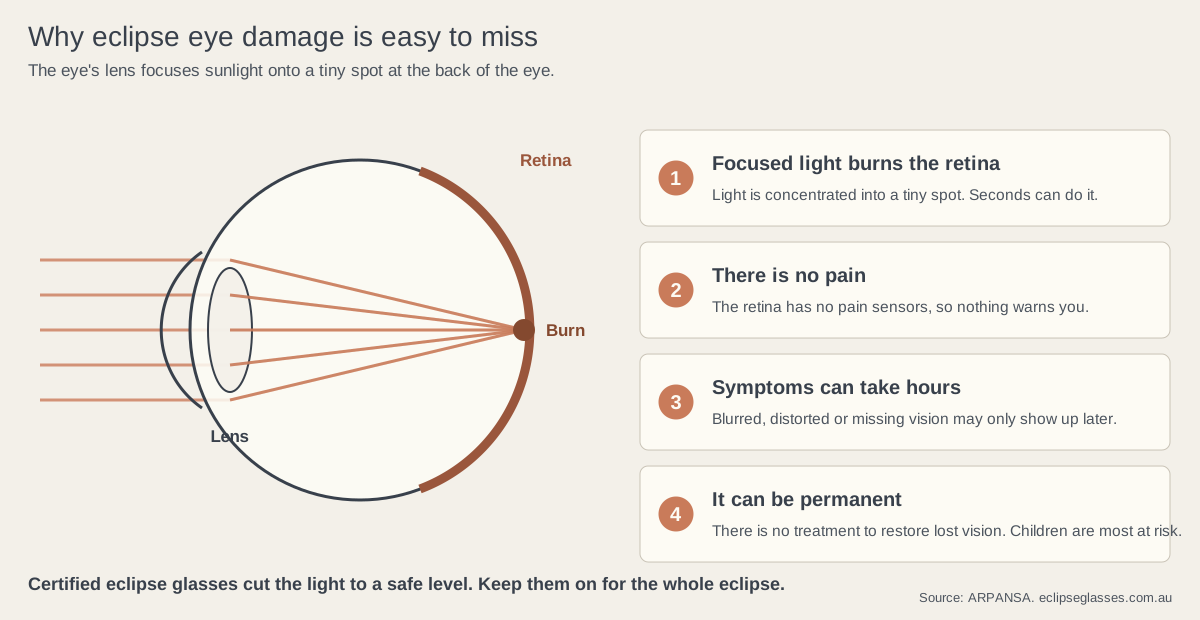
However low it is, our rule does not change: glasses stay on for the whole eclipse. Our guide on why you need eclipse glasses explains what an eclipse can do to your eyes.
Why everyone in New Zealand needs eclipse glasses
Whether you are in Dunedin for totality or in Auckland for a 68% partial eclipse, the advice is the same:
- Glasses stay on for the whole eclipse, from the moment it starts until it ends or the Sun sets, including totality. Never look at the Sun without certified glasses.
- Sunglasses are not enough. ARPANSA, NASA and the AAS all say ordinary sunglasses, even very dark ones, are never safe for an eclipse. See eclipse shades vs eclipse glasses.
- Never use glasses with a camera, binoculars or a telescope. Optics need their own solar filter on the front. Our guide to photographing the eclipse safely covers phones and cameras.
- Children need an adult beside them, with glasses fitted in the shade before the eclipse starts.
How to check eclipse glasses are safe
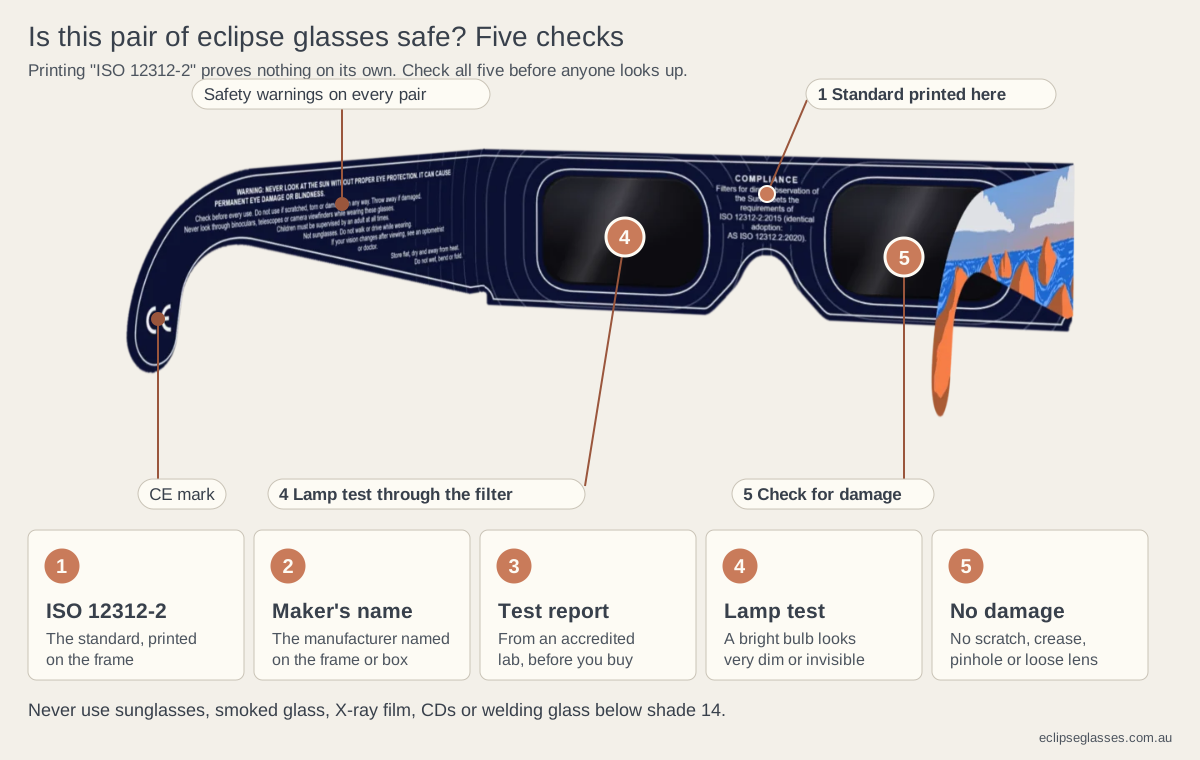
Before the 2024 US eclipse, the American Astronomical Society warned that factories were printing a known maker's name on glasses it never made, and some were unsafe as well as fake. The same checks work in New Zealand, and our guide to where to buy eclipse glasses in New Zealand goes through them:
- ISO 12312-2 and the maker's name printed on every pair.
- A maker on the AAS list of reputable vendors, or glasses you can trace to one.
- A test report from an accredited laboratory, before you buy in bulk.
- No scratches, creases or pinholes. A damaged pair goes in the bin.
Our guides to where to buy safe eclipse glasses and the best eclipse glasses go through these checks in detail, and how our glasses are certified shows the paperwork behind ours: made by Rainbow Symphony, a maker on the AAS list, tested to ISO 12312-2 by ICS Laboratories, with a QR batch certificate on every pair.
Schools, councils, events and shops in New Zealand
With visitors already booking for Otago, the same planning applies as in Australia, and the same lead times. These guides were written for Australia but work for New Zealand too:
- How many eclipse glasses an event needs: one pair per person, plus staff and about 10% spares.
- A checklist for public viewings, from now to the day.
- Planning for tourism operators: guest packs, branded glasses and lead times.
- Branded glasses for businesses, from 500 units, 6 to 8 weeks from proof approval.
- An eclipse safety plan for schools. 22 July 2028 is a Saturday, so most students will watch with family.
You can order our eclipse glasses and family kits online for delivery to New Zealand: choose New Zealand in the cart, and delivery is a flat A$19.95. They are made by Rainbow Symphony, a manufacturer on the American Astronomical Society's list of reputable vendors, carry a QR batch certificate on every pair, and ship from NSW by 31 May 2028. For bulk orders from New Zealand schools, councils, events, tourism operators and retailers, tell us what you need and we will come back with a quote.
Certified eclipse glasses delivered to New Zealand for A$19.95. Choose New Zealand in the cart, or ask about bulk supply for your school, event or shop.
Shop eclipse glassesFAQ
Will New Zealand see the 2028 total solar eclipse?
Yes. On Saturday 22 July 2028 totality crosses Otago and Southland, including Milford Sound, Queenstown, Alexandra, Wanaka and Dunedin, at about 4:15pm to 4:19pm NZST. The rest of New Zealand sees a partial eclipse.
How long is totality in Queenstown and Dunedin?
About 2 minutes 55 seconds in Queenstown and 2 minutes 51 seconds in Dunedin, by our calculations from NASA eclipse elements. Totality is longest near the centre of the path.
How much of the Sun is covered in Auckland, Wellington and Christchurch?
About 68% in Auckland, 83% in Wellington and 93% in Christchurch, at around 4:20pm to 4:24pm NZST. These are partial eclipses, so glasses stay on the whole time.
Do I need eclipse glasses in Auckland if it is only a partial eclipse?
Yes. A partial eclipse needs certified ISO 12312-2 eclipse glasses for the whole eclipse. Sunglasses are not enough, even very dark ones, and our rule is the same however low the eclipse is in the sky.
Where is the best place in New Zealand to watch the 2028 eclipse?
Anywhere inside the path in Otago and Southland with a clear, low view to the north-west, because the eclipse is only about 8 to 10 degrees above the horizon at totality. Check that hills, buildings or trees will not block it, and have a back-up spot in case of cloud.
When was the last total solar eclipse in New Zealand?
In 1965, visible from a small part of Northland, as RNZ reported. The 2028 eclipse is the first total eclipse visible from New Zealand since then.
Can I buy Aura Sight eclipse glasses in New Zealand?
Yes. Choose New Zealand in the cart and glasses and family kits are delivered for a flat A$19.95, shipping by 31 May 2028 with the other pre-orders. For bulk orders from New Zealand schools, councils, events, tourism operators and retailers, contact us through our wholesale page.
Sources
All checked 11.11.2026.
- RNZ, 2028 total solar eclipse in New Zealand likely big tourism drawcard, astronomer says (9 April 2024).
- Otago Daily Times, Visitors booking for 2028 eclipse (11 June 2026).
- ARPANSA (Australian Radiation Protection and Nuclear Safety Agency), Solar eclipse.
- American Astronomical Society, Solar eclipse eye safety, Suppliers of safe solar viewers and filters and its counterfeit warning (22 March 2024).
- New Zealand times, coverage and durations calculated by Aura Sight from NASA eclipse elements (Espenak), as in our 2028 eclipse guide.
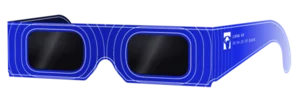
Certified eclipse glasses from Aura Sight
ISO 12312-2 certified, lab-tested and made by Rainbow Symphony, with a QR batch certificate on every pair. A$5.45 a pair from NSW stock, delivered Australia-wide (New Zealand too).