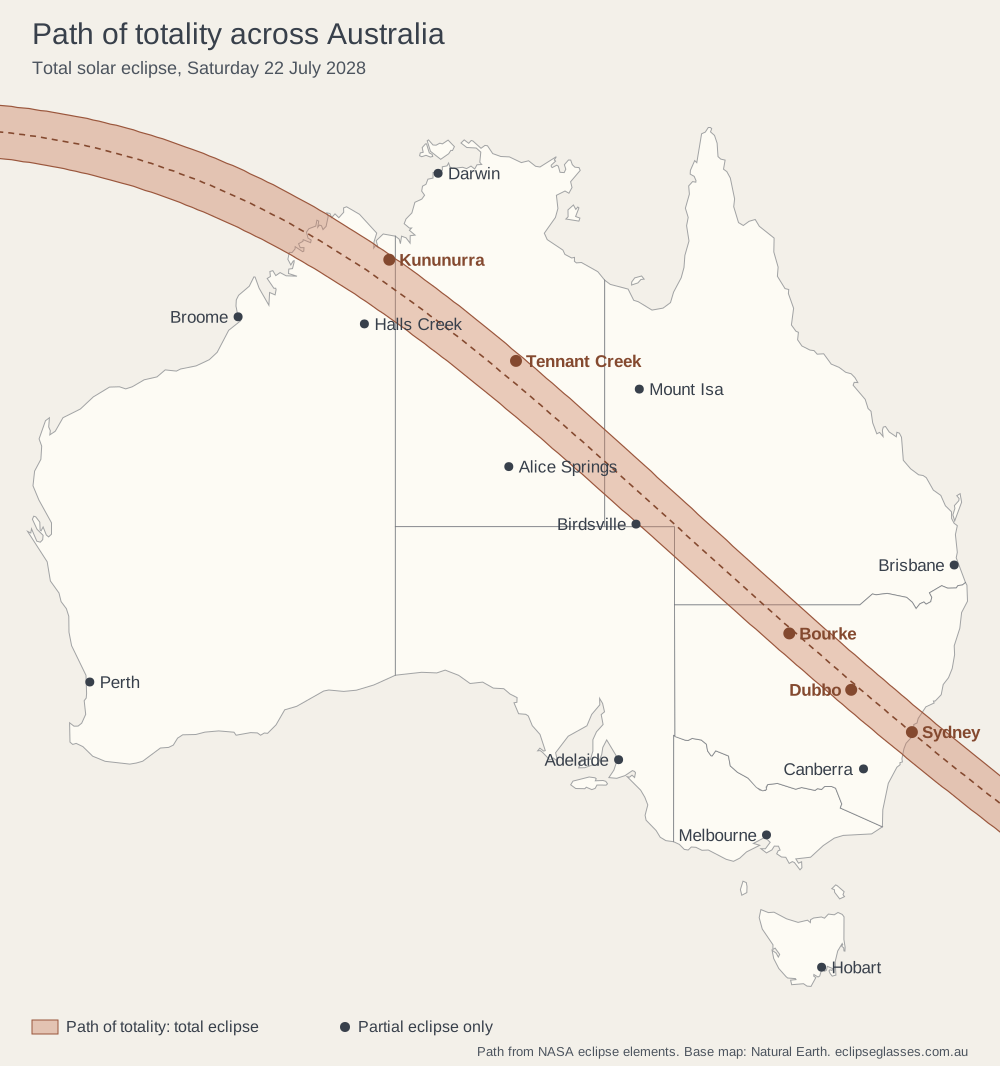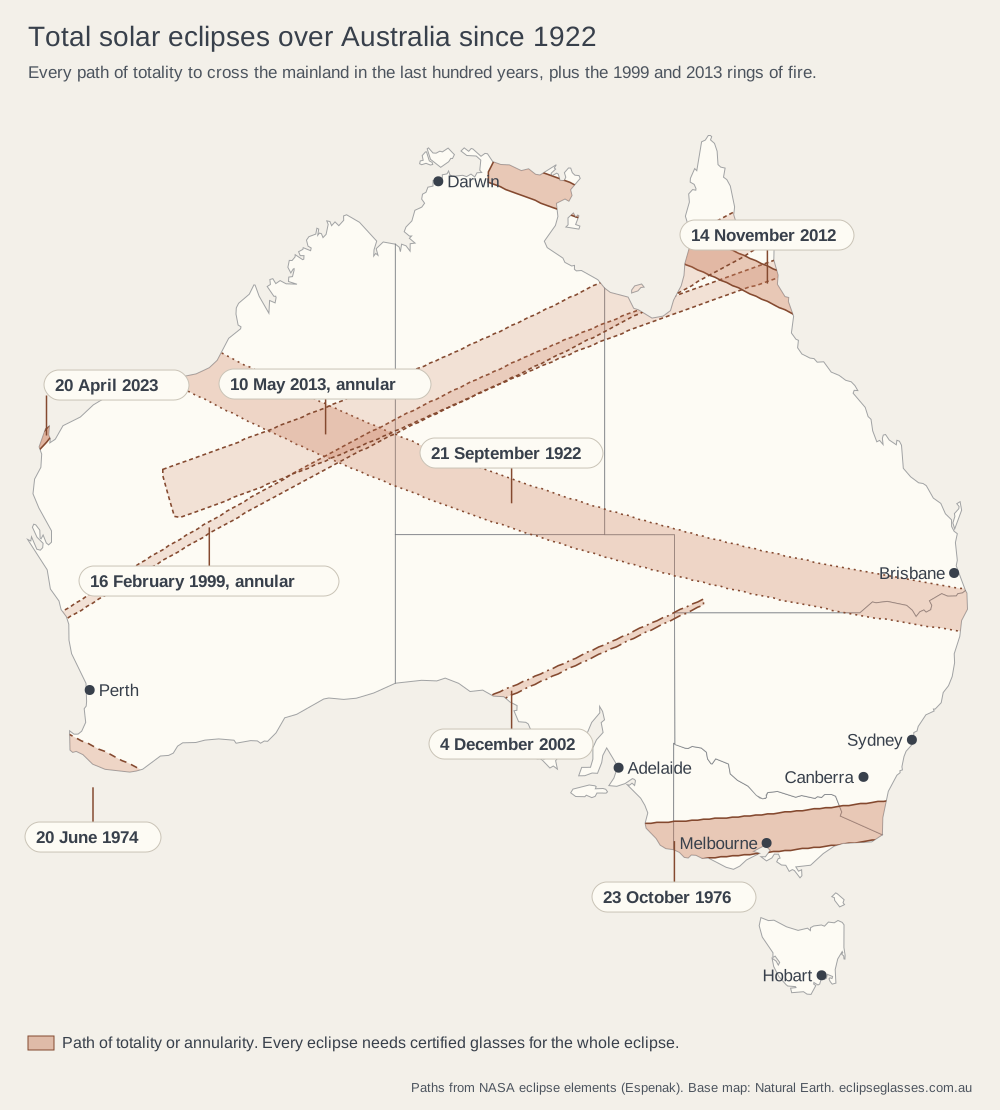
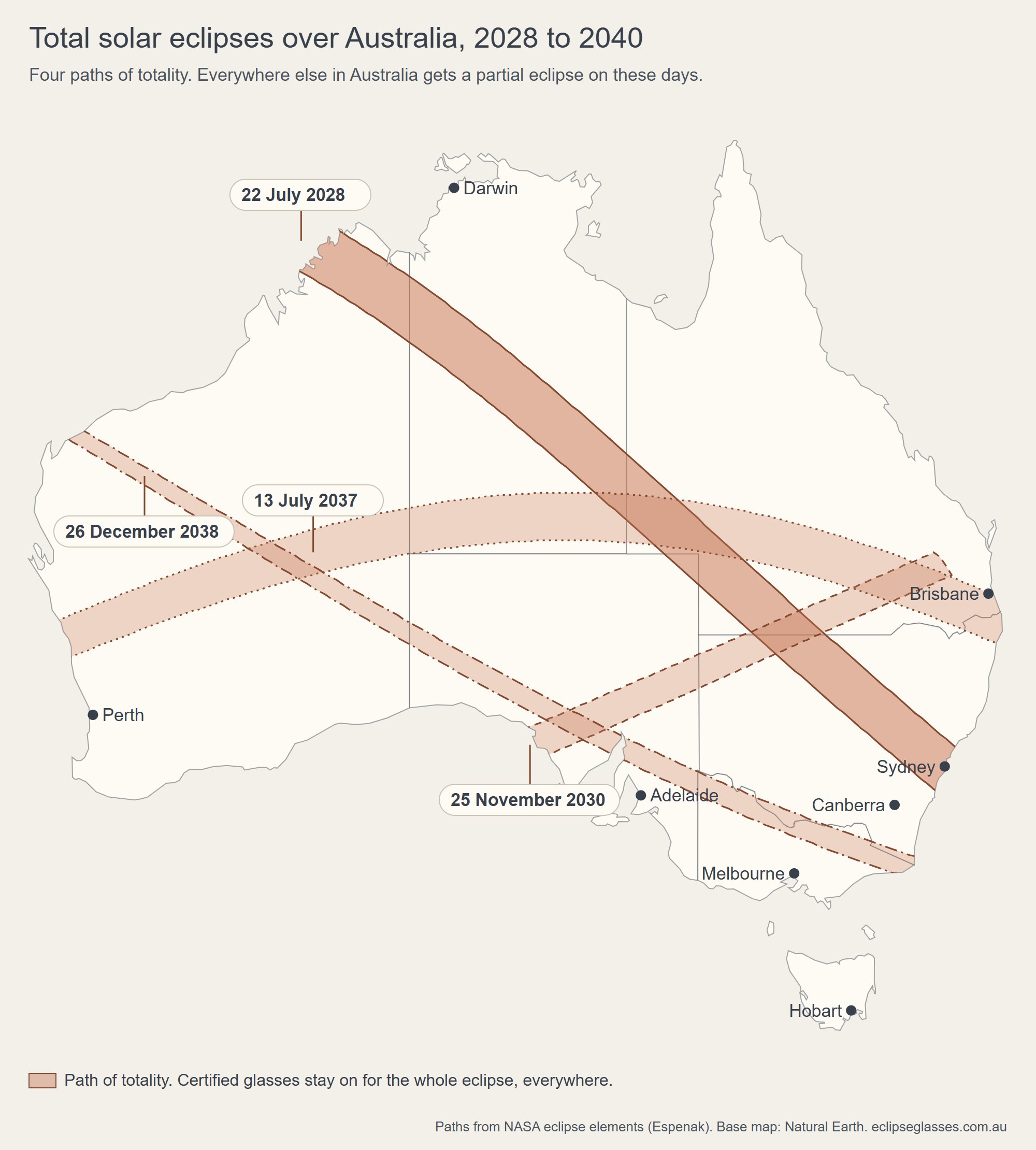
The short version. Next: 22 July 2028, total from the Kimberley to Sydney. Then 25 November 2030, total at sunset across South Australia, north-west New South Wales and south-west Queensland. Brisbane and the Gold Coast get totality on 13 July 2037; northern Victoria and Adelaide's Spencer Gulf on 26 December 2038. Certified glasses stay on for the whole of every one.
Every solar eclipse in Australia, 2028 to 2040
Eight solar eclipses can be seen from somewhere in Australia between now and 2040. Four are total eclipses with a path of totality over the mainland. The other four are partial here: the Moon covers part of the Sun and the sky stays light.
| Date (local) | Type | Where | The capital cities |
|---|---|---|---|
| Saturday 22 July 2028 | Total | Total in the Kimberley (WA), Tennant Creek (NT), south-west Queensland and New South Wales: Bourke, Dubbo, Mudgee, Bathurst and Sydney. | Total in Sydney. Partial elsewhere, Sun covered at most: Canberra 96%, Darwin 88%, Melbourne 81%, Brisbane 81%. |
| Monday 25 November 2030 | Total | Total late in the afternoon on the Eyre Peninsula and in the Flinders Ranges (SA), at Tibooburra (NSW) and in south-west Queensland, ending at sunset. | Partial elsewhere, Sun covered at most: Adelaide 91%, Perth 77%, Melbourne 75%, Hobart 58%. The Sun sets during the eclipse in Sydney, Brisbane, Canberra. |
| Wednesday 21 May 2031 | Partial in Australia | Annular (a ring of fire) over Africa, India and Indonesia, not Australia. | The Sun sets during the eclipse in Perth, Darwin. Not visible from Sydney, Melbourne, Brisbane, Adelaide, Canberra, Hobart. |
| Saturday 10 March 2035 | Partial in Australia | Annular (a ring of fire) over New Zealand, not Australia. | Partial elsewhere, Sun covered at most: Hobart 94%, Melbourne 76%, Canberra 67%, Sydney 62%. The Sun rises already eclipsed in Adelaide, Darwin. Not visible from Perth. |
| Wednesday 27 February 2036 | Partial | Partial only, everywhere it is seen. | Partial elsewhere, Sun covered at most: Hobart 7%, Melbourne 2%, Sydney 1%, Canberra 1%. Not visible from Brisbane, Perth, Adelaide, Darwin. |
| Monday 13 July 2037 | Total | Total from Geraldton (WA) through central Australia near Uluru to Charleville, Roma, Toowoomba, the Gold Coast and southern Brisbane (QLD), and Byron Bay and Lismore (NSW). | Total in Brisbane. Partial elsewhere, Sun covered at most: Perth 94%, Sydney 87%, Canberra 82%, Adelaide 77%. |
| Sunday 26 December 2038 | Total | Total from Onslow (WA) through Whyalla, Port Pirie and the Riverland (SA) to Swan Hill, Echuca, Shepparton, Wangaratta and Mallacoota (VIC). | Partial elsewhere, Sun covered at most: Adelaide 97%, Melbourne 96%, Canberra 95%, Sydney 87%. |
| Friday 11 May 2040 | Partial | Partial only, everywhere it is seen. | Partial elsewhere, Sun covered at most: Hobart 24%, Sydney 17%, Melbourne 17%, Canberra 17%. Not visible from Perth, Darwin. |
Dates are local. The March 2035 eclipse is 9 March in NASA's tables, which use UTC; in Australia it happens on the morning of 10 March. New Zealand has its own run, with a ring of fire in 2035: see every eclipse in New Zealand to 2040.
The 2028 eclipse comes first
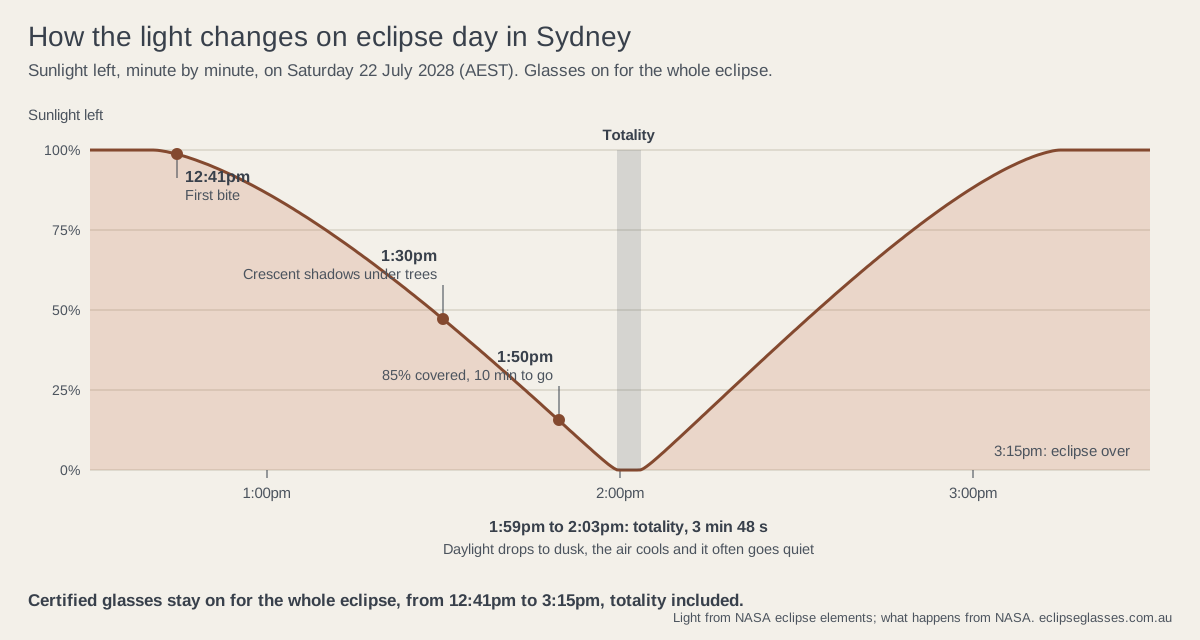
On 22 July 2028 the path of totality crosses the Kimberley, Tennant Creek, south-west Queensland and New South Wales, and leaves the coast at Sydney, with 3 minutes 48 seconds of totality in the CBD. It is the first total eclipse in Sydney since 1857. Our 2028 eclipse guide has the path and how long totality lasts, the eclipse map has times for 28 places, and 10 best places in Sydney covers where to watch from.
Times in each capital city
Local times, with daylight saving where it applies. "Sun covered" is the share of the Sun's disc the Moon covers at the greatest eclipse. Where the Sun rises or sets during an eclipse, part of it happens below the horizon.
Sydney
Sydney's next total eclipse is on Saturday 22 July 2028, with 3 min 48 s of totality in the CBD.
| Date | In Sydney | Begins | Greatest | Ends |
|---|---|---|---|---|
| Saturday 22 July 2028 | Total, 3 min 48 s | 12:41pm | 2:02pm | 3:15pm AEST |
| Monday 25 November 2030 | 79% of the Sun covered, sets during the eclipse | 6:25pm | 7:19pm | At sunset AEDT |
| Saturday 10 March 2035 | 62% of the Sun covered | 7:21am | 8:25am | 9:37am AEDT |
| Wednesday 27 February 2036 | 1% of the Sun covered | 4:33pm | 4:57pm | 5:20pm AEDT |
| Monday 13 July 2037 | 87% of the Sun covered | 11:40am | 1:12pm | 2:36pm AEST |
| Sunday 26 December 2038 | 87% of the Sun covered | 10:05am | 11:26am | 12:55pm AEDT |
| Friday 11 May 2040 | 17% of the Sun covered | 12:57pm | 2:04pm | 3:08pm AEST |
Melbourne
No total eclipse reaches Melbourne before 2040. The deepest partial eclipse is 96% on Sunday 26 December 2038.
| Date | In Melbourne | Begins | Greatest | Ends |
|---|---|---|---|---|
| Saturday 22 July 2028 | 81% of the Sun covered | 12:32pm | 1:53pm | 3:07pm AEST |
| Monday 25 November 2030 | 75% of the Sun covered | 6:20pm | 7:16pm | 8:07pm AEDT |
| Saturday 10 March 2035 | 76% of the Sun covered | 7:22am | 8:24am | 9:34am AEDT |
| Wednesday 27 February 2036 | 2% of the Sun covered | 4:15pm | 4:43pm | 5:11pm AEDT |
| Monday 13 July 2037 | 73% of the Sun covered | 11:28am | 12:56pm | 2:21pm AEST |
| Sunday 26 December 2038 | 96% of the Sun covered | 10:03am | 11:19am | 12:44pm AEDT |
| Friday 11 May 2040 | 17% of the Sun covered | 12:40pm | 1:48pm | 2:53pm AEST |
Brisbane
Brisbane's next total eclipse is on Monday 13 July 2037, with 1 min 10 s of totality in the CBD.
| Date | In Brisbane | Begins | Greatest | Ends |
|---|---|---|---|---|
| Saturday 22 July 2028 | 81% of the Sun covered | 12:41pm | 2:02pm | 3:15pm AEST |
| Monday 25 November 2030 | Partial, low in the sky at sunset | 5:30pm | After sunset | At sunset AEST |
| Saturday 10 March 2035 | 39% of the Sun covered | 6:24am | 7:24am | 8:32am AEST |
| Monday 13 July 2037 | Total, 1 min 10 s | 11:42am | 1:17pm | 2:43pm AEST |
| Sunday 26 December 2038 | 61% of the Sun covered | 9:03am | 10:23am | 11:53am AEST |
| Friday 11 May 2040 | 10% of the Sun covered | 1:20pm | 2:18pm | 3:12pm AEST |
Perth
No total eclipse reaches Perth before 2040. The deepest partial eclipse is 94% on Monday 13 July 2037.
| Date | In Perth | Begins | Greatest | Ends |
|---|---|---|---|---|
| Saturday 22 July 2028 | 50% of the Sun covered | 9:31am | 10:48am | 12:09pm AWST |
| Monday 25 November 2030 | 77% of the Sun covered | 3:02pm | 4:12pm | 5:15pm AWST |
| Wednesday 21 May 2031 | 5% of the Sun covered, sets during the eclipse | 4:07pm | 4:47pm | At sunset AWST |
| Monday 13 July 2037 | 94% of the Sun covered | 8:30am | 9:46am | 11:14am AWST |
| Sunday 26 December 2038 | 71% of the Sun covered | 6:41am | 7:41am | 8:47am AWST |
Adelaide
No total eclipse reaches Adelaide before 2040. The deepest partial eclipse is 97% on Sunday 26 December 2038.
| Date | In Adelaide | Begins | Greatest | Ends |
|---|---|---|---|---|
| Saturday 22 July 2028 | 76% of the Sun covered | 11:48am | 1:11pm | 2:29pm ACST |
| Monday 25 November 2030 | 91% of the Sun covered | 5:49pm | 6:49pm | 7:43pm ACDT |
| Saturday 10 March 2035 | 65% of the Sun covered, rises already eclipsed | Before sunrise | 7:50am | 8:56am ACDT |
| Monday 13 July 2037 | 77% of the Sun covered | 10:41am | 12:10pm | 1:40pm ACST |
| Sunday 26 December 2038 | 97% of the Sun covered | 9:23am | 10:36am | 11:58am ACDT |
| Friday 11 May 2040 | 9% of the Sun covered | 12:13pm | 1:11pm | 2:08pm ACST |
Canberra
No total eclipse reaches Canberra before 2040. The deepest partial eclipse is 96% on Saturday 22 July 2028.
| Date | In Canberra | Begins | Greatest | Ends |
|---|---|---|---|---|
| Saturday 22 July 2028 | 96% of the Sun covered | 12:38pm | 1:59pm | 3:13pm AEST |
| Monday 25 November 2030 | 77% of the Sun covered, sets during the eclipse | 6:23pm | 7:18pm | At sunset AEDT |
| Saturday 10 March 2035 | 67% of the Sun covered | 7:21am | 8:25am | 9:36am AEDT |
| Wednesday 27 February 2036 | 1% of the Sun covered | 4:26pm | 4:53pm | 5:18pm AEDT |
| Monday 13 July 2037 | 82% of the Sun covered | 11:36am | 1:06pm | 2:31pm AEST |
| Sunday 26 December 2038 | 95% of the Sun covered | 10:04am | 11:24am | 12:52pm AEDT |
| Friday 11 May 2040 | 17% of the Sun covered | 12:50pm | 1:59pm | 3:03pm AEST |
Hobart
No total eclipse reaches Hobart before 2040. The deepest partial eclipse is 94% on Saturday 10 March 2035.
| Date | In Hobart | Begins | Greatest | Ends |
|---|---|---|---|---|
| Saturday 22 July 2028 | 73% of the Sun covered | 12:40pm | 1:56pm | 3:07pm AEST |
| Monday 25 November 2030 | 58% of the Sun covered | 6:16pm | 7:10pm | 7:59pm AEDT |
| Saturday 10 March 2035 | 94% of the Sun covered | 7:25am | 8:29am | 9:41am AEDT |
| Wednesday 27 February 2036 | 7% of the Sun covered | 3:47pm | 4:35pm | 5:19pm AEDT |
| Monday 13 July 2037 | 64% of the Sun covered | 11:38am | 1:01pm | 2:20pm AEST |
| Sunday 26 December 2038 | 81% of the Sun covered | 10:14am | 11:29am | 12:51pm AEDT |
| Friday 11 May 2040 | 24% of the Sun covered | 12:31pm | 1:44pm | 2:53pm AEST |
Darwin
No total eclipse reaches Darwin before 2040. The deepest partial eclipse is 88% on Saturday 22 July 2028.
| Date | In Darwin | Begins | Greatest | Ends |
|---|---|---|---|---|
| Saturday 22 July 2028 | 88% of the Sun covered | 10:59am | 12:32pm | 2:03pm ACST |
| Monday 25 November 2030 | 29% of the Sun covered | 5:18pm | 6:07pm | 6:52pm ACST |
| Wednesday 21 May 2031 | Partial, low in the sky at sunset | 5:27pm | After sunset | At sunset ACST |
| Saturday 10 March 2035 | Partial, low in the sky at sunrise | Before sunrise | Before sunrise | 7:04am ACST |
| Monday 13 July 2037 | 64% of the Sun covered | 10:14am | 11:42am | 1:18pm ACST |
| Sunday 26 December 2038 | 44% of the Sun covered | 7:57am | 8:57am | 10:06am ACST |
Why the next one in your city may be partial
The Moon's full shadow is only about 200 km wide, so totality covers a narrow band. Everywhere else under the wider partial shadow gets a partial eclipse. That is why Melbourne gets 96% in 2038 while Shepparton, two hours north, gets about 2 minutes of totality. If you want totality, travel into the path; the map above shows where each one runs.
The same safety rules every time
A partial eclipse is never safe without protection, however much of the Sun is covered. Wear certified eclipse glasses that meet ISO 12312-2 for the whole eclipse, from the first bite to the last, totality included. Glasses that meet the standard have no fixed expiry: a pair in perfect condition can be used again, but throw out any pair that is scratched, creased or torn. Our guide to why you need eclipse glasses explains what an eclipse does to your eyes.
Certified, lab-tested eclipse glasses from NSW stock, A$5.45 a pair including GST.
Shop eclipse glassesFAQ
When is the next solar eclipse in Australia?
Saturday 22 July 2028. It is a total eclipse from the Kimberley through the Northern Territory, south-west Queensland and New South Wales to Sydney, and a partial eclipse everywhere else in Australia.
When is the next total solar eclipse in Australia after 2028?
25 November 2030. Totality crosses the Eyre Peninsula and Flinders Ranges in South Australia, Tibooburra in New South Wales and south-west Queensland in the late afternoon, ending at sunset.
When is the next total solar eclipse in Brisbane?
13 July 2037. The northern edge of the path runs through Brisbane, so totality is a little over a minute in the CBD and longer to the south: about 2 minutes in Logan, 2 and a half in Ipswich and 3 on the Gold Coast.
When is the next total solar eclipse in Victoria?
26 December 2038. The path crosses northern Victoria through Swan Hill, Echuca, Shepparton, Wangaratta and Bright to Mallacoota, with about 2 minutes of totality. Melbourne gets a 96% partial eclipse.
When is the next total solar eclipse in Perth or Western Australia?
The 2037 path crosses the coast at Geraldton, with about 2 and a half minutes of totality; Perth gets 94%. The 2028 path crosses the Kimberley and the 2038 path the Pilbara coast near Onslow.
When is the next total solar eclipse in Adelaide or South Australia?
25 November 2030 on the Eyre Peninsula and in the Flinders Ranges, and 26 December 2038 through Whyalla, Port Pirie and the Riverland. Adelaide itself gets a 97% partial eclipse in 2038.
Is there a solar eclipse in Australia in 2027?
No. The total eclipse of 2 August 2027 crosses North Africa and the Middle East and cannot be seen from Australia. The next one here is 22 July 2028.
Do I need eclipse glasses for a partial eclipse?
Yes. A partial eclipse is never safe without protection. Wear certified ISO 12312-2 eclipse glasses for the whole eclipse.
Sources
All checked 11.11.2026.
- NASA (Fred Espenak), Solar eclipses 2021 to 2030 and 2031 to 2040, and the Besselian elements for each eclipse. Eclipse predictions by Fred Espenak, NASA's GSFC.
- NASA, Path of the total solar eclipse of 13 July 2037.
- ARPANSA, Solar eclipse.
- American Astronomical Society, Solar eclipse eye safety.
- Local times calculated by Aura Sight from the NASA elements with the same method as our 2028 eclipse map.

Aura Sight glasses for everyone watching
ISO 12312-2 certified and lab-tested, with a QR batch certificate on every pair. The family kit has four pairs and a printed viewing guide.