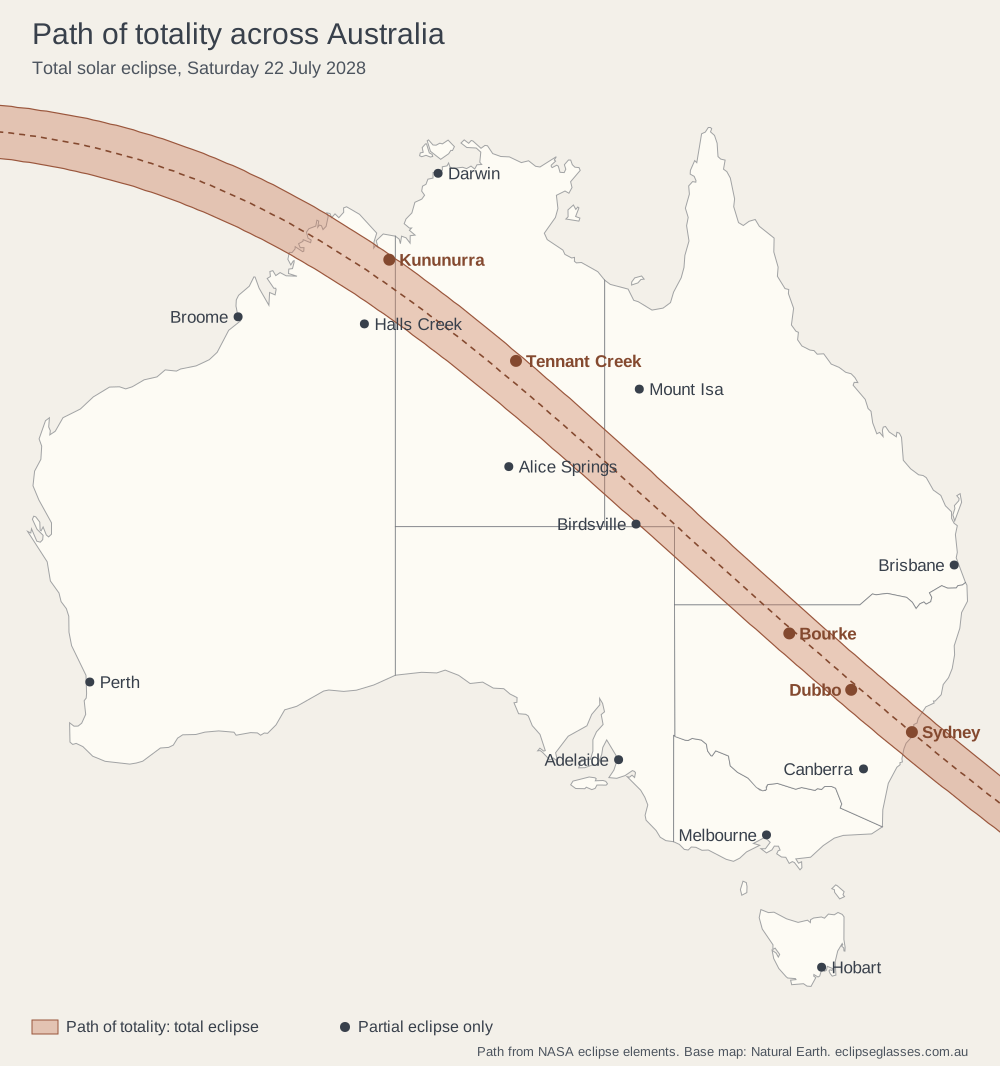
The short version. It gets as dark as dawn or dusk, but only for the minutes of totality: 3 min 48 s in Sydney and up to 5 min 10 s in the Kimberley. Before that, the light fades for over an hour. Outside the path of totality it never gets fully dark. Certified glasses stay on for the whole eclipse.
Minute by minute on 22 July 2028
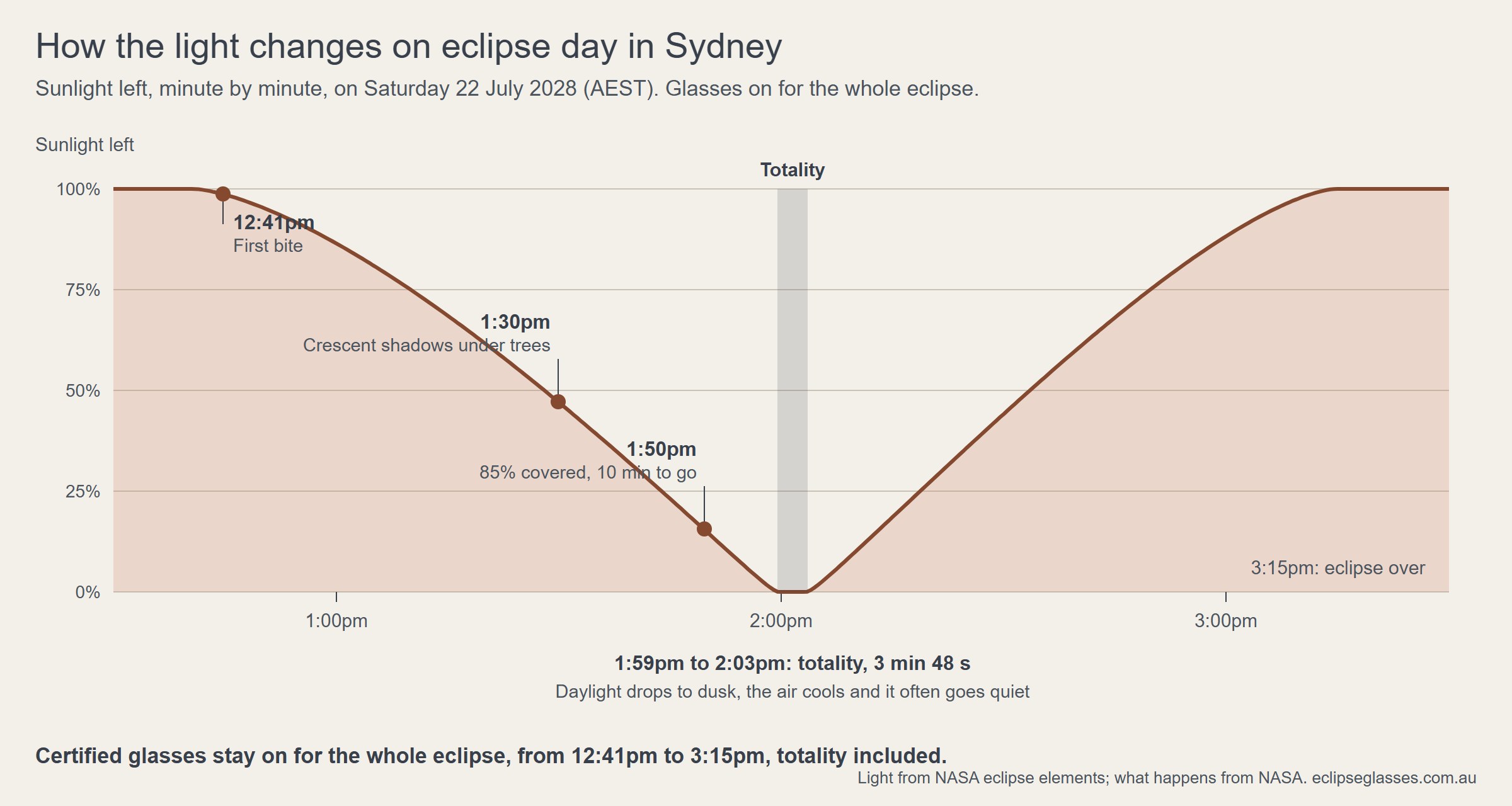
In the Sydney CBD the Moon takes its first bite out of the Sun at 12:41pm. For the next hour the light fades slowly, and the first clear sign is in the shadows: under trees, the gaps between leaves project hundreds of small crescents onto the ground.
Ten minutes before totality, 85% of the Sun is covered. From there the last sliver goes quickly, and at 1:59pm the sky drops to dusk. Totality lasts until 2:03pm. Then everything runs in reverse until the eclipse ends at 3:15pm.
How dark does it get?
NASA describes it simply: the sky becomes dark, as if it were dawn or dusk. It is not the middle of the night, but it is a sudden dusk in the middle of the day. The darkness lasts only as long as totality, which depends on where you are:
| Place | Totality lasts | Starts |
|---|---|---|
| Central Kimberley, greatest eclipse | 5m 10s | 10:52:58am AWST |
| Thargomindah | 4m 15s | 1:45:21pm AEST |
| Bourke | 4m 05s | 1:50:14pm AEST |
| Dubbo | 3m 50s | 1:55:27pm AEST |
| Sydney CBD | 3m 48s | 1:59:37pm AEST |
| Penrith | 3m 46s | 1:58:54pm AEST |
| Katoomba | 3m 29s | 1:58:31pm AEST |
| Wyndham | 3m 22s | 10:57:31am AWST |
| Tennant Creek | 3m 21s | 12:48:07pm ACST |
| Gosford | 3m 16s | 1:59:59pm AEST |
| Bathurst | 3m 02s | 1:57:36pm AEST |
| Kununurra | 2m 52s | 10:59:46am AWST |
| Wollongong | 2m 52s | 1:59:45pm AEST |
| Orange | 2m 14s | 1:57:18pm AEST |
Outside the path of totality the sky never goes fully dark, even with 96% of the Sun covered, as in Canberra. Our guide to every eclipse to 2040 shows which places get totality and when.
What happens around you
- The temperature drops. The air cools noticeably as the sunlight fades.
- It goes quiet. NASA notes that an eerie silence often settles over the crowd and the landscape.
- The light changes. In the last minutes before totality the daylight fades fast, to the level of dawn or dusk.
- Shadow bands. Just before and after totality, faint wavy bands of light and shade can ripple across the ground and pale walls.
The moments at the edges
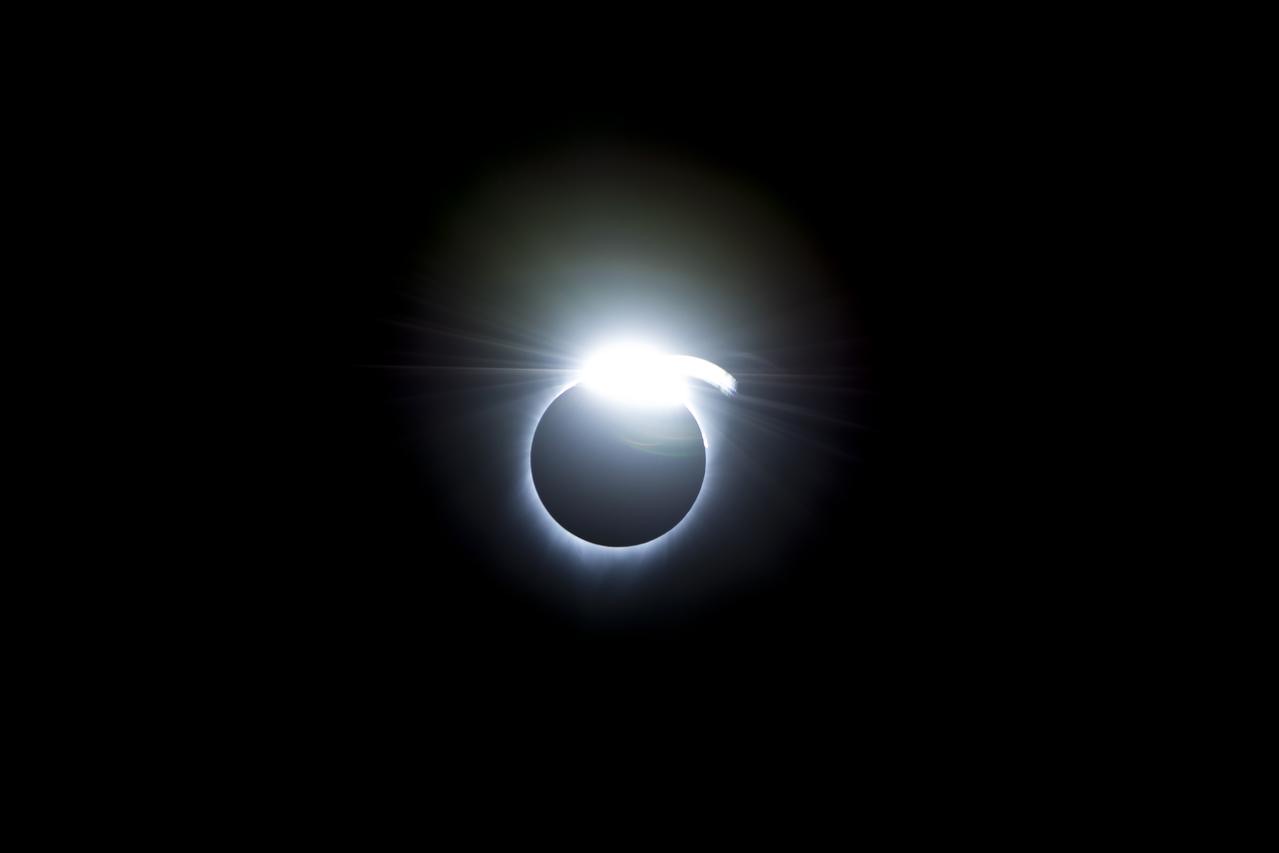
Right at the start and end of totality, the last and first light comes through the valleys on the Moon's edge as a string of bright points called Baily's beads. As they fade, a single bright point remains: the diamond ring. It marks the start and end of totality.
Why your glasses stay on
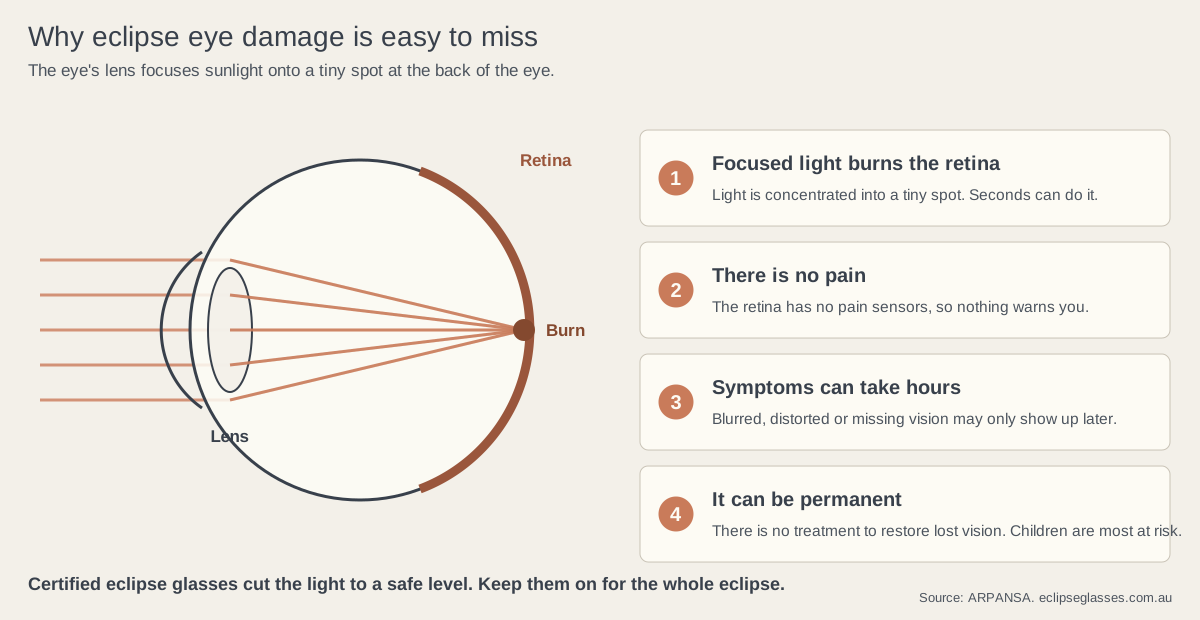
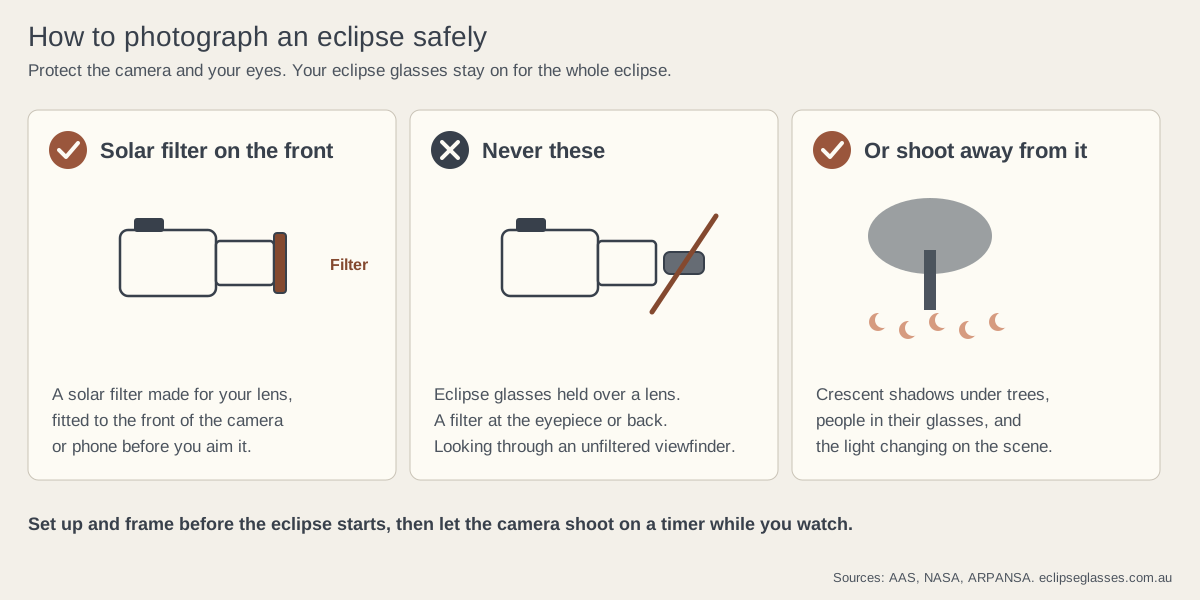
ARPANSA advises never to observe a total, partial or annular eclipse with the naked eye, so certified glasses stay on for the whole eclipse, totality included. What you notice around you is the darkness, the cold and the quiet. Read why you need eclipse glasses, and how to photograph the eclipse safely.
Certified, lab-tested eclipse glasses from NSW stock, A$5.45 a pair including GST.
Shop eclipse glassesFAQ
How long will it be dark during the 2028 eclipse?
Only for totality: 3 minutes 48 seconds in the Sydney CBD and up to 5 minutes 10 seconds in the central Kimberley. Outside the path of totality it never gets fully dark.
How dark does it get during a total solar eclipse?
About as dark as dawn or dusk, and only for the minutes of totality.
Does it get cold during a total eclipse?
Yes. The air temperature drops as the sunlight fades, and it often goes quiet.
How long does the whole eclipse last?
In Sydney, from 12:41pm to 3:15pm AEST on 22 July 2028: about two and a half hours, with totality in the middle.
What is the diamond ring?
The single bright point of sunlight at the very start and end of totality, as the Sun disappears behind the Moon and reappears.
Do I need eclipse glasses during totality?
ARPANSA advises never to observe a total, partial or annular eclipse with the naked eye, so certified glasses stay on for the whole eclipse, totality included.
Sources
All checked 11.11.2026.
- NASA, What to expect during a total solar eclipse. Used only for what happens in the sky and around you during totality.
- ARPANSA, Solar eclipse.
- Times and durations from NASA eclipse elements, as on our 2028 eclipse map.
Aura Sight glasses for everyone watching
ISO 12312-2 certified and lab-tested, with a QR batch certificate on every pair. The family kit has four pairs and a printed viewing guide.