The short version. Last eclipse of any kind: 22 September 2025, a sliver at sunrise in the south-east. Last total eclipse: 20 April 2023 at Exmouth, WA. Last total eclipse over a capital: Melbourne, 23 October 1976. Sydney's last was in 1857, and its next is 22 July 2028.
Every eclipse seen from Australia since 1922
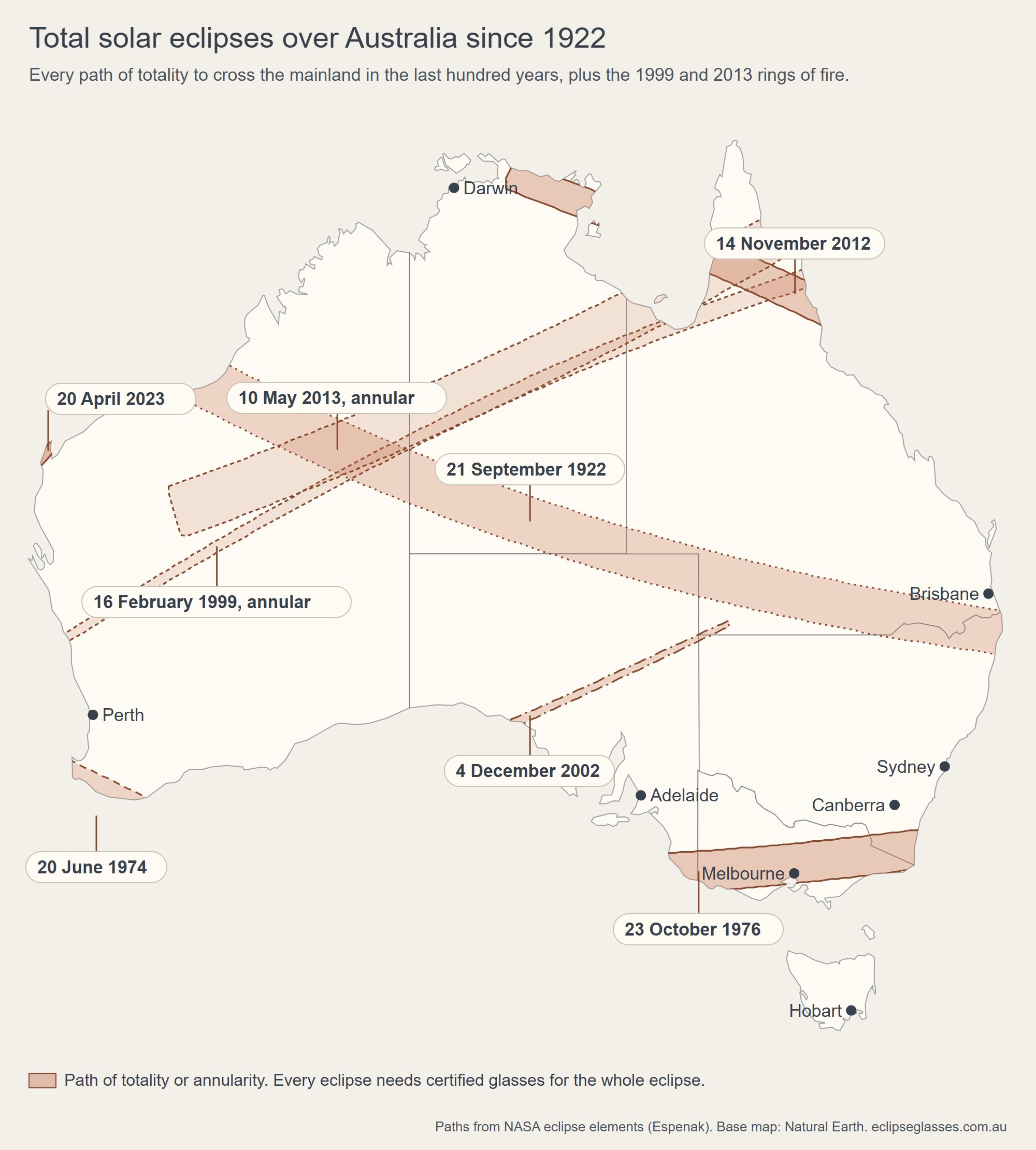
Australia sees a solar eclipse of some kind every few years, but a path of totality over the mainland comes along only a handful of times a century, and over a city far less often. These are the eclipses since 1922 with a path of totality or a ring of fire over the mainland, plus the partial eclipses seen from the capitals since 2003.
| Date (local) | Type | Where | The capital cities |
|---|---|---|---|
| Monday 22 September 2025 | Partial | Partial at sunrise in the south-east only | Rose already eclipsed in Sydney, Hobart. |
| Thursday 20 April 2023 | Total (hybrid) | Total for about a minute at Exmouth, on the North West Cape (WA) | Darwin 81%, Perth 71%, Adelaide 21%, Brisbane 16%. |
| Saturday 4 December 2021 | Total | Total over Antarctica; partial at sunset in the far south-east | Set eclipsed in Melbourne, Hobart, Canberra. |
| Thursday 26 December 2019 | Annular | Annular over India and Indonesia; partial in the far north | Darwin 31%. |
| Friday 13 July 2018 | Partial | Partial only, a nick in the far south | Hobart 4%. |
| Wednesday 9 March 2016 | Total | Total over Indonesia; partial in the north | Darwin 50%, Perth 1%. |
| Tuesday 29 April 2014 | Annular | Annular over Antarctica; partial across Australia | Perth 49%, Darwin 4%. Set eclipsed in Sydney, Melbourne, Brisbane, Adelaide, Hobart, Canberra. |
| Friday 10 May 2013 | Annular | Annular (a ring of fire) from Shark Bay and the Pilbara (WA) through Tennant Creek (NT) to Cape York (QLD) | Brisbane 40%, Adelaide 39%, Sydney 27%, Canberra 26%. Rose already eclipsed in Perth, Darwin. |
| Wednesday 14 November 2012 | Total | Total at sunrise from Arnhem Land (NT) to Cairns and Port Douglas (QLD) | Brisbane 80%, Sydney 59%, Canberra 53%, Melbourne 42%. Rose already eclipsed in Perth, Darwin. |
| Friday 25 November 2011 | Partial | Partial only, a small bite in Tasmania | Hobart 2%. |
| Monday 26 January 2009 | Annular | Annular over the Indian Ocean and Indonesia; partial in the west and north | Perth 22%, Adelaide 3%, Sydney 1%, Canberra 1%. Set eclipsed in Brisbane, Darwin. |
| Thursday 7 February 2008 | Annular | Annular over Antarctica; partial in the south-east | Hobart 19%, Sydney 12%, Canberra 11%, Melbourne 9%. |
| Monday 24 November 2003 | Total | Total over Antarctica; partial across southern Australia | Hobart 35%, Adelaide 33%, Melbourne 30%, Canberra 20%. Rose already eclipsed in Perth. |
| Wednesday 4 December 2002 | Total | Total near sunset at Ceduna and Lyndhurst (SA), ending near Thargomindah (QLD) | Perth 78%. Set eclipsed in Sydney, Melbourne, Brisbane, Adelaide, Hobart, Canberra, Darwin. |
| Tuesday 16 February 1999 | Annular | Annular (a ring of fire) on a narrow path from Greenough, south of Geraldton (WA), through Cue, Tennant Creek (NT) and the Gulf country to Cape Tribulation, north of Cairns (QLD) | Perth 89%, Darwin 72%, Adelaide 54%, Sydney 46%. Set eclipsed in Brisbane. |
| Saturday 23 October 1976 | Total | Total from Mount Gambier (SA) through Hamilton, Ballarat and Melbourne to Bright, Bega and Eden | Total in Melbourne. Canberra 97%, Sydney 93%, Adelaide 92%, Perth 85%. |
| Thursday 20 June 1974 | Total | Total in the far south-west of WA, around Albany, in the early afternoon | Perth 96%, Adelaide 72%, Melbourne 70%, Darwin 19%. Set eclipsed in Sydney, Brisbane, Hobart, Canberra. |
| Thursday 21 September 1922 | Total | Total from Wallal (WA) across central Australia to Goondiwindi, Stanthorpe and Byron Bay | Brisbane 99%, Sydney 83%, Canberra 76%, Adelaide 70%. |
Percentages are the share of the Sun covered at the greatest eclipse. Where the Sun rose or set during the eclipse, the table says so instead, because only part of it was above the horizon.
2025: a sunrise sliver
The most recent eclipse seen from Australia came at sunrise on Monday 22 September 2025. The Sun rose already eclipsed over the south-east, with only a few per cent of it covered by the time it cleared the horizon in Hobart and Sydney. The main show was over New Zealand and Antarctica.
2023: a minute of totality at Exmouth
On Thursday 20 April 2023 a rare hybrid eclipse clipped the North West Cape of Western Australia. Exmouth had about a minute of totality around 11:30am. Everywhere else in Australia got a partial eclipse: Darwin 81% and Perth 71%, but Sydney and Melbourne only about a tenth.
2012: sunrise totality in Cairns
On the morning of Wednesday 14 November 2012 the path of totality began at sunrise over Arnhem Land and crossed Cape York to Cairns and Port Douglas. Cairns had about two minutes of totality at 6:40am, with the Sun still low in the eastern sky. Six months later, on 10 May 2013, an annular eclipse drew a ring of fire from Shark Bay and the Pilbara in Western Australia through Tennant Creek to Cape York, with about three minutes of annularity at Tennant Creek.
1976: Melbourne's total eclipse
On the afternoon of Saturday 23 October 1976 the path of totality crossed south-east Australia from Mount Gambier through Hamilton, Ballarat and Melbourne to Bright, Omeo, Bega and Eden. Melbourne was the largest city in the path, with about two and a half minutes of totality late in the afternoon. It remains the last total eclipse over an Australian capital, until Sydney's in 2028.
2002, 1999 and 1974
On 4 December 2002 a short total eclipse crossed South Australia at sunset, with about 30 seconds of totality at Ceduna and a little less at Lyndhurst, low in the sky shortly before sunset. On 16 February 1999 an annular eclipse drew a narrow ring of fire across the continent, from Greenough, south of Geraldton, through Cue and Tennant Creek to Cape Tribulation, north of Cairns, with about a minute of annularity at Tennant Creek. On 20 June 1974 the path clipped the far south-west of Western Australia, around Albany, in the early afternoon.
1922: the eclipse that tested Einstein
The most famous Australian eclipse is the one of 21 September 1922. Totality crossed the continent from Wallal on the Eighty Mile Beach in Western Australia to Goondiwindi and Byron Bay. At Wallal, an expedition led by the Lick Observatory photographed the stars around the eclipsed Sun. Their measurements showed starlight bending around the Sun by the amount Albert Einstein's general theory of relativity predicted, one of the early confirmations of the theory.
Sydney's long wait
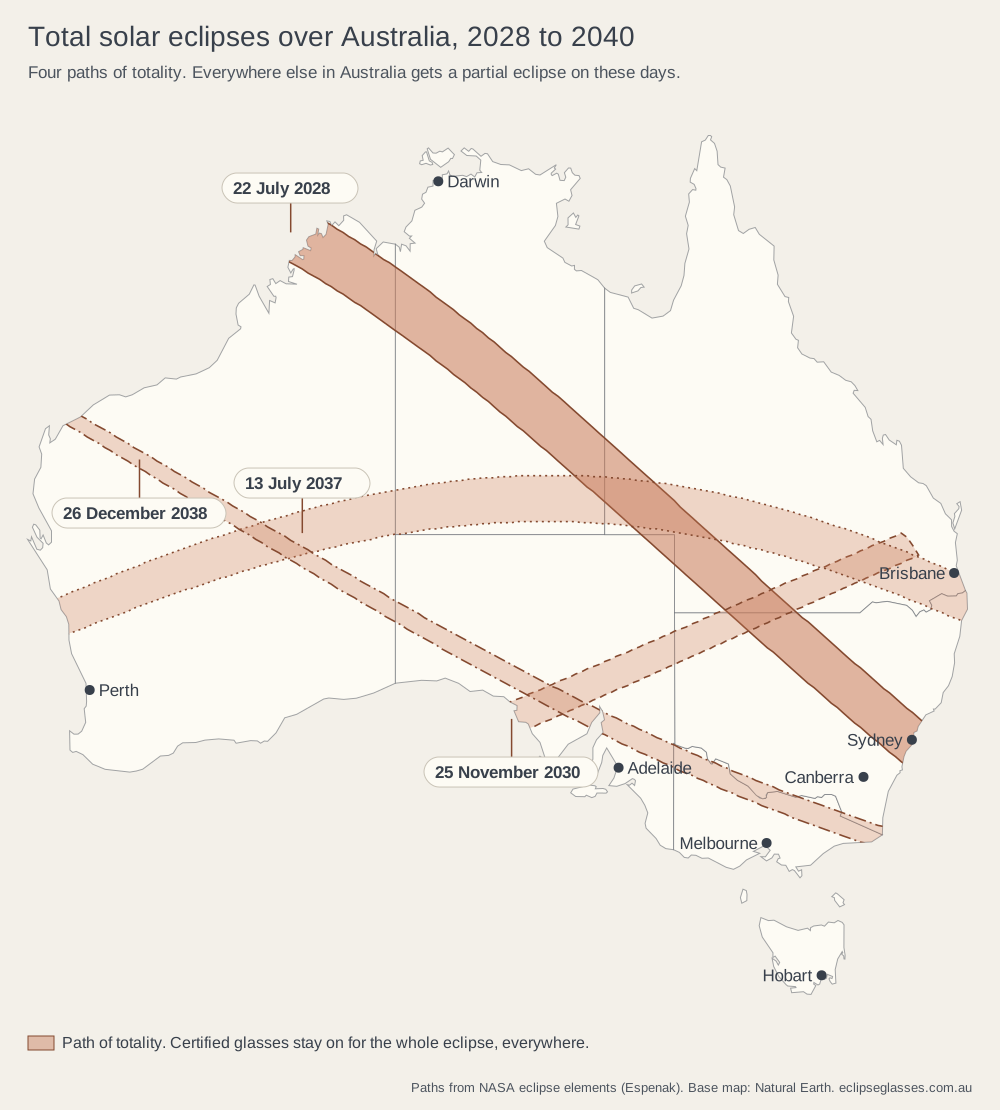
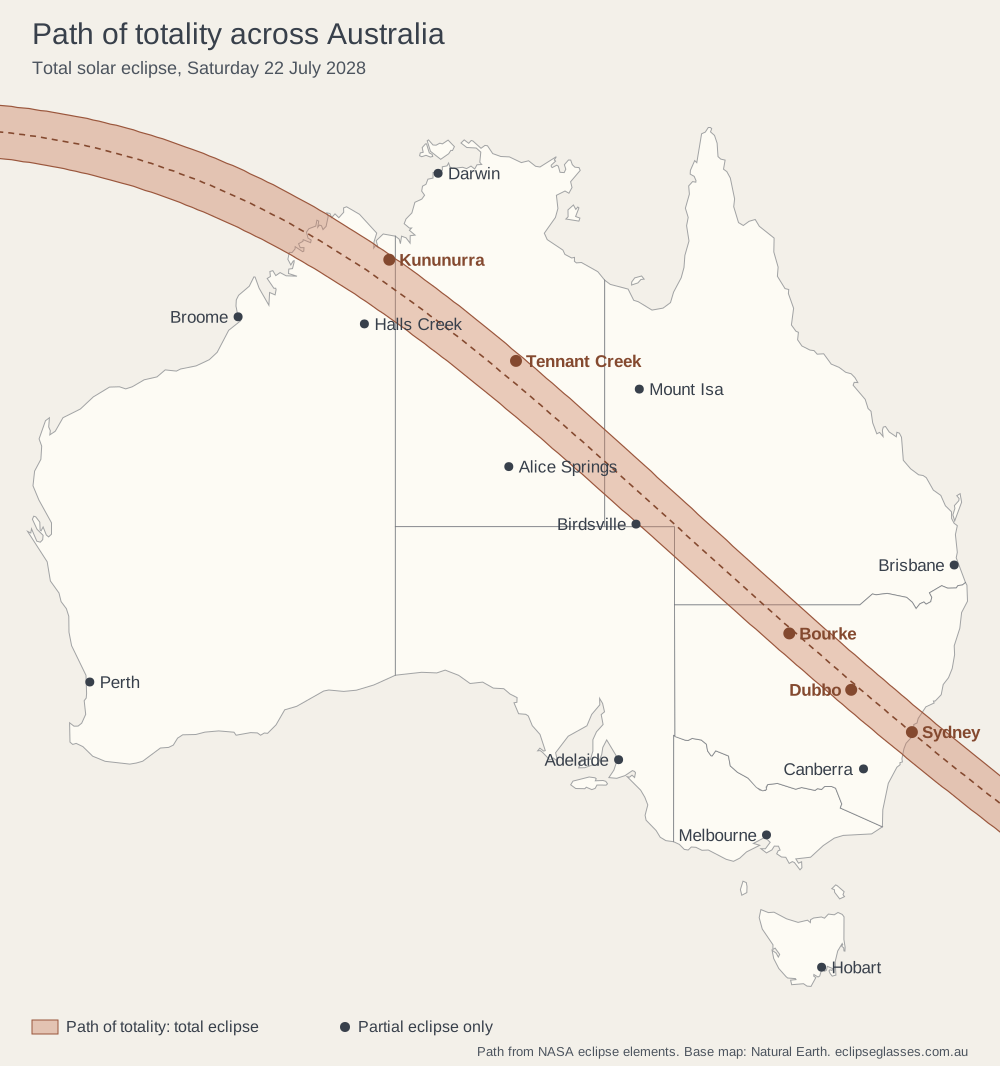
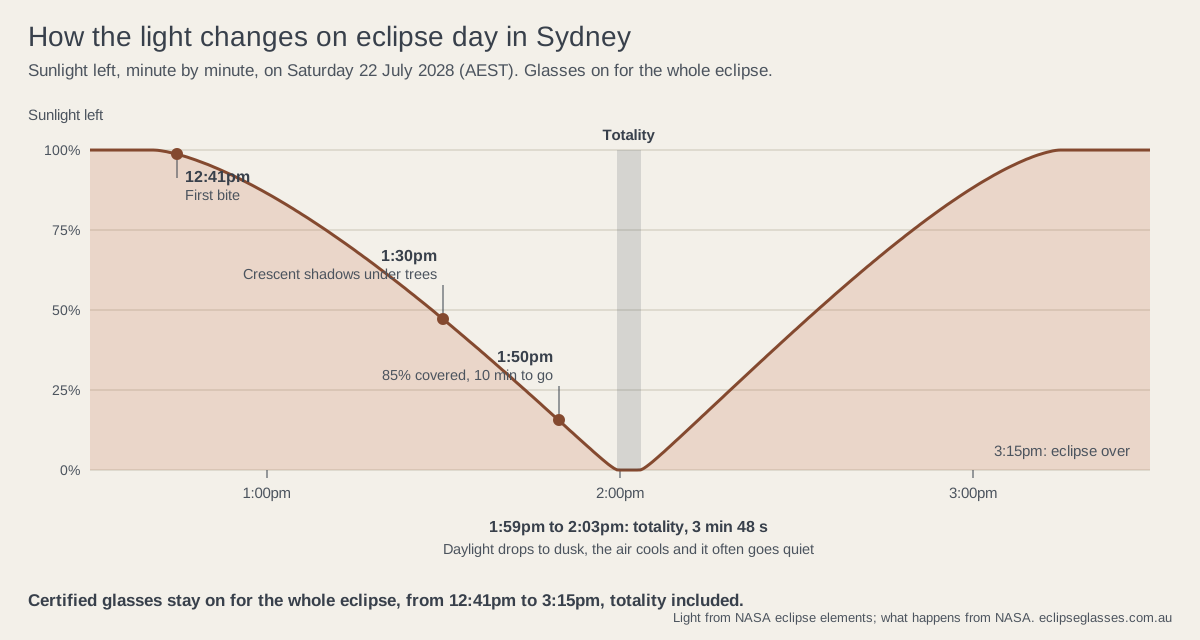
The last total eclipse over Sydney was in 1857. The next is on Saturday 22 July 2028, with 3 minutes 48 seconds of totality in the CBD. Read what happens during a total eclipse, then see every eclipse to 2040 for the ones after that.
Certified, lab-tested eclipse glasses from NSW stock, A$5.45 a pair including GST.
Shop eclipse glassesFAQ
When was the last solar eclipse in Australia?
Monday 22 September 2025, a partial eclipse at sunrise seen only from the south-east, with a few per cent of the Sun covered.
When was the last total solar eclipse in Australia?
Thursday 20 April 2023, when about a minute of totality reached Exmouth on the North West Cape of Western Australia.
When was the last total solar eclipse in Melbourne?
Saturday 23 October 1976, with about two and a half minutes of totality late in the afternoon. It was the last total eclipse over an Australian capital.
When was the last total solar eclipse in Sydney?
1857. The next is on Saturday 22 July 2028, with 3 minutes 48 seconds of totality in the CBD.
When was the last total solar eclipse in Queensland?
Wednesday 14 November 2012, at sunrise over Cairns and Port Douglas, with about two minutes of totality.
Which Australian eclipse tested Einstein's theory?
The total eclipse of 21 September 1922. A Lick Observatory expedition at Wallal, Western Australia, measured starlight bending around the Sun by the amount general relativity predicted.
When is the next solar eclipse in Australia?
Saturday 22 July 2028, a total eclipse from the Kimberley to Sydney.
Sources
All checked 11.11.2026.
- NASA (Fred Espenak), decade tables of solar eclipses and the Besselian elements for each eclipse. Eclipse predictions by Fred Espenak, NASA's GSFC.
- Lick Observatory, The Lick Observatory eclipse expeditions, general relativity and the bending of starlight.
- Powerhouse (Museum of Applied Arts and Sciences), 100 years since the total solar eclipse which confirmed Einstein's general theory of relativity.
- Wikipedia, Solar eclipse of October 23, 1976 and September 21, 2025.
- Coverage and times calculated by Aura Sight from the NASA elements with the same method as our 2028 eclipse map; historical times are in standard time.

Aura Sight glasses for everyone watching
ISO 12312-2 certified and lab-tested, with a QR batch certificate on every pair. The family kit has four pairs and a printed viewing guide.