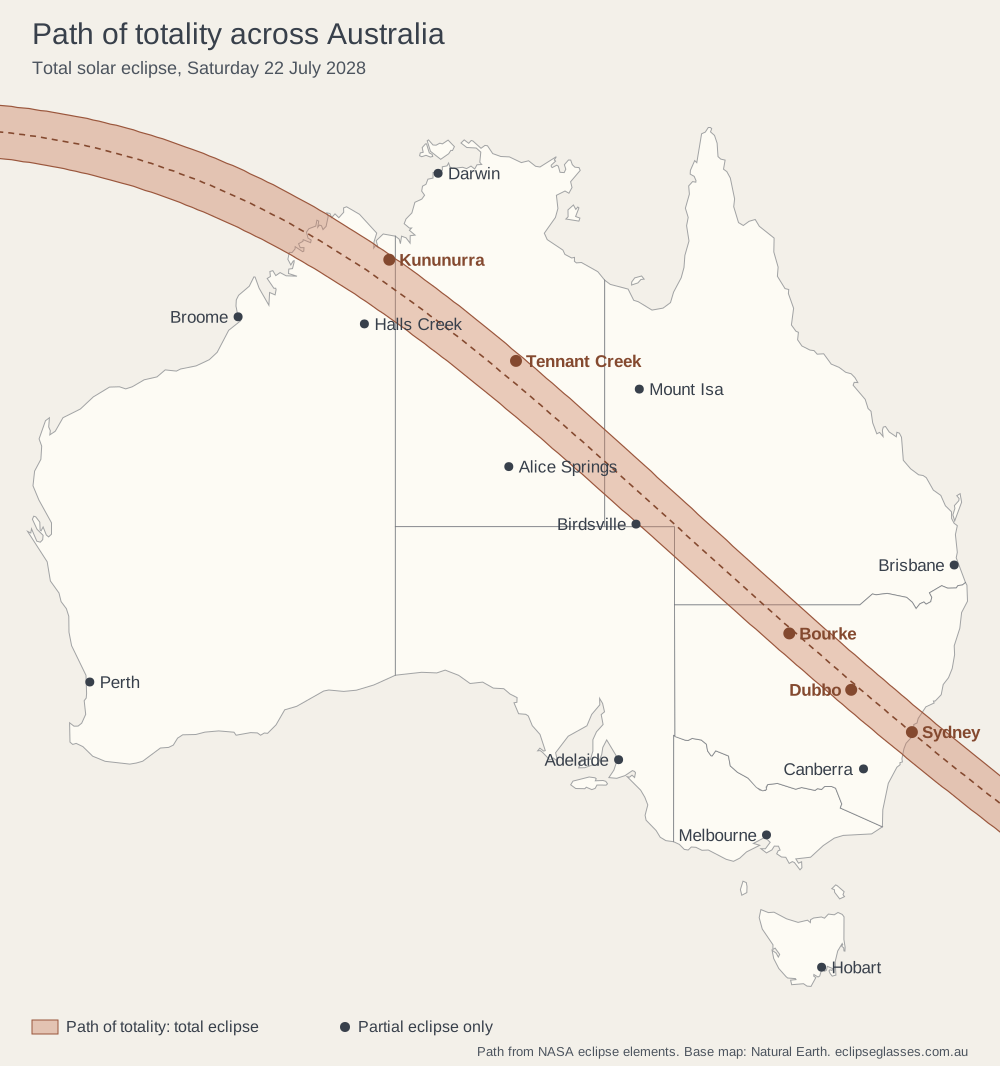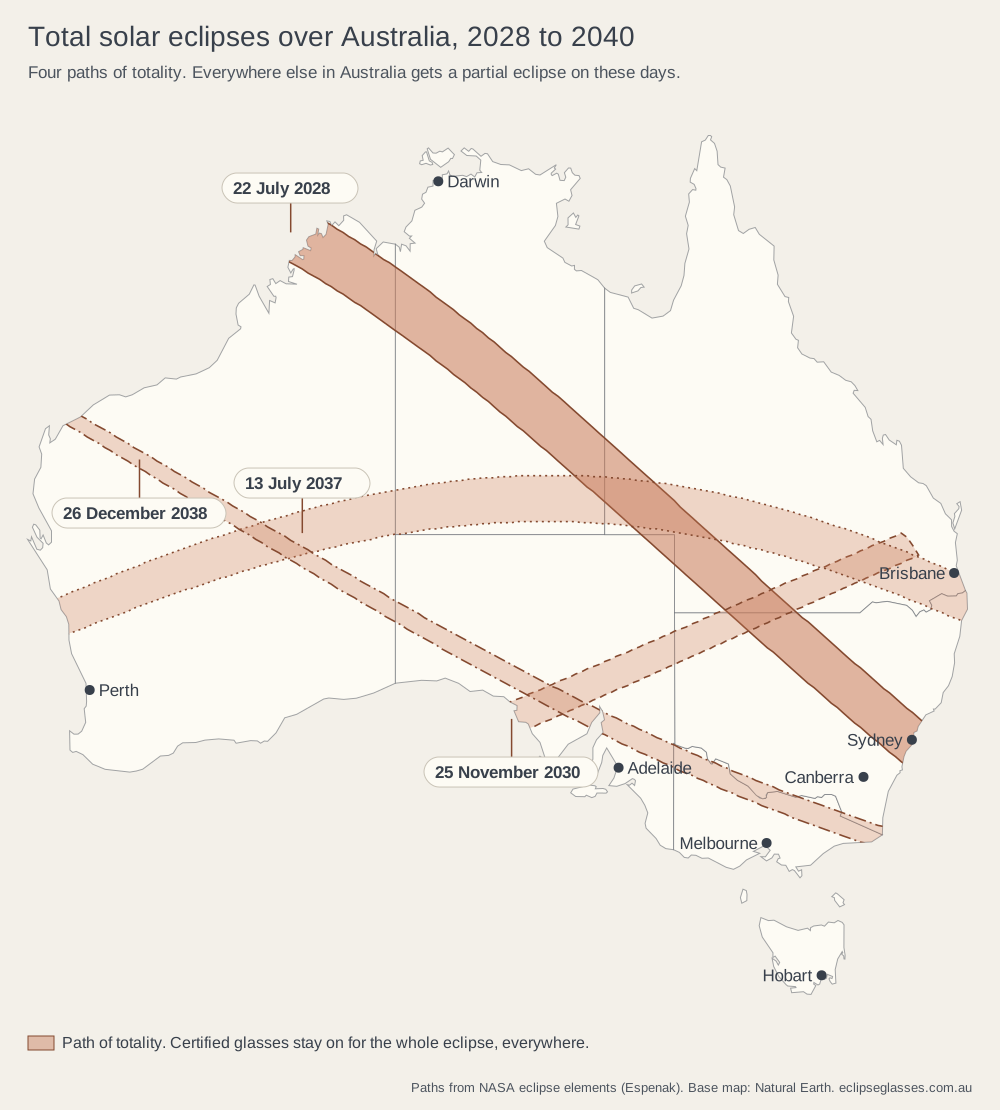
The short version. Anything below 100% is a partial eclipse, so everyone needs certified eclipse glasses for the whole eclipse, from first contact to last. Coonabarabran, Cessnock and Birdsville get over 99.9% but no totality. Newcastle gets 99.7%, Canberra 96.1% and Alice Springs 95.3%. If you want totality, check your exact address on the eclipse map and drive well inside the path, not just over the line.
Why is 99.9% not the same as totality?
Totality only happens inside the path, where the Moon covers the Sun completely. Outside it, however close, a sliver of the Sun is always left uncovered. Our 2028 eclipse guide puts it plainly: just outside the path it never gets dark like it does inside, and the Sun's corona shows only while the Sun is completely covered.
That sliver matters for your eyes. ARPANSA, the Australian Government's radiation safety agency, says never to try to observe a total, partial or annular eclipse with the naked eye. It warns that eclipse light can burn the retina in a matter of seconds, that the retina feels no pain so there is no warning, and that the damage can be permanent. A 99.9% eclipse is a partial eclipse, so the same rules apply as at 50%.
Our rule is the most cautious one: certified eclipse glasses stay on for the whole eclipse, at any percentage, everywhere in Australia. Inside the path, too. Our guide to why you need eclipse glasses explains what an eclipse can do to your eyes.
What does "per cent covered" mean?
It is the share of the Sun's disc the Moon covers at maximum eclipse, the middle of the event in your town. Before and after that moment the share is lower. At 99.7% in Newcastle, the eclipse still runs for about two and a half hours from start to finish, and all of it is partial.
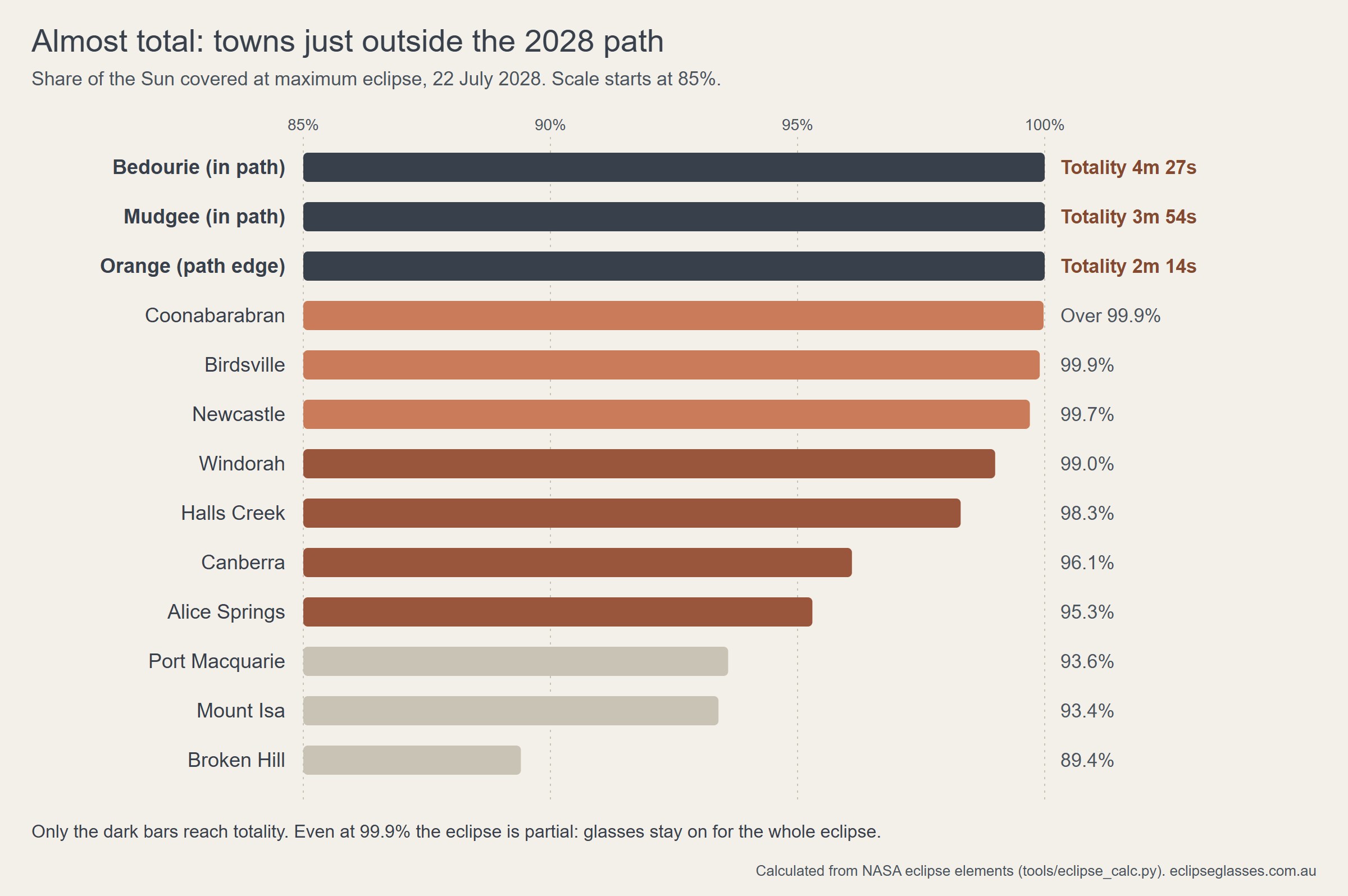
The chart shows the share of the Sun covered at maximum eclipse in towns just outside the path, next to three towns inside it. Only the towns inside reach 100% and get totality. Everyone else, even at 99.9%, has a partial eclipse.
Which towns are just outside the path?
These towns get 89% to over 99.9% of the Sun covered. The fourth column is the straight-line distance from town to the nearest point inside the path, from our calculator. Roads will be longer.
| Town | Sun covered | Maximum | Path starts (straight line) | Inside the path nearby |
|---|---|---|---|---|
| Cessnock, NSW | Over 99.9% | 2:01pm AEST | About 5 km south | Wollombi and Laguna, 1 to 2.5 min |
| Coonabarabran, NSW | Over 99.9% | 1:58pm AEST | About 4 km south | Siding Spring Observatory 1m 48s; Mendooran 3m 32s |
| Birdsville, Qld | 99.9% | 1:37pm AEST | About 5 km north | Bedourie 4m 27s |
| Singleton, NSW | 99.8% | 2:01pm AEST | About 15 km south-west | Broke, about 1 min |
| Newcastle, NSW | 99.7% | 2:02pm AEST | About 24 km south | Catherine Hill Bay 1m 13s; The Entrance 2m 43s |
| Muswellbrook, NSW | 99.7% | 2:00pm AEST | About 24 km south-west | Bylong Valley Way, 2 to 3 min |
| Nowra, NSW | 99.6% | 2:00pm AEST | About 24 km north-east | Kiama 1m 42s |
| Maitland, NSW | 99.6% | 2:01pm AEST | About 25 km south-west | Wollombi and the Watagans |
| Parkes, NSW | 99.5% | 1:56pm AEST | About 29 km north-east | Wellington 3m 46s |
| Walgett, NSW | 99.5% | 1:55pm AEST | About 33 km south-west | Coonamble 2m 47s |
| Cobar, NSW | 99.3% | 1:52pm AEST | About 42 km north-east | Nyngan 3m 17s |
| Windorah, Qld | 99.0% | 1:43pm AEST | About 52 km south-west | Thargomindah 4m 15s |
| Goulburn, NSW | 98.6% | 1:59pm AEST | About 67 km north-east | Wollongong 2m 52s |
| Halls Creek, WA | 98.3% | 11:01am AWST | About 82 km north-north-east | Kununurra 2m 52s |
| Tamworth, NSW | 96.8% | 2:00pm AEST | About 123 km south-west | Mudgee 3m 54s |
| Canberra, ACT | 96.1% | 1:58pm AEST | About 147 km north-east | Katoomba 3m 29s |
| Alice Springs, NT | 95.3% | 12:53pm ACST | About 182 km north-east | Barrow Creek 1m 32s; Wauchope 4m 55s |
| Port Macquarie, NSW | 93.6% | 2:03pm AEST | About 219 km south-west | Gosford 3m 16s |
| Mount Isa, Qld | 93.4% | 1:33pm AEST | About 232 km south-south-west | Bedourie 4m 27s |
| Broken Hill, NSW | 89.4% | 1:15pm ACST | About 361 km north-east | Bourke 4m 05s |
Times are to the minute for the town centre. Broken Hill keeps South Australian time (ACST). For every capital city and the full list of towns inside the path, see our 2028 eclipse guide; for the eclipses after 2028, see the next solar eclipse in Australia.
Should you drive into the path?
If you can, yes: the step from 99.9% to totality is the whole point of a total eclipse, and only the path gets it. Three things decide whether the trip is worth it.
- Check your exact address first. The path edge can cut through a single town or city. Lake Macquarie is split in half, and Cessnock town misses out while Millfield, Paxton and Wollombi are inside. Put your address and your destination into the eclipse map.
- Go deeper, not just over the line. The closer you are to the centre line, the longer totality lasts. Near the edges it drops quickly: Orange, near the southern edge, gets 2m 14s, while Mudgee, closer to the centre, gets 3m 54s. Swansea, on the northern edge at Lake Macquarie, gets only about 11 seconds.
- Edge figures are less certain. For places close to an edge, the real duration can differ by 10 seconds or more from the calculation. A few kilometres further in buys you margin.
The longest totality in Australia is 5 minutes 10 seconds, in the central Kimberley in WA. In the more accessible towns, Thargomindah gets 4m 15s, Bourke 4m 05s, Dubbo 3m 50s and Sydney 3m 48s. Town guides such as Dubbo, Orange, Bathurst, Bourke and Sydney list local times and spots.
Plan to arrive early and have a backup spot further in. In the Hunter alone, hundreds of thousands of people live just north of the edge, and small roads near the line will be busy on the day.
What this means for shops, schools and events outside the path
Towns just outside the path are not out of the eclipse. Everyone who stays gets a deep partial eclipse lasting about two and a half to three hours, and everyone who drives in needs glasses too. So the demand for glasses is the same as inside the path.
- Households. One pair per person, for the whole eclipse. The family eclipse kit has four certified pairs and a printed viewing guide for A$19.25; single pairs are A$5.45 including GST.
- Schools. The eclipse falls on a Saturday, so a pair sent home with each student covers the day. See eclipse glasses for schools and our eclipse safety plan for schools. Fundraising boxes let P&Cs sell glasses to families.
- Councils and events. A viewing event in a 99% town still needs a pair for every guest. See eclipse glasses for events, the event checklist and how many glasses to order.
- Shops, servos and visitor centres. Travellers heading for the path pass through near-path towns. Wholesale comes in counter displays of 50, and custom-branded glasses start from 500 units. Tourism operators can read our guide for operators.
Our glasses are made by Rainbow Symphony, a manufacturer on the American Astronomical Society's reputable vendors list, tested to ISO 12312-2:2015 by ICS Laboratories, and every pair carries a QR batch certificate. See how our glasses are certified and where to buy safe glasses.
FAQ
Is 99.9% almost as good as totality?
No. At 99.9% a sliver of the Sun is still uncovered, so it never gets dark the way it does inside the path and the corona does not show. Only the path of totality gets totality. Glasses stay on for the whole eclipse.
Do I need eclipse glasses if my town gets 99% covered?
Yes. A 99% eclipse is a partial eclipse, and ARPANSA says never to try to observe a partial eclipse with the naked eye. Wear certified ISO 12312-2 eclipse glasses for the whole eclipse.
Will Newcastle get a total eclipse?
No. Newcastle is just outside the northern edge and gets 99.7% of the Sun covered at 2:02pm AEST. The nearest totality is about 24 km south, around Lake Macquarie and the Central Coast: Catherine Hill Bay gets 1m 13s and The Entrance 2m 43s.
Will Canberra get a total eclipse?
No. Canberra gets 96.1% of the Sun covered at 1:58pm AEST. The path starts about 147 km north-east in a straight line; Katoomba gets 3m 29s of totality.
Does Coonabarabran get a total eclipse?
No, but only just. Coonabarabran gets over 99.9% of the Sun covered, and the path starts about 4 km south of town. Siding Spring Observatory, west of town, gets about 1m 48s, and Mendooran 3m 32s.
How far should I drive to see totality?
Further than the edge. Totality is shortest near the edges and longest near the centre line: Orange, near the southern edge, gets 2m 14s and Mudgee 3m 54s. Check your destination on the eclipse map and aim a few kilometres inside the path.
Where is the longest totality in Australia?
The central Kimberley in WA, with 5 minutes 10 seconds. Among easier-to-reach towns, Wauchope in the NT gets 4m 55s, Bedourie in Queensland 4m 27s and Bourke 4m 05s.
Glasses for everyone, whether you stay home for 99% or drive into the path: four certified pairs and a printed viewing guide for A$19.25, from NSW stock. For groups, see glasses for schools or glasses for events.
Family eclipse kitSources
All checked 11.11.2026.
- ARPANSA (Australian Radiation Protection and Nuclear Safety Agency), Solar eclipse.
- Astronomical Society of Australia, How to view the eclipse.
- American Astronomical Society, Solar eclipse eye safety.
- Coverage, times, straight-line distances and durations calculated from NASA (Espenak) Besselian elements for 22 July 2028, as in our eclipse map, NSW guide and town guides. Durations near a path edge can differ by 10 seconds or more.

Aura Sight glasses for everyone watching
ISO 12312-2 certified and lab-tested, with a QR batch certificate on every pair. The family kit has four pairs and a printed viewing guide.