The short version. Pick a site with a clear view to the north-west and check your town's coverage on the eclipse map. Order ISO 12312-2 certified glasses for every guest plus spares, and file the test report, CE certificate and QR batch details with your risk assessment. Brief every staff member and volunteer on one rule: glasses on for the whole eclipse, totality included.
What needs doing, and when?
Here is the whole job on one page. Each phase is explained below.
| When | What to get done |
|---|---|
| Now | Choose the site, check your town's coverage and times, name an event lead and a safety officer. |
| 2027 | Estimate numbers, get a quote, decide on standard or branded glasses, start the risk assessment. |
| By May 2028 | Glasses ordered and delivered, compliance pack filed, staff roles set, attendee messaging written. |
| The week before | Inspect stock, pack hand-out points, brief staff and volunteers, send the final reminder. |
| On the day | Hand out glasses on arrival, repeat the safety message, run the timeline, swap damaged pairs. |
| After | Collect and store undamaged glasses, debrief, thank your crowd. |
Now: where will you hold it?
- Choose a site with a clear view to the north-west. In Sydney the eclipse sits about 29 degrees above the horizon to the north-west at totality, so trees, buildings and ridges can block it. Ovals, parks, headlands and open water facing north-west work well.
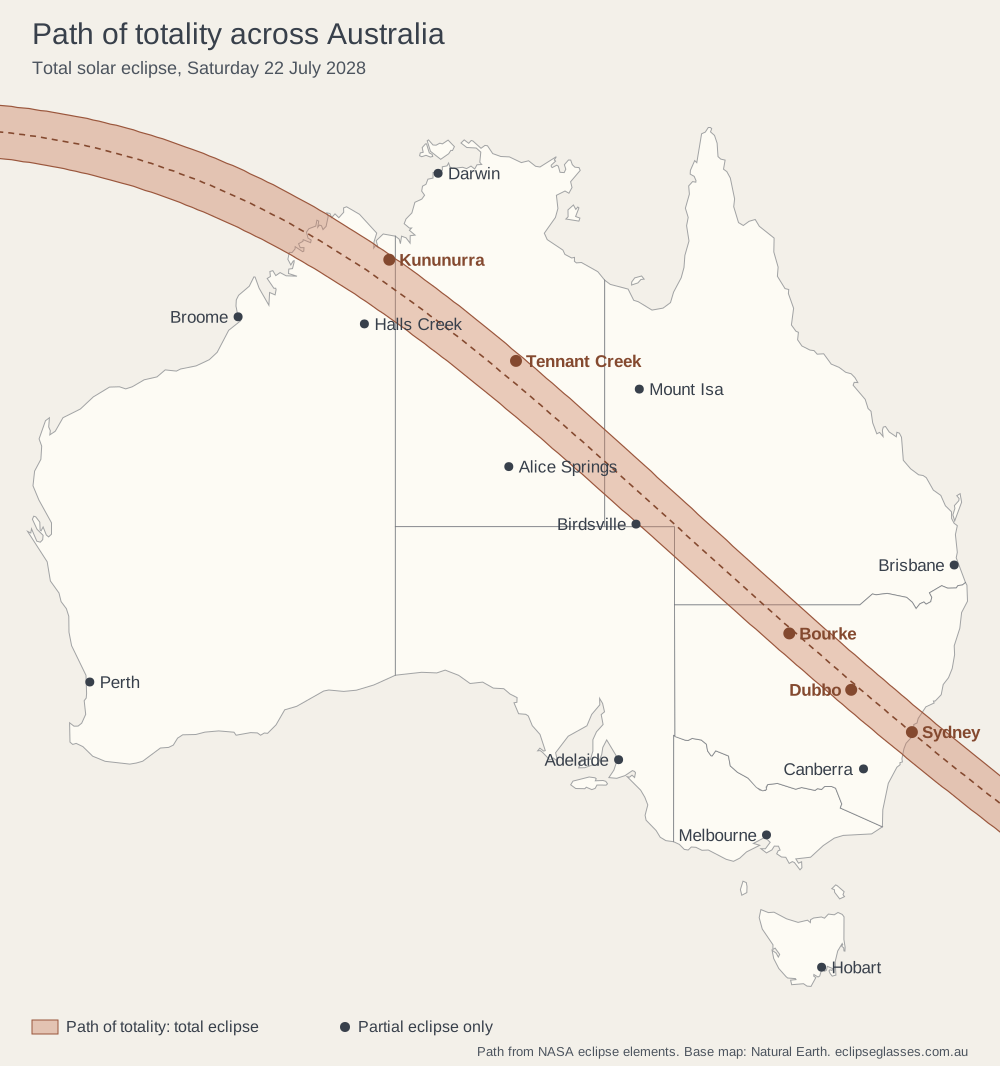
- Check your town's coverage and times. Our eclipse map gives local times and how much of the Sun is covered. Totality lasts 3 min 48 s in the Sydney CBD and 3 min 50 s in Dubbo. Towns just outside the path still get a deep partial eclipse: Coonabarabran is over 99.9% covered, Birdsville 99.9%, Newcastle 99.7%, Halls Creek 98.3% and Canberra 96.1%. Our guide to towns just outside the path explains what that means for your crowd.
- Name an event lead and a safety officer. One person owns the glasses order and the timeline; one owns the risk assessment and the safety briefing.
- Plan for a winter crowd. It is a Saturday in July: think about toilets, warm drinks, shelter and how people get home.
2027: how many glasses, and which kind?
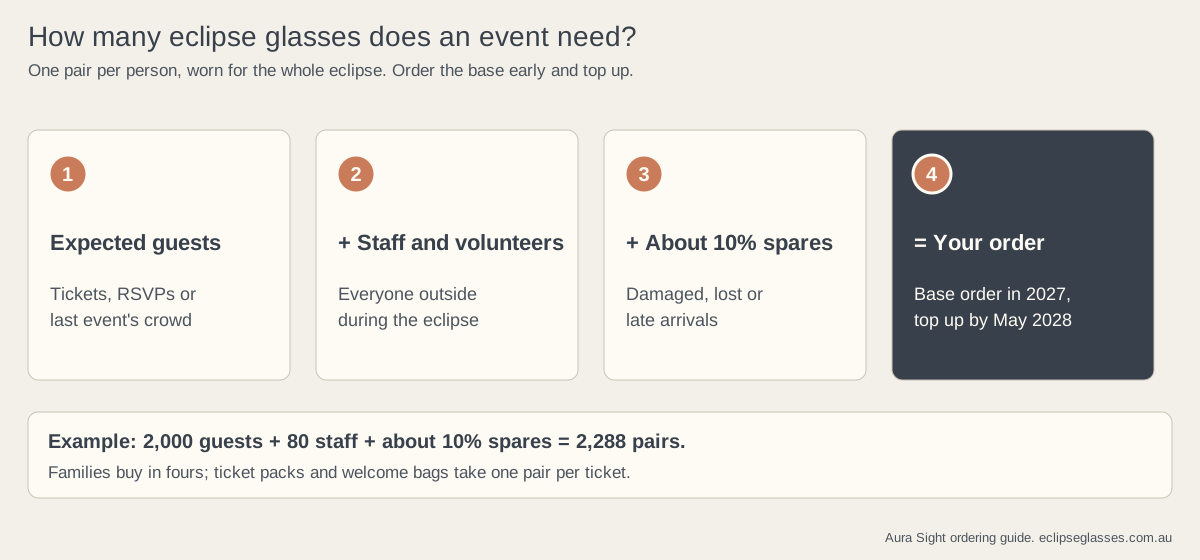
- Estimate numbers. Order one pair per person, plus spares for staff, volunteers, walk-ups and pairs that get creased or scratched. Our guide to how many eclipse glasses to order for an event walks through the sums.
- Get a quote. Send us your expected numbers through the events page. If attendance depends on ticket sales, give a range and we quote both ends. We reply within one business day.
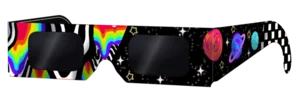
- Decide on standard or branded glasses. Standard prints ship from NSW stock. Branded glasses start at 500 units, pack in cartons of 100 and take 6 to 8 weeks from proof approval. Orders over 1,000 get a printed sample before the full run. Many organisers lock in a branded run early and top up with standard prints as numbers firm up.
- Start the risk assessment. Eye safety is the main hazard. ARPANSA warns that eye damage from an eclipse can be permanent, and the retina feels no pain, so there is no warning.
By May 2028: what paperwork does the safety officer need?
- Have the glasses ordered and delivered. Online orders of up to 999 pairs ship until 31 May 2028. For larger runs, allow for the branded lead time plus your own approvals. Wholesale orders have no change-of-mind returns, and unsold stock cannot be returned after the eclipse, so order to your real numbers.
- File the compliance pack. Every order ships with one. Our glasses are made by Rainbow Symphony, a manufacturer on the American Astronomical Society's reputable vendors list. The filter is tested to ISO 12312-2:2015 by ICS Laboratories, an A2LA-accredited laboratory, and the glasses are CE-certified under EU PPE Regulation 2016/425 (Notified Body 2834). Every pair carries a QR code linked to its batch certificate, and the full test report and CE certificate are available on request. See how our glasses are certified.
- Set staff and volunteer roles. You need people at each hand-out point, a swap desk for damaged pairs, a lead for children's areas, an MC who reads the safety script, and someone watching for anyone using binoculars, cameras or telescopes without a proper filter.
- Plan hand-out points. Hand glasses out at the gates, so nobody reaches the viewing area without a pair. Keep spares at an info tent.
- Plan for accessibility. Keep a seated area with an unblocked north-west outlook. People who wear prescription glasses keep them on and wear eclipse glasses over the top. Have a pinhole projection or a live stream on a screen for anyone who cannot wear glasses; ARPANSA says indirect viewing is the safest way to follow an eclipse.
- Write the attendee messaging. Tell people before the day that glasses are provided, that they stay on for the whole eclipse, and that binoculars and cameras need their own front-mounted solar filter.
The week before: are the glasses ready?
- Inspect the stock. Open a sample of cartons and check lenses for scratches, creases, pinholes or a loose filter. Any damaged pair goes in the bin.
- Pack each hand-out point with glasses, spares, signs and a printed copy of the safety script.
- Brief every staff member and volunteer on the script below. They should be able to say it from memory.
- Send the final reminder with the times, the site, what to bring for the cold and the glasses rule.
What should the safety briefing say?
Your crowd takes its cue from the MC, the screens and the signs. Keep it short and repeat it from the gates opening until the eclipse ends:
- Glasses on before the eclipse starts, and before you face it.
- Glasses stay on for the whole eclipse, totality included. This is our rule, the most cautious one.
- Check your pair. Scratched, creased, torn or a pinhole? Swap it at the info tent.
- Never use eclipse glasses with cameras, binoculars or telescopes. Concentrated light burns through the filter. Optics need their own solar filter on the front.
- Children: an adult fits the glasses on each child in the shade before the eclipse and stays close by. ARPANSA says to supervise children very closely, because young eyes let more light reach the retina.
- Never look at the Sun without certified glasses, not even for a moment. Ordinary sunglasses are never safe.
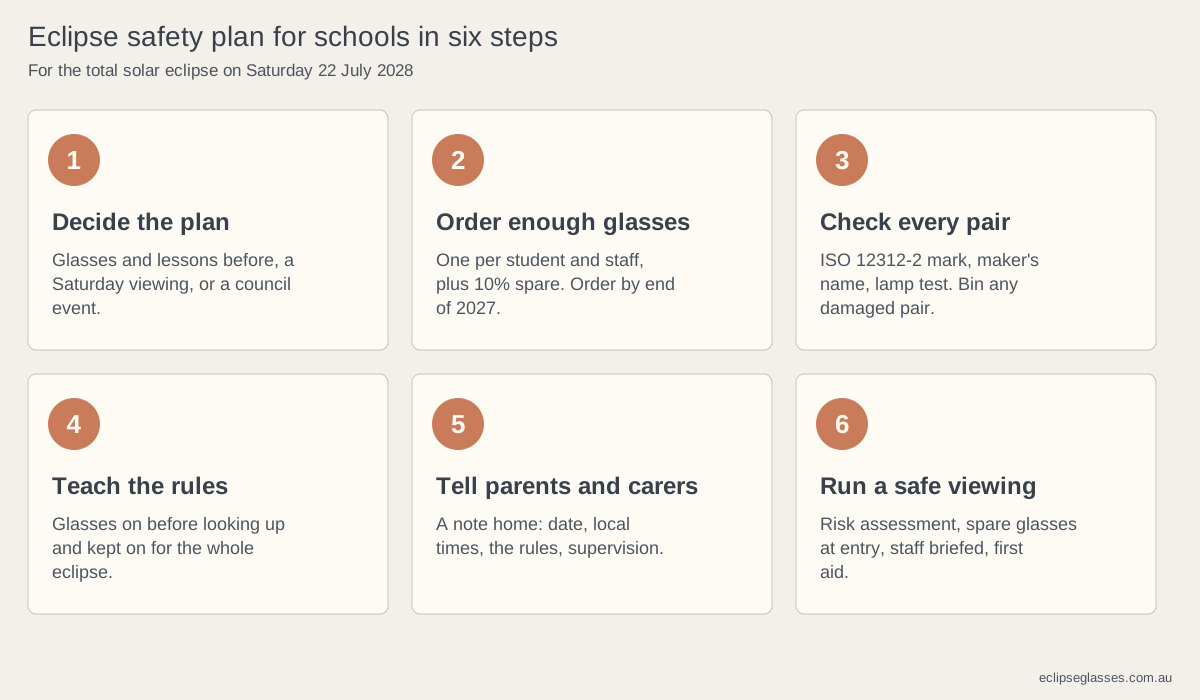
Running the event with schools? The eclipse safety plan for schools covers supervision in more detail.
On the day: what time does the eclipse run?
Sydney eclipse 2028 times
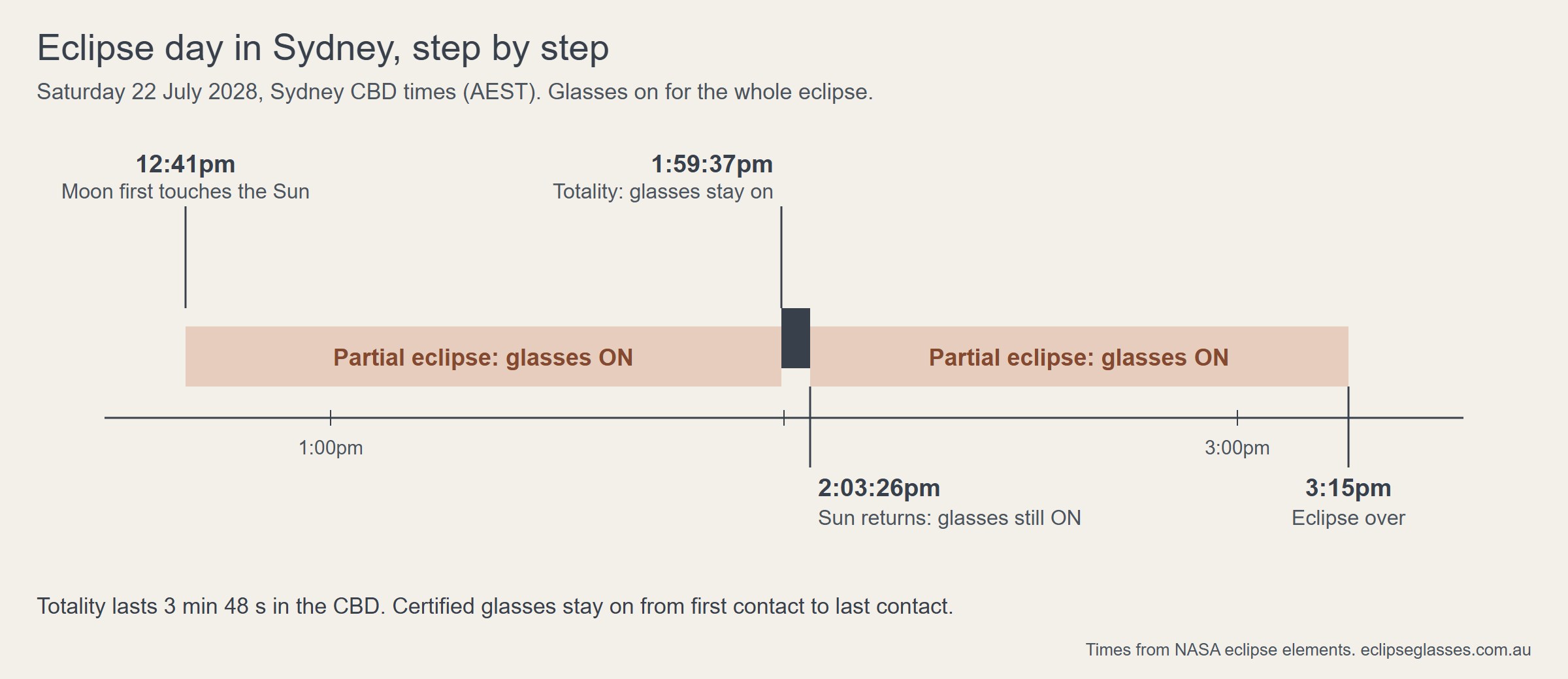
On the day, the eclipse runs from 12:41pm to 3:15pm AEST in the Sydney CBD, with totality from 1:59:37pm to 2:03:26pm. In Dubbo it runs from 12:35pm to 3:12pm, with totality from 1:55:27pm to 1:59:17pm. Check your own town on the eclipse map; in WA subtract two hours, and in the NT and SA subtract half an hour.
- Gates open early. Everyone should have glasses well before the eclipse starts.
- Run the script at set times: on arrival, 15 minutes before the start, at the start, before totality and before the end.
- Watch the crowd, not the sky. Staff spot pairs being pushed up, children without an adult and anyone with unfiltered optics.
- Keep the swap desk stocked and bin damaged pairs on the spot.
- If cloud rolls in, keep going. Put a live stream on the screen, and keep glasses on in case the cloud breaks.
After the event: can you keep the glasses?
- Collect undamaged pairs if you plan future viewings, or let guests keep them. The American Astronomical Society says ISO 12312-2 glasses have no fixed expiry and can be reused if they are less than 10 years old and undamaged.
- Store them flat and dry, and inspect every pair again before any future use.
Running eclipse tours or packages? See our guides for tourism operators and custom-printed glasses for business.
Certified glasses for every guest, the compliance pack for your safety officer, and a quote within one business day. Want your logo on the frames? See custom-branded eclipse glasses.
Get a quote for your eventFAQ
How many eclipse glasses do we need for a public viewing?
One pair per person you expect, plus spares for staff, volunteers, walk-ups and any pair that gets creased or scratched. If attendance depends on ticket sales, give us a range and we quote both ends.
What paperwork do we get for our safety officer?
Every order ships with a certification pack. The filter is tested to ISO 12312-2:2015 by ICS Laboratories, an A2LA-accredited laboratory, and the glasses are CE-certified under EU PPE Regulation 2016/425. Every pair has a QR code that links to its batch certificate, and the full test report and CE certificate are available on request.
Do people keep their glasses on during totality?
Yes. Our advice is that certified glasses stay on for the whole eclipse, from the moment it starts until it ends, totality included. Put that one rule in every announcement, sign and card.
When should we order glasses for a 2028 event?
Branded glasses take 6 to 8 weeks from proof approval, so allow for that plus your own sign-off time. Online orders of up to 999 pairs ship until 31 May 2028. Larger and wholesale orders are quoted per order.
Our town is just outside the path of totality. Is a public viewing still worth running?
Yes. Canberra still gets 96.1% of the Sun covered and Birdsville 99.9%, so there is a deep partial eclipse to share. Glasses stay on for the whole eclipse, because the Sun is never fully covered there.
Can people bring binoculars or telescopes?
Only with a proper solar filter fitted to the front. Eclipse glasses must never be used with cameras, binoculars or telescopes: concentrated light burns through them. Ask your local astronomy club to run any telescopes.
What do we do with the glasses after the event?
Collect undamaged pairs if you plan to run future viewings. The American Astronomical Society says ISO 12312-2 glasses have no fixed expiry and can be reused if they are less than 10 years old and undamaged. Bin any pair that is scratched, torn or punctured.
Sources
All checked 11.11.2026.
- ARPANSA (Australian Radiation Protection and Nuclear Safety Agency), Solar eclipse.
- Astronomical Society of Australia, How to view the eclipse.
- NASA, Eclipse safety.
- American Astronomical Society, Solar eclipse eye safety, Solar viewers and filters and Solar filters for optics.
- Local times and coverage from NASA eclipse elements, as on our eclipse map and in our 2028 eclipse guide.
Aura Sight supplies schools, councils and events
Bulk cartons from NSW stock with the certification pack for your safety officer, or glasses printed with your logo from 500 units.