The short version. An eclipse can cause retinal burns (solar retinopathy) in seconds. The retina has no pain sensors and symptoms can take hours to appear, so there is no warning. Sunglasses do not help. Wear certified ISO 12312-2 eclipse glasses for the whole eclipse, or watch it indirectly with a pinhole projector or a live stream.
An eclipse is still dangerous sunlight
On a normal day nobody stares at the Sun: it is too bright and you turn away. An eclipse changes that. As the Moon covers more of the Sun, it is tempting to keep looking, and ARPANSA warns that during a total eclipse so much is covered that people are tempted to stare. The part left uncovered is still sunlight at full strength. ARPANSA puts it simply: you should never try to observe a total, partial or annular eclipse with the naked eye.
What an eclipse can do to your eyes
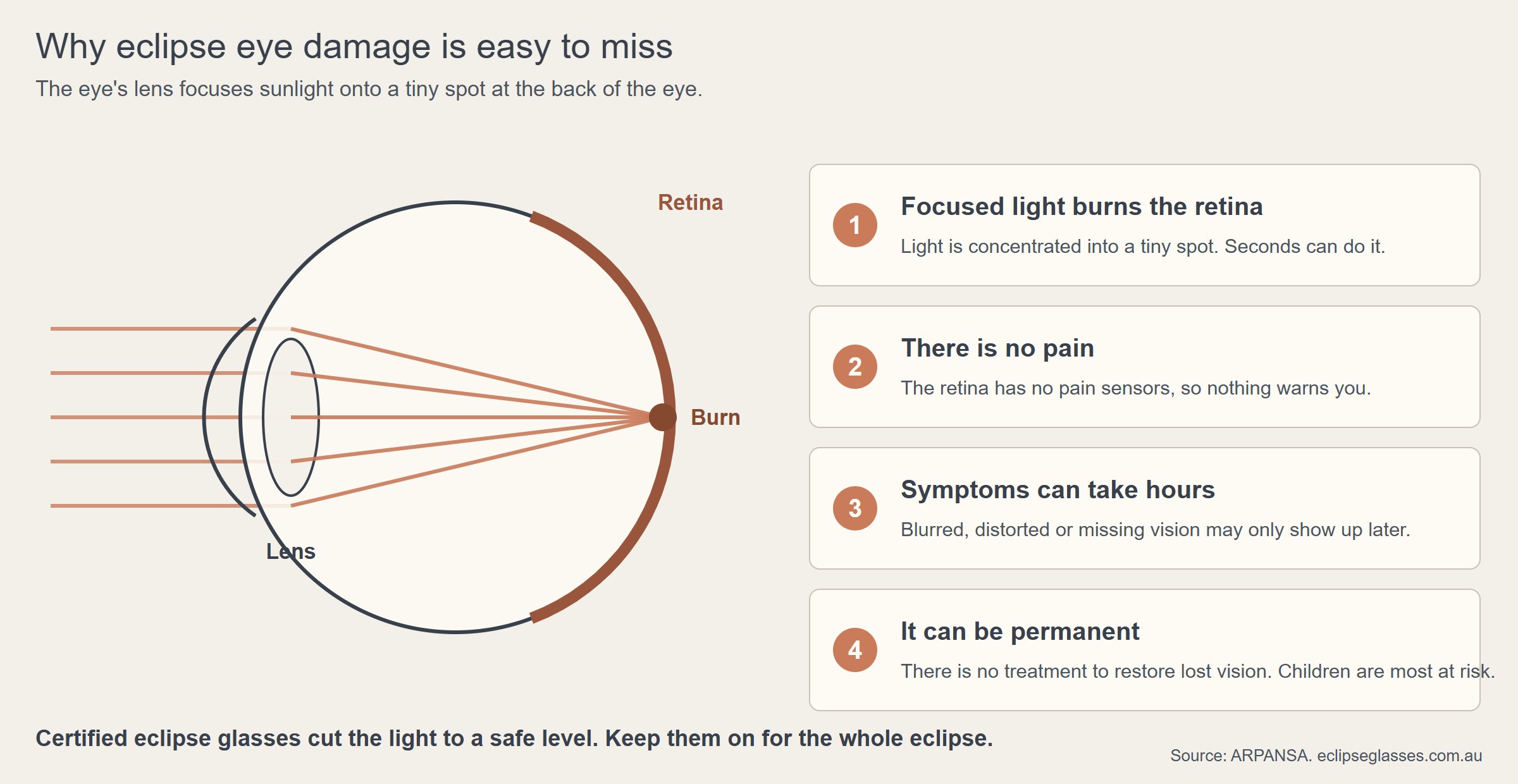
The lens of your eye focuses light onto the retina, the layer at the back of the eye that does the seeing. Concentrated sunlight burns it. Doctors call this solar retinopathy. According to ARPANSA:
- It takes seconds. The time varies between people, but in every case it is a matter of seconds.
- It does not hurt. The retina has no sensitivity to pain, so nothing tells you it is happening.
- Symptoms can take hours. Loss of vision, distorted vision or altered colour vision may not appear straight away.
- It can be permanent. There is no treatment to restore lost vision, although vision may improve over time.
Children are especially at risk: young eyes let more light through to the retina than adult eyes.
Why sunglasses do not work
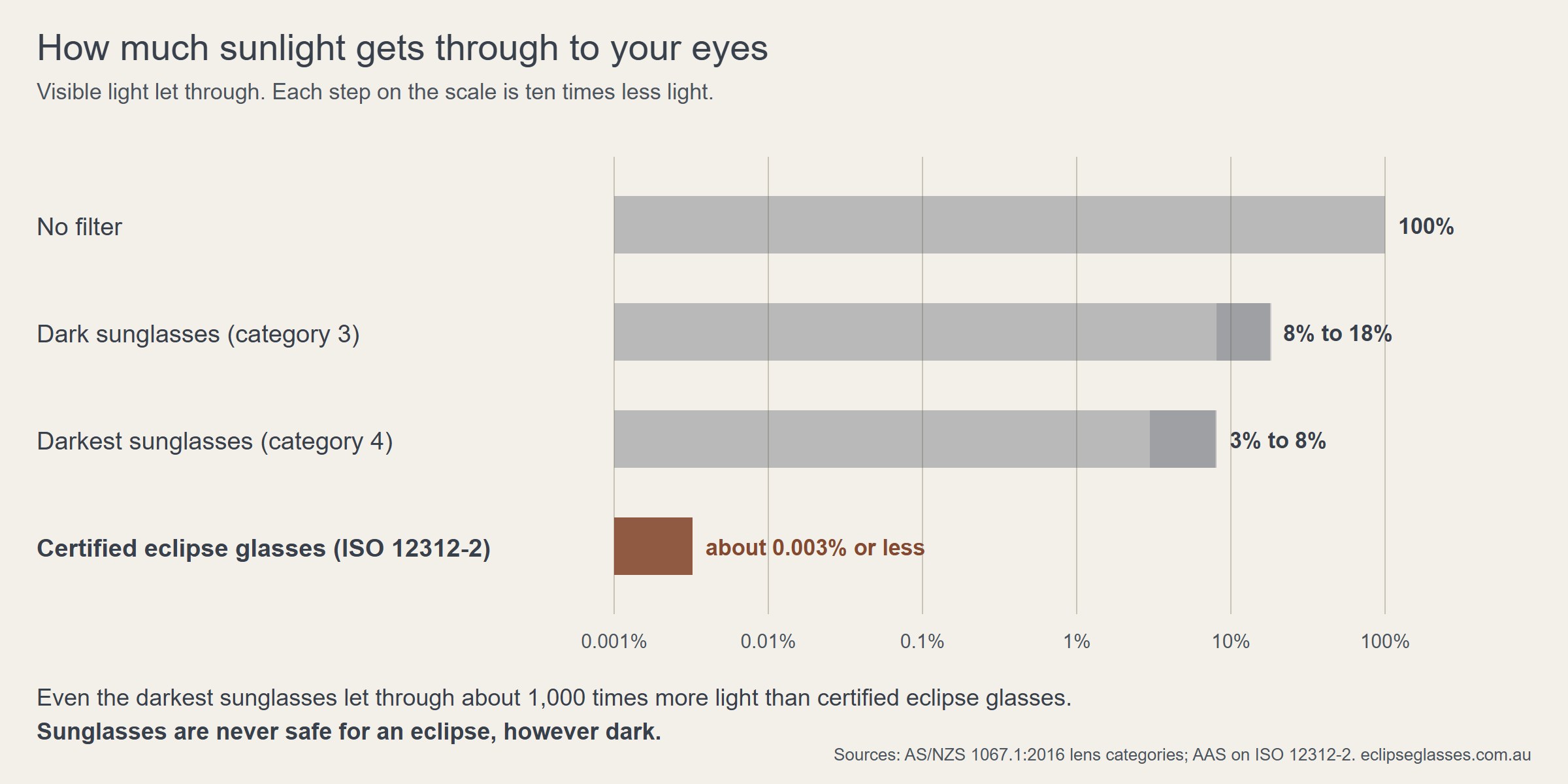
Sunglasses are made for glare, not for an eclipse. Even the darkest category 4 lenses let through 3% to 8% of visible light. Certified eclipse glasses let through about 0.003% or less, around a thousand times less. Stacking sunglasses does not close the gap, and neither does smoked glass, X-ray film or a CD.
Our guide to eclipse shades vs eclipse glasses covers the names, welding glass and sunglass categories in more detail.
What eclipse glasses do
Eclipse glasses use a solar filter tested to ISO 12312-2:2015, the international standard for filters for direct observation of the Sun. It limits visible, ultraviolet and infrared light to safe levels. ARPANSA says glasses that meet it can allow safe viewing, as long as they are in good condition, fit properly and are used correctly.
Before you buy, check the pair:
- The standard: ISO 12312-2 printed on the product.
- The maker: the manufacturer's name and address.
- The source: a maker on the American Astronomical Society's list of reputable vendors, or its authorised dealer.
- The condition: no scratches, creases, tears or pinholes. Check before every use, and throw out a damaged pair.
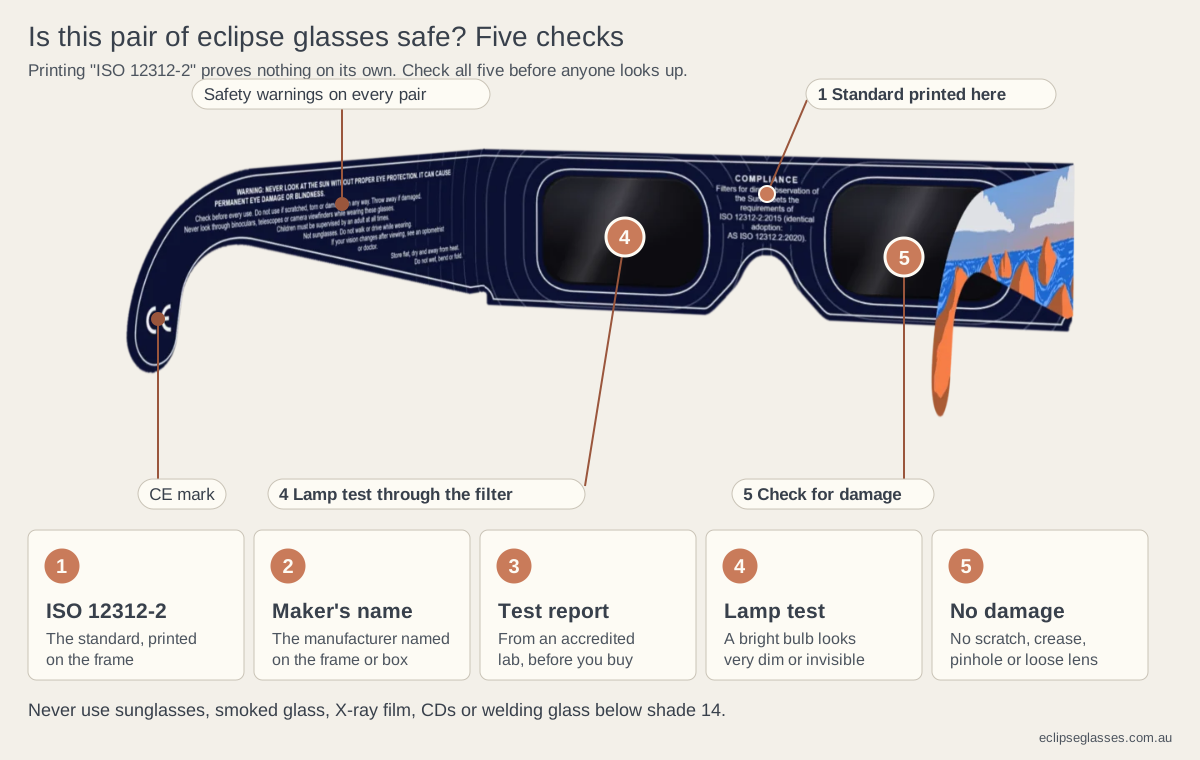
Printing "ISO 12312-2" on a frame proves nothing on its own. Our guide to where to buy eclipse glasses in Australia explains each check.
Do you need them during totality?
Yes. ARPANSA advises never to observe a total, partial or annular eclipse with the naked eye, so certified glasses stay on for the whole eclipse, totality included. Keeping them on from start to finish also keeps things simple, which matters most with children.
Other safe ways to watch
ARPANSA says the safest ways are indirect:
- Pinhole projection. Stand with your back to the Sun. Make a hole about 1 mm wide in a card and let it cast an image onto a white card about 1 m away. You watch the image of the eclipse on the white card.
- A live stream on TV or online.
Never use eclipse glasses with cameras, binoculars or telescopes. They concentrate the light far beyond what the glasses can block. Optics need their own specialist solar filter fitted to the front.
Children and groups
Supervise children very closely, and check every pair before it goes on. For a school, the eclipse safety plan for schools sets out the steps. When the next eclipse is in your city, see every solar eclipse in Australia to 2040.
Certified, lab-tested eclipse glasses from NSW stock, A$5.45 a pair including GST.
Shop eclipse glassesFAQ
Why do you need special glasses for a solar eclipse?
Because the part of the Sun the Moon leaves uncovered can burn your retina in seconds. Certified ISO 12312-2 eclipse glasses cut visible, ultraviolet and infrared light to safe levels.
What happens if you watch an eclipse without eclipse glasses?
You can get retinal burns, called solar retinopathy. There is no pain, symptoms can take hours to appear, and the damage can be permanent. There is no treatment to restore lost vision.
Does eclipse eye damage hurt?
No. The retina has no sensitivity to pain, so there is no warning that an injury has happened.
Can you use sunglasses for an eclipse?
No. Even the darkest sunglasses let through about a thousand times more light than certified eclipse glasses. Never look at the Sun through sunglasses, however dark.
Do you need eclipse glasses during a partial eclipse?
Yes. A partial eclipse is never safe without protection, however much of the Sun is covered. Keep certified glasses on for the whole eclipse.
Do children need eclipse glasses?
Yes, and they need close supervision. Young eyes let more light through to the retina than adult eyes, so children are especially at risk.
Can you watch an eclipse without glasses at all?
Only indirectly: with a pinhole projector, facing away from the Sun, or on a live stream. Never use cameras, binoculars or telescopes without a specialist solar filter on the front.
Sources
All checked 11.11.2026.
- ARPANSA (Australian Radiation Protection and Nuclear Safety Agency), Solar eclipse.
- NASA, Eclipse safety.
- American Astronomical Society, Solar eclipse eye safety and the ISO 12312-2 standard.
- ISO, ISO 12312-2:2015, Eye and face protection: filters for direct observation of the sun.
- AS/NZS 1067.1:2016, Eye and face protection: sunglasses and fashion spectacles (lens categories).
Aura Sight glasses for everyone watching
ISO 12312-2 certified and lab-tested, with a QR batch certificate on every pair. The family kit has four pairs and a printed viewing guide.