The short version. Eclipse shades and eclipse glasses are the same product if they meet ISO 12312-2. Sunglasses, even very dark ones, are not eclipse shades. Check the ISO 12312-2 mark, the maker's name and address, and the condition of the filter, and keep them on for the whole eclipse.
Same thing, different names
In Australia "shades" is everyday slang for sunglasses, so some brands sell "eclipse shades" or "solar shades". In the United States "eclipse glasses" is the usual term, and astronomers say "solar viewers". Even ARPANSA, Australia's radiation safety agency, files its advice under "eclipse sunglasses". Eclipse Shades® is also a brand: Rainbow Symphony's, who make our glasses.
The name does not matter; the standard does. ISO 12312-2:2015 limits how much visible, ultraviolet and infrared light a filter lets through. A pair that passes is safe under any name. A pair that has never been tested is not safe under any name. As the Australian Space Agency warns, "it is not safe to directly look at the sun ... without using proper eye protection".
Sunglasses are not eclipse shades
This is where the word causes harm. Sunglasses are made for everyday glare, not for an eclipse. The gap is enormous:
| What it is | Visible light let through | Safe for the eclipse? |
|---|---|---|
| Certified eclipse glasses or eclipse shades (ISO 12312-2) | About 0.003% or less | Yes, for the whole eclipse |
| Dark sunglasses (category 3) | 8% to 18% | Never |
| The darkest sunglasses (category 4) | 3% to 8% | Never |
| Welding glass below shade 14 | Far too much | Never |
NASA puts it plainly: eclipse glasses are not regular sunglasses, and safe solar viewers are "thousands of times darker". Even category 4 sunglasses let through about a thousand times more light than a certified filter, and stacking pairs does not close the gap. ARPANSA warns that eclipse damage to the eyes can be permanent, with no treatment to restore lost vision.
What "shade" means on welding glass
Welding filters are rated by shade number: the higher the number, the darker the filter. Use only shade 14 or darker. That is the level the American Academy of Ophthalmology calls safe for an eclipse; astronomers set the bare minimum at shade 12, and we recommend the extra margin. Most welding lenses and helmets are lighter than shade 14. If you cannot confirm the number, do not use it. Certified eclipse glasses are cheaper, lighter and easier for children to wear.
What the safety authorities say
Four bodies set the advice we follow. They agree on the essentials:
Where the advice differs, we follow the most cautious version: glasses stay on for the whole eclipse.
Paper frames and plastic frames
Some sellers say "shades" for plastic frames that look like sunglasses and "glasses" for the flat paper kind. The filter standard is the same. The differences are practical:
- Paper frames: light, cheap and easy to buy in bulk for a school or event. They fit over most prescription glasses.
- Plastic frames: sturdier and more comfortable for long sessions, and they cost more. Some do not fit over prescription glasses.
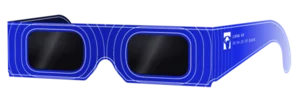
Never use either with a camera, binoculars or a telescope: the concentrated light burns through the filter and into your eye. Our glasses are made by Rainbow Symphony, a manufacturer on the American Astronomical Society's reputable vendors list. They are paper framed and tested to ISO 12312-2:2015 by an accredited laboratory, with a QR code on every pair that opens its batch certificate. See how our glasses are certified.
How to check any pair, whatever it is called
- The standard: ISO 12312-2 printed on the product.
- The maker: the manufacturer's name and address, not just a brand logo.
- The source: a known manufacturer or its authorised dealer.
- The test report: from an accredited laboratory, available before you buy.
- The condition: no scratches, creases, tears or pinholes. Check before every use.

Printing "ISO 12312-2" on a frame proves nothing on its own; counterfeit glasses did exactly that before recent eclipses overseas. Our guide to where to buy eclipse glasses in Australia covers each check in detail.
Certified, lab-tested eclipse glasses from NSW stock, A$5.45 a pair including GST.
Shop eclipse glassesFAQ
Are eclipse shades the same as eclipse glasses?
Yes, if both meet ISO 12312-2. The name is marketing; the certified filter and the test report are what make a pair safe.
Are solar shades safe for the eclipse?
Yes, if they meet ISO 12312-2 and come from a maker you can identify. Solar shades, eclipse shades and eclipse glasses are names for the same certified filter. Never use sunglasses sold as shades.
Can I use sunglasses for the eclipse?
No. Even the darkest sunglasses let through about a thousand times more light than certified eclipse glasses. Never look at the Sun through sunglasses, however dark.
Is welding glass safe for the eclipse?
Only shade 14 or darker, the level eye doctors recommend. Most welding lenses are lighter than that, so if you cannot confirm the shade number, do not use it.
What do Australian health authorities recommend?
ARPANSA says the safest way to watch is indirect, such as pinhole projection or a live stream, and that eclipse glasses meeting ISO 12312-2 can allow safe viewing. Supervise children closely either way.
Are plastic eclipse shades safer than paper eclipse glasses?
No. Both are equally safe if they meet ISO 12312-2. Plastic frames are sturdier; paper frames are cheaper and fit over most prescription glasses.
Can I wear eclipse glasses over my prescription glasses?
Yes. Put your normal glasses on first and the eclipse glasses over the top, and make sure no sunlight gets in around the edges.
Sources
All checked 08.11.2026. We recheck every six months and whenever an authority updates its advice.
- ARPANSA (Australian Radiation Protection and Nuclear Safety Agency), Solar eclipse.
- Astronomical Society of Australia, How to view a solar eclipse.
- Australian Space Agency, Rare solar eclipse: everything you need to know (2023).
- NASA, Eclipse safety.
- American Academy of Ophthalmology, Is a welder's helmet safe for viewing a solar eclipse?
- American Astronomical Society, Solar eclipse eye safety and Reputable vendors of solar viewers and filters.
- ISO, ISO 12312-2:2015, Eye and face protection: filters for direct observation of the sun.
- AS/NZS 1067.1:2016, Eye and face protection: sunglasses and fashion spectacles (lens categories).
Glasses for everyone watching, from NSW stock
ISO 12312-2 certified and lab-tested, with a QR batch certificate on every pair. The family kit has four pairs and a printed viewing guide.

