
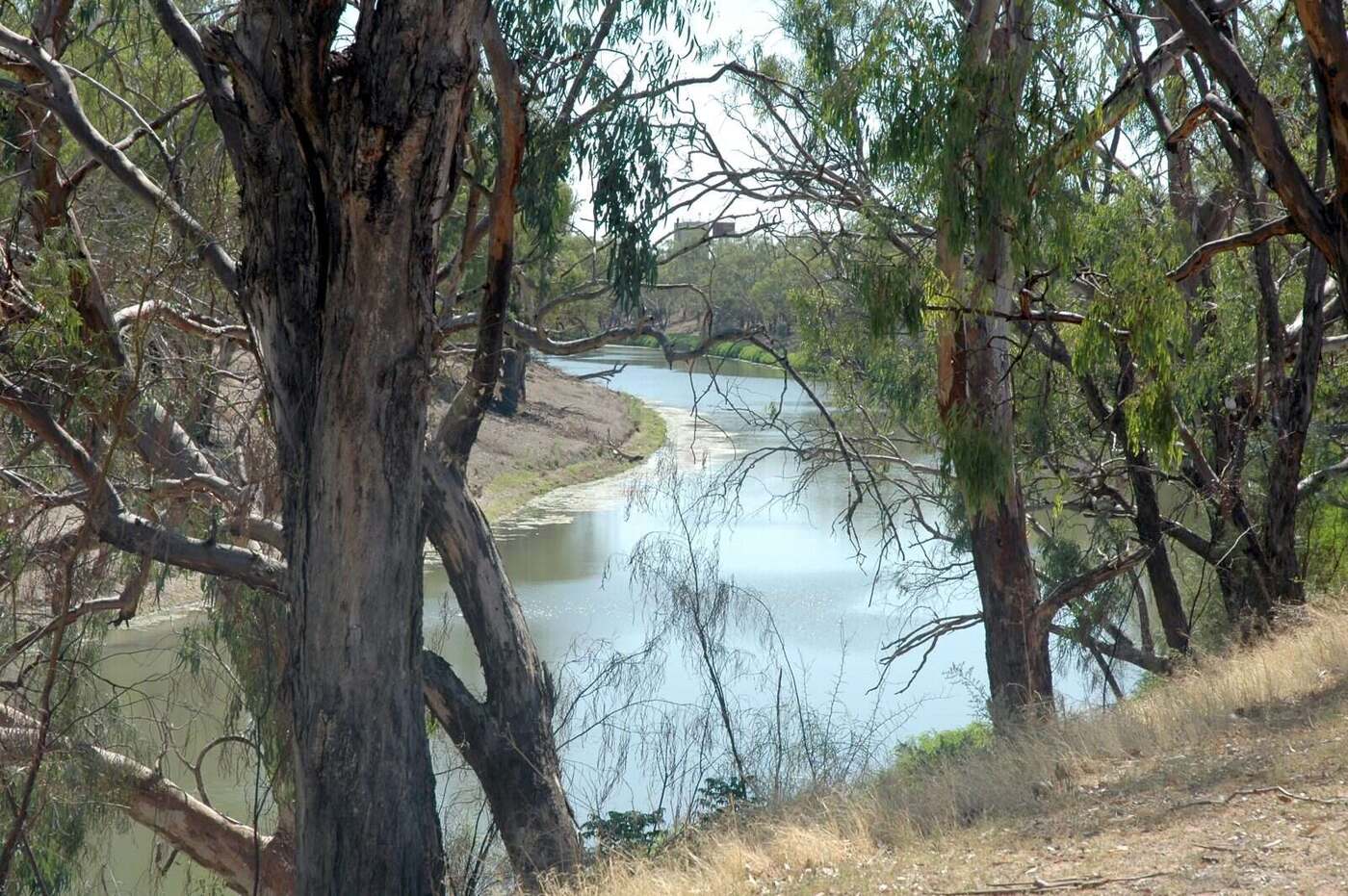
Sydney CBD (Town Hall) · Sat 22 July 2028
3m 48s
of totality
1:59:37 pm to 2:03:26 pm AEST
The afternoon, drawn to scale · 2 h 34 min from start to finish
Where the path runs
The path of totality is about 188 km wide across NSW. Inside it: Bourke, Nyngan, Gilgandra, Dubbo, Wellington, Mudgee, Orange, Bathurst, Lithgow, the Blue Mountains, all of Greater Sydney, the Central Coast and Wollongong. Just outside: Newcastle, Maitland, Cessnock, Singleton, Muswellbrook and Scone to the north, and Canberra, Goulburn, Bowral and Nowra to the south. If you're near an edge, a short drive towards the centre line can add a minute or more of totality.
Which NSW town suits you
Pick by what you want from the day. For the longest totality and the best odds of clear skies, go far west to Bourke: just over four minutes and around 17 clear days in a typical July. For a big town with motels, an airport and near-maximum duration, choose Dubbo or Mudgee. For the classic city shot, Sydney Harbour. For drama, the Blue Mountains, but pack for cold and cloud.
If you live near either edge, a short drive towards the centre line makes a big difference. In Orange, heading 30 minutes north-east to Ophir adds almost a minute. In the Hunter, a 15 to 40 minute drive south-west from Cessnock or Singleton takes you into totality.
Getting around on eclipse day
Three corridors will carry most of the traffic: the Great Western Highway to the Blue Mountains and Bathurst, the M1 from Newcastle to the Central Coast, and the Newell Highway through Dubbo. Plan to be at your spot by late morning. The eclipse starts around 12:30 pm, and roads tend to jam in the last hour before an eclipse as people make late decisions.
Accommodation in the path towns will sell out well ahead, as it did in Exmouth for the 2023 eclipse. If you can't get a bed, stay just outside and drive in early, or stay home: almost everyone in Greater Sydney can see totality from their own suburb.
What makes a good viewing spot
Everywhere in NSW the eclipsed Sun is in the north-north-west, about 28 to 35° up. A good spot has nothing tall close by in that direction: open water, a sports oval, a lookout or a paddock. You don't need a sea view or a mountain top. Check your sightline at 2 pm on any clear winter afternoon. If you can see the Sun from there, you'll see the eclipse.
What you'll see in NSW, minute by minute
Times are AEST for Sydney CBD (Town Hall).
- 12:40:46 pmfirst contact in Sydney. Bourke saw the first notch on the Sun's right-hand edge at about 12:27 pm, and now it reaches the coast. Glasses on.
- About 1:29 pmthe Sun is about 52% covered over Sydney. Out west the eclipse is further along. In every town on the path the light goes flat with a faint metallic tint, and patches of sunlight under trees become small crescents.
- About 1:44 pmabout 76% covered. The winter afternoon starts to feel like early evening and the air cools. Birds may go quiet, in Sydney parks and on western farms alike.
- About 1:54 pmabout 93% covered. Around now Bourke's totality, which began at 1:50:15 pm, is ending and Dubbo's is about to start at 1:55:27 pm. In Sydney, watch the north-west darken as the shadow moves towards the coast at more than 4,000 km/h.
- 1:59:37 pmSydney's diamond ring, then totality, once the shadow has crossed the state from Bourke. Glasses stay on. The sky goes dark and the low sky all round turns sunset colours.
- 2:03:26 pmsunlight returns as a second diamond ring on the opposite edge, and Sydney's totality ends as the shadow heads out over the Pacific. Glasses stay on.
- 3:14:43 pmlast contact on the coast. Inland towns finished earlier, from around 3:09 pm.
When to look
Times run west to east. The eclipse starts between about 12:27 pm (Bourke) and 12:41 pm (the coast). Totality falls between 1:50 pm and 2:01 pm, and the eclipse phases end around 3:09 to 3:15 pm. Everywhere in NSW the Sun is in the north-north-west, about 28 to 35° above the horizon, so you need a clear sightline to the NNW, not an ocean view.
Best odds of clear skies
Head west if you can. Bourke averages 17.5 clear days in July against Sydney's 12 and the Central Tablelands' 6 to 7. Orange and Bathurst are the cloudiest towns in the path in winter. Have a plan B, and watch the forecast models from about five days out.
Crowds and planning
Expect New Year's Eve-scale crowds on the Harbour foreshore, gridlock on the Great Western Highway, and accommodation in Dubbo, Mudgee, Bathurst and Bourke booked out well ahead. It's a Saturday afternoon in winter, so pack warm layers, food and water, and get to your spot by late morning.
Where to watch in NSW
Bourke and Mount Oxley
Outback town / mesa lookout · Bourke Shire
The best odds of clear skies in the state, plus the longest totality, and you can watch the Moon's shadow race in across a horizon with nothing on it.
Sightline. Flat outback horizon in every direction; the Sun is 35° up in the NNW. Mount Oxley (on Rossmore Station, by arrangement) rises above the plain for a 360° view of the approaching shadow.
Getting there. Bourke is about 8 to 9 h drive from Sydney, or fly to Bourke/Cobar. Mount Oxley is on private land (Rossmore Station). Book access and camping through the property. Facilities. Town motels, caravan parks and station stays. Very limited supply: book well ahead.
Heads up. Remote area: carry water and fuel. Mount Oxley is private, so don't go without permission.
Dubbo (Taronga Western Plains Zoo, city parks)
Regional city · Dubbo Regional
The longest totality of any large NSW town, with more clear July days than the tablelands and plenty of open space.
Sightline. Flat Macquarie River plains; the Sun is 32° up in the NNW with nothing on the horizon.
Getting there. About 5 h from Sydney via the Great Western and Mitchell highways, or fly or train (NSW TrainLink XPT). Facilities. Full city services.
Heads up. Accommodation will sell out years ahead, so check camping or day-trip options.
Mudgee
Wine-country town · Mid-Western Regional
Near-maximum duration within about 3.5 h of Sydney, on the drier western side of the Divide.
Sightline. Open valley farmland; the Sun is 31° up in the NNW above the low hills.
Getting there. About 3.5 to 4 h from Sydney via the Bells Line of Road or Great Western Hwy and the Castlereagh Hwy. Facilities. Town services, vineyards, showground.
Heads up. Winter frost and morning fog are common but usually clear by midday.
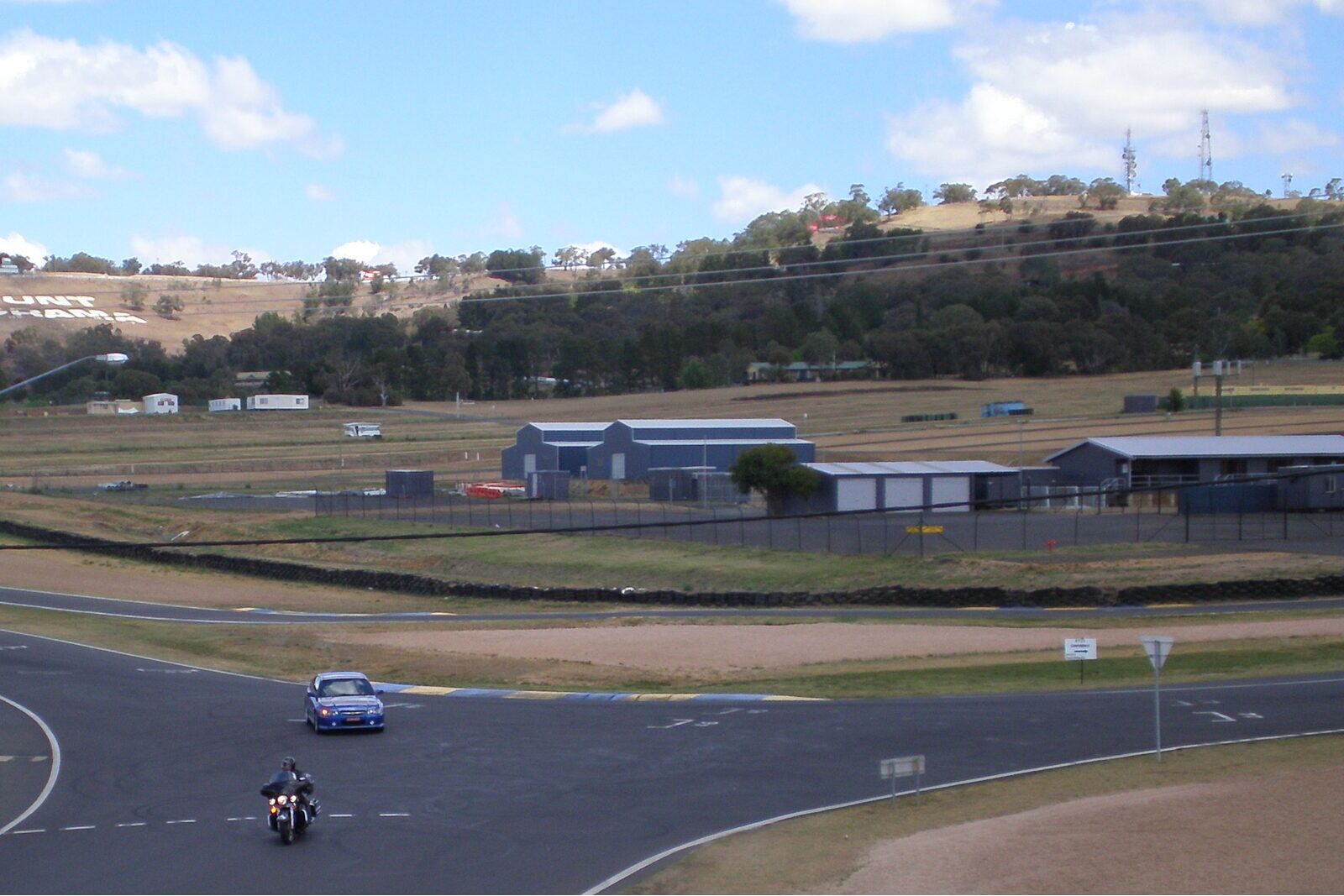
Bathurst, Mount Panorama
Race circuit / hill · Bathurst Regional
An iconic, elevated public site with huge capacity, in a city already organising a weekend program around the eclipse.
Sightline. Elevated hillside above the city with wide views north-west across the Macquarie valley; the Sun is 30° up in the NNW.
Getting there. About 3 h from Sydney via the Great Western Hwy. The circuit road is a public road outside race events. Facilities. Circuit facilities vary by day. Expect council-run infrastructure if it becomes an official site.
Heads up. About 2 min 54 s here; the city centre gets about 3 min 01 s. Tableland winters are cloudier (6.6 clear July days).
Sydney Harbour, Mrs Macquaries Point
Harbour foreshore · City of Sydney
The world's postcard shot of this eclipse: corona above the Bridge and Opera House, with near-maximum totality.
Sightline. Looks NW across Farm Cove to the Opera House and Harbour Bridge. The eclipsed Sun hangs 29° up, just right of the Bridge over Kirribilli.
Getting there. 15 to 20 min walk from Circular Quay, St James or Martin Place. Facilities. Toilets in the Royal Botanic Garden; event facilities if officially activated.
Heads up. Likely to close when full. Have a backup in the Botanic Garden or the Domain.
Eclipse times around NSW
Length of totality
| Place | Totality begins | Totality | Coverage |
|---|---|---|---|
| Bourke | 1:50:15 pm | 4m 05s | 100% |
| Brewarrina | 1:52:02 pm | 3m 26s | 100% |
| Nyngan | 1:53:19 pm | 3m 17s | 100% |
| Gilgandra | 1:55:21 pm | 3m 51s | 100% |
| Dubbo | 1:55:27 pm | 3m 50s | 100% |
| Wellington | 1:56:05 pm | 3m 46s | 100% |
| Mudgee | 1:56:59 pm | 3m 54s | 100% |
| Coonamble | 1:55:12 pm | 2m 47s | 100% |
| Siding Spring Observatory (Coonabarabran) | 1:56:51 pm | 1m 48s | 100% |
| Orange | 1:57:18 pm | 2m 14s | 100% |
| Bathurst | 1:57:38 pm | 3m 01s | 100% |
| Lithgow | 1:58:09 pm | 3m 41s | 100% |
| Katoomba | 1:58:31 pm | 3m 29s | 100% |
| Penrith | 1:58:54 pm | 3m 46s | 100% |
| Parramatta | 1:59:19 pm | 3m 49s | 100% |
| Sydney CBD | 1:59:37 pm | 3m 48s | 100% |
| Gosford | 1:59:59 pm | 3m 16s | 100% |
| Wollongong | 1:59:45 pm | 2m 53s | 100% |
| Kiama | 2:00:20 pm | 1m 42s | 100% |
Times AEST, computed from JPL DE421 lunar ephemeris and cross-checked against NASA/Espenak Besselian elements. For places close to an edge, such as Kiama and Siding Spring Observatory, the real duration can differ by 10 s or more.
Weather odds and crowds
A typical July · Bourke Post Office, BOM 048013
Cloud odds fall steadily as you go inland and north-west. July clear days: Bourke 17.5, Dubbo 11.5, Sydney 12.0, Mudgee 9.4, Katoomba 8.0, Orange 7.0, Bathurst 6.6 (BOM). Eclipsophile (Jay Anderson) rates prospects 'excellent to very good' west of the Great Dividing Range and 'fair to middling' on the Blue Mountains and coast. On the coast a westerly day (air sinking off the Divide) is usually the clearest. (Mean 3 pm temperature in July: 17°C.)
This is the most-populated total eclipse path in Australian history. Almost all of Greater Sydney (5.2 million people) is inside it, so most people will watch from home, school ovals and local parks. The big pressure points will be the Harbour foreshore, the Blue Mountains lookouts on a single highway, and inland centres with good weather odds. For comparison, Exmouth (WA, population about 2,800) drew about 20,000 visitors for 2023's 1-minute eclipse, and Bourke and Dubbo offer four times that duration.
Eye safety
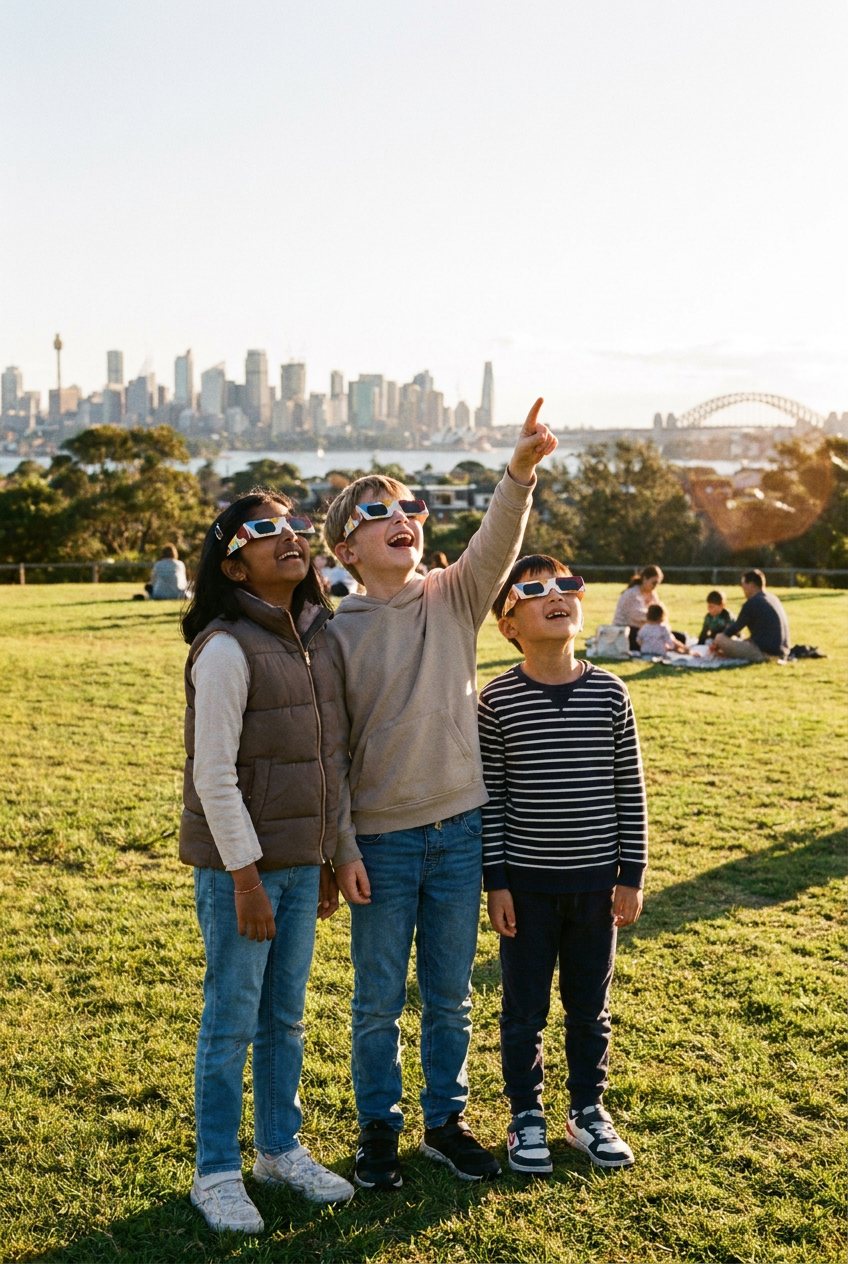
The same rule applies from Bourke to Wollongong: ISO 12312-2 certified eclipse glasses stay on for every second of the eclipse, from first contact to last contact, including totality inside the path. In Newcastle, Tamworth, Broken Hill and other places outside the path there is no totality, and glasses stay on the whole time too. Sunglasses, smoked glass and homemade filters do not protect your eyes, and cameras, binoculars and telescopes need a proper solar filter on the front.
Every pair is ISO 12312-2 certified and tested by an independent lab. You can check the test certificate online.
Buy eclipse glassesFor schools, councils and businesses in NSW
Because 22 July 2028 is a Saturday, NSW schools from Bourke to Wollongong will need to hand out glasses and teach eclipse safety on Friday 21 July 2028 or earlier. Schools just outside the path, in Newcastle, Tamworth or Broken Hill, need them just as much, because the eclipse is never safe to look at. Councils planning events at sites such as Mount Panorama or the Harbour foreshore, along with clubs, venues and accommodation hosts in towns like Dubbo, Mudgee and Bourke, should plan on one certified pair per person. With 8.07 million people in the area this guide covers, stock will run short in the final weeks. For larger orders we have bulk cartons, fundraising boxes of 20 to 250 pairs for schools and clubs, and custom-branded glasses from 500 units, with an artwork proof before anything is printed.
FAQ
Is Sydney in the path of totality?
Yes. Sydney is almost on the centre line. Totality in the CBD runs from 1:59:37 pm to 2:03:26 pm (3 min 48 s).
Where in NSW is totality longest?
Around Bourke (4 min 05 s). Of the larger centres, Mudgee and Dubbo get about 3 min 50 s.
Is Newcastle in the path?
No. Newcastle is about 24 km outside the northern edge and gets 99.7% of the Sun covered. Drive 40 to 60 minutes south to Lake Macquarie's southern shores or the Central Coast for totality.
Is Canberra in the path?
Canberra sits outside the path, with about 96% of the Sun covered. The southern edge runs through Bowral, so drive on to Picton or the Illawarra (Wollongong gets about 2 min 53 s).
More eclipse guides nearby
- Sydney eclipse guide
- Dubbo eclipse guide
- Blue Mountains eclipse guide
- Central Coast eclipse guide
- Orange eclipse guide
- Newcastle eclipse guide
- 2028 eclipse times across Australia
- Interactive eclipse map