
The afternoon, drawn to scale · 2 h 35 min from start to finish
Blue Mountains eclipse times (AEST)
Totality begins between about 1:58:20 pm (Mount Victoria) and 1:58:50 pm (Glenbrook). See the town table for each village.
Dress for 1,000 metres in July
The upper mountains average a 3 pm temperature of only about 8°C in July, and it gets colder during totality. Bring a warm jacket, beanie, gloves and something to sit on. Lookouts are exposed to wind, so a thermos is a good idea for the two-and-a-half-hour show.
Upper or lower mountains?
Totality is longest along the Bells Line of Road (Mount Tomah and Bilpin, about 3 min 47 to 50 s) and shortest around Katoomba and Leura (about 3 min 29 to 32 s). The lower mountains are warmer and less likely to be in cloud. Glenbrook, Springwood and Faulconbridge all get about 3 min 41 to 44 s.
Traffic and transport
The Great Western Highway is the only main road through the mountains and will be very busy. Take the Blue Mountains Line train if you can: Katoomba, Leura, Wentworth Falls and Blackheath stations are all within walking distance or a short bus ride of a lookout. If you drive, arrive by late morning and expect to wait to get out afterwards.
What you'll see in Blue Mountains, minute by minute
Times are AEST for Katoomba Echo Point. Lower down, Glenbrook goes into totality 19 s later.
- 12:39:00 pmfirst contact. Wherever you are on the ridge, from Glenbrook to Mount Victoria, a small bite now shows on the right-hand edge of the Sun through your glasses. Glasses on.
- About 1:28 pmthe Sun is about 53% covered. The blue haze over the valleys takes on a flat, slightly metallic look, and sunlight coming through gum leaves makes small crescents on the ground.
- About 1:43 pmabout 77% covered. At 1,000 m the air was cold to begin with, and now it gets colder. The light feels like late afternoon, and birds in the bush around the lookouts may stop calling.
- About 1:53 pmabout 93% covered. Look north-west along the range towards Mount Victoria and Lithgow. That sky goes dark first, as the Moon's shadow arrives at more than 4,000 km/h.
- 1:58:31 pmthe diamond ring flashes and totality starts at Echo Point. Glasses stay on. The sky goes dark, and out over the valleys the horizon glows like sunset on every side.
- 2:02:00 pma second diamond ring flashes on the opposite edge, and daylight starts to come back into the valleys. Glasses stay on.
- 3:13:58 pmlast contact at Echo Point. The Moon moves clear of the Sun and the eclipse over the mountains is over.
Where to look
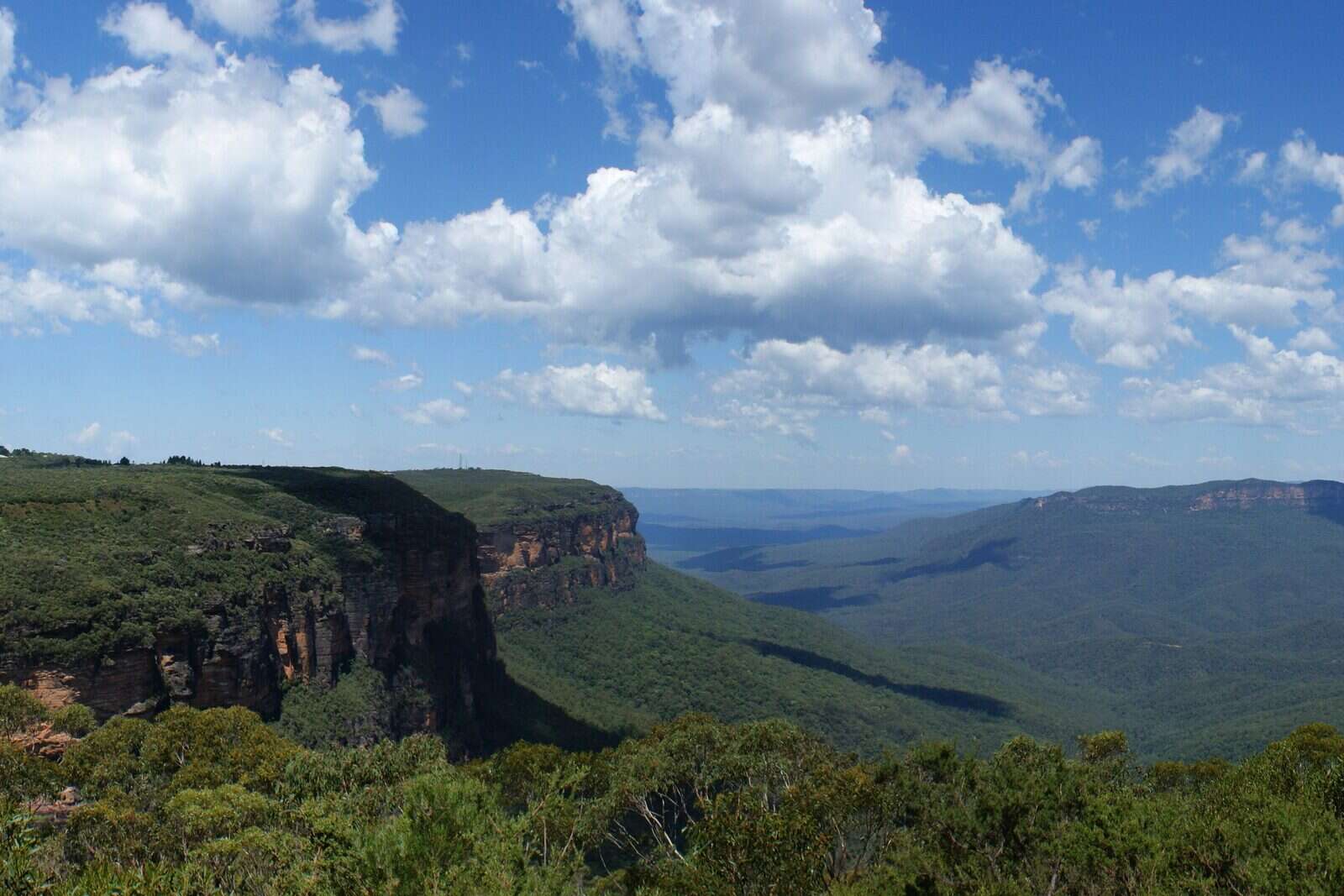
Most of the famous lookouts, Echo Point and Govetts Leap among them, face south or east, but the totality Sun is in the north-north-west: about 30° up, on a bearing of 329° true. So at those lookouts you turn to your left or behind you. That works, because the sky above the plateau is open. Mount Blackheath Lookout is the exception, facing west to north-west over the Kanimbla Valley with the Sun up and to your right. Wherever you stand, the thing to watch is close trees. Something on your NNW side blocks the Sun if you are nearer to it than about 1.8 times its height, so give a 10 m tree at least 18 m, and a 20-storey (60 m) building at least 110 m.
Sun at mountain totality · North-north-west, 30° up, above the plateau rather than the valleys
The path near Blue Mountains · numbers match the spots below
On the lawns at Mount Tomah or around Wentworth Falls Lake, trees are the main risk. Anything on your NNW side blocks the Sun if it's closer than about 1.8× its own height: stand 18 m back from a 10 m tree, and 110 m from a 20-storey tower.
Weather and traffic
Mountain cloud is the biggest risk, with about 8 clear July days in Katoomba. Check the forecast; if it's grim, Penrith and the Hawkesbury are 45 to 60 minutes down the hill and often clearer. Take the train (Blue Mountains Line) rather than drive.
How long totality lasts around the Blue Mountains
Length of totality
| Place | Totality begins | Totality | Coverage |
|---|---|---|---|
| Glenbrook | 1:58:50 pm | 3m 43s | 100% |
| Springwood | 1:58:44 pm | 3m 44s | 100% |
| Faulconbridge | 1:58:42 pm | 3m 43s | 100% |
| Lawson | 1:58:37 pm | 3m 37s | 100% |
| Hazelbrook | 1:58:38 pm | 3m 38s | 100% |
| Wentworth Falls | 1:58:34 pm | 3m 35s | 100% |
| Leura | 1:58:31 pm | 3m 32s | 100% |
| Katoomba | 1:58:31 pm | 3m 29s | 100% |
| Blackheath | 1:58:24 pm | 3m 36s | 100% |
| Mount Victoria | 1:58:20 pm | 3m 38s | 100% |
| Mount Tomah | 1:58:29 pm | 3m 47s | 100% |
| Bilpin | 1:58:35 pm | 3m 50s | 100% |
| Lithgow | 1:58:09 pm | 3m 41s | 100% |
Times AEST, computed from JPL DE421 lunar ephemeris and cross-checked against NASA/Espenak Besselian elements. Every town in this table is well inside the path. It is only close to the path edges that durations become sensitive and can shift by 10 s or more.
Where to watch in Blue Mountains
Blue Mountains Botanic Garden, Mount Tomah
Botanic garden at 1,000 m · Blue Mountains (Bells Line of Road)
The best combination of duration, elevation, facilities and space in the mountains.
Sightline. High open lawns on a basalt summit with views of 100 km or more. Choose a lawn without tall trees close on the NNW side.
Getting there. Bells Line of Road, Mount Tomah. Facilities. Visitor centre, cafe, toilets, parking
Heads up. Car park capacity. Expect closures when full.
Govetts Leap Lookout (Blackheath)
Cliff-top lookout · Blue Mountains (Blackheath)
Dramatic valley scenery, with about 9 s more totality than Echo Point.
Sightline. The lookout faces east into the Grose Valley, so the Sun (NNW, 30° up) is to your left over low heath, with open sky. You watch the valley light collapse as the shadow arrives.
Getting there. End of Govetts Leap Rd, Blackheath; 30 min walk from Blackheath station. Facilities. Toilets, NPWS info
Heads up. Cold and windy. Stay behind barriers.
Mount Blackheath Lookout
Cliff-top lookout / hang-gliding launch · Blue Mountains (Blackheath)
Wide valley views in the Sun's general direction and fewer crowds than the Grose-side lookouts.
Sightline. Faces west to north-west over the Kanimbla Valley. The Sun is up and to the right, above open farmland, with no ridges anywhere near its height.
Getting there. Via Shipley Rd and Mount Blackheath Rd, 15 min from Blackheath; the last 4 km is unsealed but suitable for 2WD. Facilities. Toilets, picnic area
Heads up. Unsealed road; slow in heavy traffic.
Wentworth Falls Lake
Lakeside park · Blue Mountains (Wentworth Falls)
Easy, flat and family-friendly, off the highway.
Sightline. Open lawns around the water. Choose the bank with no pines on your NNW side.
Getting there. Sinclair Cres, Wentworth Falls; 15 min walk from the station. Facilities. Toilets, BBQs, playground
Euroka Clearing (Glenbrook, Blue Mountains NP)
Grassy clearing in national park · Blue Mountains (Glenbrook)
Lower, milder and closer to Sydney, with wildlife reacting to the sudden dusk.
Sightline. A large open grassy clearing. The tree line is far enough away at a 29° Sun height if you stand mid-clearing.
Getting there. Via the Glenbrook park entry (vehicle fee and gate hours apply). Facilities. Toilets, campground
Heads up. Park gates may close when full.
Glasses on, the whole time
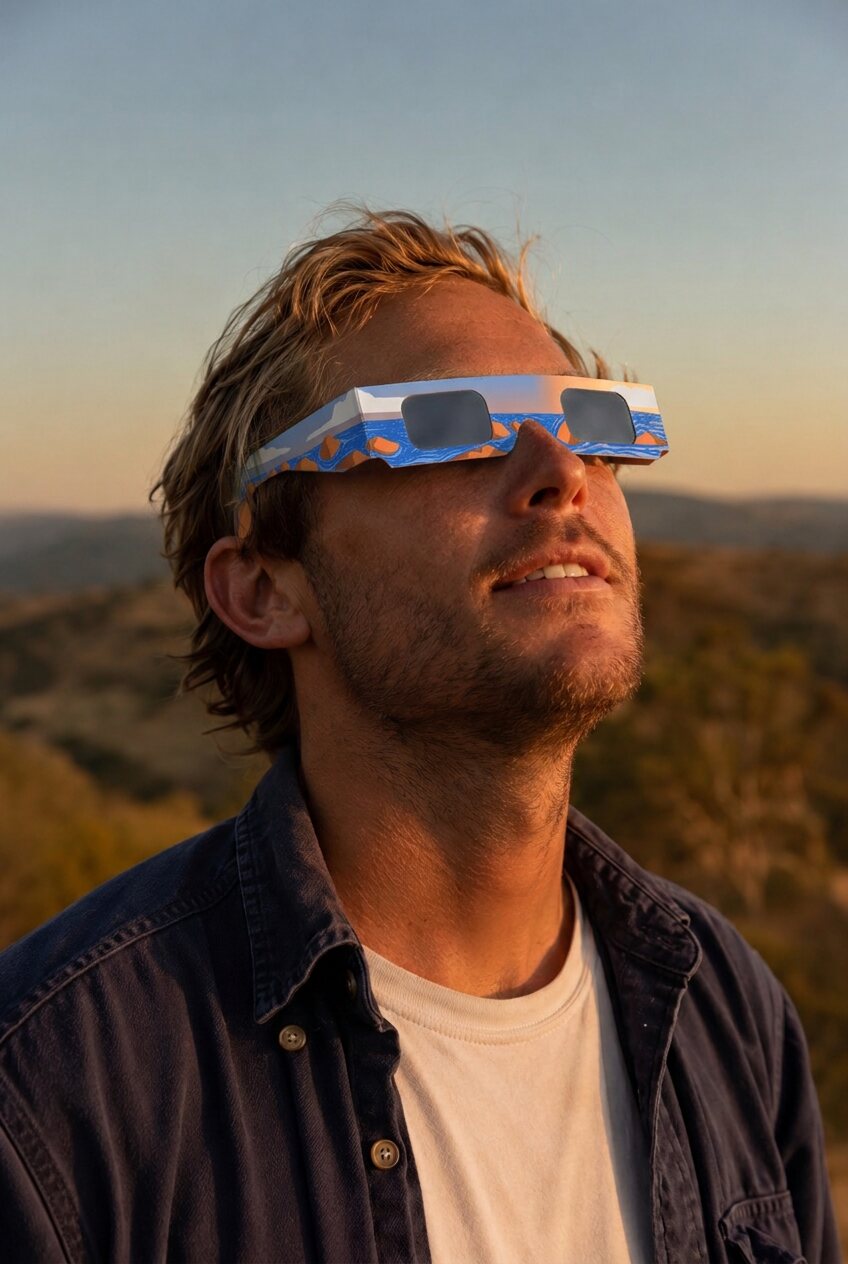
Through the whole eclipse at Echo Point, from 12:39:00 pm to 3:13:58 pm, keep ISO 12312-2 certified eclipse glasses on for every second, including totality from 1:58:31 pm to 2:02:00 pm. Sunglasses, smoked glass and homemade filters will not protect your eyes, and a camera, binoculars or a telescope needs a proper solar filter on the front before you look through it.
Every pair is ISO 12312-2 certified and tested by an independent lab. You can check the test certificate online.
Buy eclipse glassesWill it be clear?
A typical July · Katoomba (Farnells Rd), BOM 063039
The mountains are cloudier than the plains in winter: Katoomba averages 8.0 clear and 9.9 cloudy July days against Penrith/Richmond's 10.7 clear. Westerly flow can build wave cloud over the range, and the mean 3 pm temperature is only 8°C, so dress for it. If the forecast is poor, the drop to Penrith (3 min 46 s) is often clearer.
The Blue Mountains will be one of the biggest eclipse-tourism draws in NSW, but the Great Western Hwy is a single corridor. Expect gridlock on Saturday morning; take the train if you can.
Common questions
Where is totality longest in the Blue Mountains?
Along the Bells Line of Road: Mount Tomah and Bilpin get about 3 min 47 to 50 s.
Is the weather better in the mountains?
Usually not in winter. Katoomba averages fewer clear July days than Penrith or Sydney.
Schools, councils and events
Because 22 July 2028 is a Saturday, schools from Glenbrook and Springwood up to Katoomba, Blackheath and Mount Victoria will need to give out glasses and teach eclipse safety by Friday 21 July 2028. Councils, clubs, venues and accommodation hosts in both the upper and lower mountains should plan on one certified pair for every person at a viewing event. The Blue Mountains has about 78,000 residents and will be one of the biggest eclipse-tourism draws in NSW, so expect stock to run short in the final weeks. Bulk cartons, fundraising boxes of 20 to 250 pairs, and custom-branded glasses from 500 units (with an artwork proof before printing) are all available.
Nearby guides
- Katoomba eclipse guide
- Penrith eclipse guide
- The Hawkesbury eclipse guide
- Orange eclipse guide
- The whole NSW path eclipse guide
- 2028 eclipse times across Australia
- Interactive eclipse map