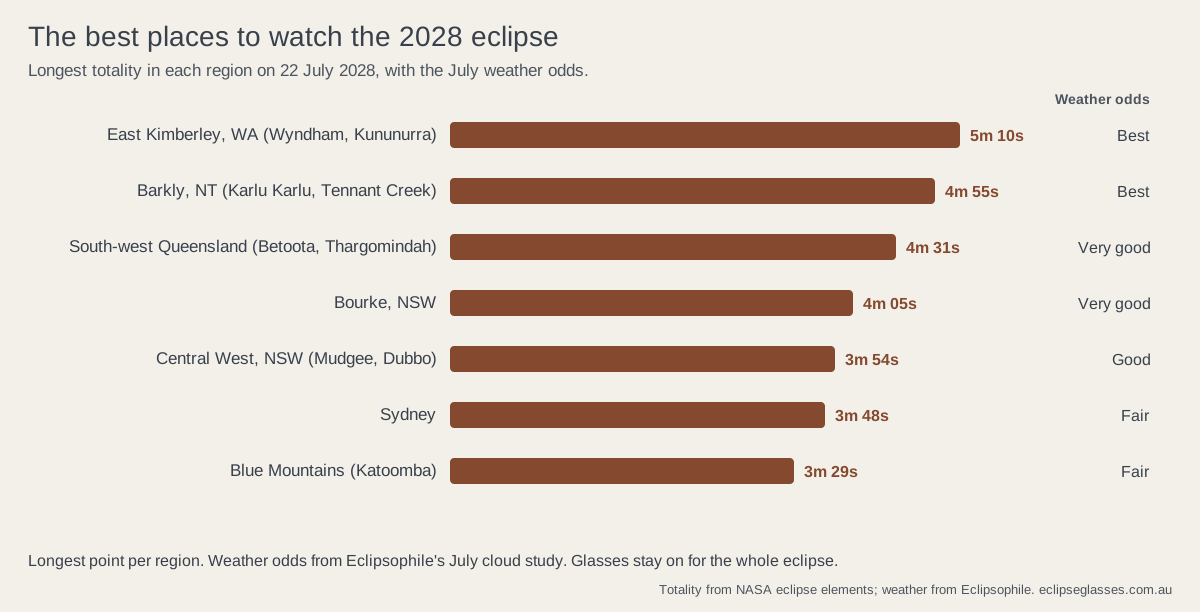
The short version. Nobody can forecast the weather for Saturday 22 July 2028 yet, but the climate record is clear. The inland and north-west are among the best places on Earth for clear July skies: from the WA coast to Karlu Karlu in the Northern Territory, satellites measure less than 10% cloud. Odds slip as the path climbs the Great Dividing Range, and the Blue Mountains and the coast, Sydney included, are the cloudiest part of the track. In Sydney, 9 of the last 26 eclipse dates were clear and 5 were overcast.
What are the cloud odds along the path?
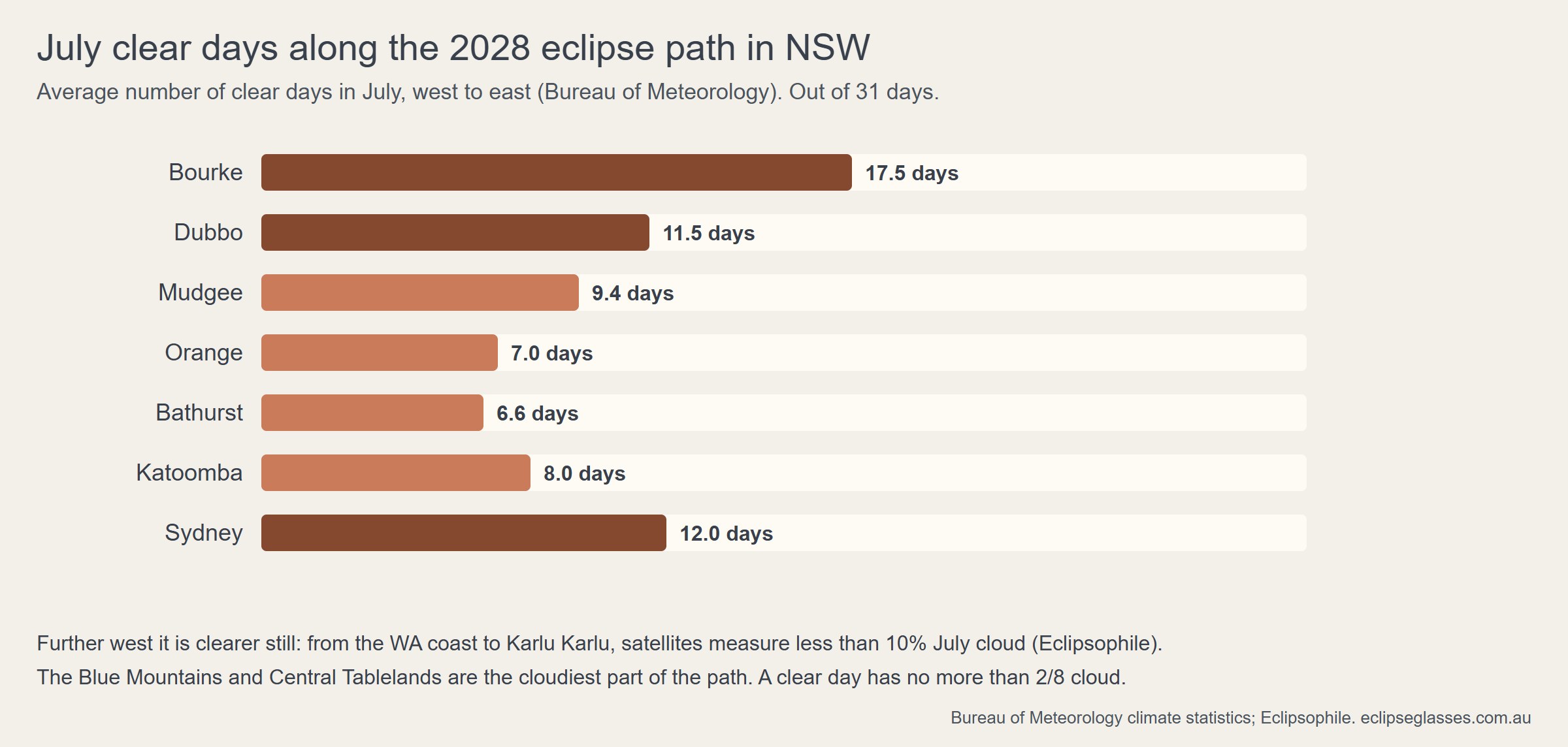
The figures below come from two sources. For the outback, we use the climate study of the 2028 track by meteorologist Jay Anderson at Eclipsophile, which combines satellite cloud data with Bureau of Meteorology (BOM) records. For NSW we use BOM's average number of clear days in July, the same figures on our town guides. A clear day in BOM's records has no more than 2 eighths of the sky covered by cloud.
| Region | Totality (example) | What the July record says |
|---|---|---|
| Kimberley, WA | Wyndham, 3 min 22 s | Satellite cloud below 10%. Halls Creek gets sunshine for more than 93% of daylight hours. |
| Barkly and Central NT | Tennant Creek, 3 min 21 s | Below 10% cloud as far as Karlu Karlu, with sunny hours above 90% on the track. |
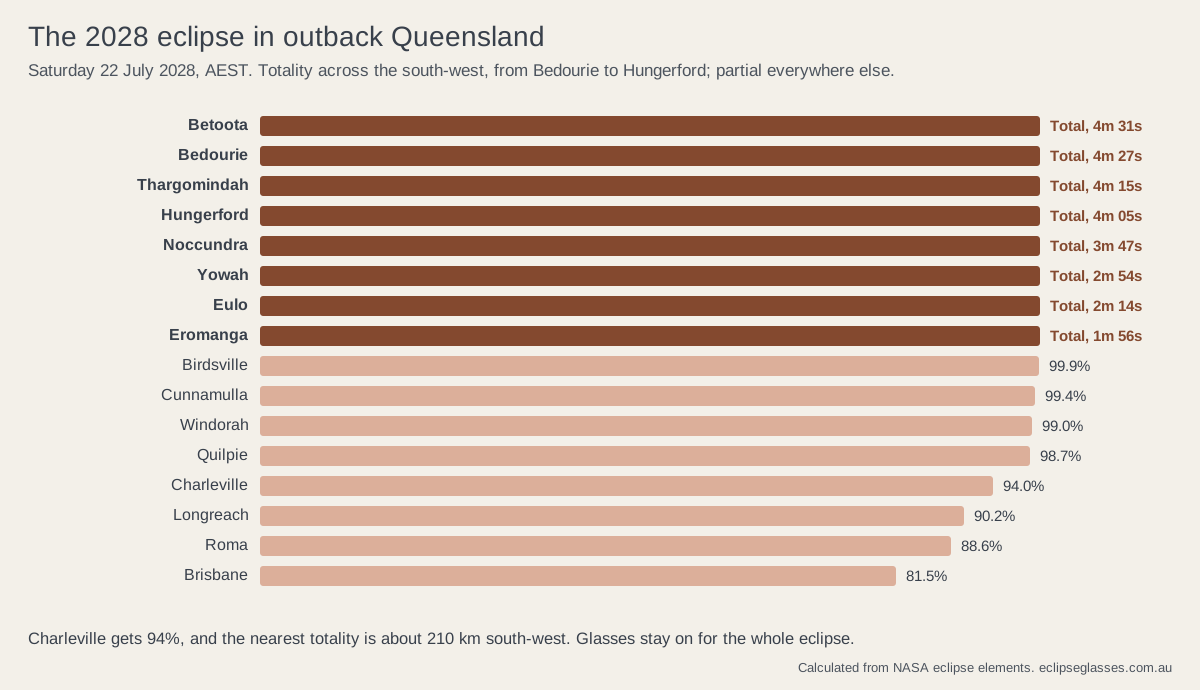
| South-west Queensland | Thargomindah, 4 min 15 s | A slow climb in cloud east of Karlu Karlu, but still easy viewing. Bedourie averages 10.8 mm of rain in July. |
| Far west NSW | Bourke, 4 min 05 s | 17.5 clear days in July (BOM, Bourke Post Office) |
| Central west NSW | Dubbo, 3 min 50 s | 11.5 clear days in July (BOM, Dubbo). Mudgee 9.4. |
| Central Tablelands and Blue Mountains | Bathurst, 3 min 02 s | 6.6 clear days in July in Bathurst, 7.0 in Orange, 8.0 in Katoomba (BOM). Average cloud under the track 35% to 50%. |
| Sydney | CBD, 3 min 48 s | 12.0 clear days in July (BOM). On 22 July from 2000 to 2025: 9 clear, 5 overcast. |
Satellite cloud and clear days measure different things, so compare rows within a source rather than across them. The pattern is the same in both: the further inland and north-west you go, the better your odds.
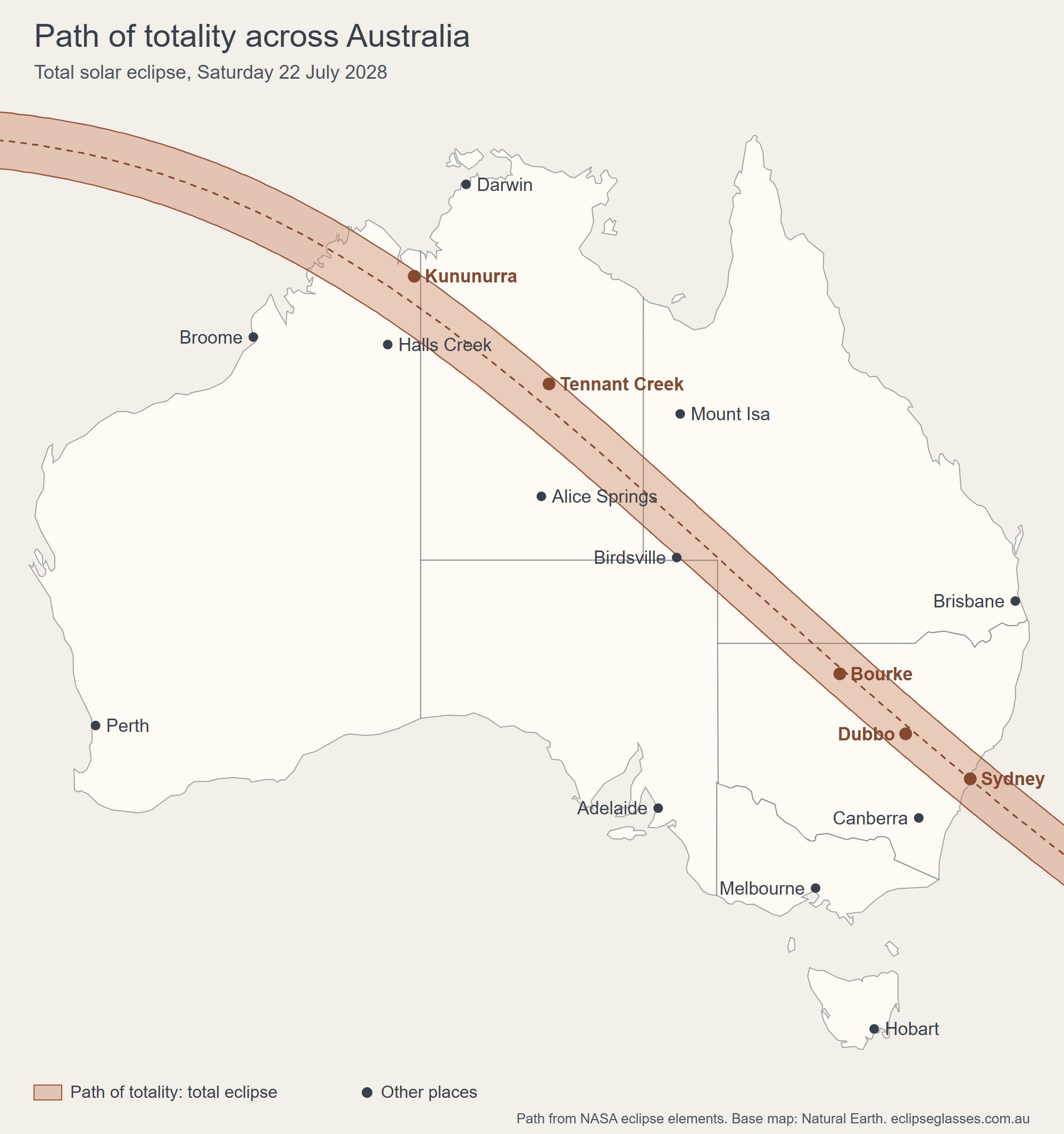
2028 eclipse path map for Australia
Why is the outback so clear in July?
July is the middle of northern Australia's dry season. Eclipsophile calls the prospects west of the Great Dividing Range "excellent to very good" and says the eclipse comes "with a high probability of success, particularly on the Outback". Along the whole Australian centre line, average July daytime cloud never climbs above 40%.
From the Indian Ocean coast to Karlu Karlu (Devils Marbles), satellite cloud stays below 10%. Beyond Karlu Karlu it climbs slowly into Queensland, where Eclipsophile describes the run from Bedourie to Thargomindah as "an easy eclipse-viewing vista". For towns and times, see our guides to WA and the Kimberley, Alice Springs and the NT and outback Queensland.
How do the odds change across NSW?
They fall as the path climbs east. Bourke has the best record on the NSW part of the track, with 17.5 clear days in an average July. Dubbo has 11.5 and Mudgee 9.4. Eclipsophile puts average cloud at just under 40% by Mudgee, as the ground begins to rise.
The Central Tablelands are the cloudiest towns in the path in winter. Bathurst averages 6.6 clear days in July and Orange 7.0. Over the Blue Mountains, average cloud under the track is 35% to 50%, and Eclipsophile notes a drop of about 8% in average cloudiness as the track descends towards the coast.
Will it be cloudy in Sydney on eclipse day?
Maybe, and the chance is not the same across the city. Jay Anderson checked satellite images of 22 July in every year from 2000 to 2025, between the Opera House and the airport at Botany Bay. On 9 days it was clear, on 5 it was overcast, and on the other 12 the sky was open somewhere in the 13 km between the two.
His conclusion: "the cloud cover in Sydney is often highly variable across the city". He compares Sydney's chances to Cairns in 2012, when some people saw the eclipse and others a short distance away were clouded out. BOM averages 12.0 clear days in a Sydney July. On the coast, a westerly day, with air sinking off the Divide, is usually the clearest. Our 10 best places in Sydney spread across the city for exactly this reason.
When will we know the actual forecast?
Not until the week of the eclipse. BOM's long-range outlooks look only a few months ahead, and they give odds of a wetter or drier season, not cloud on one afternoon. Eclipsophile's advice is to use the numerical weather forecasts in the days before the eclipse. Our NSW guide suggests following the forecast models from about five days out.
So plan around the climate now and keep the final choice flexible. If you're travelling inland, book somewhere you can drive from on the morning, so you can move to a clearer spot in the path. Use the 2028 eclipse map to check that a backup spot is inside the path, and our best places in Australia guide to compare regions.
Do you need eclipse glasses if it's cloudy?
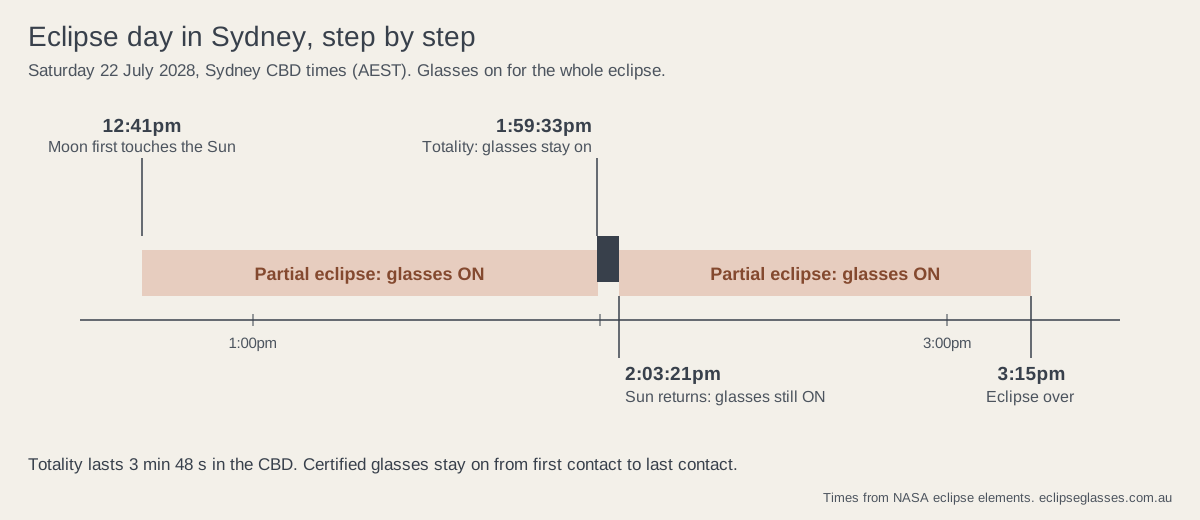
Yes. Cloud can thin or part at any moment during the eclipse, and the partial phases last well over an hour on each side of totality. Certified glasses stay on for the whole eclipse, totality included, whatever the sky is doing. Our certified eclipse glasses are A$5.45 a pair, and the family eclipse kit has four pairs and a viewing guide for A$19.25.
FAQ
Where is the best weather for the 2028 eclipse in Australia?
The north-west and the outback. From the WA coast to Karlu Karlu in the Northern Territory, satellites measure less than 10% cloud in July (Eclipsophile). In NSW, Bourke has the best record, with 17.5 clear days in an average July (BOM).
What are the chances of cloud in Sydney on 22 July 2028?
From 2000 to 2025, satellite images of 22 July showed 9 clear days and 5 overcast days over the Sydney CBD and Botany Bay. On the other 12, the sky was open somewhere between the two (Eclipsophile).
Is the Blue Mountains a good place if the weather is bad?
It is one of the cloudier parts of the path. Average July cloud under the track there is 35% to 50%, and Katoomba averages 8.0 clear days in July. Have a backup spot.
When can I trust a forecast for eclipse day?
Only in the last few days. Seasonal outlooks don't forecast cloud for a single afternoon. Follow the weather models from about five days out and be ready to move within the path.
Do I still need eclipse glasses if it's cloudy?
Yes. Cloud can clear at any moment, so certified glasses stay on for the whole eclipse, totality included.
Sources
All checked 12.11.2026.
- Jay Anderson, Eclipsophile, "Total solar eclipse of 2028 July 22": cloud and sunshine figures for the track, the Sydney satellite check for 22 July 2000 to 2025, and the forecasting advice.
- Bureau of Meteorology, Climate statistics for Australian locations: mean number of clear days in July for Bourke Post Office (048013), Dubbo (065012), Mudgee, Orange, Bathurst Agricultural Station, Katoomba and Sydney, as used on our town guides.
- Bureau of Meteorology, About the long-range forecasts.
- Totality lengths from our town and region guides, calculated from NASA's Besselian elements for the 22 July 2028 eclipse (Fred Espenak, NASA GSFC).
- ARPANSA, Solar eclipse; American Astronomical Society, Solar eclipse eye safety; NASA, Eclipse safety.

Aura Sight glasses for everyone watching
ISO 12312-2 certified and lab-tested, with a QR batch certificate on every pair. The family kit has four pairs and a printed viewing guide.