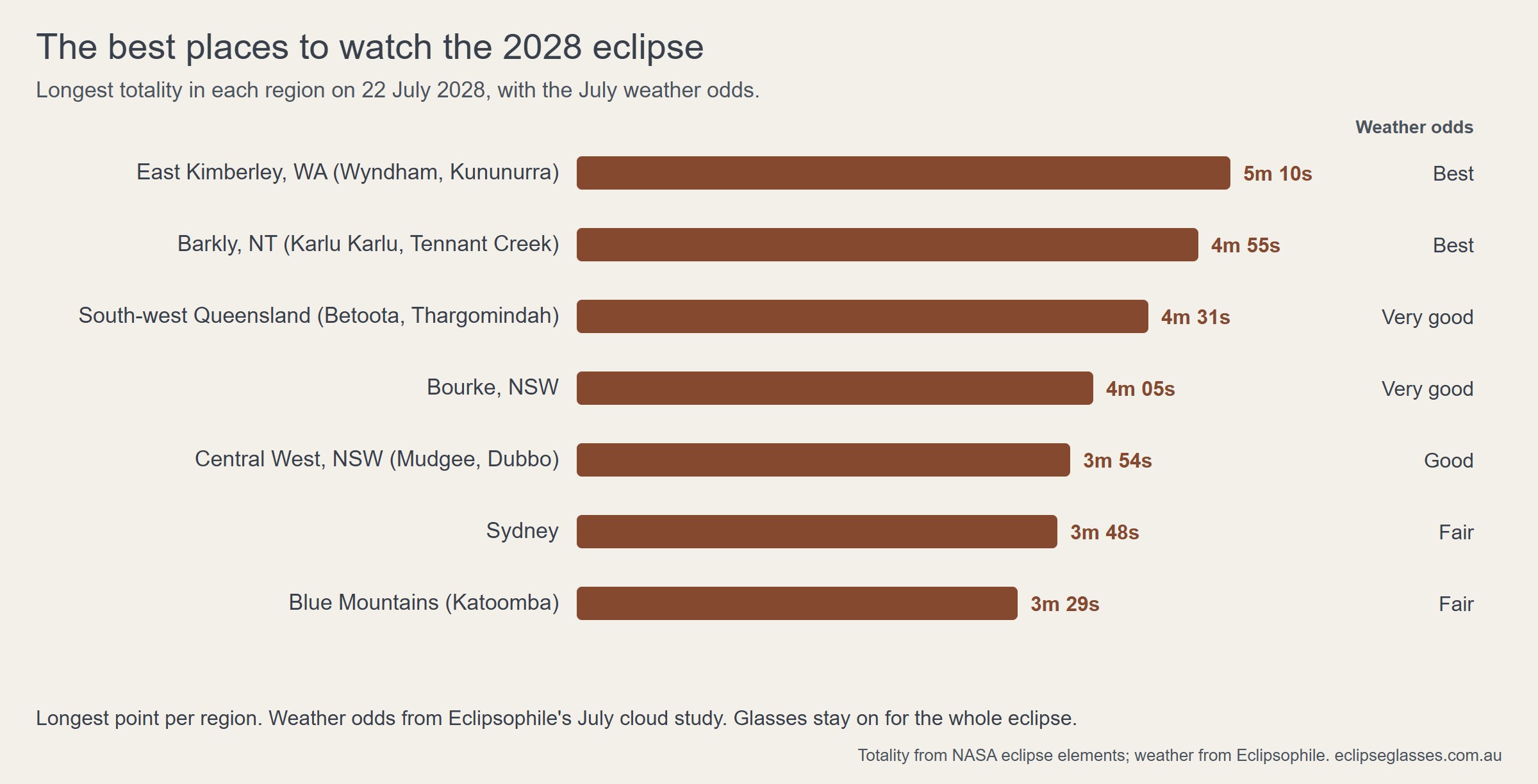
The short version. For the longest totality and the best weather odds, go north-west: the east Kimberley in WA and the Barkly region of the NT get up to 5 minutes 10 seconds, with satellite cloud under 10%. For the easiest trip, Sydney gets 3 minutes 48 seconds, but with a higher chance of cloud. Inland NSW, around Bourke, Dubbo and Mudgee, is the middle ground. Wherever you go, certified eclipse glasses stay on for the whole eclipse.
Where are the best places to watch the 2028 eclipse?
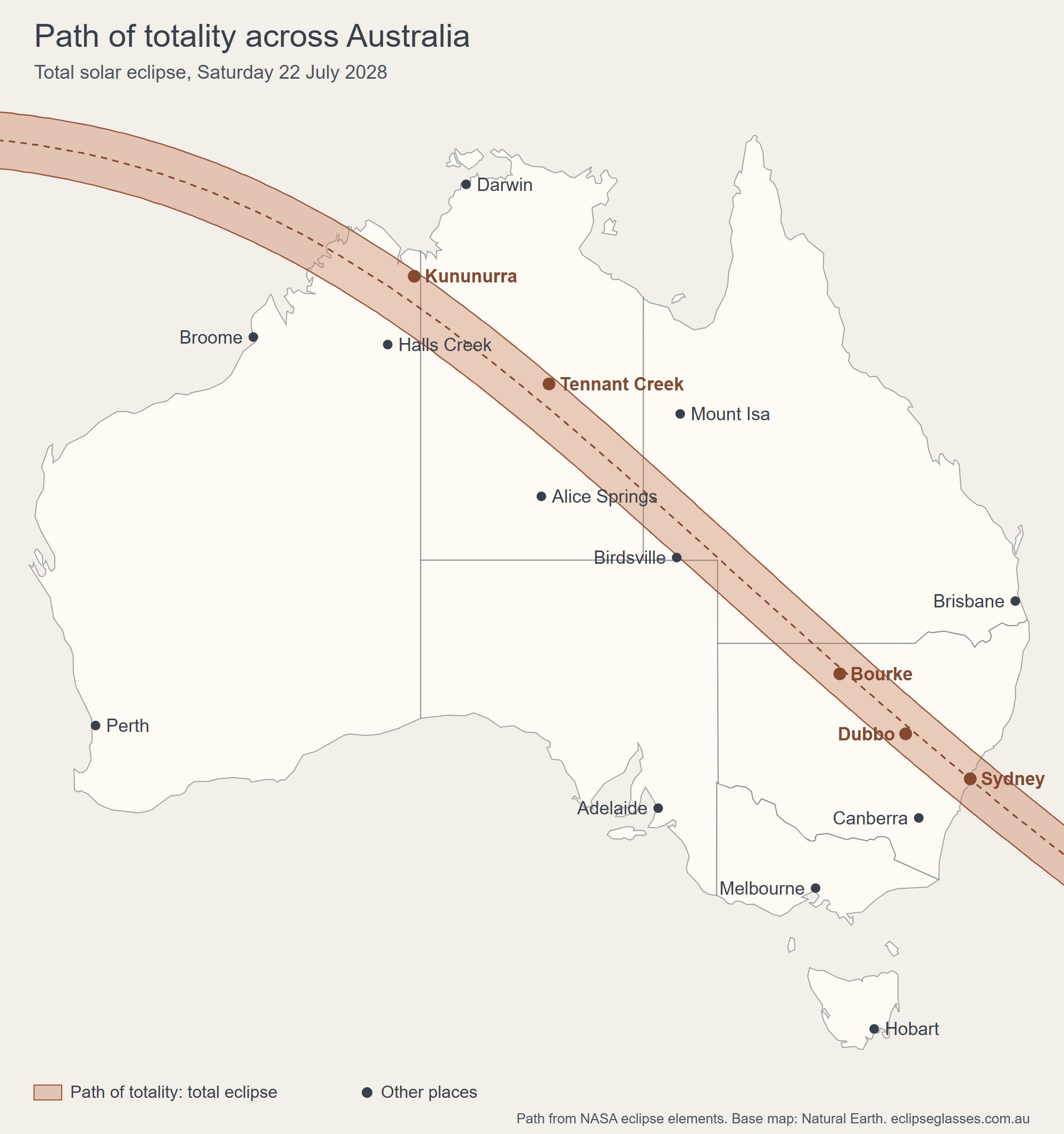
We ranked the main regions in the path on three things: how long totality lasts, the weather odds, and how easy it is to get there and stay. All times are local on Saturday 22 July 2028, from NASA's eclipse elements, as on our 2028 eclipse map.
| Region | Totality | Local time | Weather odds | Getting there |
|---|---|---|---|---|
| East Kimberley, WA (Wyndham, Kununurra) | Up to 5 min 10 s; Wyndham 3 min 22 s | About 11am AWST | Best | Remote; fly to Kununurra |
| Barkly, NT (Karlu Karlu, Tennant Creek) | 4 min 55 s at Karlu Karlu; Tennant Creek 3 min 21 s | About 12:50pm ACST | Best | Remote; Stuart Highway |
| South-west Queensland (Betoota, Thargomindah) | 4 min 31 s at Betoota; Thargomindah 4 min 15 s | About 1:40pm AEST | Very good | Very remote; few beds |
| Bourke, NSW | 4 min 5 s | 1:50pm AEST | Very good | Outback town; drive or fly |
| Central West, NSW (Mudgee, Dubbo) | Mudgee 3 min 54 s; Dubbo 3 min 50 s | About 1:55pm AEST | Good | A few hours from Sydney |
| Sydney | 3 min 48 s in the CBD | 1:59pm AEST | Fair | Easiest: it comes to you |
| Blue Mountains (Katoomba) | 3 min 29 s | 1:58pm AEST | Fair | Train from Sydney |
Weather odds are our summary of Eclipsophile's satellite analysis for the 2028 track: excellent to very good west of the Great Dividing Range, fair to middling over the Blue Mountains and the coast. No forecast exists this far out. Our eclipse weather odds by region has the numbers.
2028 eclipse path map for Australia
1. The east Kimberley, Western Australia
The longest totality in Australia, 5 minutes 10 seconds, is in the central Kimberley, mid-morning local time. Wyndham gets 3 minutes 22 seconds and Kununurra 2 minutes 52 seconds. Eclipsophile measures satellite cloud along the track from the WA coast to Karlu Karlu at under 10%, and Halls Creek gets sunshine in more than 93% of daytime hours. The catch is distance: it is remote, and beds will go early. See our Perth and WA guide.
2. Karlu Karlu and the Barkly, Northern Territory
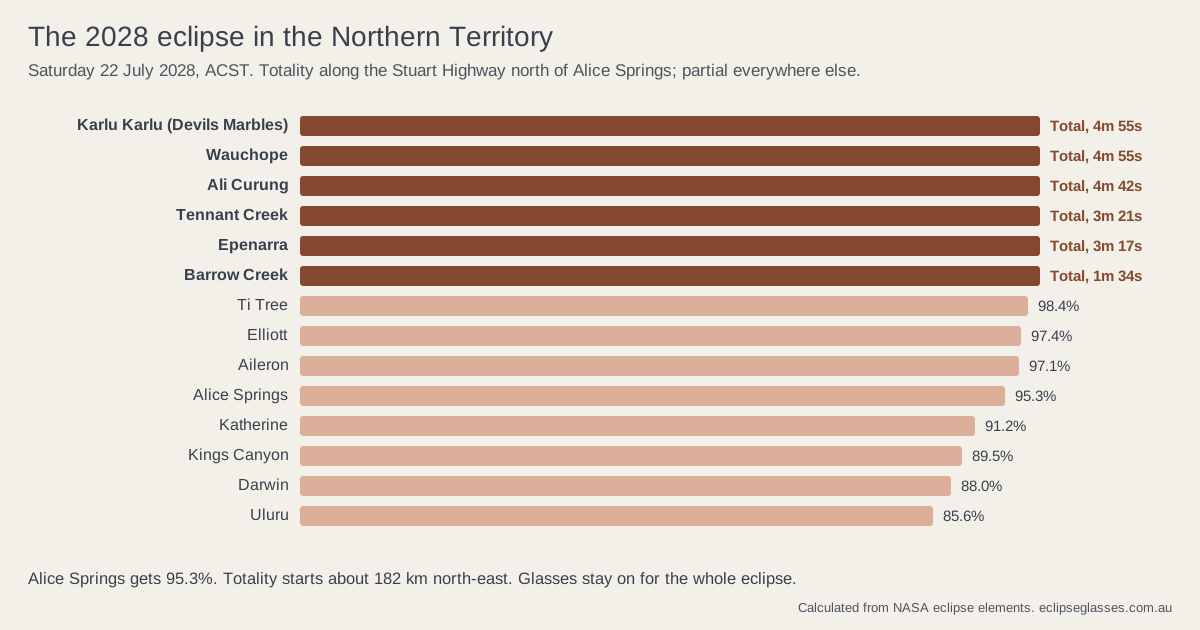
Karlu Karlu (Devils Marbles) and Wauchope, near the centre line, get 4 minutes 55 seconds, from about 12:48pm ACST. Tennant Creek, the biggest town in the path, gets 3 minutes 21 seconds. Alice Springs is outside the path at 95.3%. Karlu Karlu is a sacred site and a conservation reserve, so check NT Parks before you plan to be there. See our Alice Springs and NT guide.
3. South-west Queensland
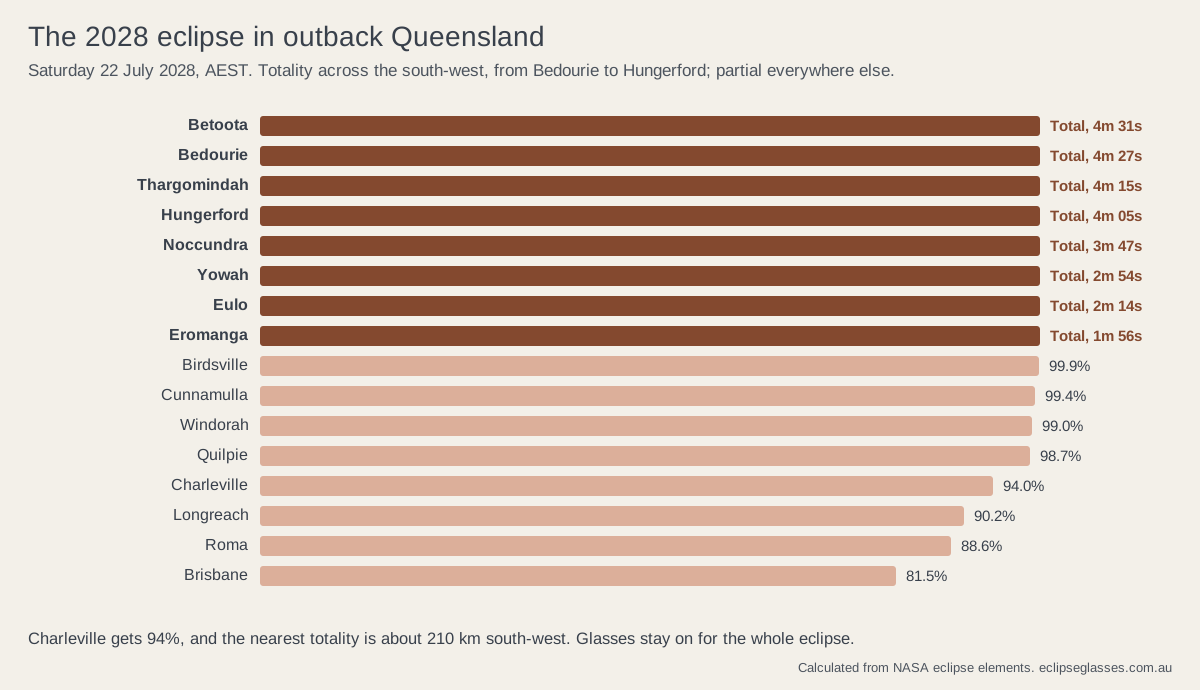
Betoota gets 4 minutes 31 seconds and Thargomindah 4 minutes 15 seconds, in the early afternoon. Eclipsophile calls the stretch from Bedourie to Thargomindah an easy viewing spot. These are tiny towns, so you need a base: Charleville, outside the path at 94%, is one option. See our outback Queensland guide.
4. Bourke, NSW
Bourke gets 4 minutes 5 seconds from 1:50pm AEST, the longest totality of any sizeable NSW town, with the drier skies west of the Great Dividing Range. See our Bourke eclipse guide.
5. The Central West, NSW
Mudgee, almost on the centre line, gets 3 minutes 54 seconds, and Dubbo 3 minutes 50 seconds. Eclipsophile puts average July cloud just under 40% at Mudgee. It is a good balance of long totality, better odds than the coast, and a manageable drive from Sydney. See our guides to Mudgee, Dubbo, Bathurst and Orange.
6. Sydney
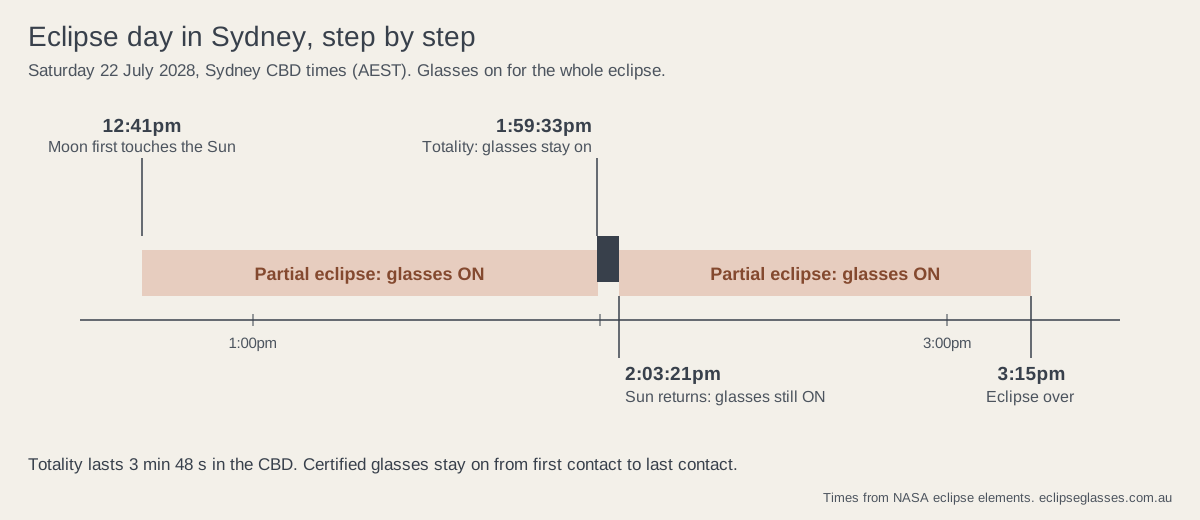
The Sydney CBD gets 3 minutes 48 seconds, from 1:59:37pm to 2:03:26pm AEST, and most of greater Sydney is in the path. It is the easiest totality on Earth to reach in 2028, but the coast has a higher chance of cloud: Eclipsophile's check of 22 July from 2000 to 2025 found 9 clear days, 5 overcast and 12 with some breaks. See our 10 best places to watch in Sydney.
7. The Blue Mountains
Katoomba gets 3 minutes 29 seconds, with lookouts that make the eclipse memorable. Eclipsophile notes the mountains raise average July cloud to between 35% and 50% under the track, so have a backup plan. See our Blue Mountains guide.
How should you choose?
- If you want the longest totality and the best odds, and can travel, go north-west to the Kimberley or the Barkly.
- If you want a road trip from Sydney, head west over the Great Dividing Range to the Central West or Bourke.
- If you want the easiest day, stay in Sydney, and be ready to move within the city if cloud is forecast.
- Wherever you go, stand well inside the path. Near the edges totality is short, and towns like Newcastle (99.7%) and Canberra (96.1%) miss out. Our guide to towns just outside the path explains why it matters.
New Zealand gets totality too, later in the day, in Queenstown and Dunedin. See our New Zealand guide.
What do you need to bring?
Certified eclipse glasses for everyone, worn for the whole eclipse, totality included. Remote towns will not have spare stock on the day. Our certified eclipse glasses are A$5.45 a pair, and the family eclipse kit has four pairs for A$19.25, delivered Australia-wide until 31 May 2028. Never use eclipse glasses with binoculars, a telescope, a camera or a phone.
FAQ
Where is the best place in Australia to watch the 2028 eclipse?
For the longest totality and the best weather odds, the east Kimberley in WA and the Barkly in the NT, with up to 5 minutes 10 seconds. For the easiest trip, Sydney, with 3 minutes 48 seconds.
Where is totality longest in Australia in 2028?
In the central Kimberley in Western Australia: 5 minutes 10 seconds, at about 10:55am AWST.
Is Sydney a good place to watch the 2028 eclipse?
Yes for convenience: the CBD gets 3 minutes 48 seconds of totality just before 2pm AEST. The coast has a higher chance of cloud than inland, so have a backup spot.
Where is the best weather for the 2028 eclipse?
West of the Great Dividing Range. Eclipsophile measures satellite cloud under 10% from the WA coast to Karlu Karlu in the NT, rising to just under 40% at Mudgee.
Is the 2028 eclipse better in the Kimberley or Sydney?
The Kimberley has longer totality and better weather odds, but it is remote. Sydney is much easier to reach, with shorter totality and more chance of cloud.
Do I need eclipse glasses in the path of totality?
Yes. The partial phases before and after totality last over an hour each. Certified glasses stay on for the whole eclipse, totality included.
Sources
All checked 12.11.2026.
- Times calculated from NASA's Besselian elements for the 22 July 2028 eclipse, Fred Espenak, NASA GSFC, as on our eclipse map.
- Jay Anderson, Eclipsophile, Total solar eclipse 2028 July 22 (cloud and sunshine statistics).
- ARPANSA, Solar eclipse.
- Astronomical Society of Australia, How to view the eclipse; American Astronomical Society, Solar eclipse eye safety and the ISO 12312-2 standard.

Aura Sight glasses for everyone watching
ISO 12312-2 certified and lab-tested, with a QR batch certificate on every pair. The family kit has four pairs and a printed viewing guide.