The short version. Buy a solar filter made for your device from a supplier on the American Astronomical Society's list of solar filter suppliers for optics, or from a telescope or astronomy shop that sells those brands. It goes over the front of the lens, never the back. Fit it securely, check it for damage before each use, and keep your own certified eclipse glasses on for the whole eclipse. We sell eclipse glasses for your eyes, not filters for optics.
Why does a camera need its own filter?
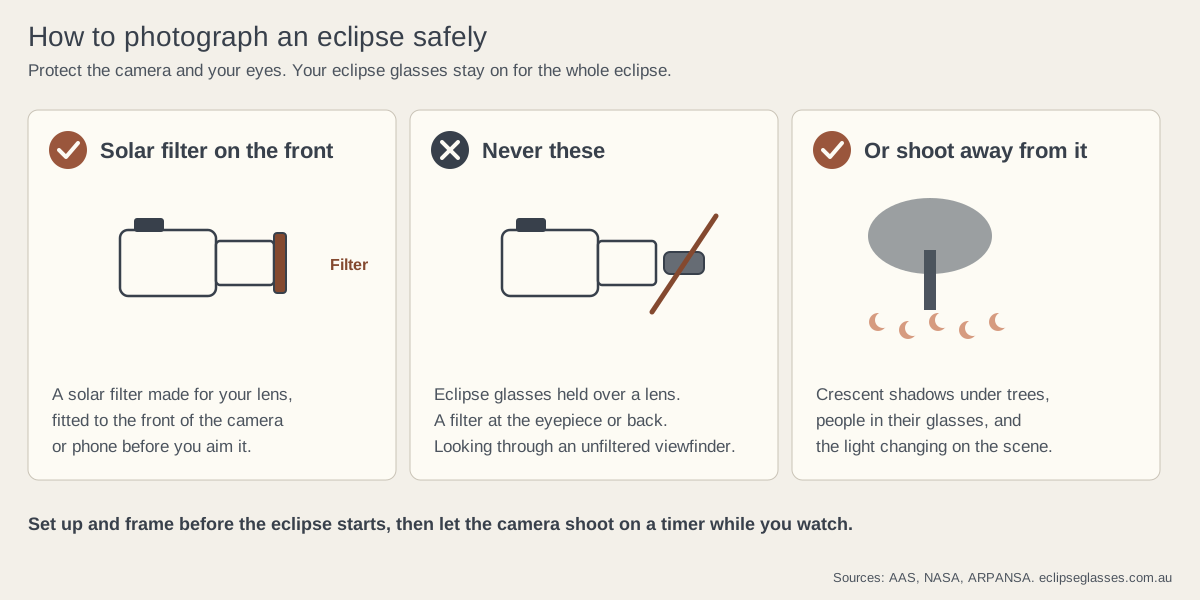
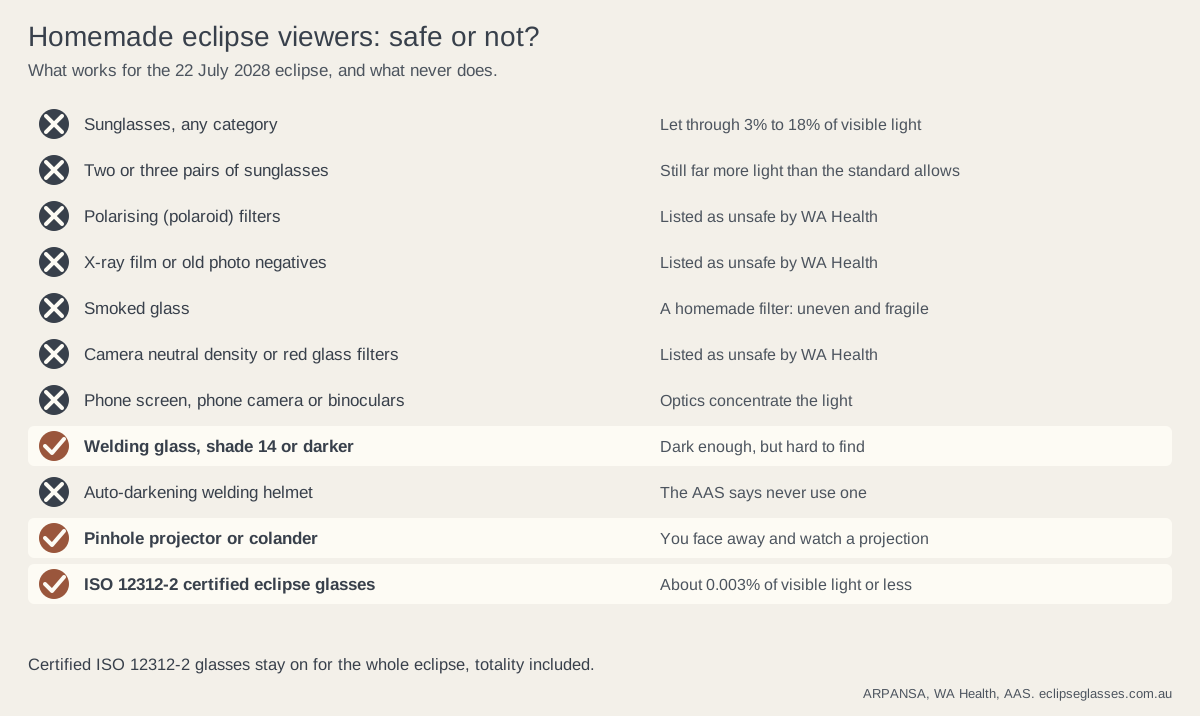
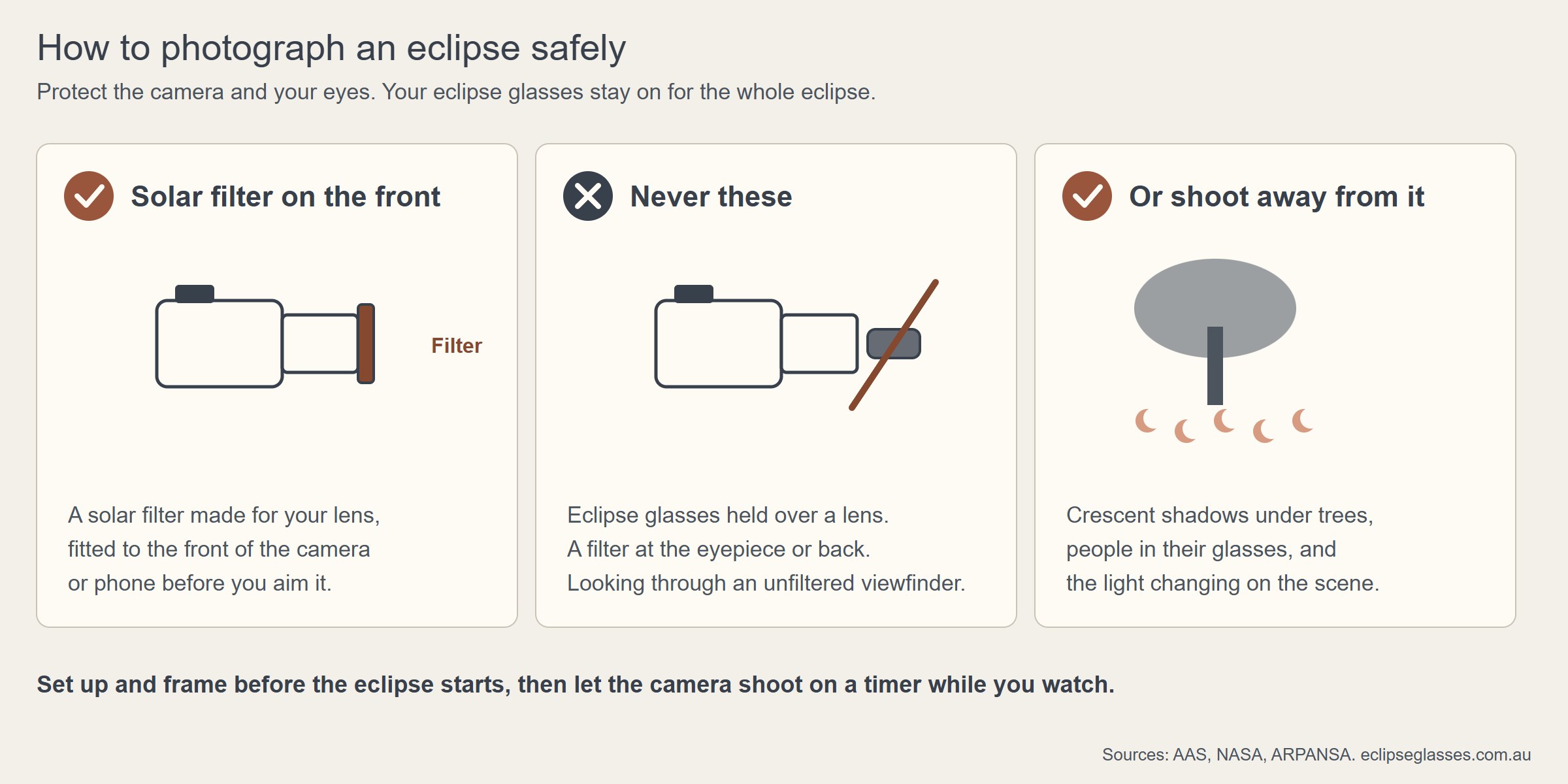
A lens gathers sunlight and concentrates it. The American Astronomical Society says cameras, binoculars and telescopes need a solar filter for two reasons: to protect your eyes, and to protect the equipment. Behind a lens, concentrated light burns through the filter in eclipse glasses, so glasses held over a lens, or worn while you look through binoculars or a viewfinder, are not protection. ARPANSA warns that optical aids without a properly fitted solar filter cause immediate and severe eye damage, even when you are wearing eclipse glasses.
Which filter for which device?
- DSLR or mirrorless camera: a screw-on or magnetic solar filter sized to the front of the lens. Screw-on fits the lens's filter thread; magnetic filters attach to a ring on the lens.
- Compact or bridge camera: a slip-on or adapter-mounted solar filter that covers the whole front of the lens. Many compacts have no filter thread, so check how it attaches.
- Phone: a clip-on solar filter made for phones, or a solar filter sheet held over the lens. Never hold eclipse glasses over the lens. A phone's wide lens makes the eclipse small, so many people photograph the scene instead.
- Binoculars: a matched pair of solar filters, one over each front lens. Both front openings need covering, held on so they can't slip.
- Telescope: a full-aperture solar filter over the front opening. Never an eyepiece filter at the back. The AAS calls those dangerous.
What are solar filters made of?
The AAS lists three common materials for optics filters:
- Metal on glass, usually the most durable and the most expensive.
- Aluminised polyester film, often called "Mylar", light and cheaper, sold as framed filters and as sheets.
- Black polymer, another film option.
Some show the eclipse white, others yellow or orange, and the AAS says all of these work. One thing to know: ISO 12312-2, the standard for eclipse glasses, does not apply to filters for optics. That is why the supplier matters so much.
How do you size a camera filter?
- Find the filter thread size, printed on the front of most camera lenses or inside the lens cap, such as 67 mm or 77 mm.
- For a screw-on filter, buy that thread size. For a magnetic or slip-on filter, follow the maker's sizing for your lens.
- For binoculars and telescopes, measure across the outside of the front opening and pick a filter made to fit over it snugly.
- The filter must cover the whole front of the lens. A gap at the edge lets unfiltered sunlight in.
Where can you get a solar filter in Australia?
- A maker or reseller on the AAS list. The American Astronomical Society keeps a list of suppliers of solar filters for telescopes, binoculars and camera lenses, a mix of manufacturers and authorised resellers. Start there, or buy that brand from a shop.
- Telescope and astronomy shops. They know which filters fit which optics, and many stock brands from the AAS list.
- Your local astronomy club. Members can often check your setup before the day, and NASA advises getting expert advice before using a solar filter with a camera.
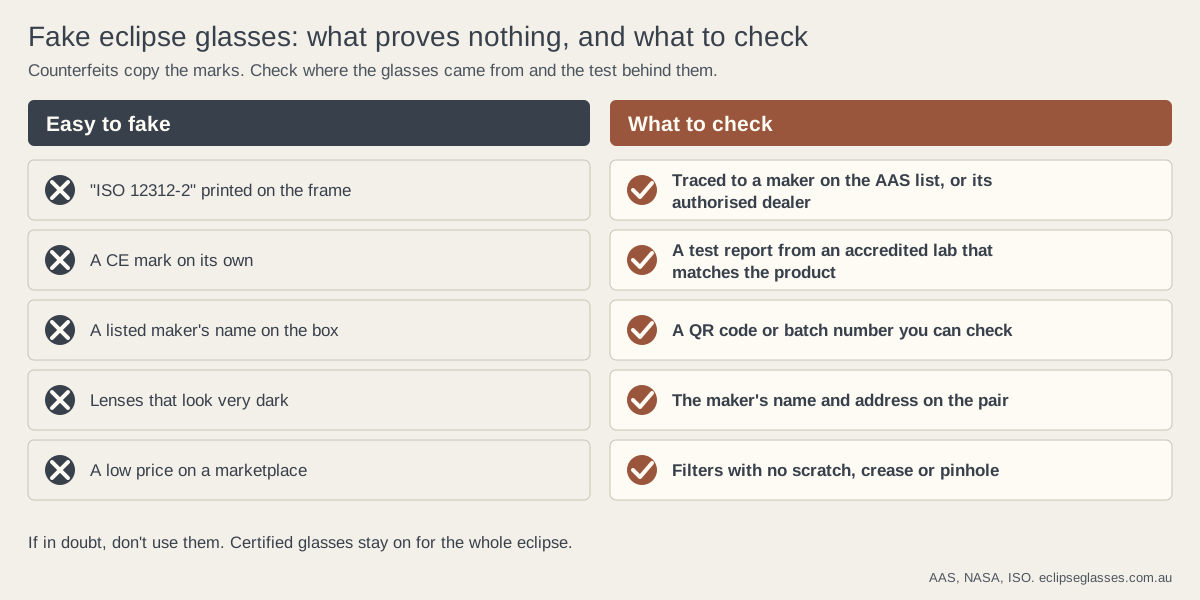
Be wary of unbranded filters from online marketplaces. Without a known maker you can't trace where a filter came from, the same problem we cover in spotting fake eclipse glasses. Buy early too: in the US, eclipse glasses ran short in the final weeks before the 2017 and 2024 eclipses, and filters for optics come from a small number of makers.
What to check before the day
- Inspect the filter for scratches, pinholes or creases before each use. Any damage, don't use it.
- Fit it so it can't pop off if the camera is bumped or the wind gusts. Tape or a strap helps on slip-on filters.
- Fit it before you point the lens at the eclipse, facing away.
- Keep the filter on for the whole eclipse, totality included. That is our rule for cameras, the same as for your glasses.
- Wear your own certified eclipse glasses the whole time. The filter protects the camera, not the person beside it.
Most eclipse photos that people treasure need no filter at all: the crowd, the light and the shadows. Our photography guide covers those, and the settings for the eclipse itself.
FAQ
Can I use eclipse glasses as a camera filter?
No. NASA says not to use eclipse glasses or handheld viewers with cameras. Behind a lens, concentrated sunlight burns through them. Use a solar filter made for the lens and wear your glasses yourself.
Does my phone need a solar filter for the eclipse?
Yes, if you point it at the eclipse. Use a solar filter made for phones over the lens. Many of the best phone photos are of the scene and the people around you, which need no filter.
Do binoculars need one filter or two?
Two. Each front lens needs its own solar filter, held on securely. Never look through binoculars without them, even while wearing eclipse glasses.
Are camera solar filters tested to ISO 12312-2?
No. ISO 12312-2 is the standard for eclipse glasses and handheld viewers, and it does not apply to filters for optics. Buy from a maker or reseller on the American Astronomical Society's list of solar filter suppliers.
Does Aura Sight sell camera filters?
No. We sell certified eclipse glasses for your eyes. For camera, binocular and telescope filters, use a supplier on the AAS list or a telescope or astronomy shop.
Can I take the filter off during totality?
Our rule is that camera filters stay on for the whole eclipse, totality included, the same as your eclipse glasses.
Sources
All checked 13.11.2026.
- American Astronomical Society, Solar filters for optics (front-mounted filters, materials, eyepiece filters, secure fitting).
- American Astronomical Society, Suppliers of solar filters (suppliers for telescopes, binoculars and camera lenses; ISO 12312-2 does not apply to optics filters; mounting over the front opening).
- NASA, Eclipse safety (no eclipse glasses with cameras; expert advice; concentrated light).
- ARPANSA, Solar eclipse (optical aids without a solar filter).
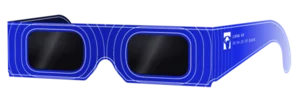
Certified eclipse glasses from Aura Sight
ISO 12312-2 certified, lab-tested and made by Rainbow Symphony, with a QR batch certificate on every pair. A$5.45 a pair from NSW stock, delivered Australia-wide (New Zealand too).