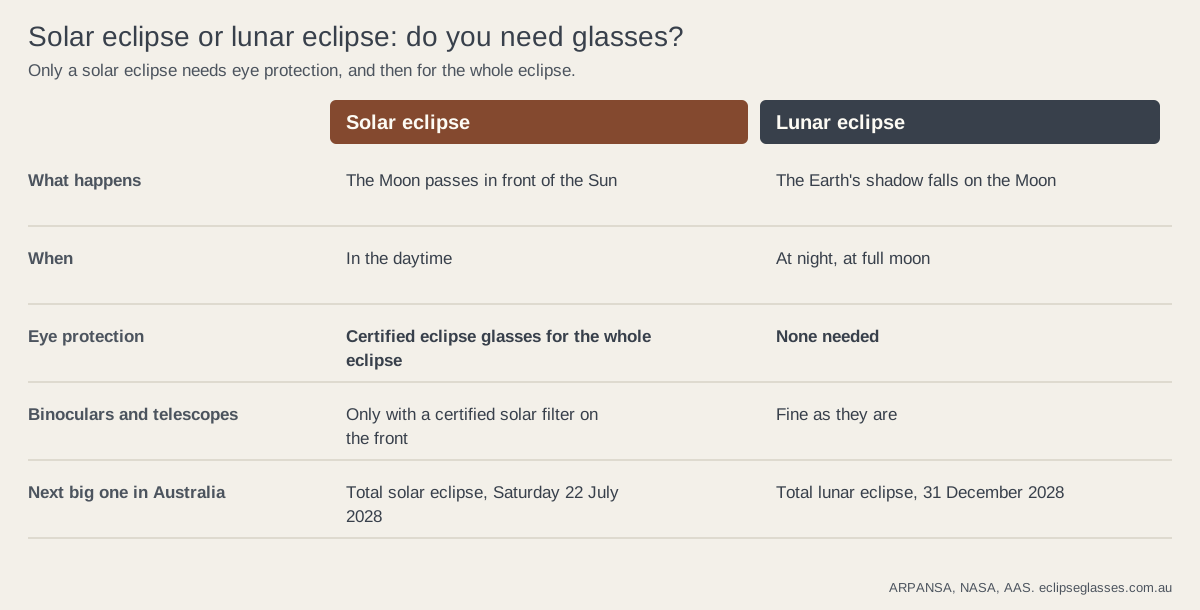
The short version. Sunglasses, stacked sunglasses, X-ray film, smoked glass, polarising filters, camera filters and other homemade filters are not safe for an eclipse. Welding glass is only safe at shade 14 or darker, and never an auto-darkening helmet. A pinhole projector is safe, because you face away from the eclipse and watch a projected image, but the image is small and faint. Certified eclipse glasses cost a few dollars and let you watch the eclipse itself.
Which homemade eclipse viewers are safe?
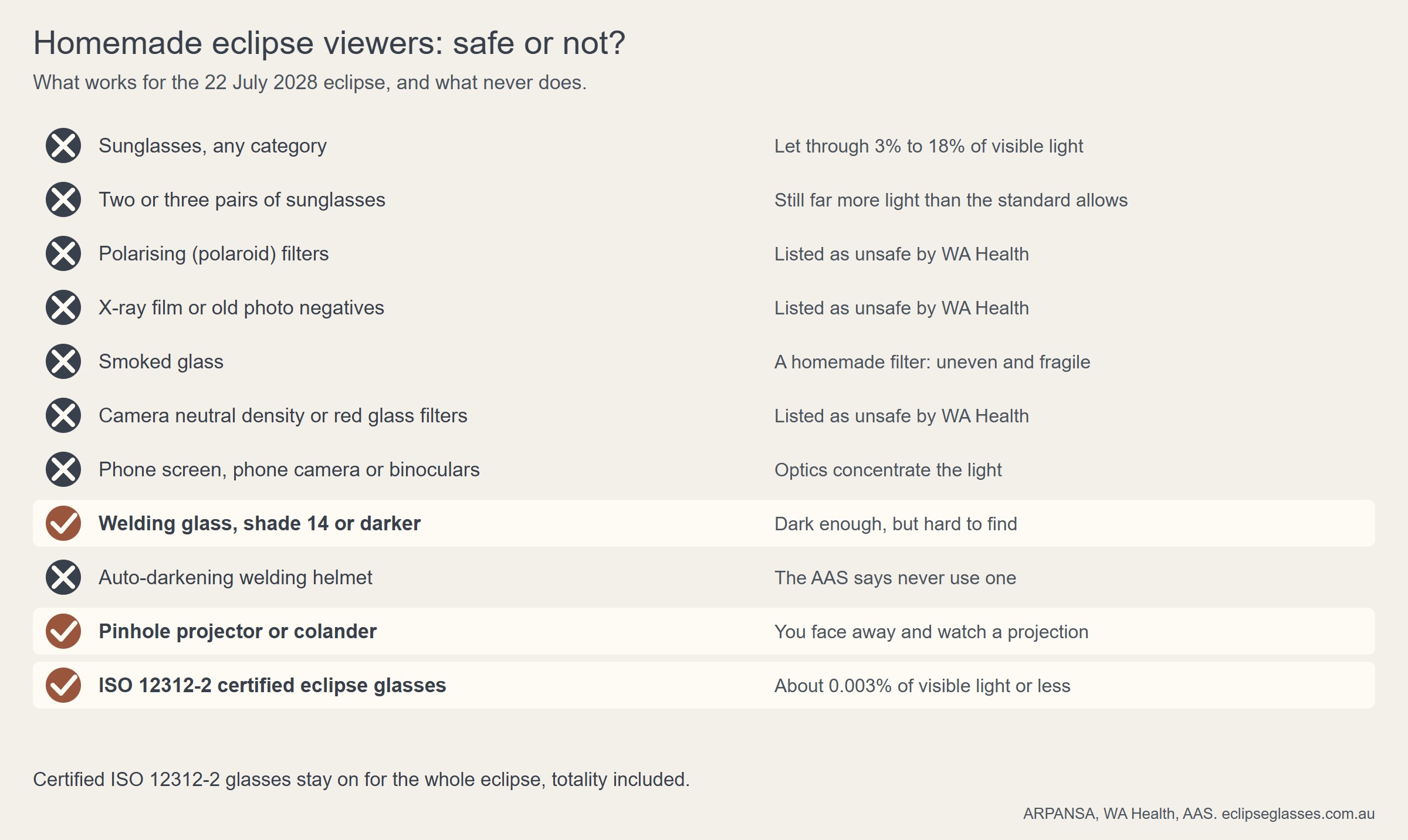
| Method | Safe? | Why |
|---|---|---|
| Sunglasses, any category | No | Let through 3% to 18% of visible light |
| Two or three pairs of sunglasses | No | Still far more light than the standard allows |
| Polarising (polaroid) filters | No | Listed as unsafe by WA Health |
| X-ray film or old photo negatives | No | Listed as unsafe by WA Health |
| Smoked glass | No | A homemade filter: uneven and fragile |
| Camera neutral density or red glass filters | No | Listed as unsafe by WA Health |
| Phone screen, phone camera or binoculars | No | Optics concentrate the light |
| Welding glass, shade 14 or darker | Yes | Dark enough, but hard to find |
| Auto-darkening welding helmet | No | The AAS says never use one |
| Pinhole projector or colander | Yes | You face away and watch a projection |
| ISO 12312-2 certified eclipse glasses | Yes | About 0.003% of visible light or less |
The Astronomical Society of Australia puts it plainly: homemade filters and ordinary sunglasses, even very dark ones, are not safe, because they let through thousands of times too much sunlight.
Why don't sunglasses work, even stacked?
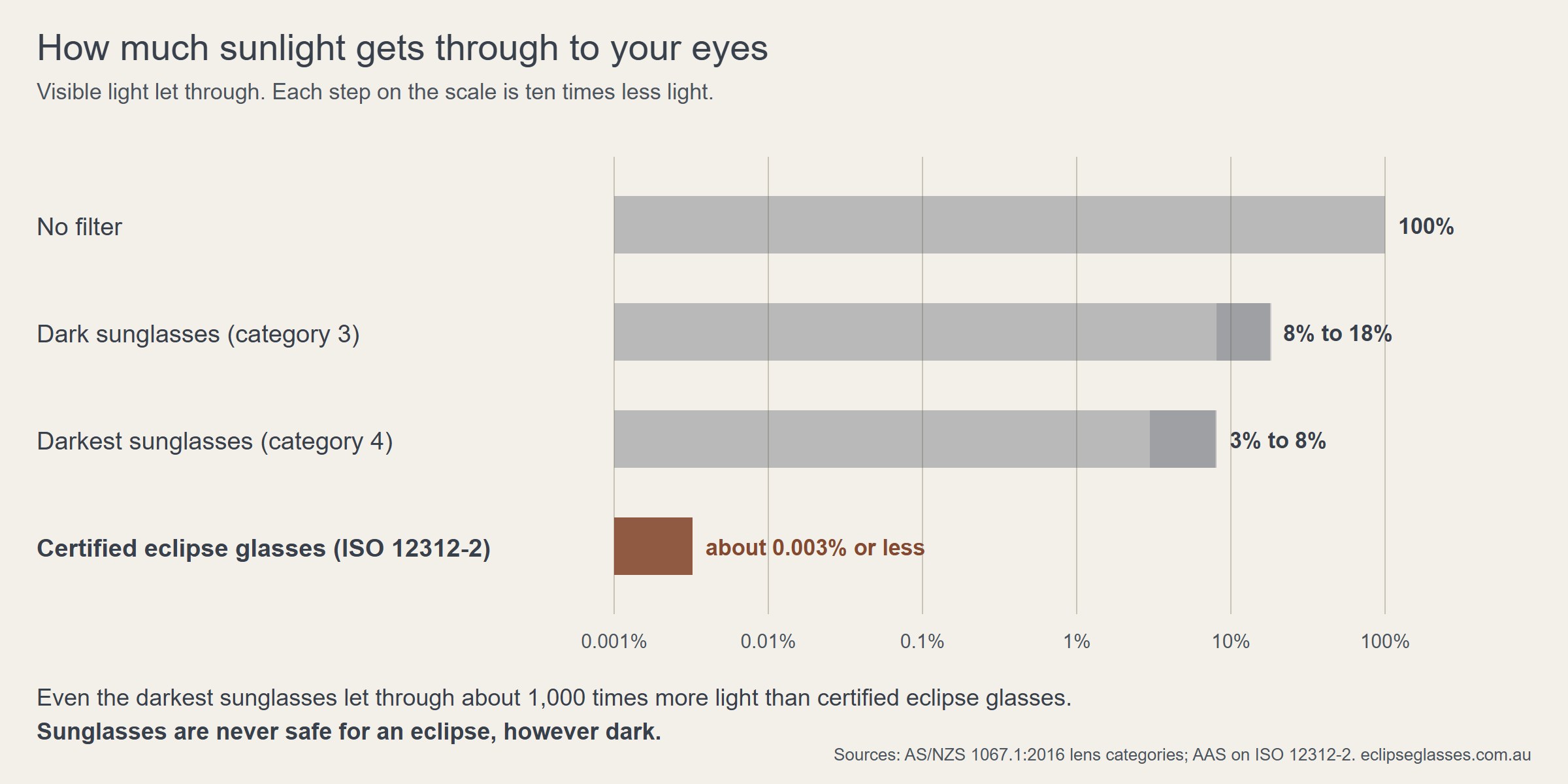
The darkest sunglasses on sale, category 4, let through 3% to 8% of visible light. Certified eclipse glasses let through about 0.003% or less. That is a gap of about a thousand times.
Stacking does not close it. Two category 4 lenses at their darkest let through about 3% of 3%, or 0.09%. That is still about 30 times the most the ISO 12312-2 standard allows, before you allow for the infrared and ultraviolet light sunglasses are not tested to block. And nothing tells you when a stack is dark enough, because the damage is painless.
What about X-ray film, smoked glass and camera filters?
These are old tricks, and they are all on the unsafe list. WA Health names regular sunglasses, polaroid filters, dark glasses, X-ray film, photographic neutral density filters, red glass filters and homemade sun filters as not safe for an eclipse. Smoked glass is a homemade filter: Sky & Telescope notes that a soot coating is very hard to make evenly dark, and it rubs off. A filter that looks dark to you can still let through far too much light.
Is welding glass safe?
Only shade 14 or darker. That is the American Academy of Ophthalmology's guidance, and it is the rule we follow. Many welding lenses are lighter than shade 14, and you often can't tell the shade of an old lens. The American Astronomical Society says never to use an adjustable or auto-darkening welding helmet for an eclipse. If you don't have a marked shade 14 lens, use certified eclipse glasses.
Can you use your phone or binoculars?
Not on their own, and never combined with eclipse glasses. Binoculars, telescopes and camera lenses concentrate sunlight, and without a certified solar filter on the front they cause immediate, severe eye damage, even if you are wearing eclipse glasses. The concentrated light burns straight through a glasses filter. A phone screen is not a filter either. Our guide on photographing the eclipse safely covers proper camera filters.
Is a pinhole projector a good alternative?
It is safe. ARPANSA rates indirect viewing, such as pinhole projection or a livestream, as the safest way to watch an eclipse. It works like this:
- Stand with your back to the Sun.
- Make a small hole, about 1 mm across, in a piece of card.
- Hold a white card about 1 m away and let the light through the hole fall on it. You watch the image on the white card.
A colander, a straw hat or anything else with lots of small holes works too, casting a row of little crescents. Never look through the hole.
The catch is what you get to watch. At 1 m, the projected eclipse is only about 1 cm across, and it is faint on a bright day. It needs direct sunshine, so a passing cloud ends the show. It is a good activity for children and a backup if you forget your glasses, but it is not the same as watching the eclipse in the sky. Our guide to eclipse glasses for kids covers toddlers and preschoolers.
Why are certified glasses the better answer?
- They let you watch the eclipse itself, the shape of the Moon moving across the Sun, for the whole eclipse.
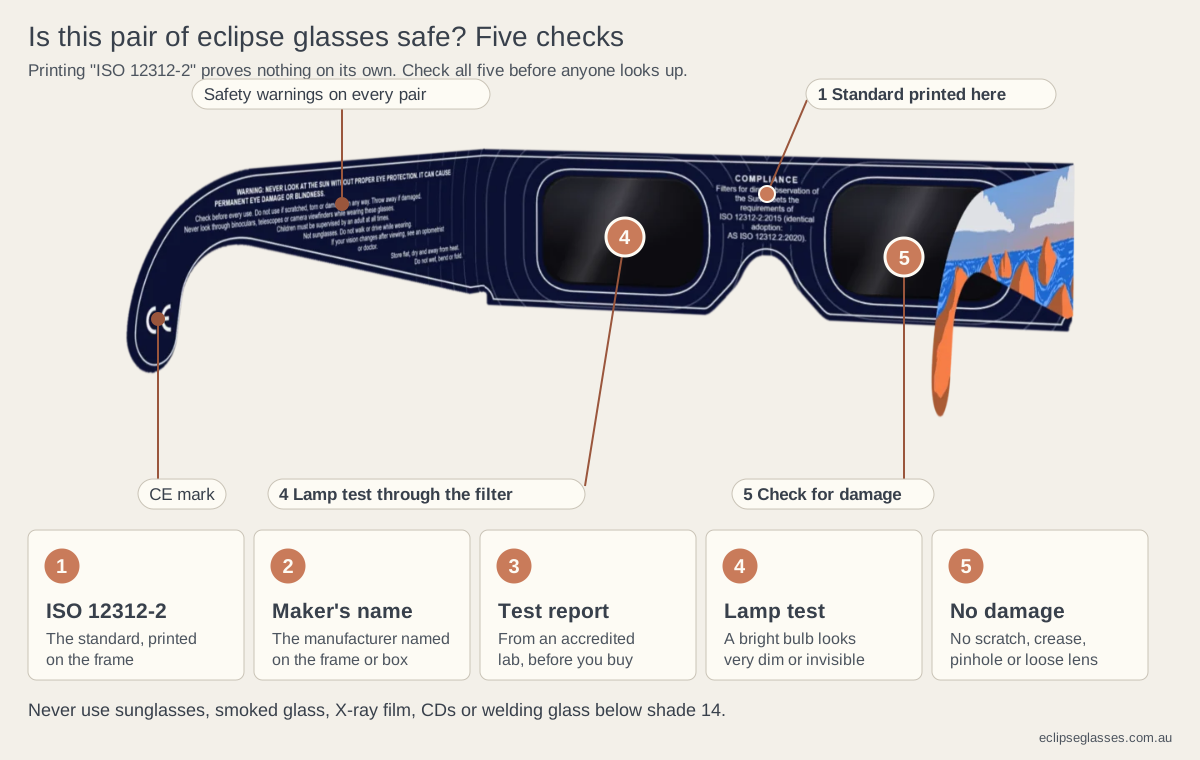
- They are tested. A certified filter meets ISO 12312-2, so you are not guessing whether something is dark enough.
- They are cheap. Our certified eclipse glasses (also called eclipse shades) are A$5.45 a pair, and a family eclipse kit of four is A$19.25.
- You can check them. Ours are made by Rainbow Symphony, a manufacturer on the American Astronomical Society list of reputable vendors, tested by ICS Laboratories, and every pair has a QR code that links to its batch certificate.
Buy early. Before the US eclipses in 2017 and 2024, glasses sold out in the final weeks, and counterfeits filled the gap. See how to check for fake eclipse glasses. Our guide on where to buy safe eclipse glasses shows how to spot a fake, and do you need glasses for an eclipse covers solar versus lunar.
FAQ
Can you watch an eclipse through sunglasses?
No. Even the darkest sunglasses let through 3% to 8% of visible light, about a thousand times more than certified eclipse glasses.
Is it safe to stack two or three pairs of sunglasses?
No. Two of the darkest lenses still let through about 0.09% of visible light, around 30 times the ISO 12312-2 limit, and there is no way to check a stack.
Can you use X-ray film or smoked glass for an eclipse?
No. WA Health lists X-ray film and homemade filters as not safe, and smoked glass is a homemade filter that is uneven and easily damaged.
Is welding glass safe for an eclipse?
Only shade 14 or darker. Many welding lenses are lighter, and the American Astronomical Society says never to use an adjustable or auto-darkening helmet.
Is a pinhole projector safe?
Yes. You stand with your back to the Sun and watch a projected image on a white card. Never look through the hole. The image is small, so it is a backup rather than a substitute for glasses.
Can I use my phone to watch the eclipse?
Not without a certified solar filter on the front of the lens, and never through eclipse glasses. Optics concentrate the light.
Sources
All checked 12.11.2026.
- ARPANSA, Solar eclipse.
- Astronomical Society of Australia, How to view the eclipse; American Astronomical Society, Solar eclipse eye safety and the ISO 12312-2 standard.
- Government of Western Australia, Department of Health, Solar retinopathy.
- Sky & Telescope, Solar filter safety; American Academy of Ophthalmology, welding helmets and eclipses.
- NASA, Eclipse safety. Sunglass categories from AS/NZS 1067.1:2016. The stacking and image-size figures are our arithmetic from these numbers.
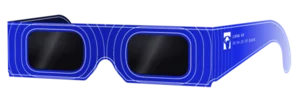
Certified eclipse glasses from Aura Sight
ISO 12312-2 certified, lab-tested and made by Rainbow Symphony, with a QR batch certificate on every pair. A$5.45 a pair from NSW stock, delivered Australia-wide (New Zealand too).