The short answer. For a solar eclipse, yes: everyone needs ISO 12312-2 certified eclipse glasses for the whole eclipse, and our advice is that they stay on through totality too. For a lunar eclipse, no: NASA says a lunar eclipse needs no eye protection at all. The 22 July 2028 eclipse over Australia is a solar eclipse, so glasses it is.
What is the difference between a solar and a lunar eclipse?
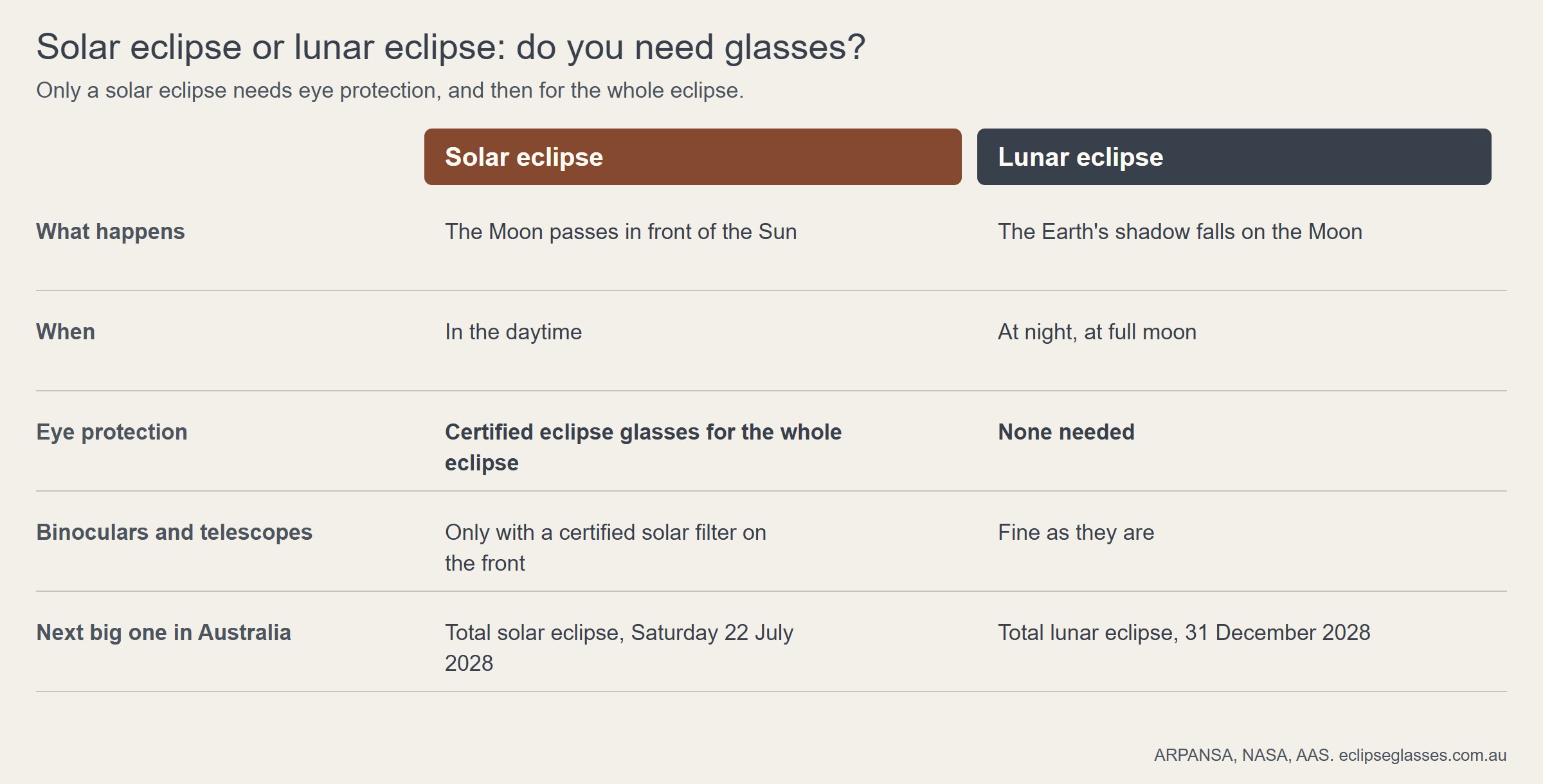
| Solar eclipse | Lunar eclipse | |
|---|---|---|
| What happens | The Moon passes in front of the Sun | The Earth's shadow falls on the Moon |
| When | In the daytime | At night, at full moon |
| Eye protection | Certified eclipse glasses for the whole eclipse | None needed |
| Binoculars and telescopes | Only with a certified solar filter on the front | Fine as they are |
| Next big one in Australia | Total solar eclipse, Saturday 22 July 2028 | Total lunar eclipse, 31 December 2028 |
The two are easy to mix up, and people search for "lunar eclipse glasses" every time the Moon turns red. There is no such thing. Eclipse glasses block almost all visible light, so at night you would see nothing through them at all. Keep them for the daytime eclipse in July.
Why do you need glasses for a solar eclipse?
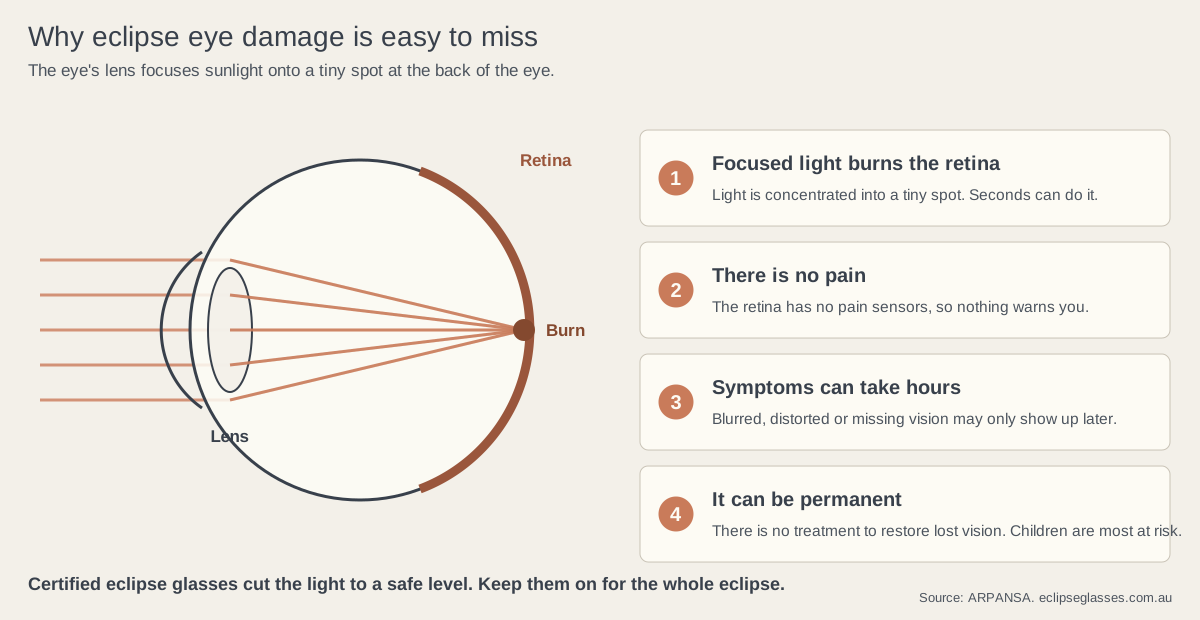
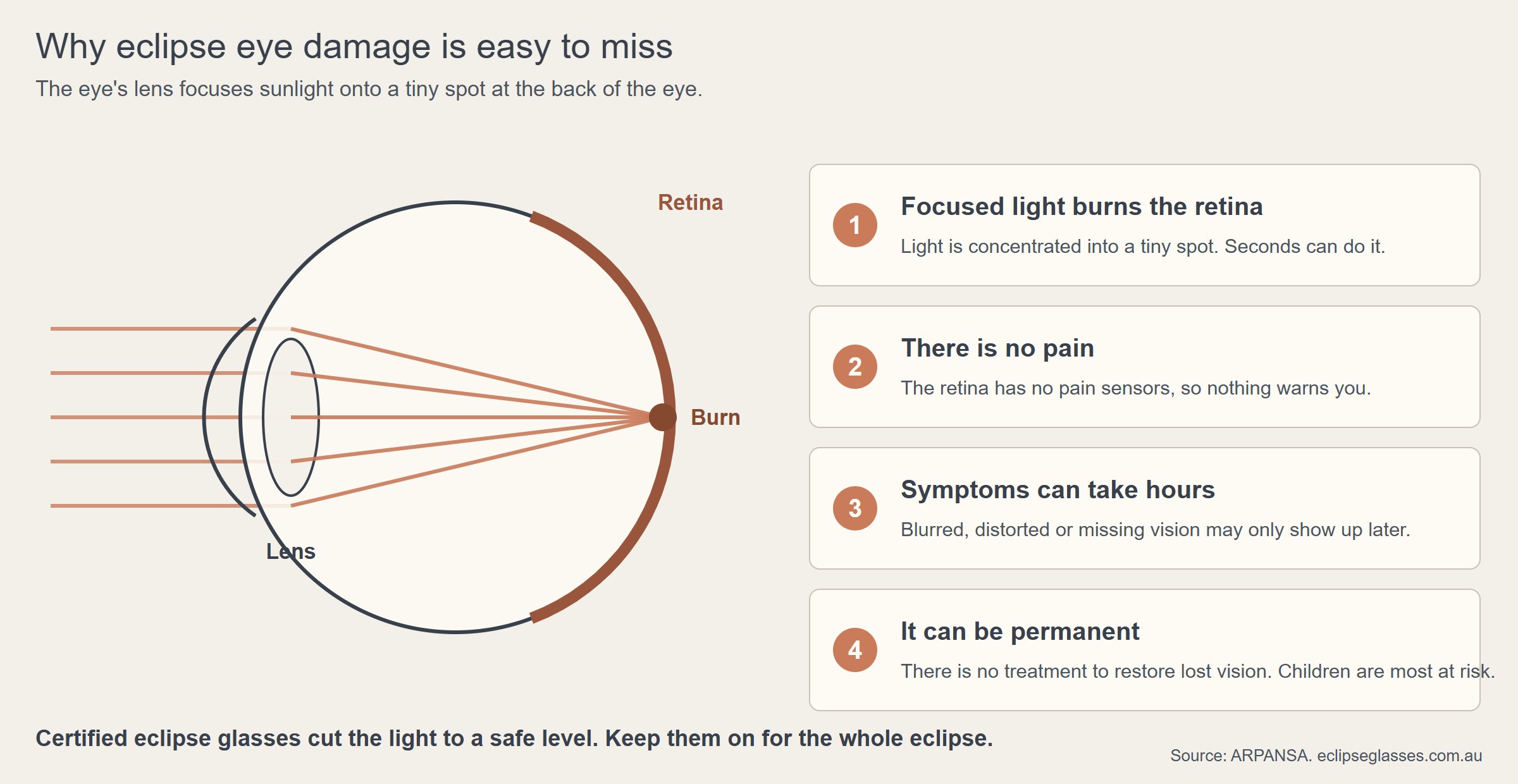
Because the uncovered part of the Sun is still bright enough to burn your retina, and an eclipse tempts people to keep watching. The damage can happen in seconds. The retina has no pain sensors and symptoms may not appear for hours, so there is no warning, and the damage can be permanent. Children are especially at risk, because young eyes let more light through to the retina.
Ordinary sunglasses, even very dark ones, are never safe. The darkest category 4 sunglasses let through 3% to 8% of visible light. Certified eclipse glasses let through about 0.003% or less, which is thousands of times darker. Our guide on why you need eclipse glasses explains what happens inside the eye.
Do you need glasses during totality?
Our advice is yes: keep them on for the whole eclipse, totality included. ARPANSA, the Australian Government's radiation safety agency, advises never to observe a total, partial or annular eclipse with the naked eye. Totality lasts only a few minutes, it is only total inside a narrow path, and the bright Sun returns in an instant. Glasses on from start to finish takes the guesswork out of it.
Most of Australia will not get totality at all. Newcastle reaches 99.7% and Canberra 96.1%, and both are partial eclipses with no safe moment. Check your own town on the 2028 eclipse map and our guide to eclipse times in every capital city.
Why doesn't a lunar eclipse need glasses?
A lunar eclipse happens at night, and the Moon only reflects sunlight. Even a full moon is far too dim to harm your eyes, and during the eclipse it gets darker still, often turning a coppery red. NASA says every phase of a lunar eclipse is fine with the naked eye, binoculars or a telescope, and that eye protection is only needed for solar eclipses.
Australia gets a good one soon after the solar eclipse: a total lunar eclipse on 31 December 2028. Space.com lists it as visible from Australia, Asia, Europe, Africa and the Pacific. You need no glasses or filters for it.
What should you never use instead of eclipse glasses?
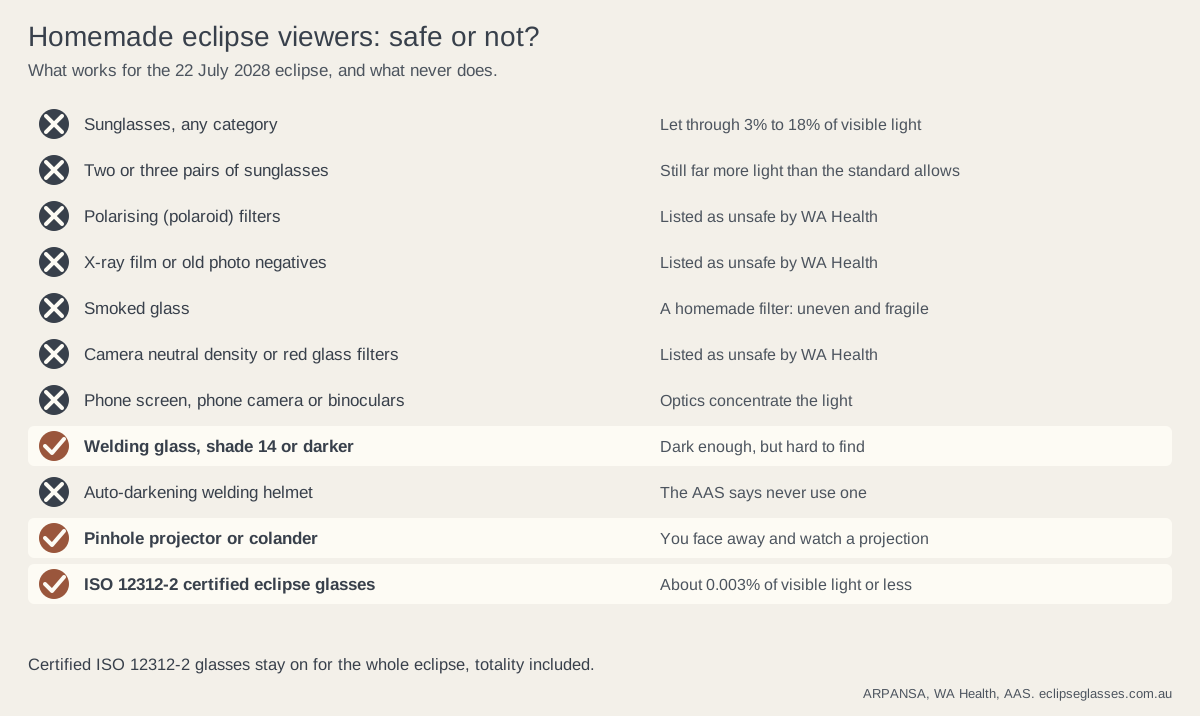
Sunglasses, X-ray film, smoked glass, polarising filters and homemade filters are not safe, however dark they look. Phones, cameras, binoculars and telescopes are worse: without a certified solar filter on the front, they concentrate the light. Our guide to homemade eclipse viewers goes through each one, including the pinhole projector, which is safe but shows you a small projected image rather than the eclipse itself.
What glasses should you buy?
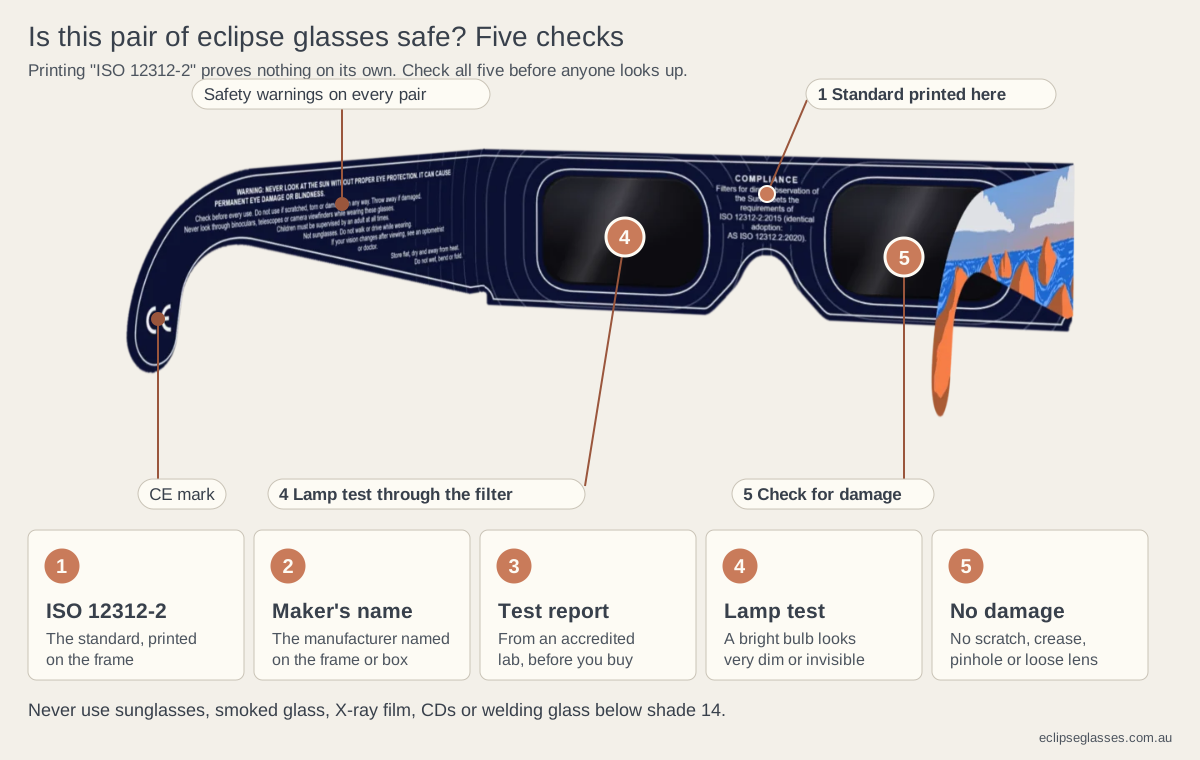
- The filter meets ISO 12312-2. In Australia the same standard is AS ISO 12312.2:2020.
- The maker's name and address are printed on the pair, and the maker is on the American Astronomical Society list of reputable vendors.
- The pair is undamaged: no scratches, tears, creases or punctures.
Our certified eclipse glasses (also called eclipse shades) are made by Rainbow Symphony, the maker of Eclipse Shades® and a manufacturer on the AAS list, and tested to ISO 12312-2:2015 by ICS Laboratories. Every pair has a QR code that links to its batch certificate. They are A$5.45 a pair, or A$19.25 for a family eclipse kit of four, delivered Australia-wide. Our guide on where to buy safe eclipse glasses covers the checks in detail.
FAQ
Do you really need glasses to watch a solar eclipse?
Yes. The uncovered part of the Sun can burn the retina in seconds, with no pain and no warning. Everyone needs ISO 12312-2 certified eclipse glasses for the whole eclipse.
Do you need glasses for a lunar eclipse?
No. A lunar eclipse needs no eye protection. NASA says every phase is fine with the naked eye, binoculars or a telescope.
Do you need glasses during totality?
Our advice is to keep certified glasses on for the whole eclipse, totality included. ARPANSA advises never to observe a total, partial or annular eclipse with the naked eye.
Are sunglasses enough for a solar eclipse?
No. Even the darkest sunglasses let through 3% to 8% of visible light. Certified eclipse glasses let through about 0.003% or less.
Is the 2028 eclipse in Australia solar or lunar?
Solar. On Saturday 22 July 2028 the Moon passes in front of the Sun, with totality from the Kimberley to Sydney. Everyone needs certified eclipse glasses.
When is the next total lunar eclipse in Australia?
31 December 2028, according to Space.com. It needs no eye protection.
Sources
All checked 12.11.2026.
- ARPANSA, Solar eclipse.
- Astronomical Society of Australia, How to view the eclipse; American Astronomical Society, Solar eclipse eye safety and the ISO 12312-2 standard.
- NASA Scientific Visualization Studio, Total lunar eclipse, March 2025 (lunar eclipses need no eye protection); NASA, Eclipse safety.
- Space.com, When is the next lunar eclipse? (31 December 2028 total lunar eclipse).
- Sunglass categories from AS/NZS 1067.1:2016. Coverage figures from NASA eclipse elements, as on our eclipse map.
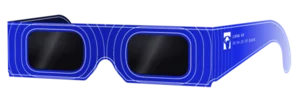
Certified eclipse glasses from Aura Sight
ISO 12312-2 certified, lab-tested and made by Rainbow Symphony, with a QR batch certificate on every pair. A$5.45 a pair from NSW stock, delivered Australia-wide (New Zealand too).