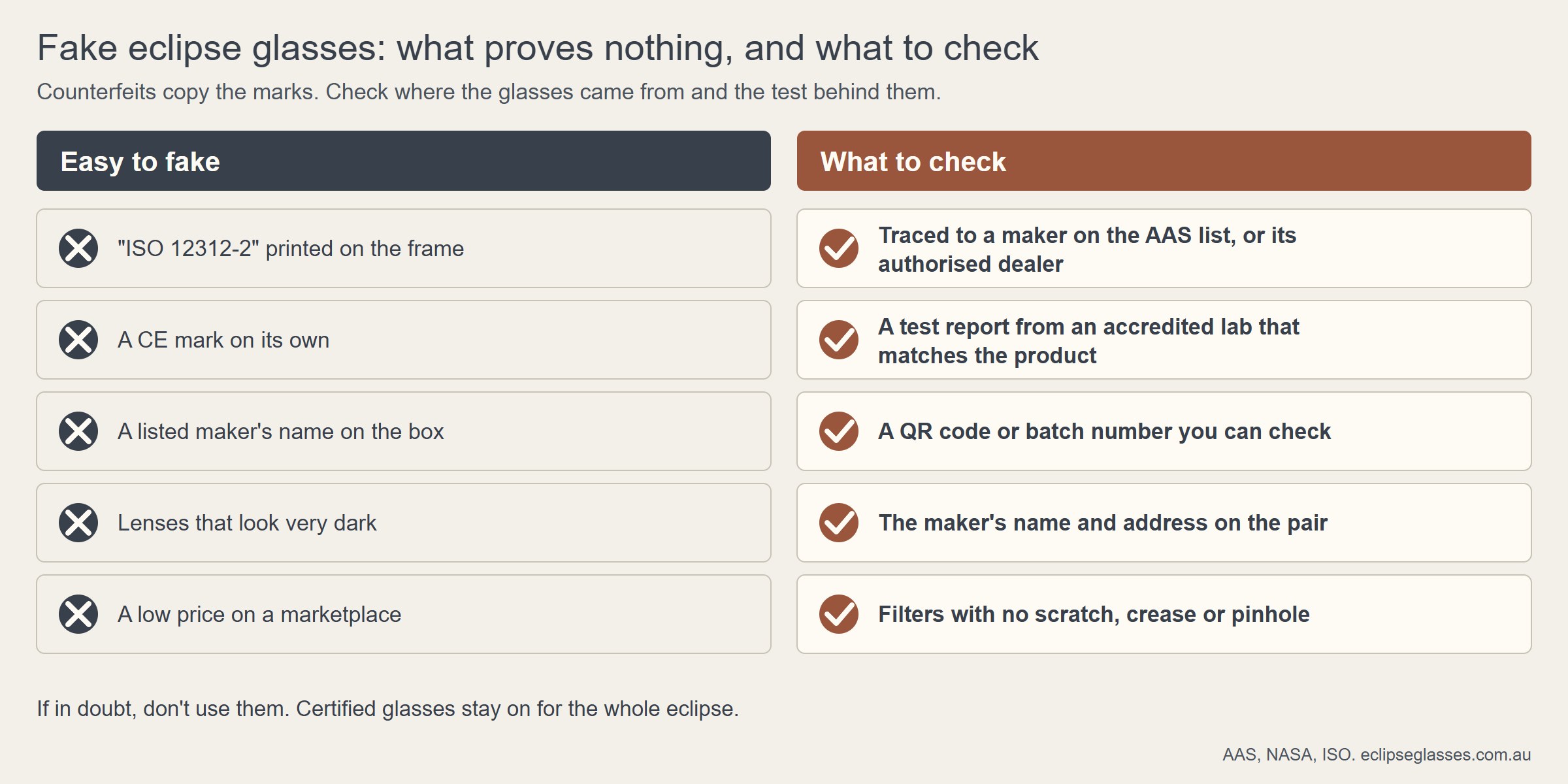
The short version. You can't tell real eclipse glasses from fakes by the printing. Counterfeits copy the ISO 12312-2 mark, CE marks and even the names of real makers. What counts is where the pair came from: a maker on the American Astronomical Society list or one of its authorised dealers, a test report from an accredited laboratory that matches the product, and a batch code or QR code you can check. If you can't trace a pair, don't use it.
What do fake eclipse glasses copy?
Counterfeits copy whatever is printed on a pair. Before the 2024 eclipse in North America, the American Astronomical Society (AAS) warned that some companies had printed the name of a manufacturer on its list on their own products, so a listed name on the box is not proof. Many fakes before the 2017 and 2024 eclipses also carried "ISO 12312-2" without ever being tested, and most of them turned up on online marketplaces. A CE mark on its own does not show a filter meets ISO 12312-2 either.
Our account of how eclipse glasses sold out in the US twice shows why fakes appear: they arrive just as real stock runs short, close to the date.
How do you check a pair is real?
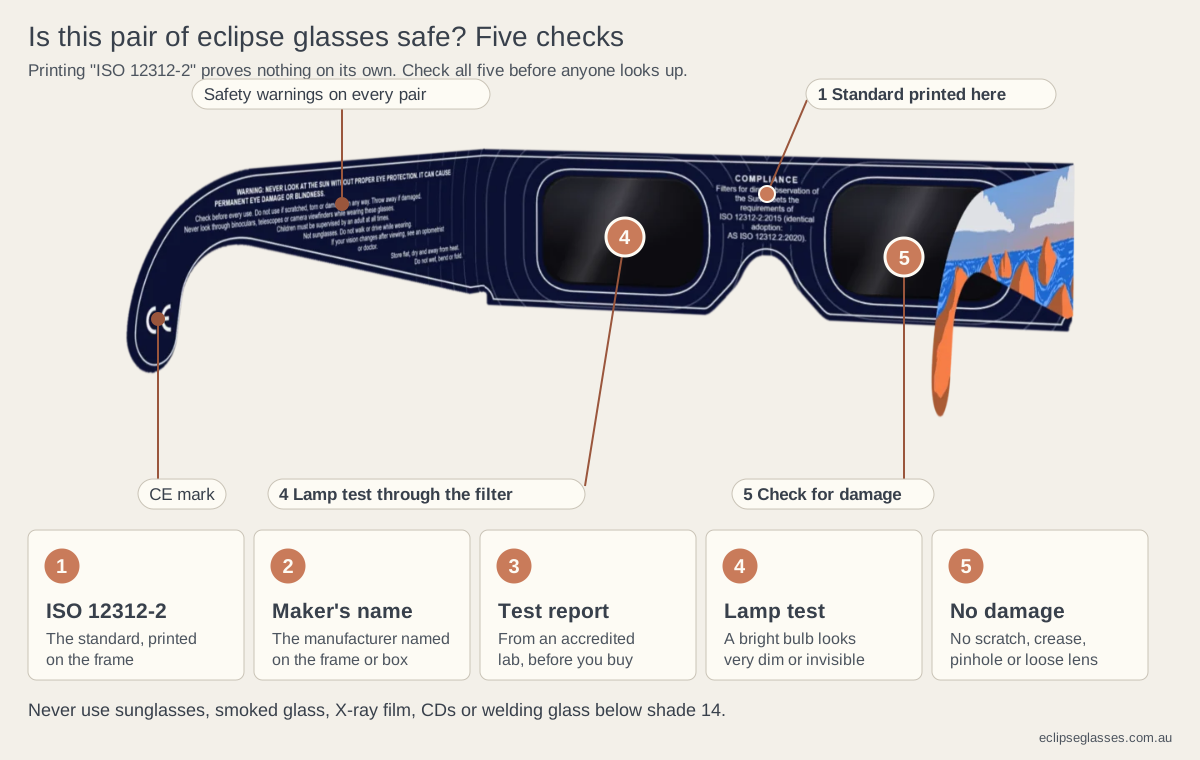
- Find the ISO 12312-2 mark. It must be there (sometimes as ISO 12312-2:2015), but on its own it proves nothing.
- Find the maker's name and address on the pair, as NASA advises. If there is none, don't use the pair.
- Check the maker is on the AAS list. The AAS keeps a list of reputable manufacturers and asks them to publish their own authorised dealers. Buy from the maker or one of those dealers. The AAS no longer vets resellers itself.
- Ask the seller for the report from an accredited laboratory, and check that the lab, the maker and the product on the report match the pair in your hand.
- Scan the QR code or check the batch code. It ties the pair to a tested batch.
- Check the condition. Filters with any scratch, crease, tear or pinhole go in the bin, real or not.
Never test a pair by looking at the Sun through it. If a pair fails any step, or you are left unsure, use a pair you can trace instead.
How does a QR batch certificate help?
Every pair of our glasses carries a QR code that opens the certificate for its batch. The glasses are made by Rainbow Symphony, a manufacturer on the AAS list, and the filter is tested by ICS Laboratories, an A2LA-accredited lab. Scanning the code links the pair in your hand to that test.
A QR code can be copied too, so check where it leads. It should open on the seller's or maker's own website, and name the same maker and product as the pair. Our certification page shows what our certificate covers.
Are there fake eclipse glasses in Australia?
So far the reports have come from overseas. Before the 2023 eclipse at Exmouth, WA Consumer Protection told the ABC it had received no complaints about fake glasses. The 2028 eclipse is a different scale: totality crosses the country from the Kimberley to Sydney, and every Australian gets at least a partial eclipse. Expect the same pattern as the US. Online marketplaces fill up in the final weeks, and that is where most fakes turned up in 2017 and 2024.
The safest plan is to buy early, from a seller who names the maker and shows the test report. Our guide to where to buy eclipse glasses in Australia compares the options.
What about the ACCC and product safety?
The ACCC runs Product Safety Australia, which sets a mandatory standard for sunglasses and fashion spectacles. Its page on that standard does not mention eclipses, and sunglasses are never safe for an eclipse anyway, however dark. If you find eclipse glasses on sale that you think are unsafe, you can report them to the ACCC with its unsafe product report form. Tell the seller, and the marketplace if you bought online, too.
What if you already bought a pair you aren't sure about?
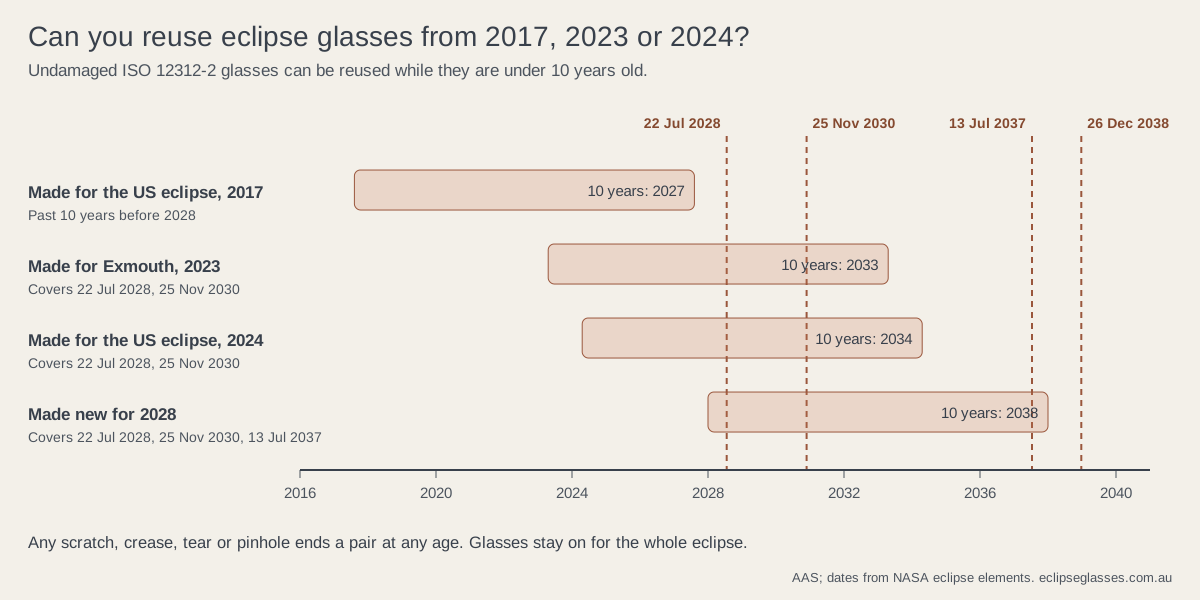
Ask the seller for the maker's name and the test report. If they can't give you both, or the maker is not on the AAS list, replace the glasses. The same goes for old pairs from 2023 or 2024: our guide to reusing old eclipse glasses covers the 10-year rule and the damage check. Children need the most care of all, so see eclipse glasses for kids before you hand any pair to a child.
FAQ
How can I tell if eclipse glasses are fake?
You can't tell from the printing alone. Check the maker is on the American Astronomical Society list or that you bought from its authorised dealer, ask for an accredited test report that matches the product, and check the batch or QR code.
Is the ISO 12312-2 mark enough?
No. Counterfeits print the mark too. It must be on the pair, but the maker, the dealer and the test report are what prove it.
Is a CE mark enough for eclipse glasses?
No. A CE mark on its own does not show a filter meets ISO 12312-2. Look for ISO 12312-2 and the maker's name and address as well.
Are eclipse glasses on online marketplaces safe?
Some are and some are not, and you can't tell from the listing. Before the 2017 and 2024 US eclipses, marketplaces were where most fakes turned up. Buy from a listed maker or one of its authorised dealers.
Where do I report unsafe eclipse glasses in Australia?
Use the ACCC's unsafe product report form on productsafety.gov.au, and tell the seller or marketplace too.
Is Aura Sight on the AAS list?
No. The list names manufacturers, not resellers. Our glasses are made by Rainbow Symphony, a manufacturer on the list, and every pair has a QR code that links to its batch certificate.
Sources
All checked 12.11.2026.
- American Astronomical Society, How can you tell if your eclipse glasses are safe? (counterfeits printing listed makers' names) and Suppliers of safe solar viewers and filters; the ISO 12312-2 standard.
- NASA, Eclipse safety (maker's name and address). ISO, ISO 12312-2:2015.
- Product Safety Australia (ACCC), Sunglasses and fashion spectacles and Report an unsafe product.
- ABC News, Exmouth eclipse glasses, 26 March 2023.
- Supplier documents for our own glasses (Rainbow Symphony, ICS Laboratories), on our certification page.
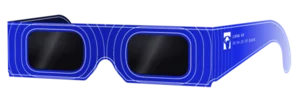
Certified eclipse glasses from Aura Sight
ISO 12312-2 certified, lab-tested and made by Rainbow Symphony, with a QR batch certificate on every pair. A$5.45 a pair from NSW stock, delivered Australia-wide (New Zealand too).