The short version. Eclipse glasses have no fixed expiry date. A pair that meets ISO 12312-2 can be reused while it is under 10 years old, as long as the filters are not scratched, punctured, torn, creased or coming loose from the frame. Glasses made for the 2023 eclipse at Exmouth or the 2024 eclipse in North America are inside that window on 22 July 2028. Glasses from the 2017 US eclipse are not. Check the label, the maker and both filters before eclipse day, and bin any pair you are unsure about.
Do eclipse glasses expire?
Not on a fixed date. The American Astronomical Society (AAS) says eclipse glasses that meet ISO 12312-2 can be reused if they are less than 10 years old and the filters are not scratched, punctured, torn, coming loose from the frame or otherwise damaged.
Some older pairs carry printed warnings to throw them away after a few years, or to use them for only a few minutes at a time. The AAS says those warnings are outdated. They do not apply to recently made glasses that meet ISO 12312-2 and are in excellent condition.
Damage is what usually ends a pair. One that sat flat in a drawer since 2023 can be fine, while one that rode around in a school bag for a week may not be.
Which old pairs are still inside the 10 years?
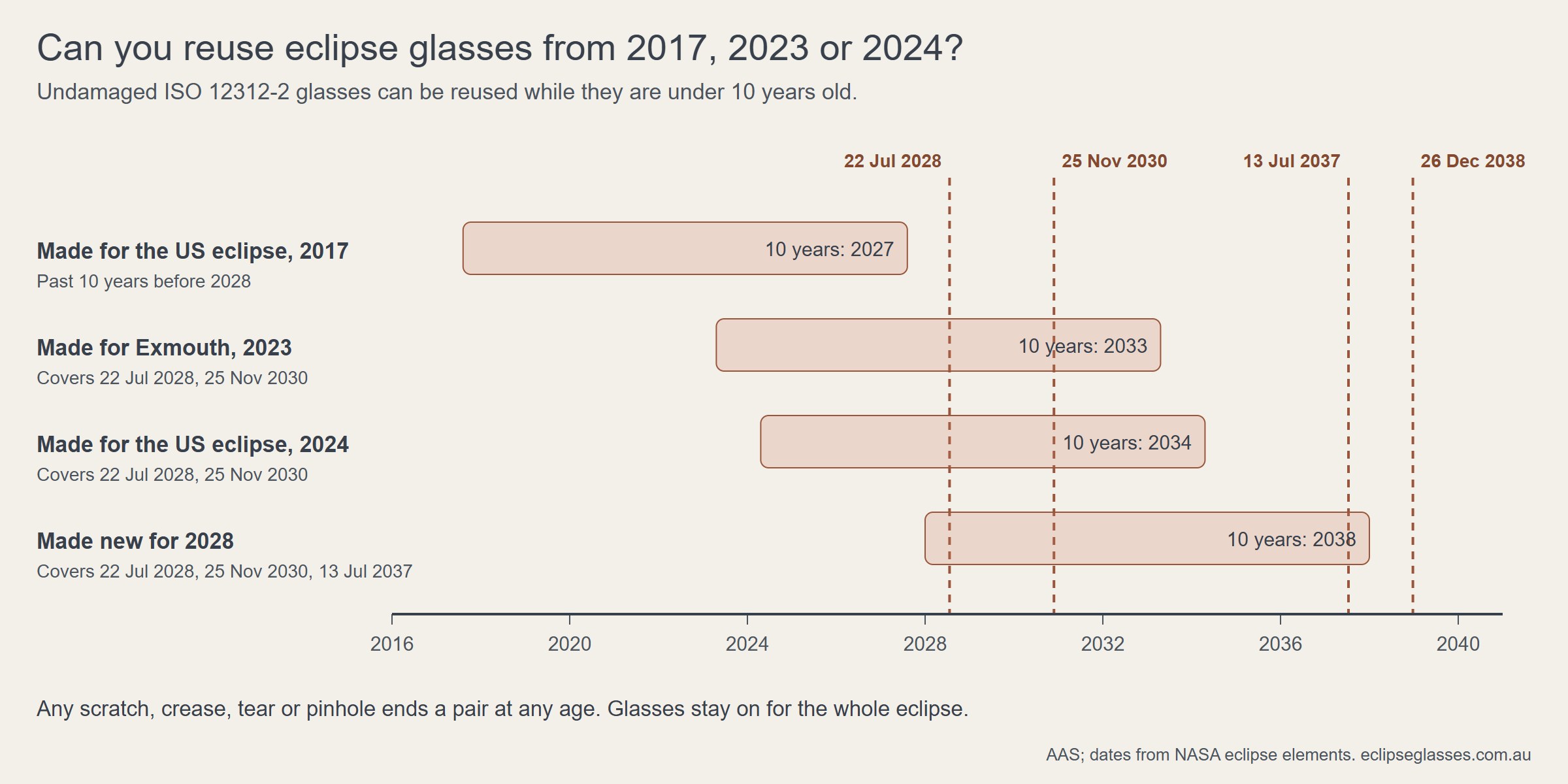
| Glasses bought for | Under 10 years on 22 July 2028? | Australian eclipses still covered |
|---|---|---|
| US eclipse, August 2017 | No | None. Past 10 years by August 2027 |
| Exmouth, WA, April 2023 | Yes | 22 July 2028 and 25 November 2030 |
| North America, April 2024 | Yes | 22 July 2028 and 25 November 2030 |
| New for 2028 | Yes | 2028, 2030 and, for pairs made after July 2027, 13 July 2037 |
The 10 years run from when a pair was made, which is usually a few months before the eclipse it was sold for. If there is no date on the pair or its packet, assume it was made before you bought it. Glasses from the 2012 eclipse in Cairns are well past 10 years, and most predate ISO 12312-2:2015 anyway.
How do you check old eclipse glasses?
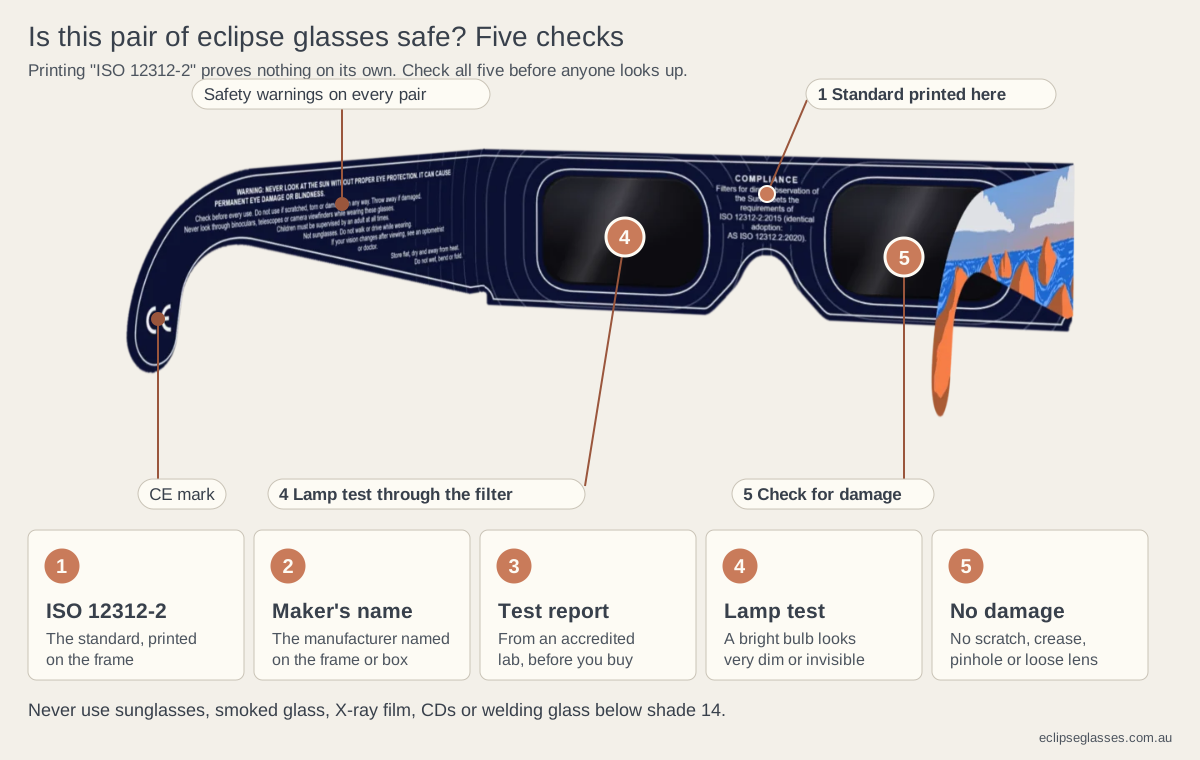
- Read the label. The pair should say ISO 12312-2 (sometimes ISO 12312-2:2015) and carry the maker's name and address. No mark, no use.
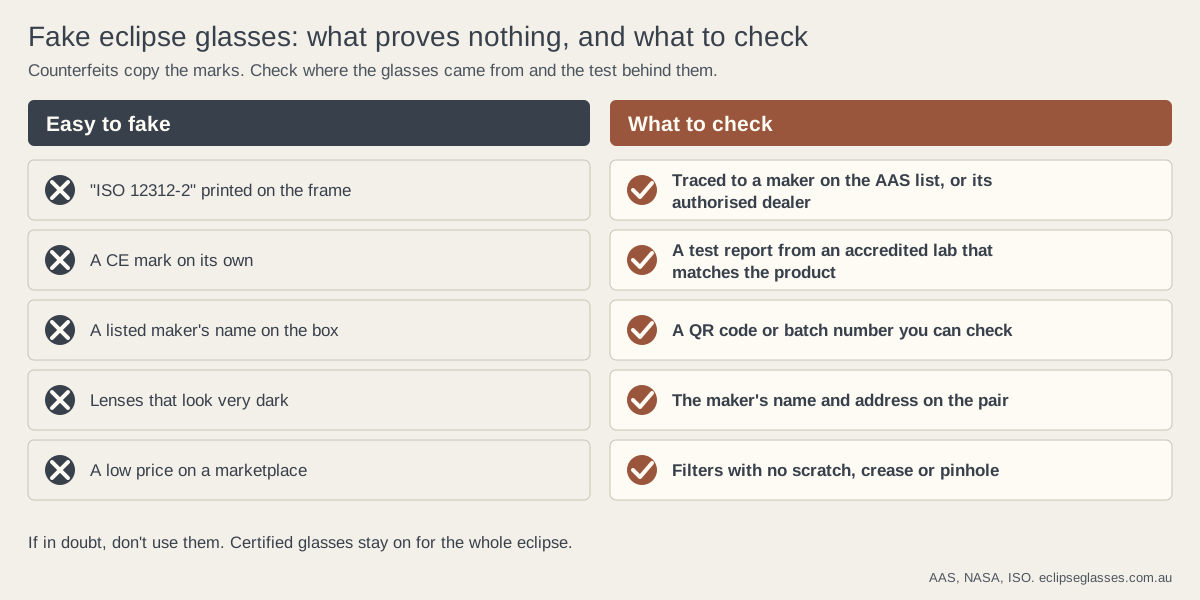
- Check the maker is on the AAS list of reputable manufacturers, or that you bought from one of its authorised dealers. Counterfeits sold before the 2024 eclipse carried the names of real makers, so a pair from a marketplace listing is a doubt. Our guide to spotting fake eclipse glasses covers this step in detail.
- Look over the filter film on both sides for scratches, punctures, tears, creases and pinholes, and check the film is still glued firmly into the frame. Any damage and the pair goes in the bin.
- Try the frame on. The arms should hold the glasses on without slipping. A split or floppy frame that will not stay on is finished, because the glasses must stay on for the whole eclipse.
Never test a pair by glancing at the Sun through it. If anything about a pair worries you, replace it: our certified eclipse glasses are A$5.45 a pair.
How should you store eclipse glasses until 2028?
The AAS says to keep them at room temperature, in the case or packet they came in, protected from scratches and punctures. In practice:
- Store them flat, in an envelope or the original sleeve, in a drawer indoors.
- Keep them out of hot cars, glove boxes and garden sheds.
- Write the year you bought them, and the maker, on the envelope.
- Keep children's pairs with the family's set, not in school bags.
When should you buy a new pair?
- The filters have any damage at all.
- You can't trace the maker, or the pair has no ISO 12312-2 mark or maker's name.
- The pair is 10 years old or more, like most glasses from 2017.
- You need more pairs. Every child needs a pair of their own, and sharing means someone waits without protection.
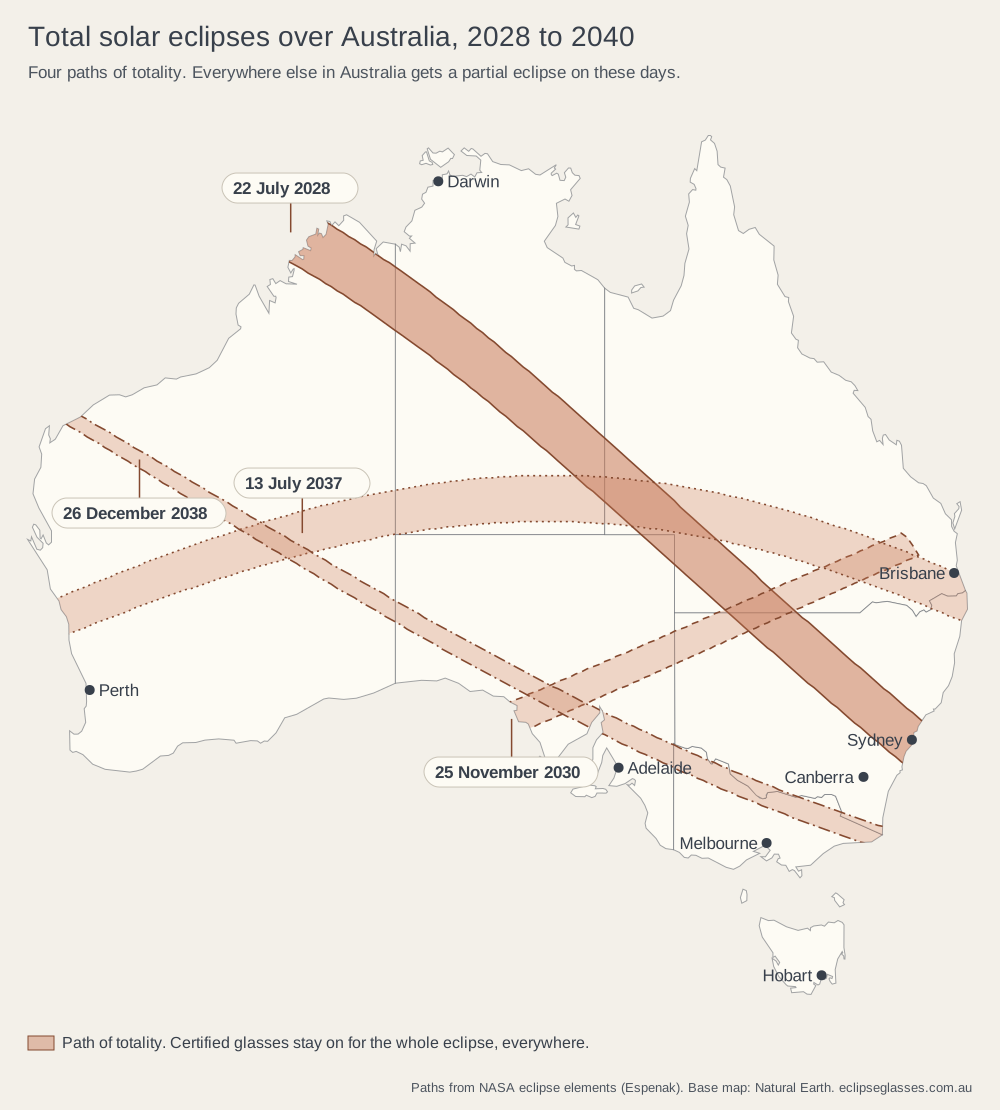
The 2028 eclipse crosses the whole country, and certified glasses ran short in the last weeks before the 2017 and 2024 eclipses in the US. Check your old pairs now, so you have time to replace them. Old or new, eclipse glasses are never for use with binoculars, telescopes or camera lenses: those need their own solar filter on the front.
FAQ
Do eclipse glasses expire?
No fixed expiry. The American Astronomical Society says ISO 12312-2 glasses under 10 years old can be reused if the filters are not scratched, punctured, torn or coming loose from the frame.
Can I use my glasses from the 2023 Exmouth eclipse in 2028?
Yes, if they meet ISO 12312-2, show the maker's name, came from a reputable maker and are undamaged. They are about five years old on 22 July 2028.
Can I use eclipse glasses from the 2017 US eclipse?
No. Glasses made in 2017 are past 10 years by the 2028 eclipse. Replace them.
My glasses say to throw them out after a few years. Is that right?
That warning is outdated, the American Astronomical Society says, for recent glasses that meet ISO 12312-2 and are in excellent condition. Age under 10 years and condition are what count.
How should I store eclipse glasses?
At room temperature, flat in their packet or an envelope, away from heat, scratches and punctures. Check them again before each eclipse.
Can old eclipse glasses be used for totality?
Undamaged certified glasses stay on for the whole eclipse, totality included. Never take them off to watch.
Sources
All checked 12.11.2026.
- American Astronomical Society, How to view a solar eclipse safely (reuse, outdated warnings, storage) and Suppliers of safe solar viewers and filters (counterfeits and authorised dealers).
- NASA, Eclipse safety (maker's name and address on the product).
- ARPANSA, Solar eclipse; Astronomical Society of Australia, How to view the eclipse.
- ISO, ISO 12312-2:2015. Eclipse dates from NASA eclipse elements, as on our next solar eclipse guide. The 10-year dates in the table are our arithmetic.
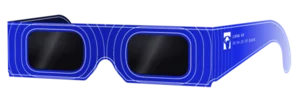
Certified eclipse glasses from Aura Sight
ISO 12312-2 certified, lab-tested and made by Rainbow Symphony, with a QR batch certificate on every pair. A$5.45 a pair from NSW stock, delivered Australia-wide (New Zealand too).