The short version. Children can and should wear certified eclipse glasses. Give each child a pair of their own, fit it in the shade before they face the eclipse, keep an adult right beside them, and keep the glasses on for the whole eclipse, totality included. Babies and toddlers who won't keep glasses on are safer with indirect viewing. 22 July 2028 is a Saturday, so most children will watch with their families, sports clubs or community events.
Why are children more at risk?
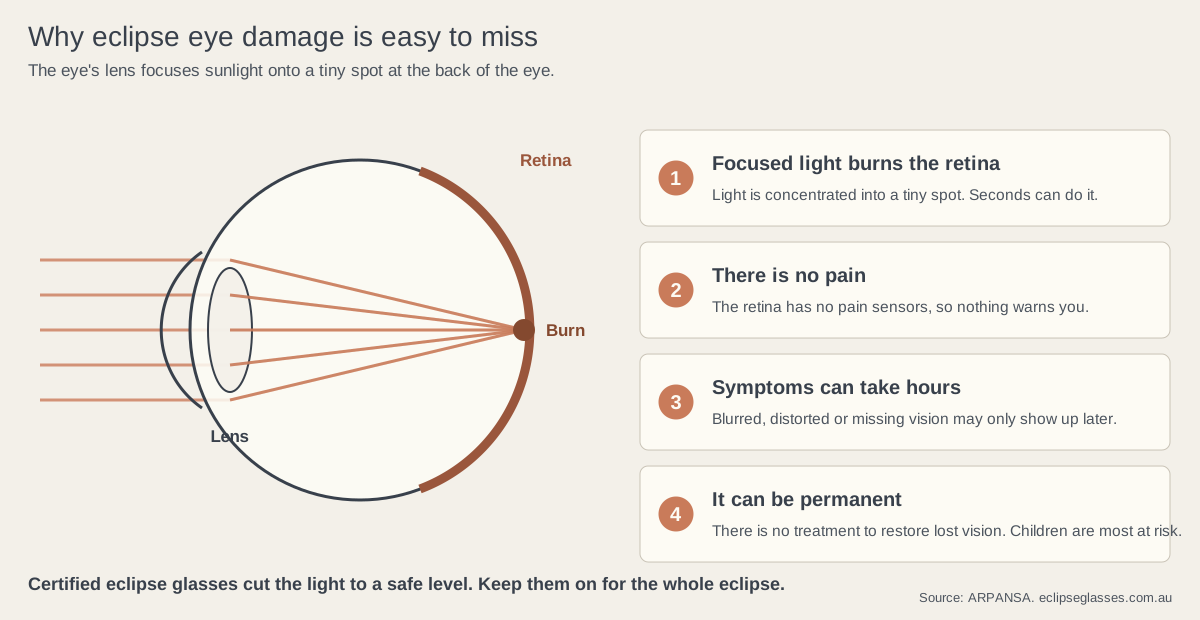
ARPANSA, the national radiation safety agency, says children are especially at risk because young eyes let more light through to the retina than adult eyes. Eclipse light can burn the retina in a matter of seconds. The retina feels no pain, and the damage may not show for hours, so a child gets no warning and may not tell anyone. The damage can be permanent.
Children are also curious, quick and easily distracted, which is why ARPANSA asks adults to supervise them very closely. Our guide on why you need eclipse glasses explains the eye damage in more detail.
Why does each child need their own pair?
Sharing creates risky moments. While one child has the glasses, the other is waiting with nothing between their eyes and the eclipse, and swaps happen at the most exciting points. A pair of their own means:
- No waiting turn, so no unprotected peeking.
- The pair is fitted to that child before the eclipse starts.
- An adult can check that pair for damage, and write the child's name on the arm.
For a family, our family eclipse kit has four certified pairs and a printed viewing guide for A$19.25. Single pairs are A$5.45. For a group, plan on one pair per person plus about 10% spare for breakages and visitors.
How do you fit eclipse glasses on a child?
- Check both filters for scratches, creases and pinholes. Any damage, use a different pair.
- In the shade, with the child facing away from the eclipse, put the glasses on and settle the arms over their ears.
- Check both eyes are covered by the filters, and that the frame stays put when they nod and turn their head.
- If a child wears prescription glasses, keep them on and put the eclipse glasses over the top.
- Only then can they turn and face the eclipse.
Our paper eclipse glasses are one size for adults and children from about age five. If a frame slides on a small face, the child holds it in place with both hands, and the adult beside them keeps an eye on it.
What about babies, toddlers and preschoolers?
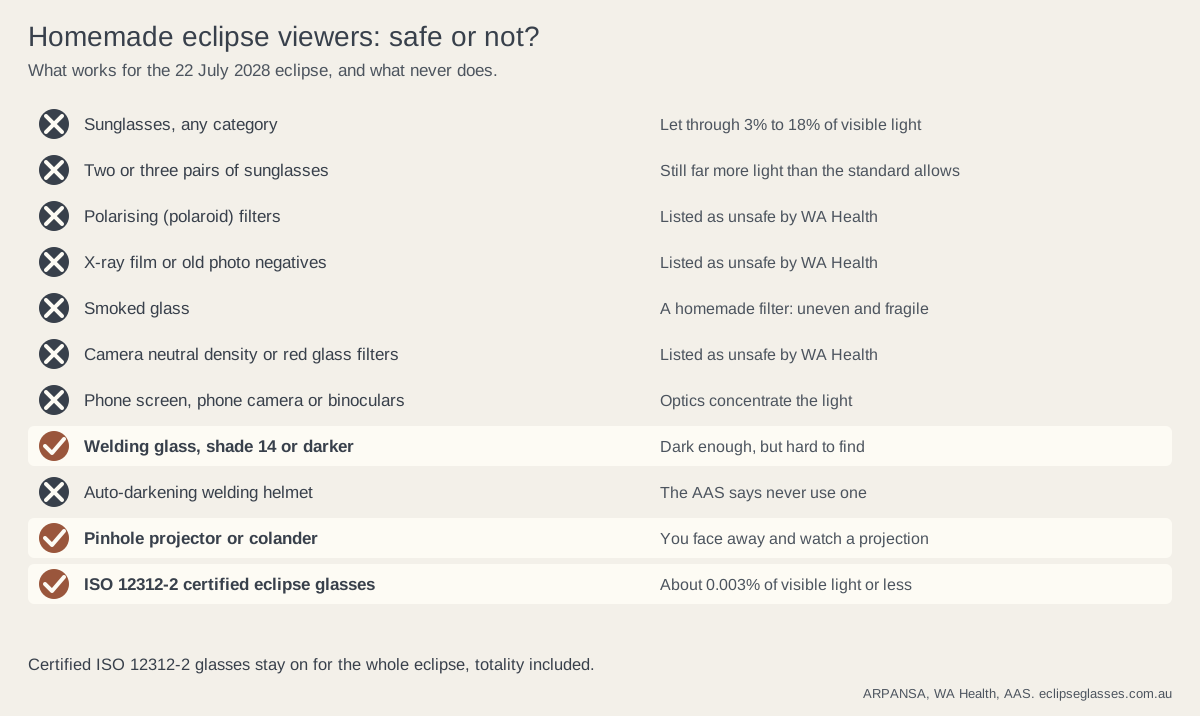
If a child is too young to keep glasses on reliably, don't rely on glasses. Keep them in the shade and use indirect viewing instead. ARPANSA rates indirect viewing, such as pinhole projection or a livestream, as the safest way to watch an eclipse. A colander held over the ground casts a dozen little crescents that toddlers love, and they are watching a shadow, not the sky. Our guide to homemade eclipse viewers shows how to make a pinhole projector.
What does close supervision look like?
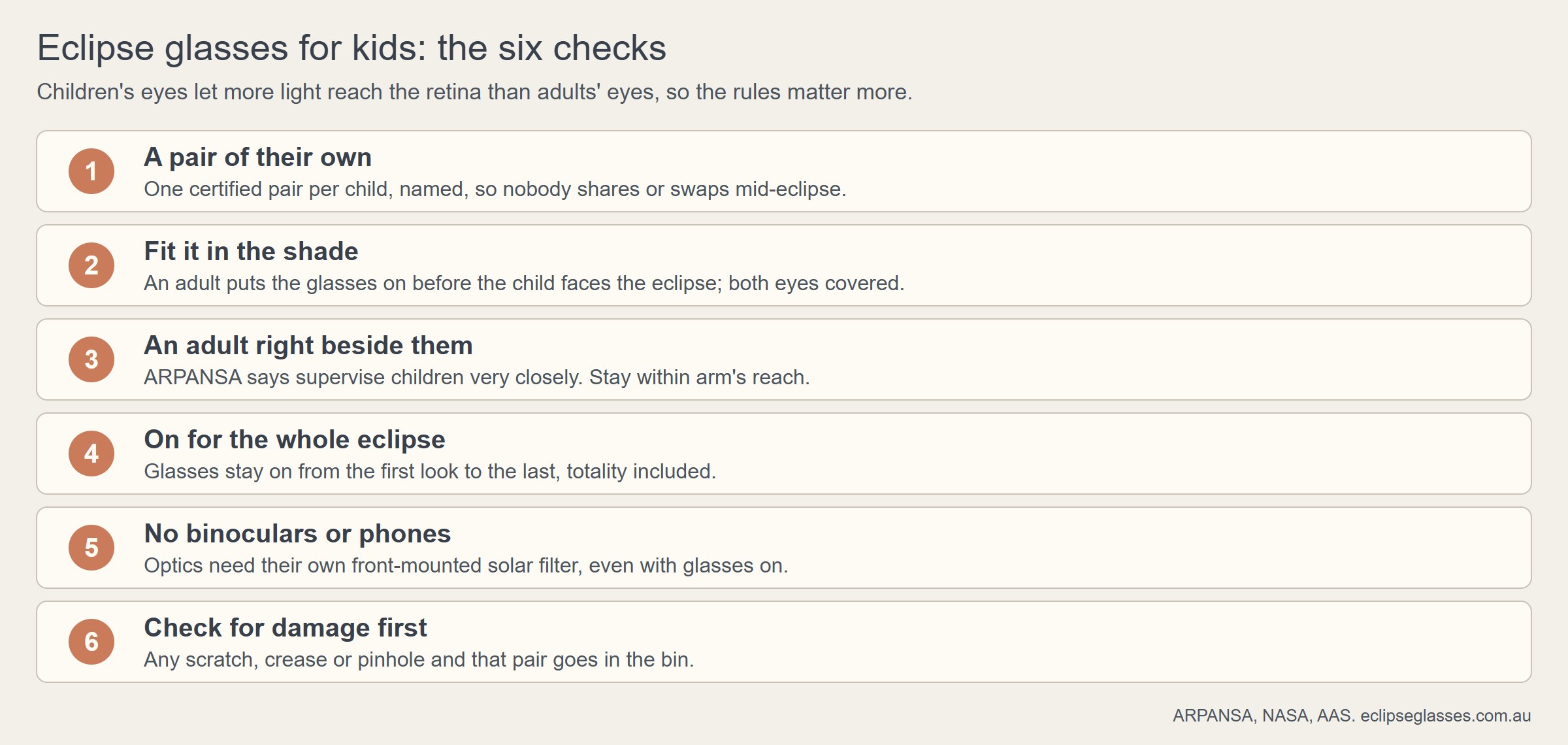
- An adult stays within arm's reach of each young child, wearing their own glasses.
- Teach the rules before the day: glasses on before you face the eclipse, and on until you have turned away again.
- Glasses stay on through totality too. No peeking over or around the frame.
- No binoculars, phones, cameras or telescopes. They concentrate the light and burn through eclipse glasses, so they need their own solar filter fitted over the front.
- Plan breaks in the shade. A whole eclipse lasts over two hours, which is a long time for a small child.
What should schools and childcare centres plan for?
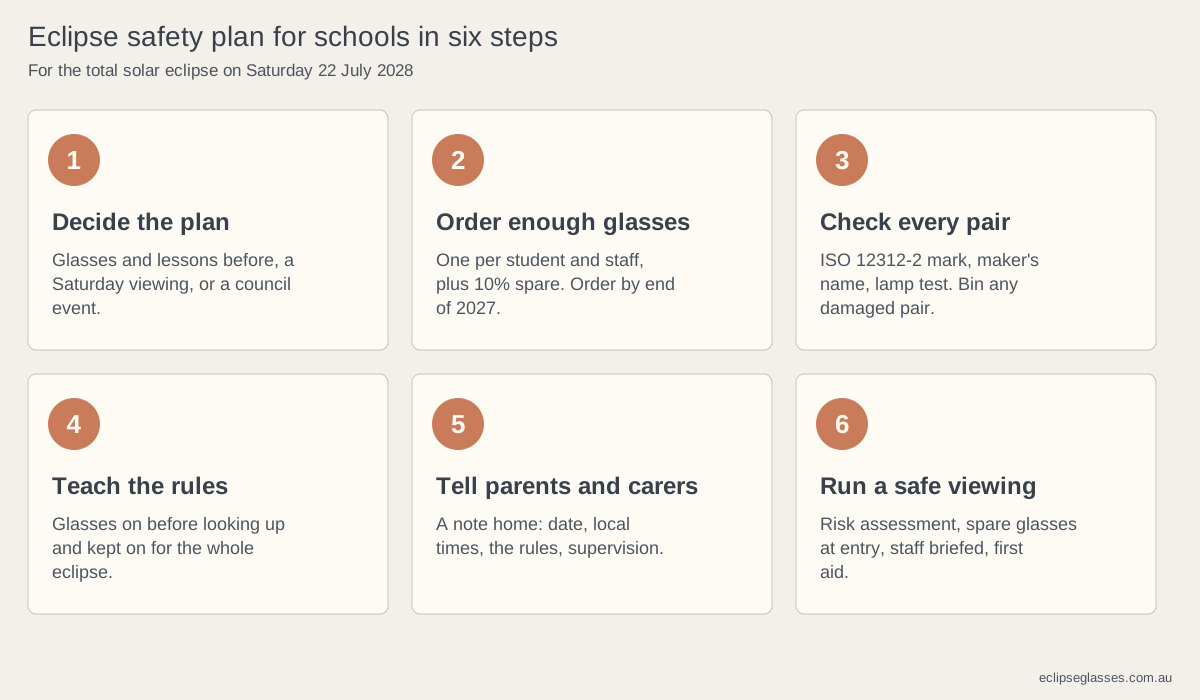
The eclipse falls on a Saturday, so the big job for schools is the week before: lessons, the safety rules, permission notes and glasses sent home with every student. Some schools will also run a Saturday viewing for families. Our eclipse safety plan for schools sets out the steps, and eclipse glasses for schools covers bulk orders.
Childcare centres, vacation care and holiday programs open on Saturday 22 July need the same plan on a smaller scale:
- A certified pair for every child old enough to wear one, and every staff member.
- Indirect viewing, or time indoors, for babies and toddlers.
- A note to parents beforehand, saying how the eclipse will be handled.
- Enough staff outside that every child is closely supervised.
Junior sport is on that Saturday too. Clubs can pause play across the eclipse, with glasses for players, coaches and parents on the sideline, rather than have children playing with the eclipse overhead.
Do children need glasses during totality?
Glasses stay on for the whole eclipse, totality included. Totality is short, the light changes fast at either end, and a child can't judge the timing. Keeping the glasses on is the only rule a child can follow without getting it wrong. The guide to what happens during totality has plenty for children to notice around them: the sudden dark, the temperature drop and the birds going quiet.
FAQ
What age can children wear eclipse glasses?
Our paper eclipse glasses fit children from about age five. Younger children who won't keep glasses on are safer with indirect viewing, such as a pinhole projector or a livestream.
Can children share eclipse glasses?
It is better not to. While one child has the glasses the other waits unprotected, and swaps happen at the exciting moments. Give each child their own pair.
Can a child wear eclipse glasses over prescription glasses?
Yes. Keep their prescription glasses on and put the eclipse glasses over the top.
Do children need eclipse glasses for a partial eclipse?
Yes. Never let anyone watch a partial, total or annular eclipse with the naked eye. Every part of Australia gets at least a partial eclipse on 22 July 2028.
Is the 2028 eclipse on a school day?
No. Saturday 22 July 2028 is a weekend, so schools prepare students in the week before, and some run a Saturday viewing for families.
How closely should children be supervised?
Very closely, ARPANSA says. An adult within arm's reach of each young child, wearing their own glasses, for the whole eclipse.
Sources
All checked 12.11.2026.
- ARPANSA, Solar eclipse (children's eyes, supervision, eye damage, indirect viewing).
- Astronomical Society of Australia, How to view the eclipse (prescription glasses, supervision).
- American Astronomical Society, How to view a solar eclipse safely; NASA, Eclipse safety (supervision, optics).
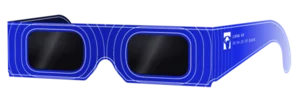
Aura Sight glasses for everyone watching
ISO 12312-2 certified and lab-tested, with a QR batch certificate on every pair. The family kit has four pairs and a printed viewing guide.