The short version. Everyone outdoors on the afternoon of 22 July 2028 needs a certified pair of their own. The eclipse lasts over two and a half hours, and all of it needs eye protection. Sunglasses never count. Check each pair for damage before you use it, and keep binoculars, cameras and telescopes away unless they have their own solar filter on the front.
When are eclipse glasses needed on 22 July 2028?
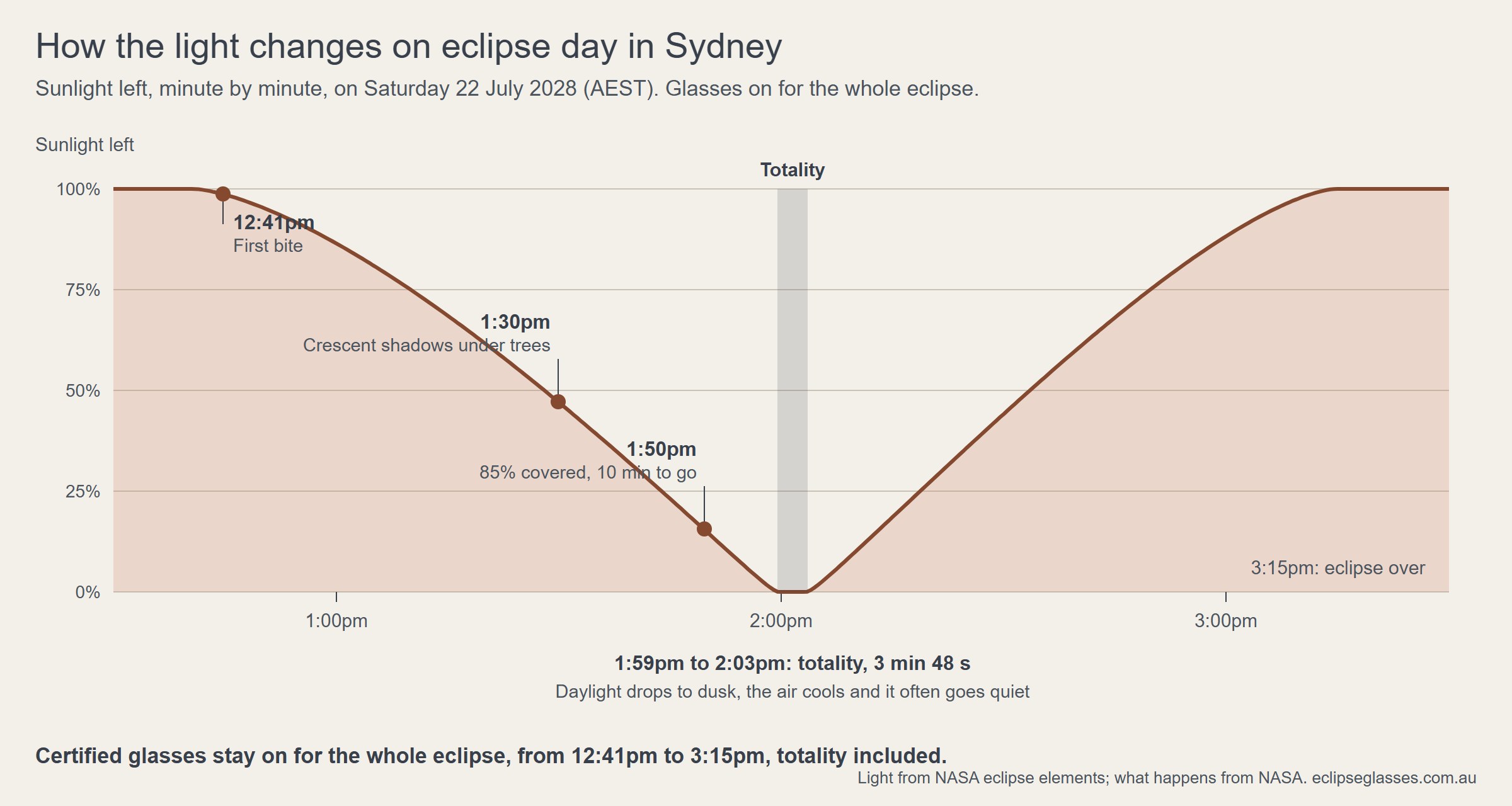
For the whole eclipse, not just the famous part. In the Sydney CBD it unfolds like this:
- 12:41pm AEST. The Moon starts to cover the Sun. Nothing seems different yet, but this is when glasses go on.
- 12:41pm to 1:59pm. The partial phase. The light dims slowly for well over an hour, and most people barely notice it.
- 1:59pm. Totality, for 3 minutes 48 seconds. Day turns to dusk.
- To 3:15pm. The partial phase again, in reverse, until the Moon moves off.
Times shift by a few minutes, or more, across Australia, and our eclipse map gives yours. The pattern is the same everywhere: a long partial eclipse that needs eye protection from start to finish.
Are they needed outside the path of totality?
Yes, and this is where most Australians will be. Outside the narrow path the eclipse stays partial the whole time:
- Newcastle gets 99.7% of the Sun covered and Canberra 96.1%.
- Brisbane gets 81.5%, Melbourne 81.3%, Adelaide 76.2% and Hobart 73.3%.
- Perth gets about half, at 50.1%.
Even 99.9% is still a partial eclipse, and the thin crescent left over is bright enough to burn the retina. ARPANSA, the national radiation safety agency, says never to try to observe a total, partial or annular eclipse with the naked eye. Our guide to towns just outside the path lists more places.
Are eclipse glasses needed during totality?
Our rule is simple: certified glasses stay on for the whole eclipse, totality included. Totality is short, the light changes fast at either end, and in a crowd nobody can judge the seconds reliably. Keeping the glasses on is the one rule every adult and child can follow without getting it wrong. Our guide to what happens during a total solar eclipse covers what you will notice around you as day turns to dusk.
Why are they needed at all?
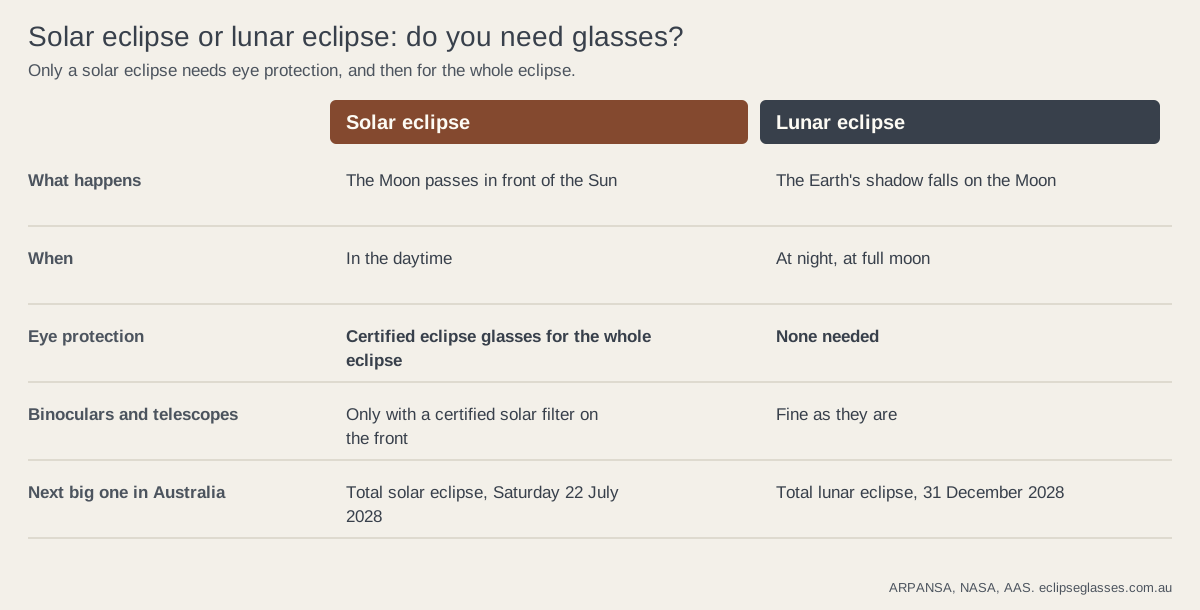
Because the light from a partial eclipse can burn the retina in seconds, with no pain and no warning. Our guide on why you need eclipse glasses explains the eye damage, and do you need glasses for an eclipse? covers solar versus lunar eclipses.
Who needs a pair?
- Everyone outdoors that afternoon, one pair each. Sharing leaves someone waiting with no protection.
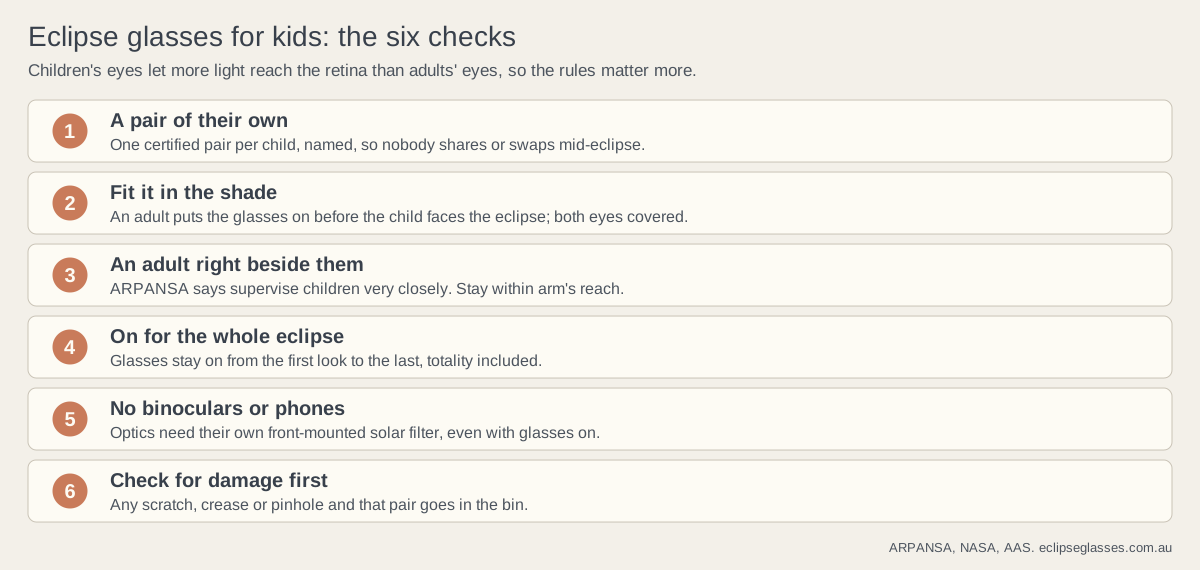
- Children, with an adult close beside them. ARPANSA asks adults to supervise children very closely. See eclipse glasses for kids.
- People who wear prescription glasses. Keep them on and wear the eclipse glasses over the top.
- Groups, schools, clubs and events. Plan on one pair per person plus about 10% spare. Our guide to how many eclipse glasses an event needs does the sums.
Single pairs are A$5.45, and our family eclipse kit has four certified pairs and a printed viewing guide for A$19.25.
What doesn't count as eclipse glasses?
- Sunglasses, even very dark ones. Safe eclipse filters are thousands of times darker.
- Homemade filters, such as smoked glass, X-ray film or stacked sunglasses.
- Welding glass lighter than shade 14, and any adjustable or auto-darkening welding helmet.
- Binoculars, cameras, phones and telescopes on their own. They concentrate the light and burn through eclipse glasses, so they need their own solar filter on the front.
With no glasses on the day, indirect viewing is safe: a pinhole projector, or a colander casting crescents onto the ground, with your back to the eclipse. ARPANSA rates indirect viewing, such as pinhole projection or a livestream, as the safest way of all. More in homemade eclipse viewers, safe or not.
How do you know a pair is safe?
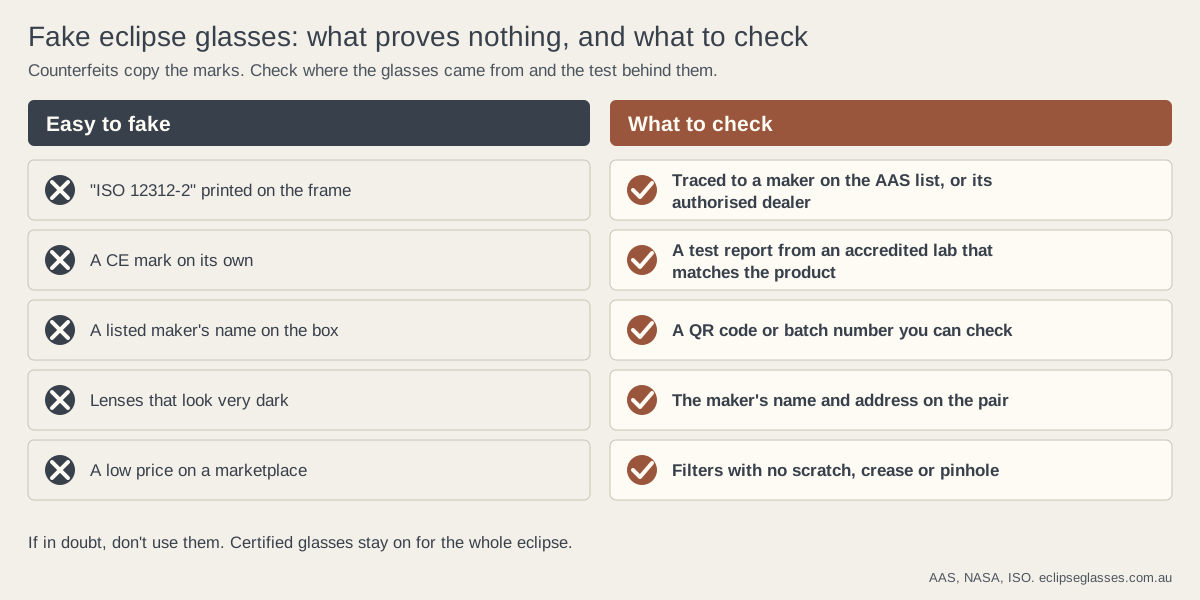
- It meets ISO 12312-2, the international standard for eclipse glasses. Standards Australia adopted it unchanged as AS ISO 12312.2:2020.
- The maker's name and address are on the pair.
- The maker is on the American Astronomical Society's reputable vendors list, or you bought from one of its authorised dealers. Counterfeiters print listed names too, so a name alone is not enough.
- The filters have no scratches, creases, tears or pinholes.
- Older pairs are under 10 years old and undamaged.
A CE mark on its own does not show a filter meets ISO 12312-2. Our glasses are made by Rainbow Symphony, a manufacturer on the AAS list, are tested by ICS Laboratories, and carry a QR code to their batch certificate. See how our glasses are certified, and our guide to spotting fake eclipse glasses.
Eclipse day checklist
- Buy certified glasses early, one pair per person plus spares. In the US, glasses sold out before its big eclipses.
- Check every pair for damage the night before, and write names on the arms.
- On the day, put glasses on in the shade, facing away, before you face the eclipse.
- Keep them on for the whole eclipse, totality included.
- No binoculars, cameras or phones pointed at the eclipse without a front-mounted solar filter.
- Keep young children within arm's reach the whole time.
- Anyone with eye discomfort or vision changes afterwards should see their local optometrist promptly.
FAQ
Are eclipse glasses needed for a partial eclipse?
Yes. Never face a partial, total or annular eclipse with the naked eye. Every part of Australia gets at least a partial eclipse on 22 July 2028, so everyone outdoors that afternoon needs certified glasses to watch it.
Are eclipse glasses needed during totality?
Our rule is that certified glasses stay on for the whole eclipse, totality included. Totality is short, the light changes fast at either end, and keeping the glasses on is the one rule everyone in a group can follow without getting the timing wrong.
How long do I need eclipse glasses for on 22 July 2028?
For the whole eclipse. In Sydney it runs from 12:41pm to 3:15pm AEST, over two and a half hours, with totality from 1:59pm. Glasses go on before you face the eclipse and stay on for the whole eclipse.
Do I need eclipse glasses if I live outside the path of totality?
Yes. Outside the path the eclipse is partial the whole time, from about half the Sun covered in Perth to 99.7% in Newcastle. A partial eclipse can still burn the retina in seconds.
Do eclipse glasses from 2023 or 2024 still work?
They can. Glasses that meet ISO 12312-2 can be reused while under 10 years old, if the filters are not scratched, punctured, torn or coming loose. Check them before you use them.
Sources
All checked 13.11.2026.
- ARPANSA, Solar eclipse (naked-eye warning, retinal burns, no pain, permanent damage, children, supervision, indirect viewing).
- Astronomical Society of Australia, How to view the eclipse (ISO 12312-2, prescription glasses, damaged pairs).
- NASA, Eclipse safety (thousands of times darker than sunglasses, optics, maker's name and address).
- American Astronomical Society, How to view a solar eclipse safely and reputable vendors (10-year reuse, counterfeits, welding helmets, pinhole projection).
- Standards Australia, media release, 18 September 2025 (AS ISO 12312.2:2020).
- Optometry Australia, eclipse media release, April 2023 (see your optometrist about eye symptoms).
- Eclipse times and coverage calculated from NASA eclipse elements.
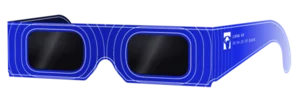
Certified eclipse glasses from Aura Sight
ISO 12312-2 certified, lab-tested and made by Rainbow Symphony, with a QR batch certificate on every pair. A$5.45 a pair from NSW stock, delivered Australia-wide (New Zealand too).