Definition. A solar eclipse is when the Moon passes between the Sun and Earth and blocks some or all of the Sun's light. What you get depends on where you stand and how far away the Moon is that day.
Types of solar eclipse: key facts
What are the 4 types of solar eclipse?
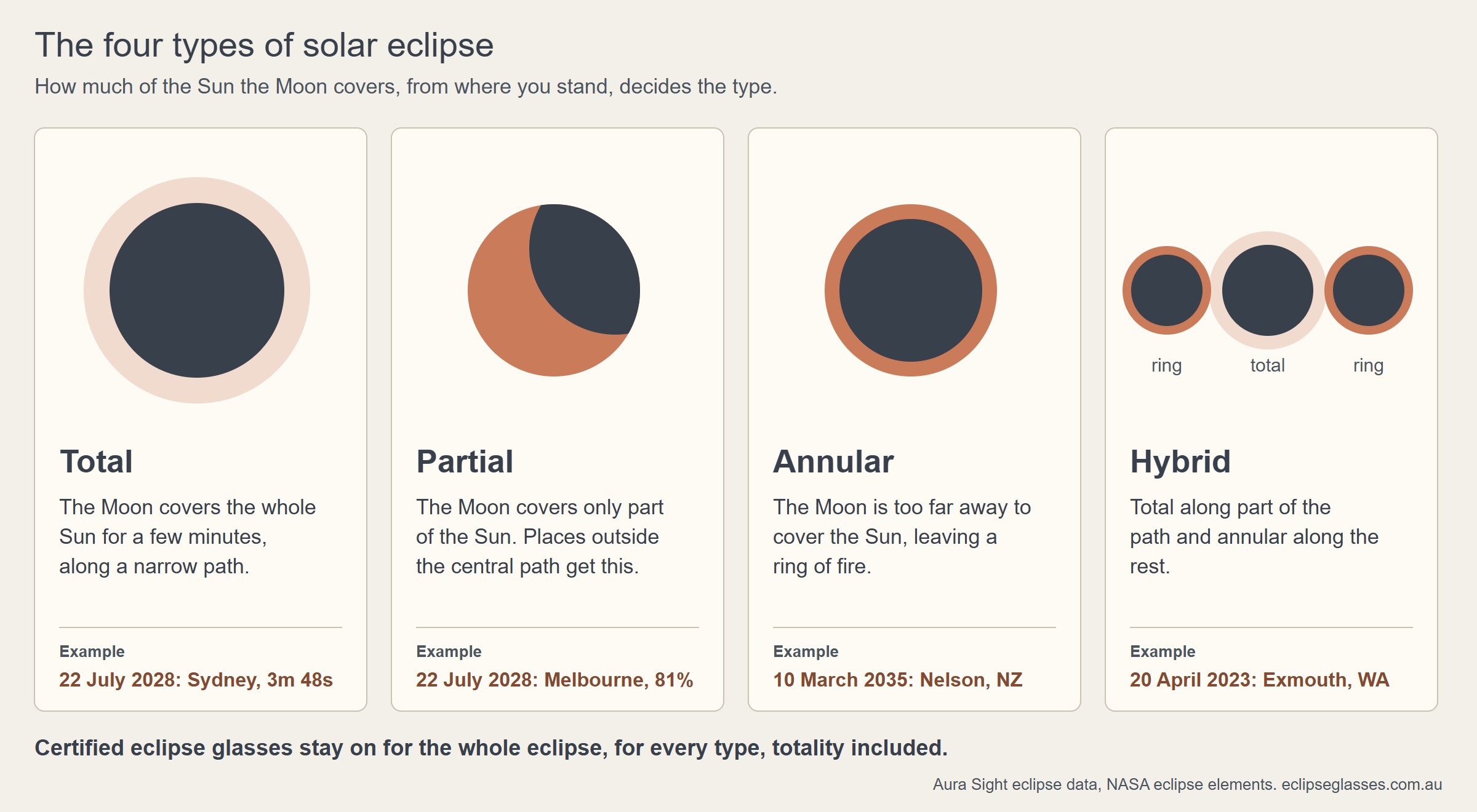
Every solar eclipse is one of four types. NASA names them by what the Moon does to the Sun along the centre of the Moon's shadow. Away from that centre, everyone gets a partial eclipse.
Total solar eclipse
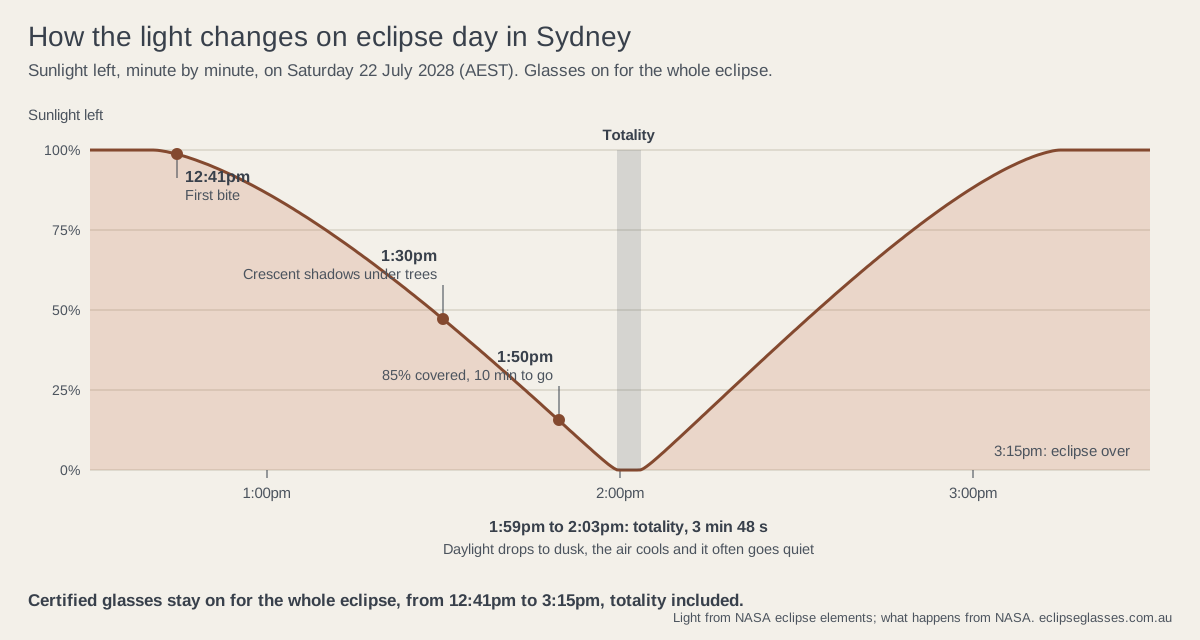
A total solar eclipse is when the Moon fully covers the Sun for a few minutes. It only happens inside a narrow path of totality, usually a couple of hundred kilometres wide. During totality the sky darkens to something like dusk, the brightest stars and planets come out, and the Sun's outer atmosphere, the corona, shows as a pale glow around the black Moon. On 22 July 2028 totality lasts up to 5 minutes 10 seconds in the central Kimberley and 3 minutes 48 seconds in the Sydney CBD. Read what happens during a total eclipse.
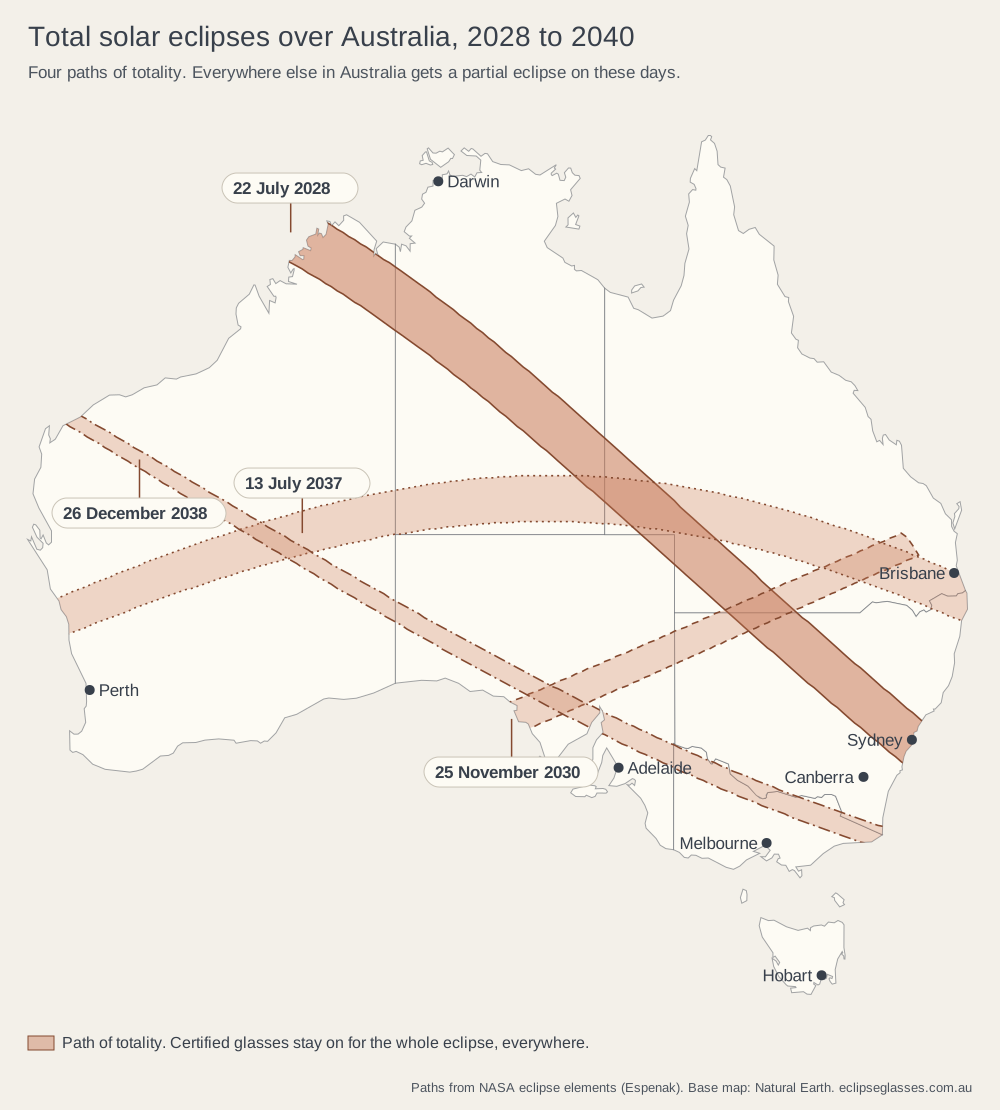
After 2028, Australia gets three more total eclipses by 2038: 25 November 2030 across South Australia and the corner country, 13 July 2037 from Geraldton to the Gold Coast and New Zealand's North Island, and 26 December 2038.
Partial solar eclipse
A partial solar eclipse is when the Moon covers only part of the Sun, so it looks as if a bite has been taken out of it. This is the type most people get, because the area that sees a partial eclipse is thousands of kilometres wide. On 22 July 2028 everywhere in Australia outside the path gets a partial eclipse: Melbourne has 81% of the Sun covered and Perth about half. Some eclipses are partial for everyone, such as 22 September 2025, which rose partly eclipsed in the south-east, a sunrise sliver (see the last solar eclipse in Australia). Even 99% covered is still a partial eclipse, and the thin crescent left is bright enough to burn the retina. See towns just outside the 2028 path.
Annular solar eclipse
An annular solar eclipse is when the Moon is too far from Earth to cover the Sun, so a bright ring of fire is left around it. The Moon's orbit is an oval, and near its farthest point it looks slightly smaller than the Sun. The sky dims but never gets dark the way it does at totality. Australia's recent rings of fire were 16 February 1999 and 10 May 2013, when the ring crossed from Shark Bay and the Pilbara through Tennant Creek to Cape York. The next ring of fire in Australia or New Zealand is on the morning of 10 March 2035 over New Zealand, with the ring lasting about a minute from Westport and Nelson to the Wairarapa. See the next solar eclipse in New Zealand.
Hybrid solar eclipse
A hybrid solar eclipse is total along part of its path and annular along the rest. The Moon's shadow only just reaches Earth, so where the curved surface of the Earth bulges closer to the Moon the eclipse is total, and further along it becomes a ring. The best known one here was 20 April 2023, which clipped the North West Cape of Western Australia: Exmouth had about a minute of totality. The next hybrid is on 14 November 2031, over the Pacific and Panama, and is not seen from Australia. Read more in every eclipse in Australia since 1922.
How often does each type of solar eclipse happen?
There are at least two and at most five solar eclipses every year, somewhere on Earth. NASA's catalogue of the 11,898 solar eclipses over 5,000 years (2000 BCE to 3000 CE) splits them like this:
| Type | Share of all solar eclipses | Seen from Australia or New Zealand |
|---|---|---|
| Partial | 35.3% | Every eclipse outside its central path; between 2028 and 2040, partial only on 27 February 2036 and 11 May 2040 |
| Annular | 33.2% | 10 May 2013 (WA, NT, QLD); next nearby 10 March 2035 (New Zealand) |
| Total | 26.7% | 14 November 2012, Cairns (sunrise totality); next 22 July 2028, then 2030, 2037 and 2038 |
| Hybrid | 4.8% | 20 April 2023, total at Exmouth; next 14 November 2031, over the Pacific |
So total eclipses are not rare worldwide, at roughly one every year or two. What is rare is one over your own town: Sydney's last total eclipse was in 1857, and its next is 22 July 2028.
Do you need eclipse glasses for every type of solar eclipse?
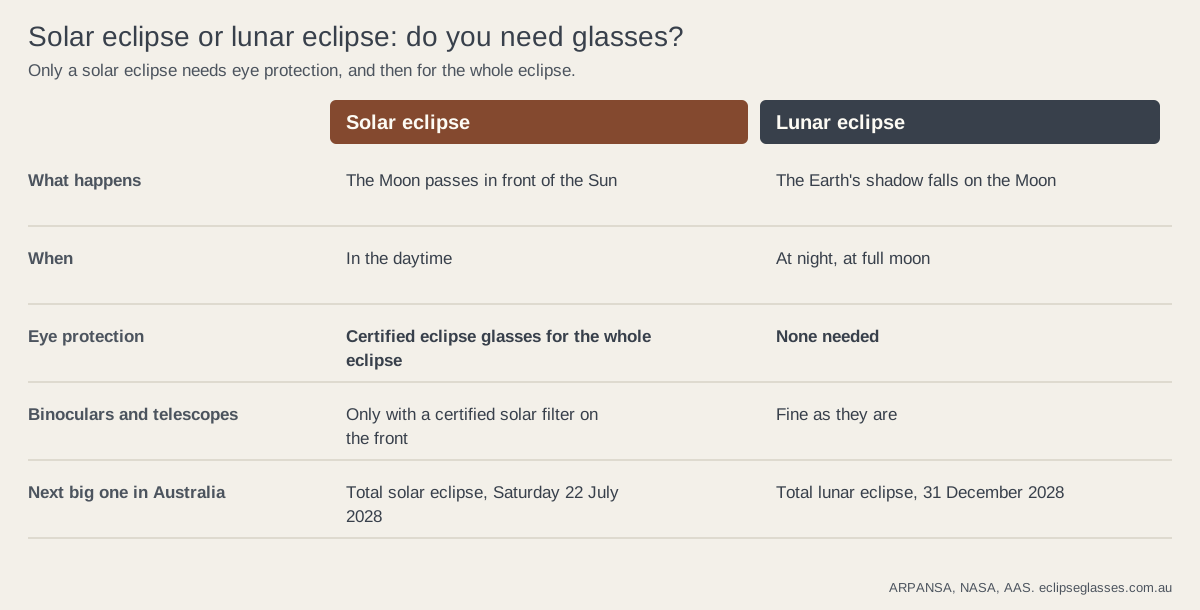
Yes. ARPANSA, the Australian Government's radiation safety agency, advises never to observe a total, partial or annular eclipse with the naked eye. Eclipse light can burn the retina in seconds, the retina feels no pain, and the damage can be permanent. Our advice is the most cautious one: keep certified glasses on for the whole eclipse, totality included, whatever the type. Cameras, binoculars and telescopes need their own solar filter on the front. A lunar eclipse is different and needs no eye protection: see solar or lunar, do you need glasses.
Every type of solar eclipse needs eye protection. Certified glasses stay on for the whole eclipse, from the first bite to the last, totality included. Ours are ISO 12312-2:2015 certified and lab-tested, A$5.45 a pair from NSW stock.
Shop eclipse glassesTypes of solar eclipse: questions
What are the 4 types of solar eclipse?
Total, partial, annular and hybrid. In a total eclipse the Moon covers the whole Sun; in a partial eclipse only part of it; in an annular eclipse the Moon is too far away and leaves a ring of fire; a hybrid eclipse is total along part of its path and annular along the rest.
What is a total solar eclipse?
A total solar eclipse is when the Moon fully covers the Sun for a few minutes, inside a narrow path of totality. Australia's next is on Saturday 22 July 2028, with 3 minutes 48 seconds of totality in the Sydney CBD.
What is the rarest type of solar eclipse?
Hybrid. Of the 11,898 solar eclipses in NASA's 5,000-year catalogue, 4.8% are hybrid, against 26.7% total, 33.2% annular and 35.3% partial.
What is a ring of fire eclipse?
An annular solar eclipse. The Moon is near its farthest from Earth, so it cannot cover the Sun and leaves a bright ring around it. The next ring of fire in Australia or New Zealand is over New Zealand on 10 March 2035.
What type was the 2023 eclipse at Exmouth?
A hybrid eclipse. It was total at Exmouth, on the North West Cape of Western Australia, for about a minute on 20 April 2023, and annular at the ends of its path.
Do you need eclipse glasses for a partial or annular eclipse?
Yes. ARPANSA advises never to observe a total, partial or annular eclipse with the naked eye. Keep certified glasses on for the whole eclipse, whatever the type, totality included.
Sources
All checked 18.11.2026.
- NASA (Fred Espenak), Five Millennium Catalog of Solar Eclipses: 11,898 eclipses, two to five a year, and the share of each type.
- NASA, decade tables of solar eclipses 2021 to 2030 and 2031 to 2040, including the 14 November 2031 hybrid.
- ARPANSA, Solar eclipse (never observe a total, partial or annular eclipse with the naked eye).
- Times and coverage calculated by Aura Sight from the NASA elements, the same method as our 2028 eclipse map.

Glasses for everyone watching
ISO 12312-2 certified and lab-tested, with a QR batch certificate on every pair. The family kit has four pairs and a printed viewing guide.