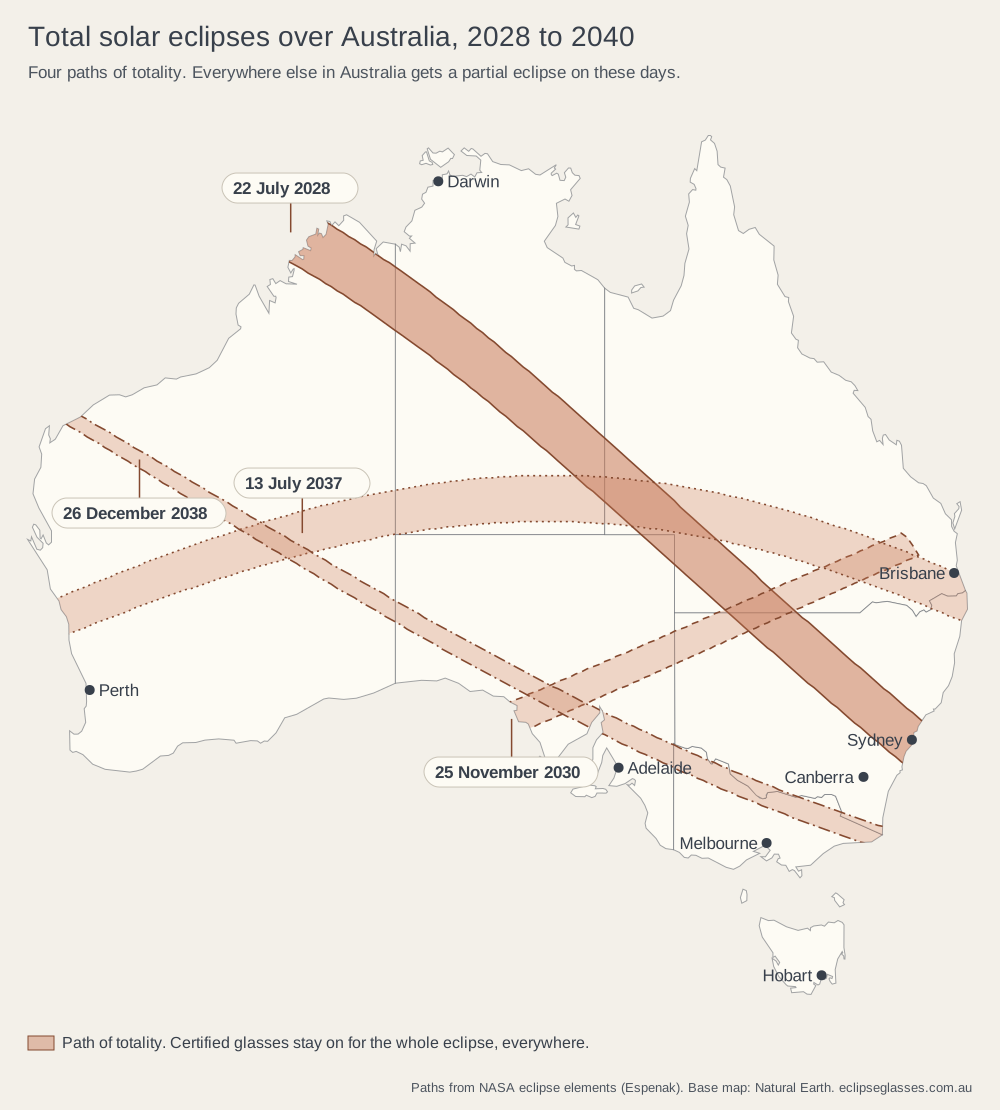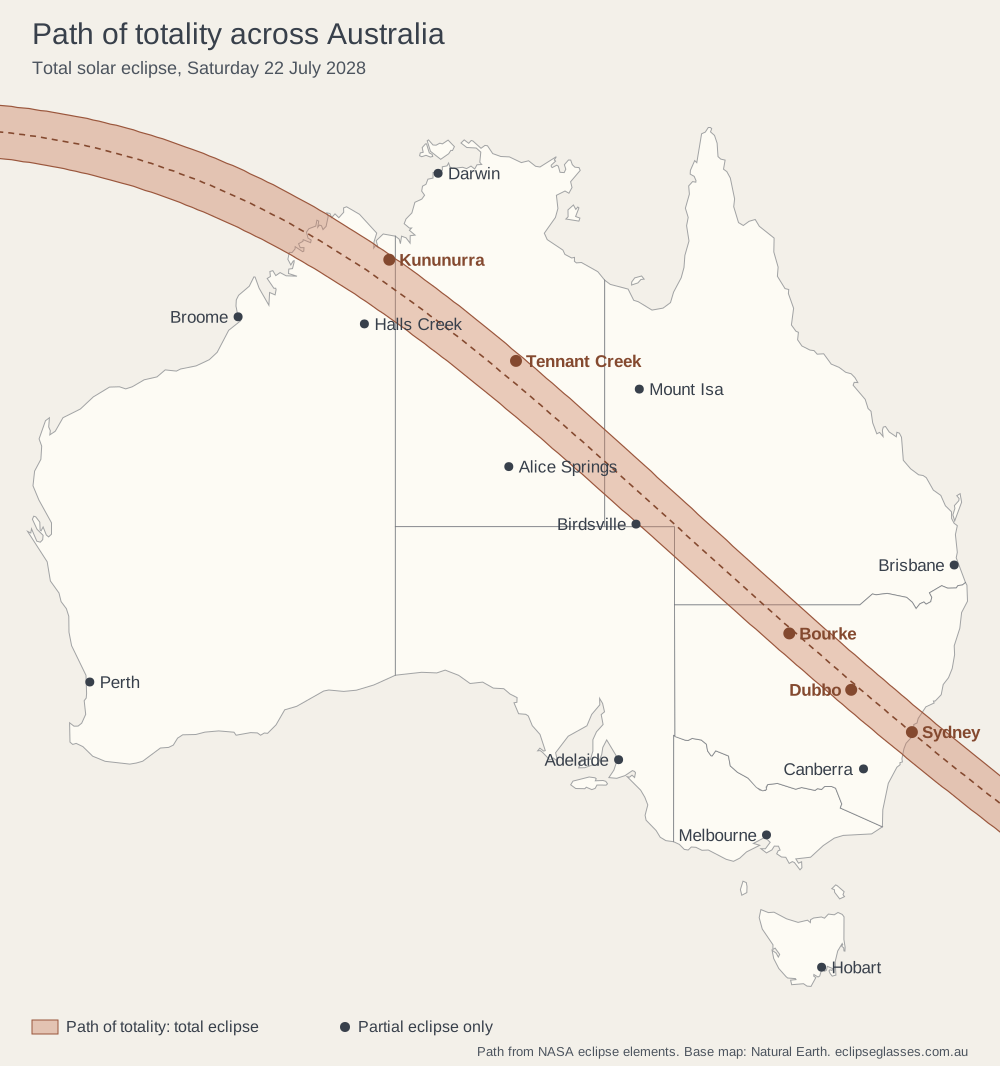
Definition. A total solar eclipse is when the Moon fully covers the Sun for a few minutes, and only inside a narrow path of totality. Outside the path the eclipse is partial.
2030 total solar eclipse: key facts
Where is the 2030 total solar eclipse in Australia?
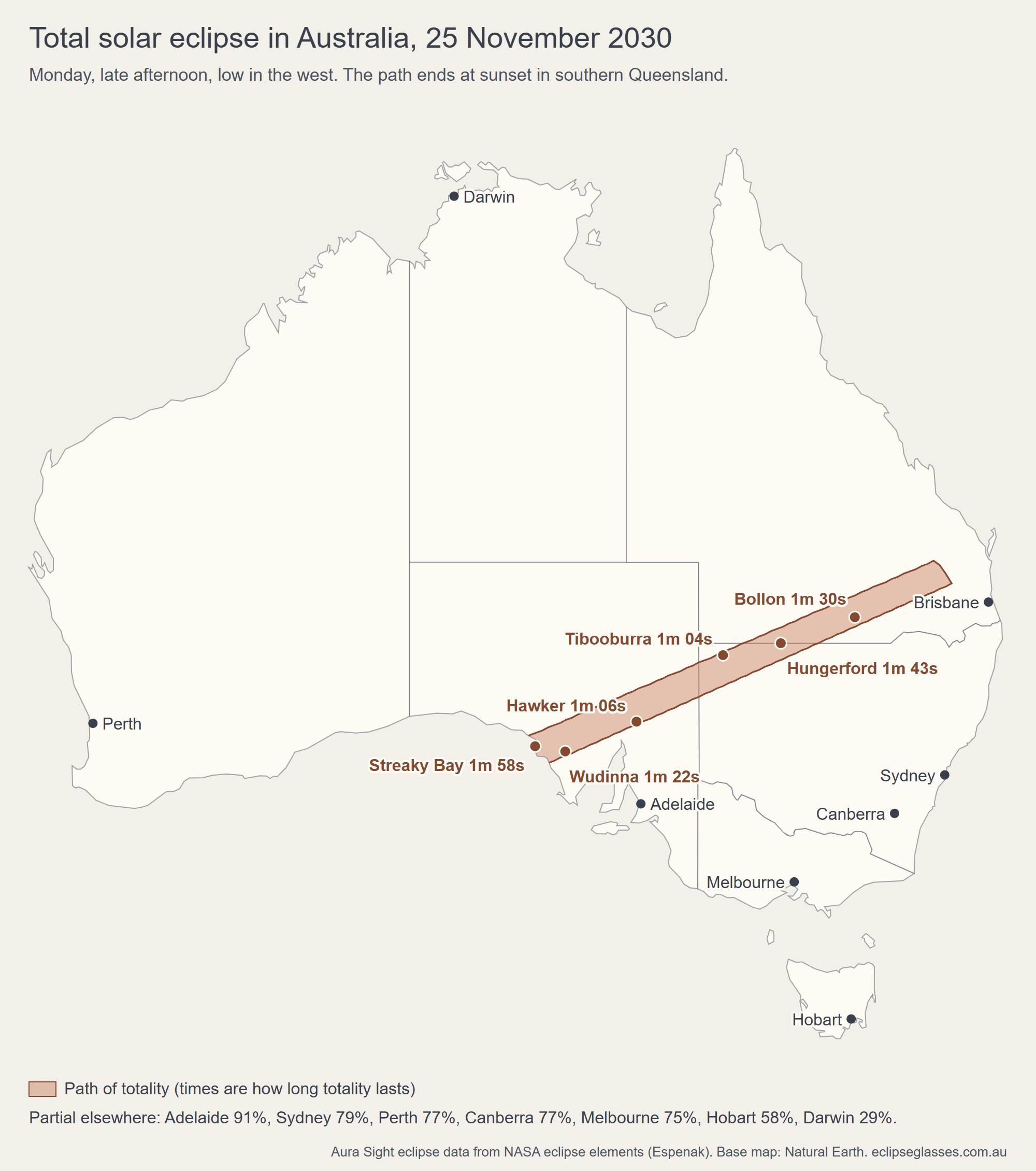
The eclipse begins at sunrise over southern Africa, crosses Namibia, Botswana and South Africa, then the Indian Ocean. Late on Monday afternoon, Australian time, the Moon's shadow reaches the Great Australian Bight. The path of totality comes ashore on the Eyre Peninsula around Streaky Bay, then runs north-east over Poochera, Minnipa and Wudinna, across Spencer Gulf to the Flinders Ranges at Hawker, Wilpena Pound and Blinman, and on into the corner country at Tibooburra and Wanaaring in New South Wales.
In Queensland it passes Hungerford, Eulo, Cunnamulla and Bollon. By then the Sun is only a few degrees above the horizon, and the path ends where the eclipsed Sun sets, in southern Queensland north of Dalby.
Many towns sit just outside the edges and get a deep partial eclipse instead: Leigh Creek and Woomera 99.9%, Port Augusta 99.7%, Ceduna 99.3% and Whyalla 98.4% in South Australia, Broken Hill 97.1% and Bourke 97.3% in New South Wales, and St George 99.9% in Queensland. A partial eclipse, however deep, never goes dark, so drive into the path for totality.
2030 eclipse times by town
Totality times for towns inside the path, in local time on Monday 25 November 2030. South Australia and New South Wales are on daylight saving; Queensland is not. Sun height is how far above the horizon the eclipse is, in degrees. Towns near the edge of the path get less totality, and edge times can shift by a few seconds.
| Town | Totality starts | Lasts | Sun height |
|---|---|---|---|
| Poochera, SA | 6:49:50pm ACDT | 2 min 01 s | 17° |
| Streaky Bay, SA | 6:49:40pm ACDT | 1 min 58 s | 17° |
| Minnipa, SA | 6:49:49pm ACDT | 1 min 53 s | 16° |
| Wudinna, SA | 6:49:58pm ACDT | 1 min 22 s | 16° |
| Blinman, SA | 6:51:59pm ACDT | 1 min 51 s | 13° |
| Wilpena Pound, SA | 6:51:36pm ACDT | 1 min 45 s | 13° |
| Hawker, SA | 6:51:33pm ACDT | 1 min 06 s | 13° |
| Tibooburra, NSW | 7:23:58pm AEDT | 1 min 04 s | 9° |
| Wanaaring, NSW | 7:23:47pm AEDT | 32 s | 7° |
| Hungerford, QLD | 6:23:49pm AEST | 1 min 43 s | 7° |
| Cunnamulla, QLD | 6:24:43pm AEST | 1 min 12 s | 5° |
| Eulo, QLD | 6:25:04pm AEST | 31 s | 6° |
| Bollon, QLD | 6:24:15pm AEST | 1 min 30 s | 4° |
The partial phase starts about an hour before totality: at Streaky Bay from 5:48pm ACDT, ending at 7:46pm ACDT. In Queensland the Sun sets before the partial phase is over.
Can you see the 2030 eclipse from the capital cities?
No capital is in the path in 2030. Every capital gets a partial eclipse. Adelaide gets 91%, low in the west; in Brisbane about 95% of the Sun is covered as it sets.
| City | Begins | Greatest | Ends | Sun covered |
|---|---|---|---|---|
| Adelaide | 5:49pm | 6:48pm | 7:43pm ACDT | 91% |
| Sydney | 6:24pm | 7:18pm | At sunset AEDT | 79%, sets during the eclipse |
| Perth | 3:01pm | 4:12pm | 5:14pm AWST | 77% |
| Canberra | 6:23pm | 7:17pm | At sunset AEDT | 77%, sets during the eclipse |
| Melbourne | 6:19pm | 7:15pm | 8:07pm AEDT | 75% |
| Hobart | 6:16pm | 7:09pm | 7:59pm AEDT | 58% |
| Darwin | 5:17pm | 6:06pm | 6:51pm ACST | 29% |
| Brisbane | 5:30pm | About sunset | At sunset AEST | About 95%, at sunset |
How does the 2030 eclipse compare with 2028?
| 22 July 2028 | 25 November 2030 | |
|---|---|---|
| Day and time | Saturday, late morning to early afternoon | Monday, late afternoon to sunset |
| Longest totality in Australia | 5 min 10 s, central Kimberley | About 2 min, Eyre Peninsula |
| Cities in the path | Sydney (3 min 48 s), Dubbo, Bathurst | None; the biggest towns are Streaky Bay and Cunnamulla |
| States and territories | WA, NT, QLD, NSW | SA, NSW, QLD |
| Sun height at totality | Well up in the sky | 17° or lower, setting |
2028 is the easier eclipse for most Australians: midday, a weekend and a city in the path. 2030 rewards people willing to travel to the outback, with a short totality low over the western horizon. Pick a spot with a clear, flat view to the west-south-west; hills, trees or buildings can hide an eclipse this low, and in the Flinders Ranges the ridges can too.
Can I keep my 2028 eclipse glasses for 2030?
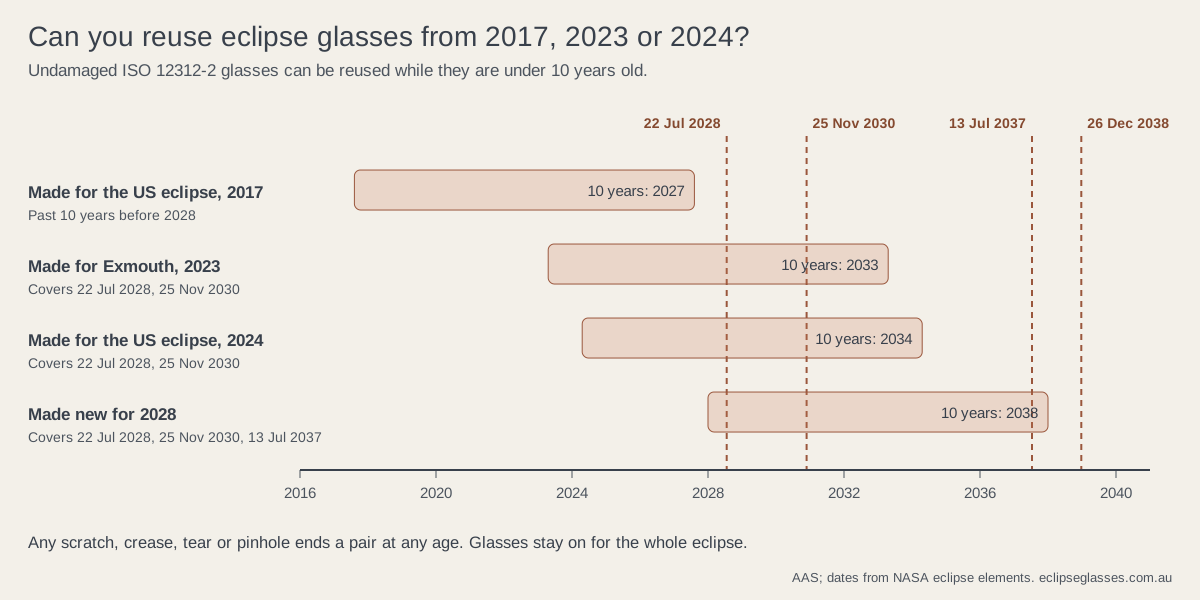
Yes, if they are still in perfect condition. The American Astronomical Society says glasses that meet ISO 12312-2 can be reused while they are under 10 years old, as long as the filters are not scratched, punctured, torn or coming loose from the frame. Pairs made for 2028 are well inside that window on 25 November 2030. Store them flat at room temperature, in their case or packet, and check both filters before you use them again. See reusing old eclipse glasses.
The 2030 eclipse is partial for most of Australia, so everyone needs glasses. Certified glasses stay on for the whole eclipse, from the first bite to the last, totality included. Ours are ISO 12312-2:2015 certified and lab-tested, A$5.45 a pair from NSW stock.
Shop eclipse glasses2030 total solar eclipse: questions
When is the next total solar eclipse in Australia after 2028?
Monday 25 November 2030, late in the afternoon, across South Australia, north-west New South Wales and south-west Queensland.
Where can you see the 2030 total solar eclipse in Australia?
Inside the path of totality: the Eyre Peninsula (Streaky Bay, Poochera, Wudinna), the Flinders Ranges (Hawker, Wilpena Pound, Blinman), Tibooburra and Wanaaring in New South Wales, and Hungerford, Cunnamulla and Bollon in Queensland. The rest of Australia gets a partial eclipse.
How long is totality in the 2030 eclipse?
Up to about 2 minutes in Australia: 2 min 01 s at Poochera and 1 min 58 s at Streaky Bay, falling to about a minute at Hawker and Tibooburra.
What time is the 2030 eclipse?
Totality is at about 6:50pm ACDT on the Eyre Peninsula, 6:52pm ACDT in the Flinders Ranges, 7:24pm AEDT at Tibooburra and 6:24pm AEST in south-west Queensland, on Monday 25 November 2030.
Is Adelaide in the path of totality in 2030?
No. Adelaide gets a partial eclipse with 91% of the Sun covered at 6:48pm ACDT. The nearest totality is in the Flinders Ranges, around Hawker and Wilpena Pound.
Can I use my 2028 eclipse glasses in 2030?
Yes, if they meet ISO 12312-2, are under 10 years old and have no scratches, holes, tears or loose filters. Store them flat in their case and check them before use.
Sources
All checked 18.11.2026.
- NASA (Fred Espenak), path of the total solar eclipse of 25 November 2030 (greatest duration 3m 43.6s; path width 139 km at the South Australian coast; the path ends at sunset near 26.3°S 151.2°E) and the 2021 to 2030 decade table. Eclipse predictions by Fred Espenak, NASA's GSFC.
- American Astronomical Society, safe viewing (reuse under 10 years old, storage).
- ARPANSA, Solar eclipse.
- Town and city times calculated by Aura Sight from the NASA elements with the same method as our guide to every eclipse to 2040.

Glasses for everyone watching
ISO 12312-2 certified and lab-tested, with a QR batch certificate on every pair. The family kit has four pairs and a printed viewing guide.