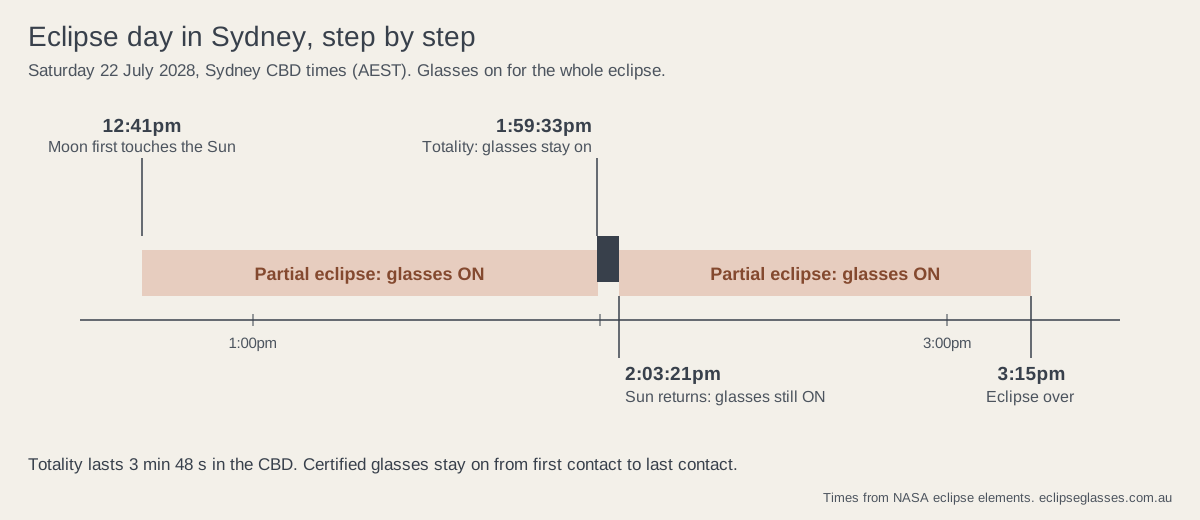
The short version. Every main campus in Sydney and Wollongong, and Charles Sturt in Bathurst and Dubbo, is in the path of totality on Saturday 22 July 2028. The eclipse runs from about 12:40pm to 3:15pm AEST, with close to four minutes of totality in Sydney just before 2pm. Book the space now, plan for a low and a high crowd, order one certified pair per person plus about 10% spare, and put telescopes in the hands of people with proper solar filters.
Which campuses are in the path of totality?
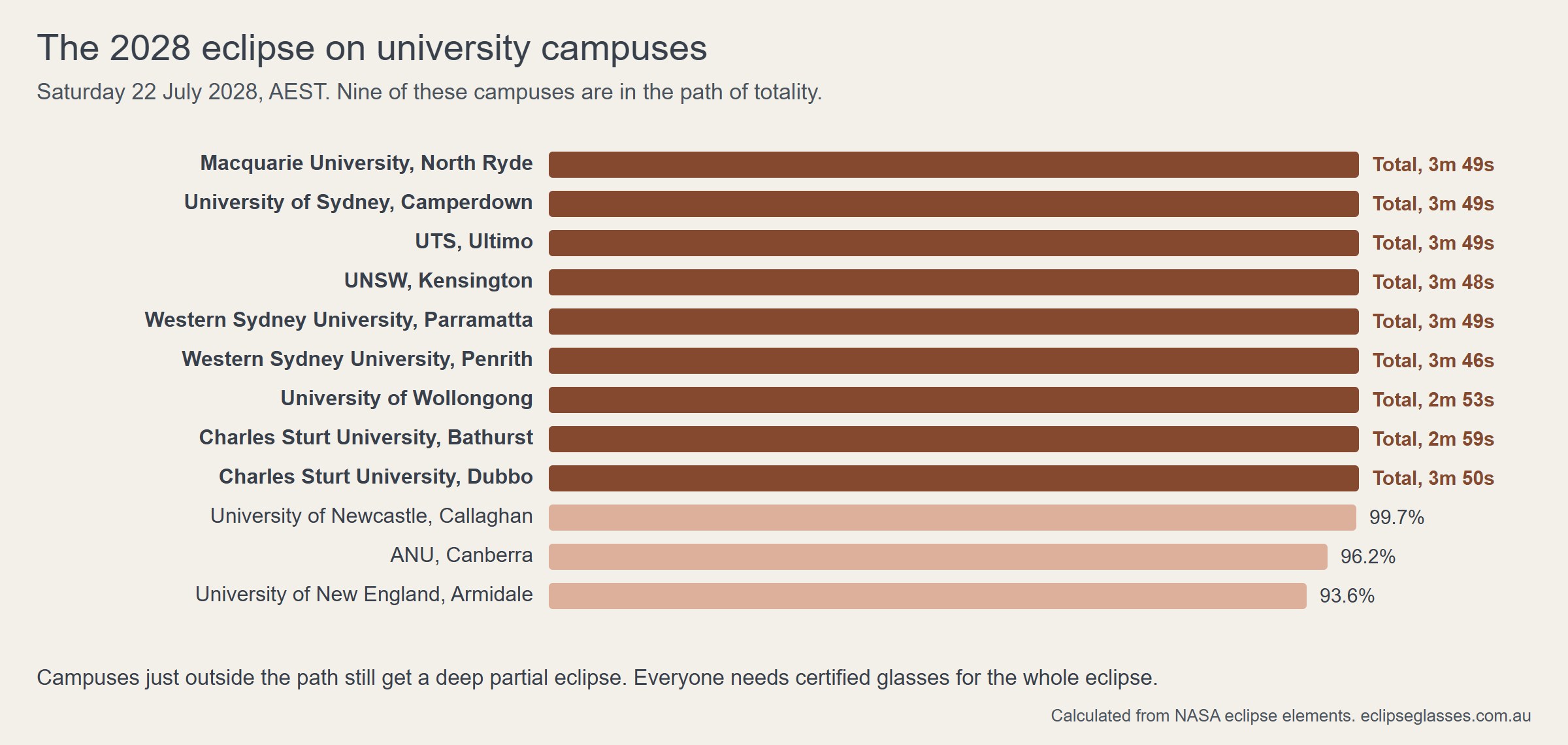
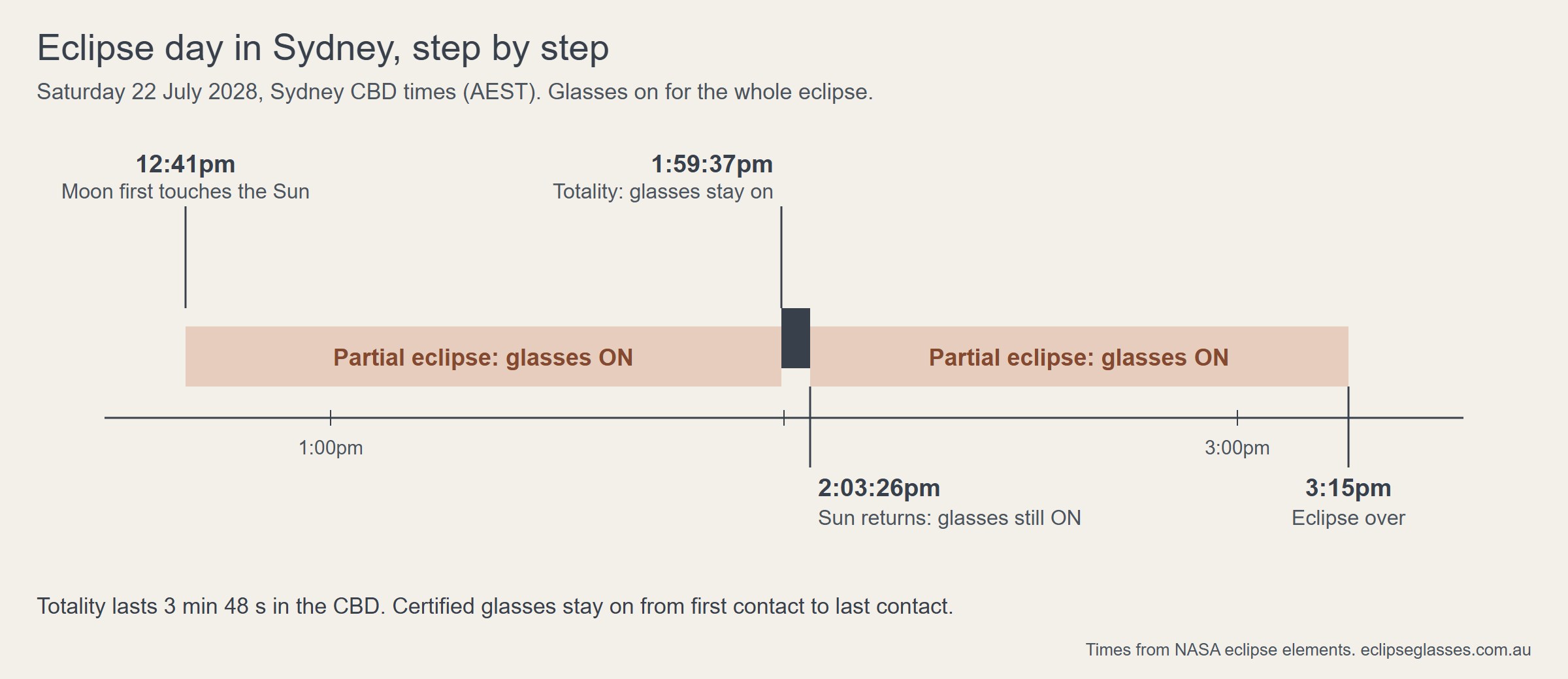
We calculated the eclipse for each campus from NASA's eclipse elements, the same method behind our 2028 eclipse map. All times are AEST on Saturday 22 July 2028.
| Campus | Eclipse begins | Totality or maximum | Totality lasts | Eclipse ends |
|---|---|---|---|---|
| Macquarie University, North Ryde | 12:40pm | 1:59:28pm to 2:03:16pm | 3 min 49 s | 3:15pm |
| University of Sydney, Camperdown | 12:41pm | 1:59:35pm to 2:03:24pm | 3 min 49 s | 3:15pm |
| UTS, Ultimo | 12:41pm | 1:59:36pm to 2:03:25pm | 3 min 49 s | 3:15pm |
| UNSW, Kensington | 12:41pm | 1:59:39pm to 2:03:28pm | 3 min 48 s | 3:15pm |
| Western Sydney University, Parramatta | 12:40pm | 1:59:20pm to 2:03:09pm | 3 min 49 s | 3:14pm |
| Western Sydney University, Penrith | 12:40pm | 1:58:55pm to 2:02:41pm | 3 min 46 s | 3:14pm |
| University of Wollongong | 12:40pm | 1:59:43pm to 2:02:36pm | 2 min 53 s | 3:14pm |
| Charles Sturt University, Bathurst | 12:37pm | 1:57:36pm to 2:00:35pm | 2 min 59 s | 3:13pm |
| Charles Sturt University, Dubbo | 12:35pm | 1:55:28pm to 1:59:18pm | 3 min 50 s | 3:12pm |
| University of Newcastle, Callaghan | 12:41pm | Maximum 2:02pm, 99.7% of the Sun covered | Not total | 3:15pm |
| ANU, Canberra | 12:38pm | Maximum 1:59pm, 96.2% covered | Not total | 3:13pm |
| University of New England, Armidale | 12:40pm | Maximum 2:01pm, 93.6% covered | Not total | 3:15pm |
Callaghan misses totality by a whisker: 99.7% is not total, and the sky will not go fully dark there. Students in Newcastle who want totality only need to head south to Lake Macquarie or the Central Coast. Every campus in Australia sees at least a partial eclipse, so every campus event needs glasses for the whole eclipse. Our guide to towns just outside the path explains why 99% is still a very different experience from totality.
Sydney eclipse 2028 times
Why should a university plan now?
People will come to campus whether you plan for it or not. An open campus with ovals, lawns and public transport is exactly where people go to watch an eclipse. Sydney's last total solar eclipse was in 1857 (see eclipses since 1922), so interest will be high.
- The eclipse falls on a Saturday, when lecture theatres are empty and students, staff, alumni and families are free to come. Check where the date falls in your academic calendar, as it is close to the start of second semester at many universities.
- Ovals, the great hall and the observatory are the obvious venues, and other groups will want them too.
- Glasses run out. Before the 2017 and 2024 eclipses in the US, stock sold out in the final weeks. Our look at eclipse glasses sell-outs has the detail.
- Your risk team needs time: a public event on campus usually needs a risk assessment, a crowd plan and sign-off on any telescopes.
What kind of eclipse event suits a campus?
- A public viewing on an oval or lawn is the simplest format: open space, a PA, a big screen with a livestream, and glasses at the gate. Our viewing event checklist covers the rest.
- A staff and student event is smaller and ticketed, for your own community, often run by a faculty, a student club or the residential colleges.
- For science outreach, physics and astronomy departments can run talks, projected images of the eclipse and telescopes fitted with solar filters. School groups are a natural fit; share our eclipse safety plan for schools with visiting teachers.
- Alumni and neighbours can be invited back to campus for a once-in-a-lifetime event.
How many eclipse glasses does a campus event need?
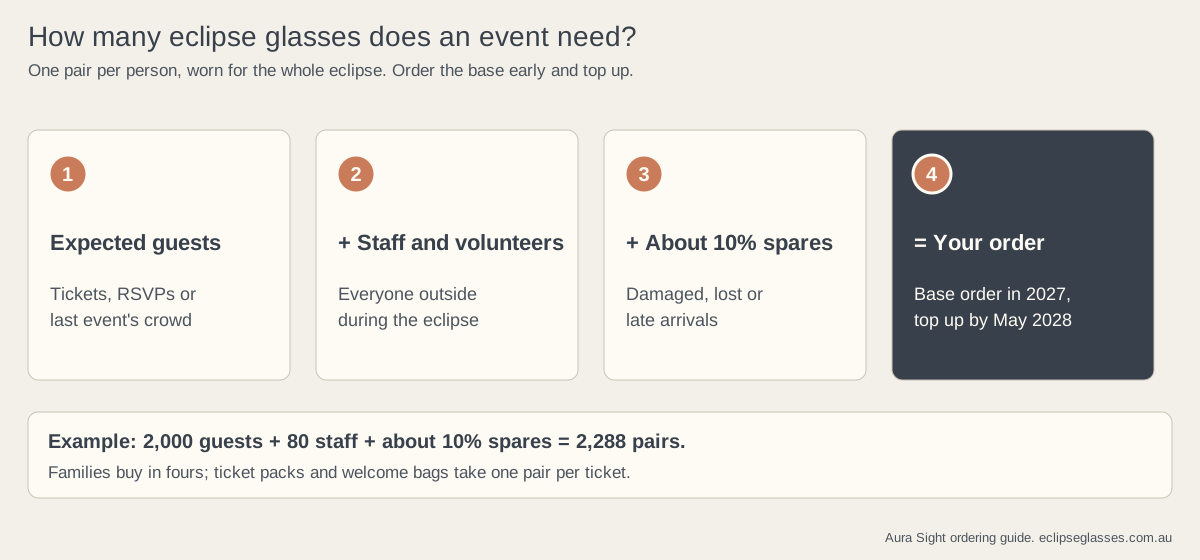
One certified pair for every person outside during the eclipse, plus about 10% spare. Count staff and volunteers as well as guests. For a lawn event expecting 1,500 people with 60 staff and volunteers, that is 1,560 people plus 156 spares: 1,716 pairs. Our guide on how many eclipse glasses an event needs has more worked examples, including how to stage an order when you don't know the crowd yet.
Online orders take up to 999 pairs at A$5.45 a pair and ship from NSW by 31 May 2028. For 1,000 pairs or more, or glasses printed with your university or event branding, ask for a quote through eclipse glasses for events. A branded run takes 6 to 8 weeks from proof approval, so lock it in early.
What safety rules should a campus event follow?
- Everyone wears their own ISO 12312-2 certified pair from the start of the eclipse to the end, totality included.
- Eclipse glasses must never be used with telescopes, binoculars, cameras or phones. Concentrated light burns straight through the filter. Telescopes and binoculars need a solar filter fitted securely to the front, checked for scratches and pinholes before use, and a trained person beside them the whole time.
- Check every pair, and throw out any pair that is scratched, torn, punctured or damaged.
- Supervise children closely. Ask parents to fit glasses on their children before the eclipse starts.
- Prescription glasses stay on, with eclipse glasses over the top.
- Offer indirect viewing too. ARPANSA says indirect viewing, such as a pinhole projector or a livestream, is the safest way to watch an eclipse. A big screen also gives people something to share if cloud rolls in.
Eye damage from an eclipse can be permanent, and the retina has no pain sensors, so there is no warning. Our guide on why you need eclipse glasses explains the risk in plain terms, and photographing the eclipse covers camera filters for media teams.
What will your WHS and risk team ask for?
Expect questions about the glasses themselves. Every order ships with a certification pack for your event file:
- The filter is tested to ISO 12312-2:2015 by ICS Laboratories, an A2LA-accredited laboratory.
- The glasses are made by Rainbow Symphony, which is on the American Astronomical Society list of reputable vendors.
- A QR code on every pair that links to its batch certificate.
- The full test report and CE certificate, on request.
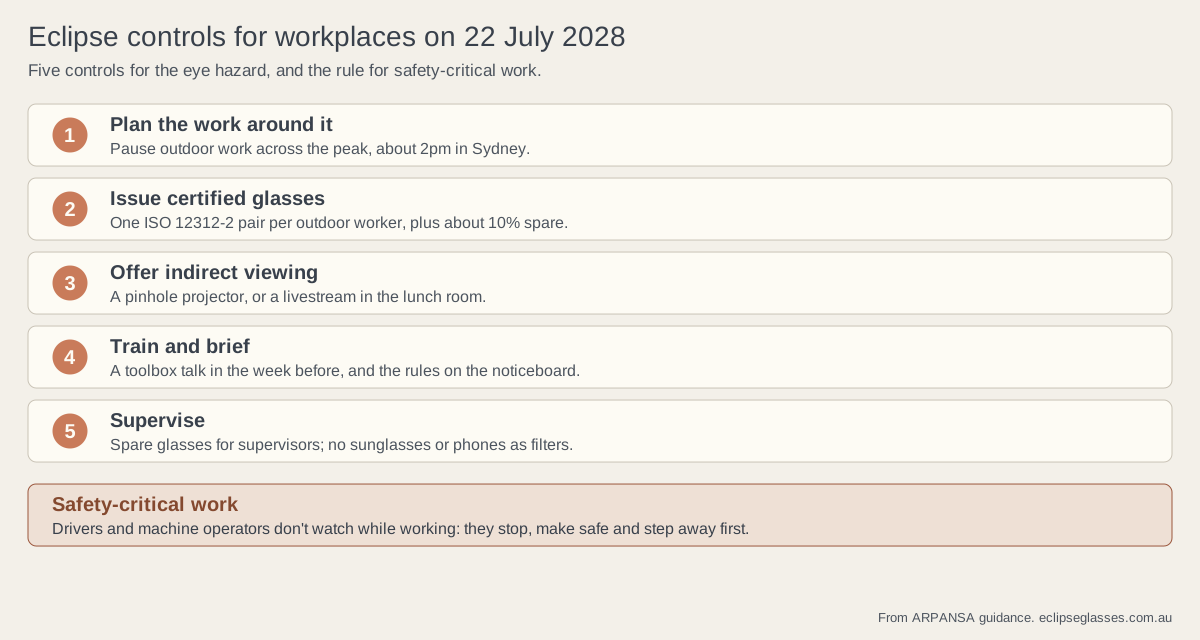
See how our glasses are certified for the detail. If staff will be working outdoors on the day, such as grounds, security and event crew, our WHS guide for workplaces covers duty of care and safety-critical tasks.
What is the planning timeline to eclipse day?
- Now to mid 2027. Pick the venue and book it. Agree who owns the event: a faculty, events, a student club or the colleges. Set a low and a high attendance.
- During 2027. Place a base glasses order for the number you are sure of. Start the risk assessment and line up telescope volunteers with solar filters.
- Early 2028. Announce the event, open registrations and recruit volunteers. Plan a livestream for the big screen.
- By 31 May 2028. Top up the glasses order as registrations firm up. Repeat orders come from the same certified batches.
- Eclipse week. Brief volunteers, check every pair and set up spares at the gate and the info tent.
- On the day. Gates open well before 12:40pm. Repeat one message from start to finish: glasses on for the whole eclipse, and never with a camera, phone or telescope.
Cloud doesn't cancel the event. In the path of totality, it gets dark in the middle of the afternoon even under cloud, and the livestream carries the eclipse from wherever skies are clear. Our guide on what totality is like covers what people will notice.
Send us your campus, your low and high numbers and when you need the glasses. We reply within one business day with a quote for both ends and a supply plan to eclipse day.
Get a quote for your campusFAQ
Is Macquarie University in the path of totality in 2028?
Yes. North Ryde gets 3 minutes 49 seconds of totality, from 1:59:28pm to 2:03:16pm AEST on Saturday 22 July 2028. The eclipse runs from 12:40pm to 3:15pm.
Which Sydney universities see a total eclipse?
All the main Sydney campuses: Macquarie, Sydney, UTS, UNSW and Western Sydney University in Parramatta and Penrith each get about 3 minutes 46 seconds to 3 minutes 49 seconds of totality, just before 2pm AEST.
Is the University of Newcastle in the path of totality?
No, but it is very close. Callaghan reaches 99.7% at about 2:02pm AEST, which is not total. Lake Macquarie and the Central Coast are in the path.
How many eclipse glasses does a campus event need?
One pair for every person outside during the eclipse, including staff and volunteers, plus about 10% spare. A lawn event for 1,500 people with 60 crew needs about 1,716 pairs.
Can students use eclipse glasses with a telescope or camera?
No. Eclipse glasses must never be used with telescopes, binoculars, cameras or phones. Optics need a solar filter fitted securely to the front, and a trained person should supervise every telescope.
Can we get glasses printed with our university logo?
Yes. Branded glasses are made to order and take 6 to 8 weeks from proof approval. Ask us for a quote with your numbers and we will confirm the run size and timing.
Sources
All checked 12.11.2026.
- Campus times calculated from NASA's Besselian elements for the 22 July 2028 eclipse, Fred Espenak, NASA GSFC, with Delta T of 69.2 s. Times are for each campus's main grounds; across a large campus they vary by a few seconds.
- ARPANSA, Solar eclipse.
- American Astronomical Society, Solar eclipse eye safety and Solar filters for optics.
- NASA, Eclipse safety.
- Astronomical Society of Australia, How to view the eclipse.

Aura Sight supplies campuses and workplaces
ISO 12312-2 certified glasses from NSW stock, with a QR batch certificate on every pair and a certification pack for your WHS file. Up to 999 pairs online, larger and branded orders by quote.