The short version. Treat the eclipse as a foreseeable eye hazard. Give every worker who will be outside a certified pair of eclipse glasses, or a safe indirect way to watch. Stop safety-critical work for the few minutes people want to watch, and never let anyone drive, operate plant or work at heights while wearing eclipse glasses. Brief staff in a toolbox talk the week before, and keep the certification pack in your WHS file.
When does the eclipse happen during the working day?
On Saturday 22 July 2028, in the middle of the day. In the Sydney CBD the eclipse runs from 12:41pm to 3:15pm AEST, with totality from 1:59:37pm to 2:03:26pm. Inland the times are a few minutes earlier, and across the rest of Australia the Moon covers part of the Sun. Times for each town are on our 2028 eclipse map.
Offices may be closed on a Saturday, but construction sites, farms, mines, transport, retail, hospitality, councils, parks and venues will all have people working outdoors. In the path, totality turns day to dusk for a few minutes, so expect workers and the public to stop and watch whatever they are doing. On farms, livestock may act as if evening has come; see what animals do during an eclipse.
Do WHS laws cover the eclipse?
No WHS law names the eclipse, and as of November 2026 we have not found eclipse-specific guidance from Safe Work Australia or the state regulators. But under the model WHS laws, a business must ensure, so far as is reasonably practicable, the health and safety of its workers and of other people affected by its work. Victoria's OHS Act sets similar general duties. Cancer Council notes that UV radiation is already recognised as a workplace hazard under those laws.
An eclipse is a known date and a known hazard, so it fits the usual process: identify the risk, assess it, put controls in place, consult workers and train them. This guide is general information, not legal advice. Check your obligations with your state regulator.
What is the eye hazard?
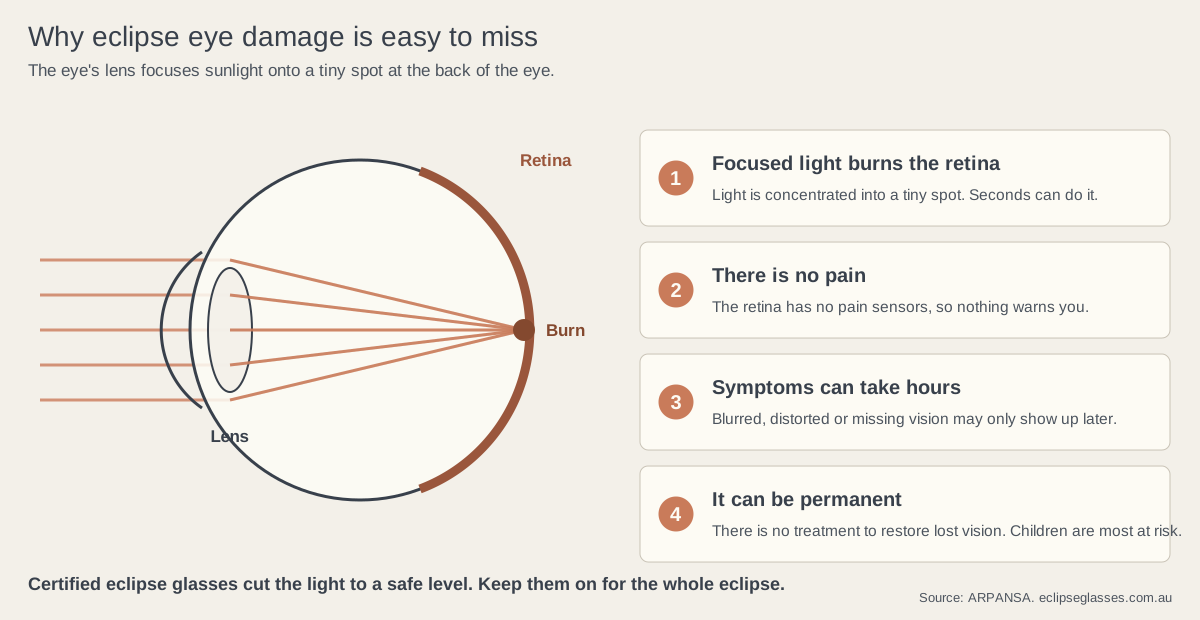
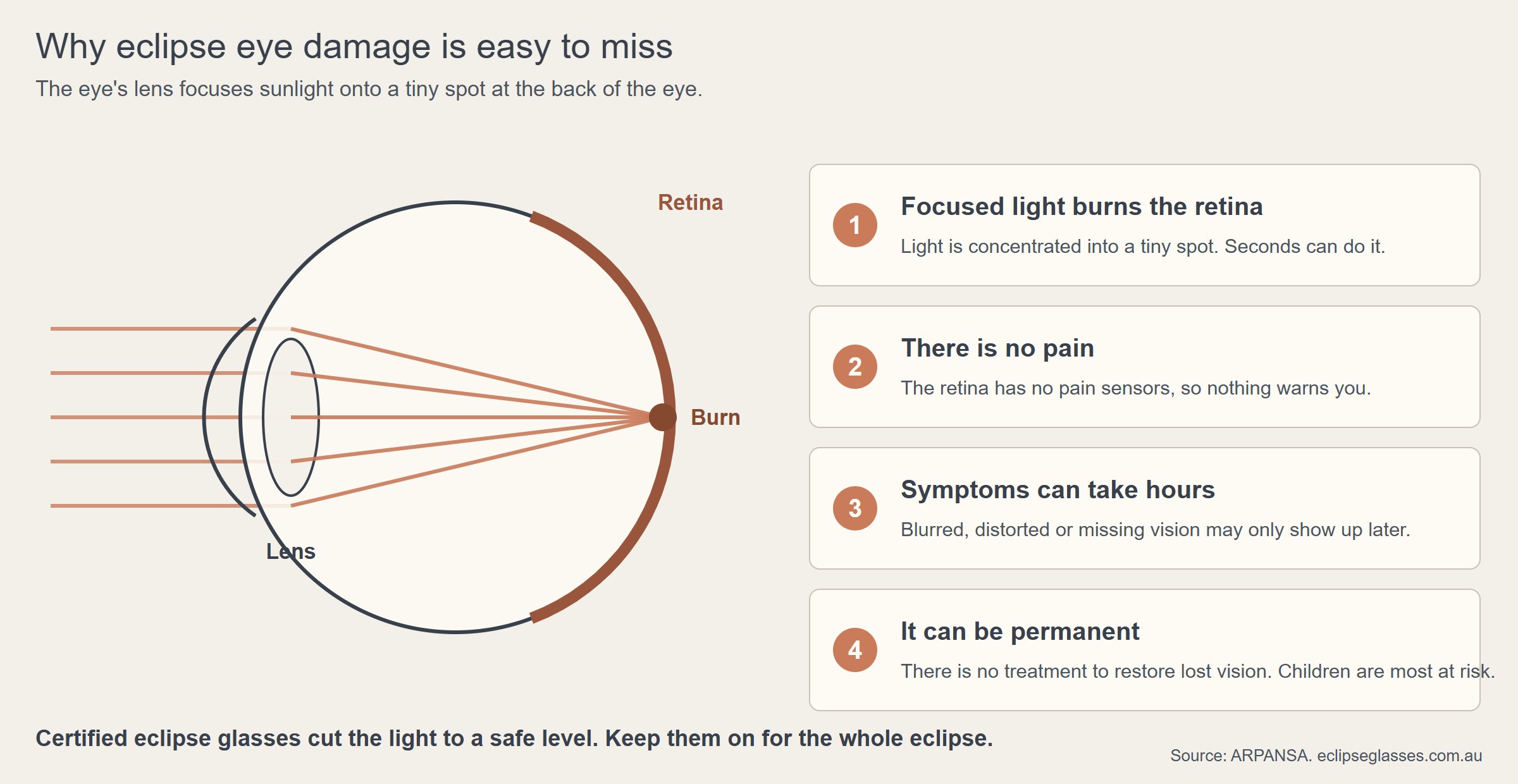
Watching the eclipse without protection can burn the retina in seconds. The retina has no pain sensors and symptoms may not appear for hours, so there is no warning. The damage can be permanent. Ordinary sunglasses, even very dark ones, are never safe for an eclipse. Certified eclipse glasses let through about 0.003% of visible light or less, thousands of times darker than sunglasses. Our guide on why you need eclipse glasses explains it in plain terms.
Welders on site may reach for a welding helmet. Only shade 14 or darker is suitable for an eclipse, and many welding lenses are lighter than that. Certified eclipse glasses are the simpler answer.
Which controls should you put in place?
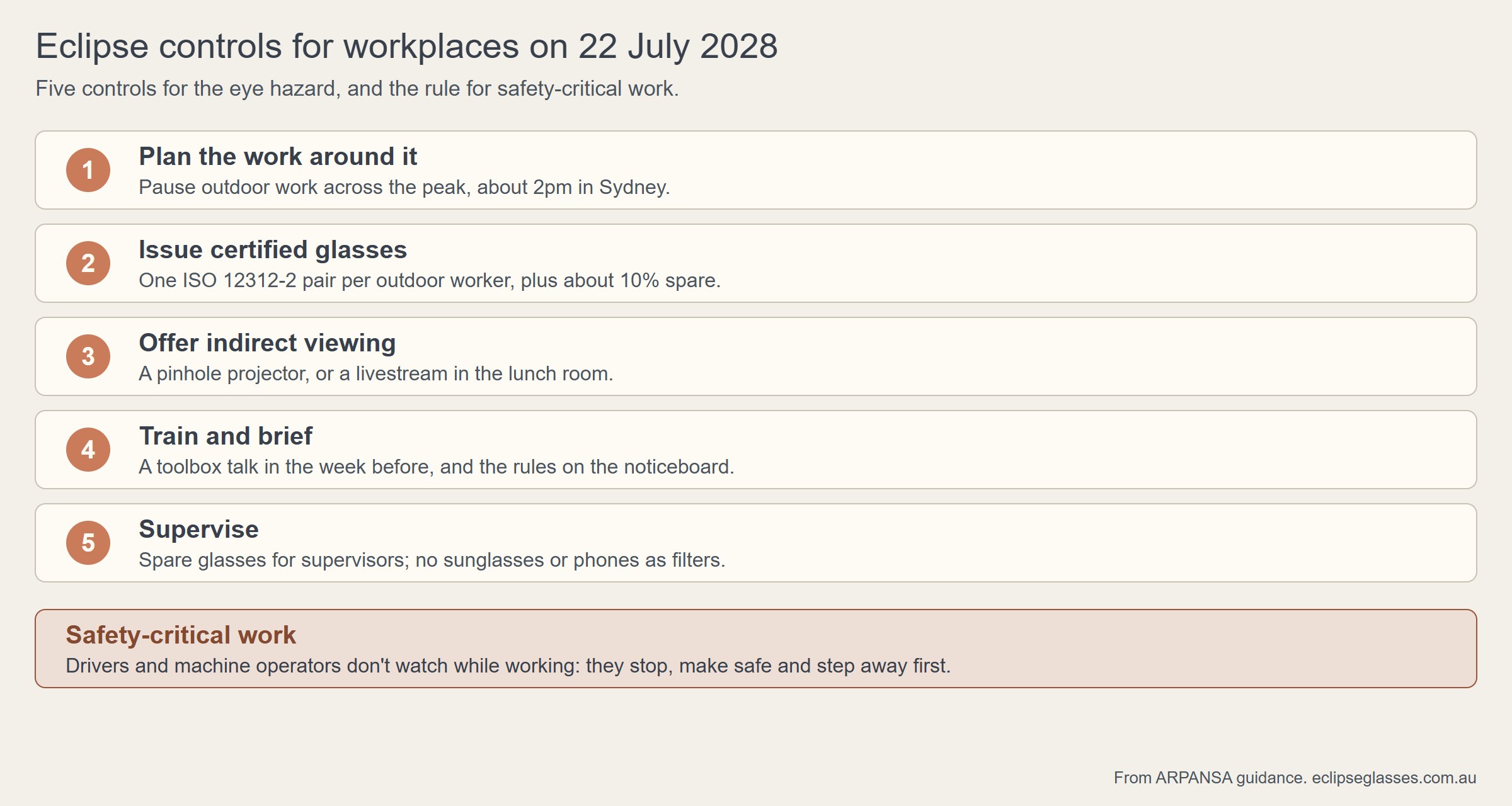
- Plan the work around it. Schedule a break or a pause in outdoor work across the peak of the eclipse, so people can watch together and safely instead of mid-task. In Sydney, the peak is about 2pm.
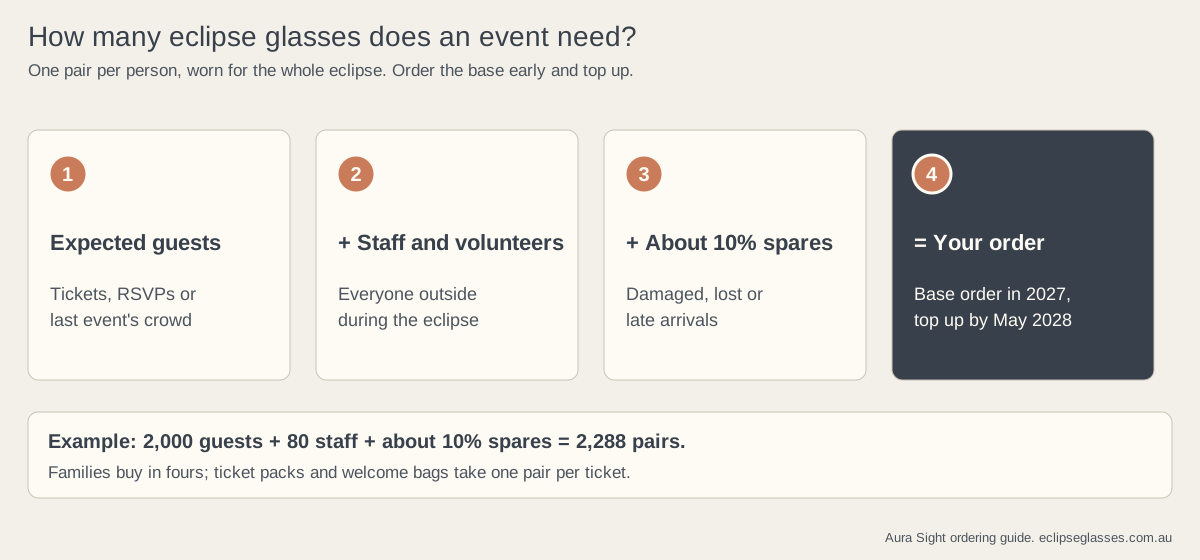
- Issue certified glasses. One ISO 12312-2 certified pair for every worker who will be outside, plus about 10% spare for damaged and lost pairs. Each person wears their own pair for the whole eclipse.
- Offer indirect viewing. ARPANSA says indirect viewing, such as a pinhole projector or a livestream, is the safest way to watch. A livestream in the lunch room works for staff who stay indoors.
- Train and brief. Run a short toolbox talk in the week before (see below), and put the rules on the noticeboard.
- Supervise. Give supervisors spare glasses and ask them to watch for anyone using sunglasses, phones or no protection at all.
What about safety-critical work?
Eclipse glasses block almost all light, so you can't see anything else through them. That makes them unsafe for anyone who is moving or in control of something.
- Drivers, forklift and crane operators and machine operators should not try to watch the eclipse at all while working. If they want to watch, they stop, make the machine safe and step away first.
- Workers on scaffolds, roofs or ladders come down to a safe spot before putting glasses on.
- Anyone using eclipse glasses stands still in a safe place, away from traffic and moving plant.
- In the path, it gets dark for a few minutes around totality. Turn on vehicle headlights and site lighting, and expect pedestrians and drivers to be distracted.
- Towns in the path expect a lot of visitors, so delivery and transport schedules should allow for busy roads on the day.
What should a toolbox talk cover?
- The date and local times of the eclipse, and when the site will pause.
- Never watch the eclipse without certified eclipse glasses or a safe indirect method. Sunglasses are never enough.
- Glasses stay on for the whole time you are watching the eclipse, and each person uses their own pair.
- Never use eclipse glasses with a phone, camera, binoculars or a telescope.
- Check your pair before use. If it is scratched, torn or punctured, get a new one from your supervisor.
- Stop, make safe and stand still before putting glasses on. Never while driving, operating plant or working at heights.
- Report any blurred, distorted or changed vision after the eclipse, even hours later.
How many eclipse glasses does a workplace need?
Count everyone who will be outside during the eclipse: your workers, contractors and anyone you host, such as visitors or customers at an outdoor venue. Add about 10% spare. A builder with 120 people across three Saturday sites needs 132 pairs. That is under our online limit of 999 pairs, at A$5.45 a pair from NSW stock with delivery by 31 May 2028. For larger orders, or glasses for customers and the public, see how many eclipse glasses an event needs and ask us for a quote.
Many businesses will also want glasses for staff and their families, or for customers. Glasses printed with your brand and safety message are made to order: our guide to custom-printed eclipse glasses for business explains how it works.
What should go in your WHS file?
- The risk assessment and the controls you chose.
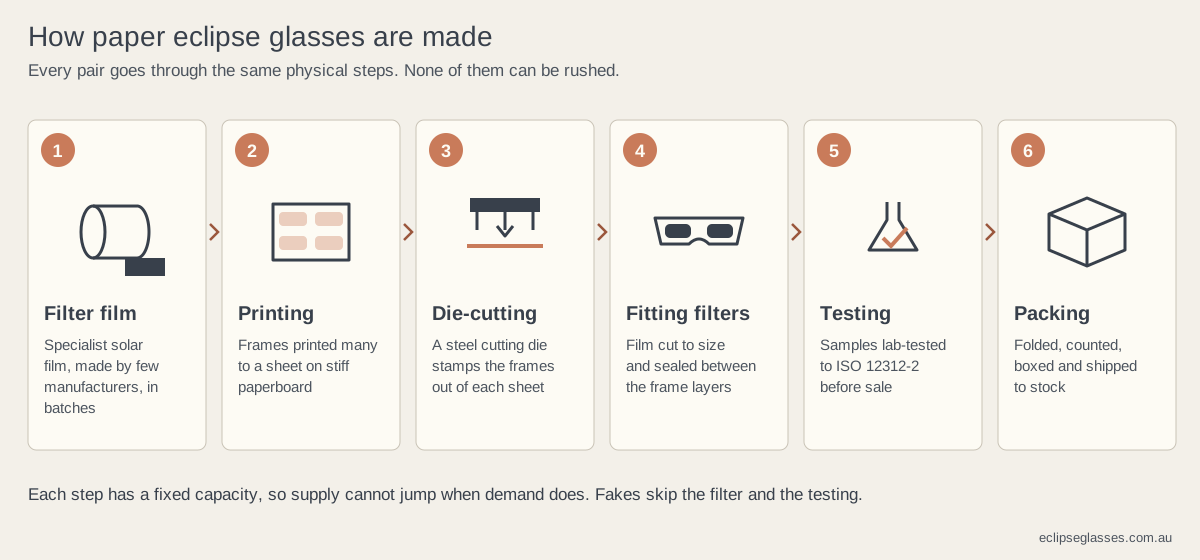
- The certification pack: the filter is tested to ISO 12312-2:2015 by ICS Laboratories, an A2LA-accredited laboratory, and the glasses are made by Rainbow Symphony, which is on the American Astronomical Society list of reputable vendors. A QR code on every pair links to its batch certificate.
- A record of the toolbox talk and who attended.
- Any incident reports. A worker who notices loss of vision, distorted vision or altered colour vision after the eclipse should see an optometrist or eye doctor promptly.
See how our glasses are certified for the full detail. Universities and other large employers running a public event on site can also use our campus eclipse planning guide.
Tell us how many people you have outside on the day and where. We reply within one business day with a quote and a delivery date, and the certification pack goes with every order.
Get a quote for your teamFAQ
Do employers have to provide eclipse glasses?
No law names the eclipse, but WHS laws require businesses to manage foreseeable risks to workers so far as is reasonably practicable. For staff outdoors during the eclipse, certified glasses or a safe indirect way to watch are simple, low-cost controls.
Are sunglasses or safety glasses enough for the eclipse?
No. Ordinary sunglasses and tinted safety glasses are never safe for an eclipse. Only ISO 12312-2 certified eclipse glasses, or welding glass of shade 14 or darker, are suitable.
Can workers wear eclipse glasses while driving or operating machinery?
No. Eclipse glasses block almost all light, so you can't see anything else through them. Workers stop, make the machine or vehicle safe and stand still in a safe place before putting them on.
What time is the eclipse on 22 July 2028?
It is in the middle of the day. In the Sydney CBD it runs from 12:41pm to 3:15pm AEST, with totality from 1:59:37pm to 2:03:26pm. Other towns are on our eclipse map.
How many eclipse glasses should a business order?
One pair for every person outside during the eclipse, including contractors and visitors, plus about 10% spare. Up to 999 pairs can be ordered online; larger orders are by quote.
What if a worker reports eye problems after the eclipse?
Record it as an incident and send them to an optometrist or eye doctor promptly. Symptoms such as blurred, distorted or changed colour vision can appear hours after exposure.
Sources
All checked 12.11.2026.
- Safe Work Australia, Model WHS laws; WorkSafe Victoria, OHS Act and regulations.
- Cancer Council NSW, What are my WHS duties? (UV radiation as a workplace hazard).
- ARPANSA, Solar eclipse.
- American Astronomical Society, Solar eclipse eye safety and the ISO 12312-2 standard; American Academy of Ophthalmology, welding helmets and eclipses.
- NASA, Eclipse safety. Sydney times from NASA eclipse elements, as on our eclipse map.
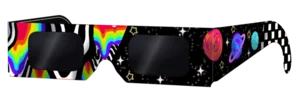
Aura Sight supplies campuses and workplaces
ISO 12312-2 certified glasses from NSW stock, with a QR batch certificate on every pair and a certification pack for your WHS file. Up to 999 pairs online, larger and branded orders by quote.