The short version. Many animals act as if evening has come. At a US zoo in 2017, 13 of 17 species studied changed their behaviour during totality: giraffes huddled, flamingos bunched together and gorillas headed for their night quarters. Birds sing a false dawn chorus as the light returns, and bees stop flying. Pets don't need eclipse glasses, and you should never put eclipse glasses on an animal. If your pet gets anxious, keep it indoors in its normal routine.
Why do animals react to an eclipse?
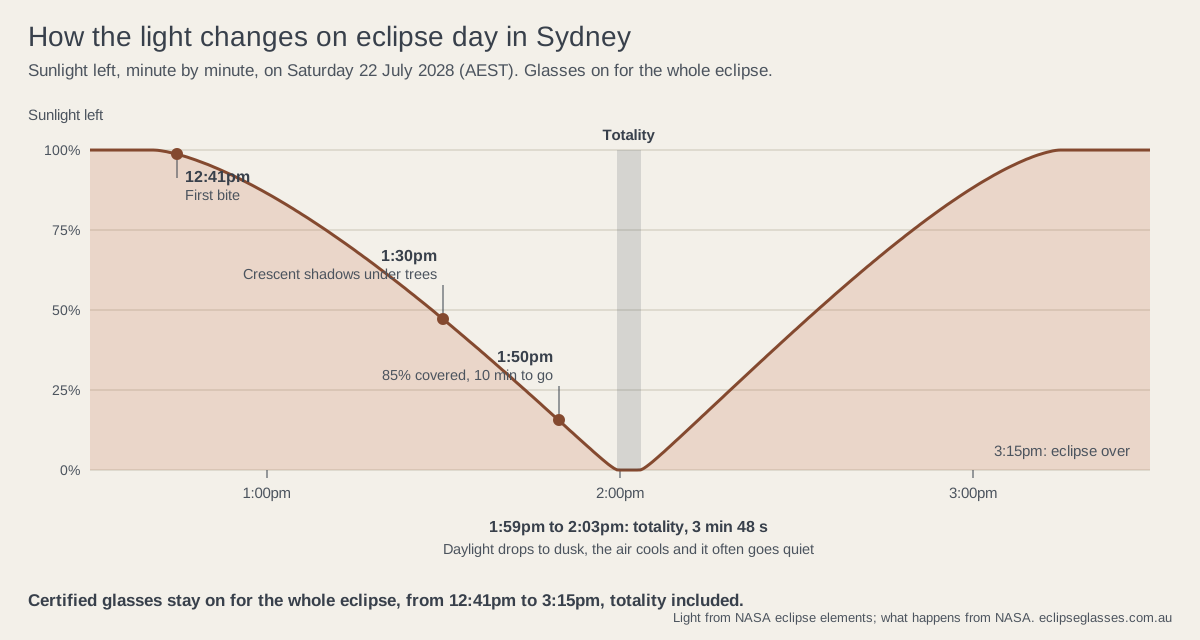
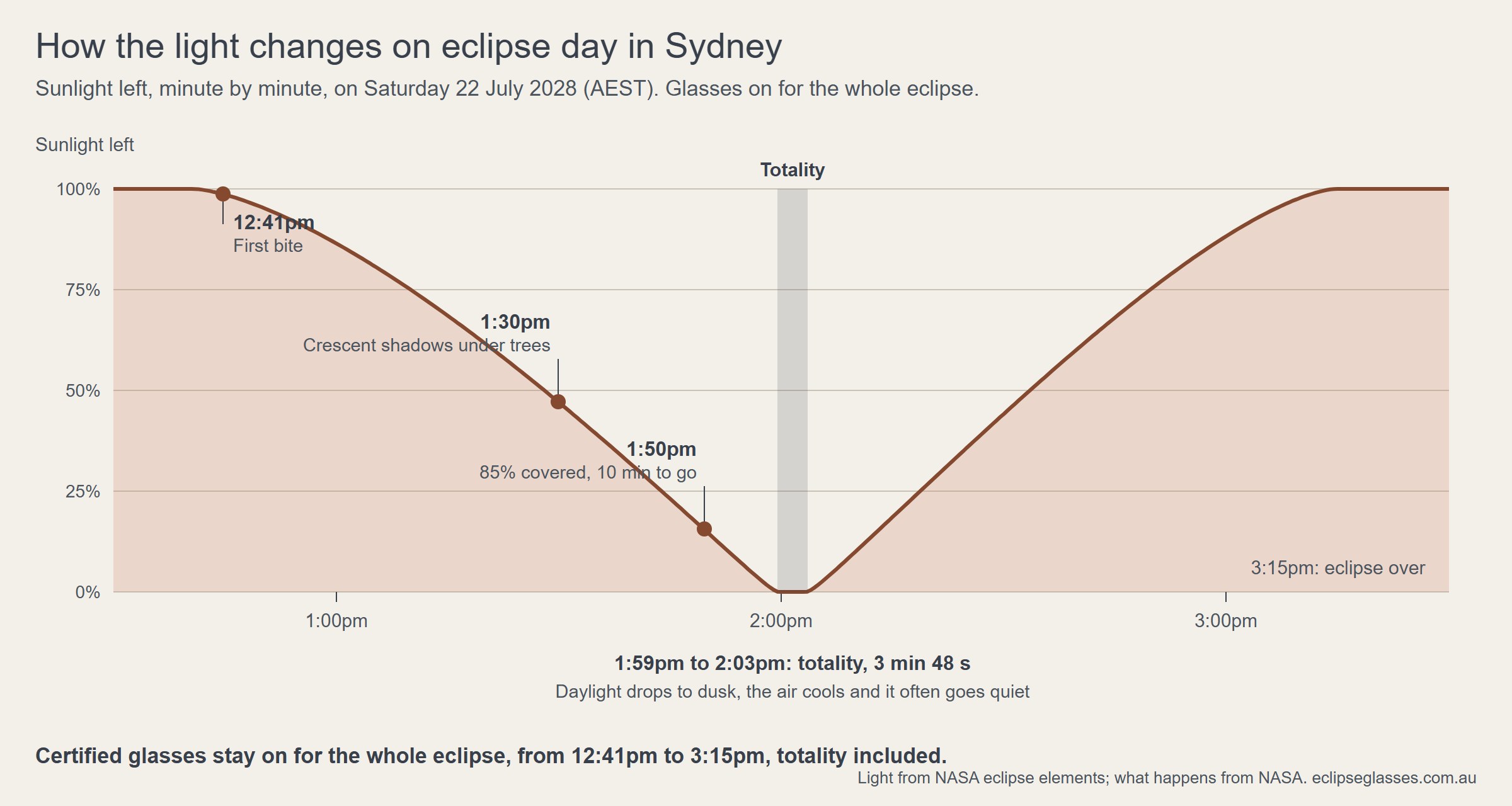
Because the light changes the way it does at dusk, only faster. In the path of totality the daylight fades over more than an hour, then drops to twilight in seconds. Temperatures fall too. Many animals take their cue from light levels, so for a few minutes they behave as though the day is over. In Sydney on 22 July 2028, the eclipse runs from 12:41pm to 3:15pm AEST, with totality from 1:59:37pm to 2:03:26pm.
What did zoo animals do during the 2017 eclipse?
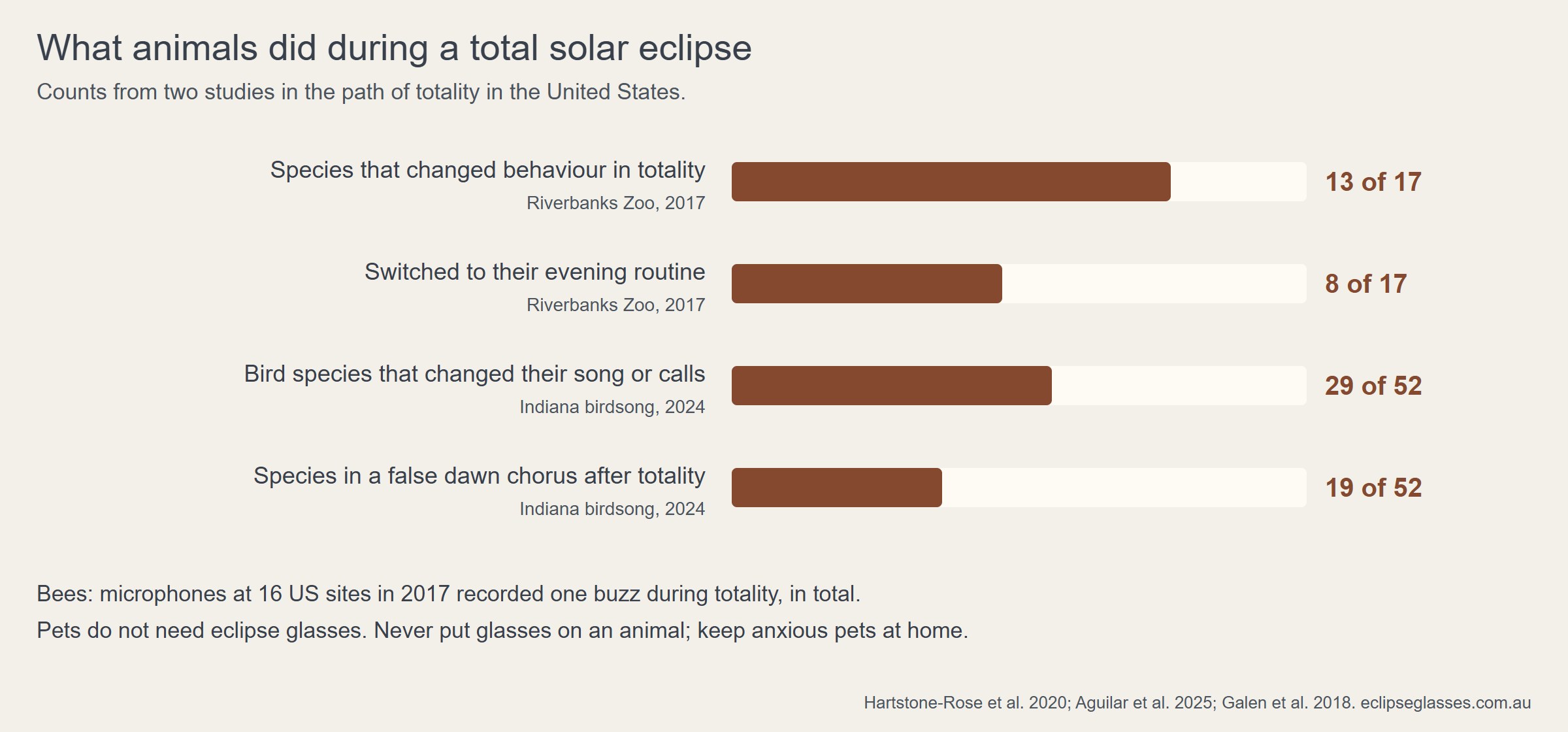
The best study comes from Riverbanks Zoo in South Carolina, which was in the path of totality on 21 August 2017. Researchers and volunteers watched 17 groups of animals before, during and after the eclipse. The study, published in the journal Animals in 2020, found that 13 of them behaved differently during totality, and 8 of those switched to their evening routine.
- Giraffes stopped feeding and huddled together at the back of their exhibit, then galloped as totality ended.
- Flamingos bunched tightly together on their central island, with the young birds in the middle.
- Gorillas walked to the door of their indoor enclosure, as they do every evening.
- Siamangs (a kind of gibbon) started loud calls that carried on after totality.
- Lorikeets, the Australian parrots, flew together to the end of their exhibit near their nest boxes and went silent.
- Galapagos tortoises became more active and moved faster than the researchers had seen before.
- Kookaburras, another Australian bird, showed no change.
Some animals, including the baboons, gorillas and giraffes, also seemed anxious. Only the reptiles did something new rather than their usual evening routine.
What happened in 2024?
The same lead researcher, Adam Hartstone-Rose, watched animals at the Fort Worth and Dallas zoos on 8 April 2024. His preliminary findings, given to NPR, were that animals "behave as if it becomes evening" almost everywhere. Gorillas went to their indoor door again. Tortoises pushed on their barn door. Giraffes at Dallas galloped near totality. He described the stress as low, and suggested some of it came from the excited crowds around the animals.
A zoo in Quebec, Canada, tested that idea: it closed to visitors for the eclipse. Researchers there found that most species showed little response. Japanese macaques climbed higher and sat still, zebras ran, a crane stopped calling for the whole of totality, and camels moved towards their night quarters.
Do birds go quiet during totality?
Many do, and then they sing as if it were morning. In Indiana in 2024, researchers recorded birdsong around Bloomington and collected thousands of observations from the public. In the study, published in Science in 2025, 29 of 52 species changed how much they sang or called. Some went quiet during totality and others called more. After totality, 19 species sang a "false dawn chorus": barred owls called about four times more than usual and American robins about six times more.
In 2017, an analysis of 143 US weather radars showed birds and insects in flight dropping away as totality approached. Bird watchers in 2017 reported owls calling and vultures coming in to roost, then leaving again when the light returned. Reports of birds falling silent go back centuries: an observer of a total eclipse in 1544 wrote that "birds ceased singing".
What do bees, crickets and spiders do?
- Bees stop flying. Microphones at 16 sites in the US in 2017 picked up only one buzz during totality. The bees kept flying through the partial phases and stopped only when it went dark.
- Crickets start chirping near totality, as they do at dusk, according to NASA's Eclipse Soundscapes project.
- Spiders take down their webs. During the 1991 eclipse in Mexico, many colonial orb-weaving spiders began taking down their webs at totality and rebuilt them when the light returned.
What about farm animals?
The evidence is thinner than the stories. In a public survey of almost 500 observations during the 1932 total eclipse in New England, people reported that chickens came home to roost and bees returned to their hives. But when researchers studied dairy cattle grazing during the 1999 total eclipse in England, the herd's grazing was little affected. So chickens may settle down, but don't expect the cows to head for the shed.
What should you do with your pets?
Mostly, let them have a normal day. There are no peer-reviewed studies of dogs or cats during an eclipse, so this advice comes from vets.
- Pets don't need eclipse glasses. Rena Carlson, then president of the American Veterinary Medical Association, told NPR in 2024 to "keep the glasses for yourself". Animals are outside every day and don't stare at bright light the way an excited person might.
- Never put eclipse glasses on an animal. They won't stay on, they won't fit, and a pet that pulls them off can tear or swallow them.
- Keep anxious pets at home. Carlson said pets are better off "at home, in their normal environment", and that they are probably more anxious because of our excitement than anything else. A crowded park on eclipse day is no place for a nervous dog.
- Don't assume it's risk-free. Lori Bierbrier of the ASPCA told NPR that staring is unlikely, but that an animal's eyes could be damaged if it stared for long enough. If your pet squints or its eyes seem sore after the eclipse, see your vet.
Farm animals and horses need no special treatment. Keep their routine as normal as you can.
Can you help record what animals do?
Yes. Much of what we know comes from ordinary people writing down what they noticed, from the 1932 survey to the 2024 birdsong study. On 22 July 2028, if you're in the path, note what birds, insects or animals near you do before, during and after totality. NASA's Eclipse Soundscapes project collected recordings and observations for the 2023 and 2024 eclipses. And while you watch the animals, keep your own glasses on whenever you face the eclipse.
Eclipse glasses are for people
Your pet doesn't need them, but every person watching does, for the whole eclipse. The partial phases last over an hour on each side of totality, and certified glasses stay on from start to finish, totality included. Our certified eclipse glasses are A$5.45 a pair, and the family eclipse kit has four pairs and a viewing guide for A$19.25. For what you'll see and hear in those few minutes, read what happens during a total solar eclipse.
FAQ
Do animals act strangely during a total solar eclipse?
Many do. At Riverbanks Zoo in 2017, 13 of 17 species studied changed their behaviour during totality, most of them switching to their evening routine.
Do dogs need eclipse glasses?
No. Vets say pets don't need eclipse glasses, and you should never put eclipse glasses on an animal. Keep anxious pets at home in their normal routine.
Should I keep my pets inside during the eclipse?
If they are anxious, yes. The AVMA's president said in 2024 that pets are better off at home in their normal environment, and that our excitement probably worries them more than the eclipse.
Do birds stop singing during an eclipse?
Many change their song. In Indiana in 2024, 29 of 52 species changed how much they sang or called, and 19 sang a false dawn chorus after totality.
Do cows go to the barn during an eclipse?
Probably not. A study of dairy cattle during the 1999 total eclipse in England found their grazing was little affected. Chickens are more likely to settle down to roost.
Sources
All checked 12.11.2026.
- Hartstone-Rose A, Dickinson E, Paciulli LM et al., Total Eclipse of the Zoo: Animal Behavior during a Total Solar Eclipse, Animals 10(4):587, 2020.
- NPR, Animals are stressed during eclipses, but not for the reason you think, 23 April 2024.
- Discover, When a total solar eclipse darkened an empty zoo, on Lazure L et al., Zoo Biology.
- Indiana University, Research conducted during 2024 eclipse reveals..., on Aguilar LA et al., "Total solar eclipse triggers dawn behavior in birds", Science 390:152, 2025.
- BirdCast, What did birds and insects do during the 2017 solar eclipse?, on Nilsson C et al., "Aeroecology of a solar eclipse", Biology Letters, 2018.
- EarthSky, Bees stopped buzzing during the 2017 total solar eclipse, on Galen C et al., Annals of the Entomological Society of America, 2018.
- US Fish and Wildlife Service, Wildlife behavior and the solar eclipse.
- Science News Explores, What do animals do during a solar eclipse?, 21 August 2017.
- Rutter SM et al., The effect of a total solar eclipse on the grazing behaviour of dairy cattle, Applied Animal Behaviour Science 79:273, 2002.
- NPR, Solar eclipse pet safety tips, 5 April 2024 (AVMA and ASPCA).
- NASA, Eclipse Soundscapes project.
- Sydney times calculated from NASA's Besselian elements for the 22 July 2028 eclipse (Fred Espenak, NASA GSFC).
- ARPANSA, Solar eclipse; NASA, Eclipse safety.
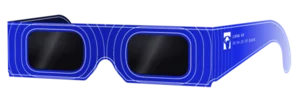
Certified eclipse glasses from Aura Sight
ISO 12312-2 certified, lab-tested and made by Rainbow Symphony, with a QR batch certificate on every pair. A$5.45 a pair from NSW stock, delivered Australia-wide (New Zealand too).