Key facts: solar eclipse in Melbourne, 22 July 2028
A partial solar eclipse is when the Moon covers only part of the Sun, so the sky stays light; a total eclipse is when it covers all of it for a few minutes.
What time is the eclipse in Melbourne?
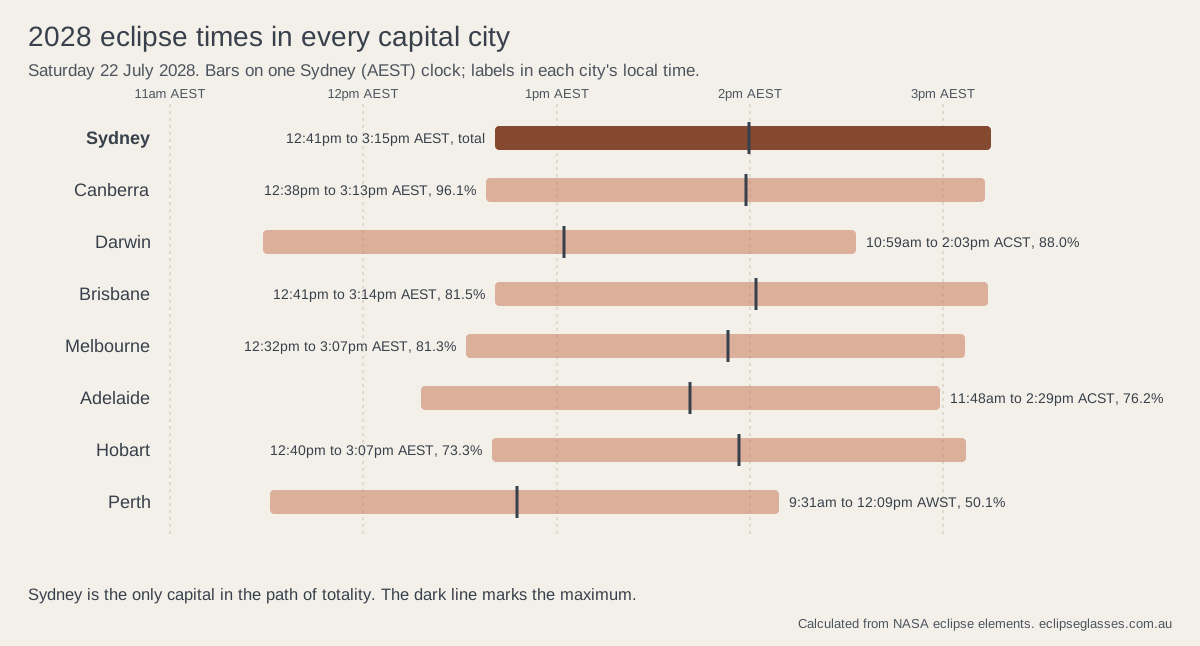
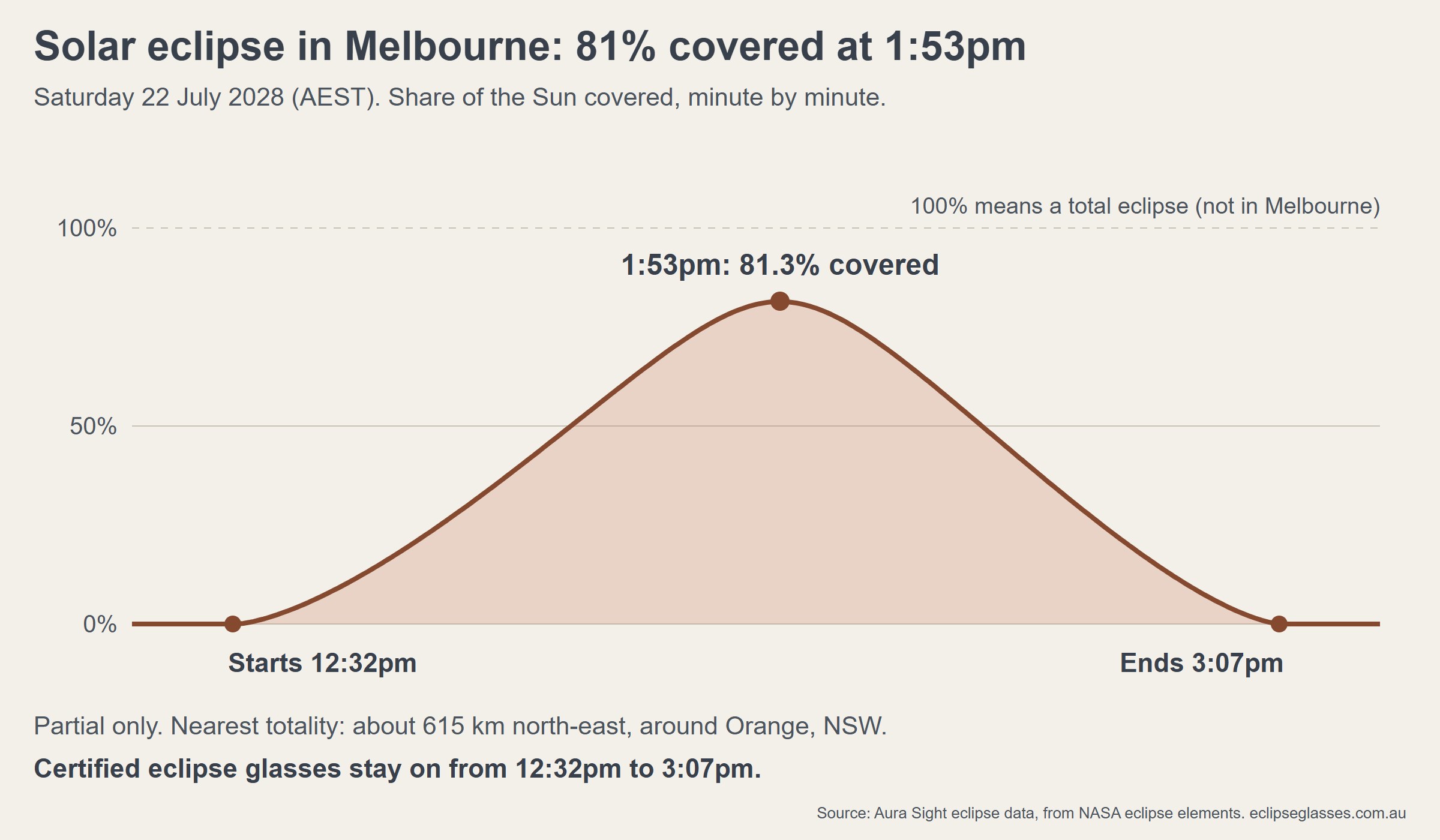
Times are AEST. There is no daylight saving in July, so Melbourne is on the same clock as Sydney and Brisbane. The figures are for the Melbourne CBD and match our 2028 eclipse times for every capital city.
| Stage | Time |
|---|---|
| Eclipse starts | 12:32pm |
| Most covered (81.3%) | 1:53:02pm |
| Eclipse ends | 3:07pm |
| Length | 2 h 35 min |
81.3% is the share of the Sun's area that is covered. Eclipse sites that quote the magnitude (0.84) give the share of its width instead, which is why some list a higher figure.
At its maximum the Sun is about 29° above the horizon, to the north-north-west (bearing about 337°). In July that is low enough for tall buildings and trees to block it, so pick a spot with an open view to the north.
Eclipse times around Melbourne and Victoria
The whole state gets a partial eclipse at about the same time. Coverage rises the further north you go, because the path of totality runs through New South Wales.
| Place | Starts | Most covered | Sun covered | Ends |
|---|---|---|---|---|
| Melbourne CBD | 12:32pm | 1:53pm | 81.3% | 3:07pm |
| Geelong | 12:32pm | 1:52pm | about 79% | 3:06pm |
| Frankston | 12:33pm | 1:53pm | about 81% | 3:07pm |
| Ballarat | 12:30pm | 1:51pm | about 80% | 3:06pm |
| Bendigo | 12:30pm | 1:52pm | about 83% | 3:07pm |
| Albury-Wodonga | 12:34pm | 1:56pm | about 90% | 3:10pm |
| Mildura | 12:24pm | 1:48pm | about 85% | 3:05pm |
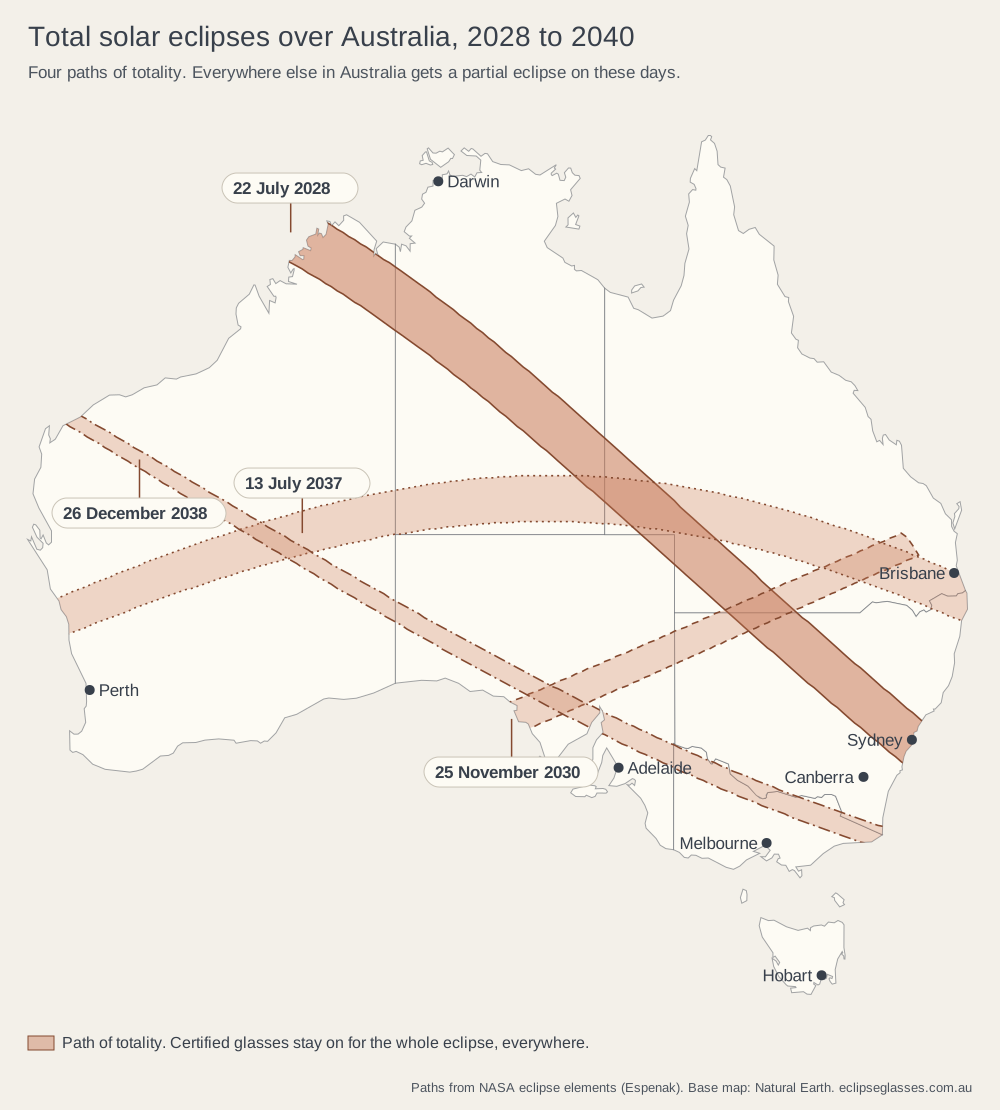
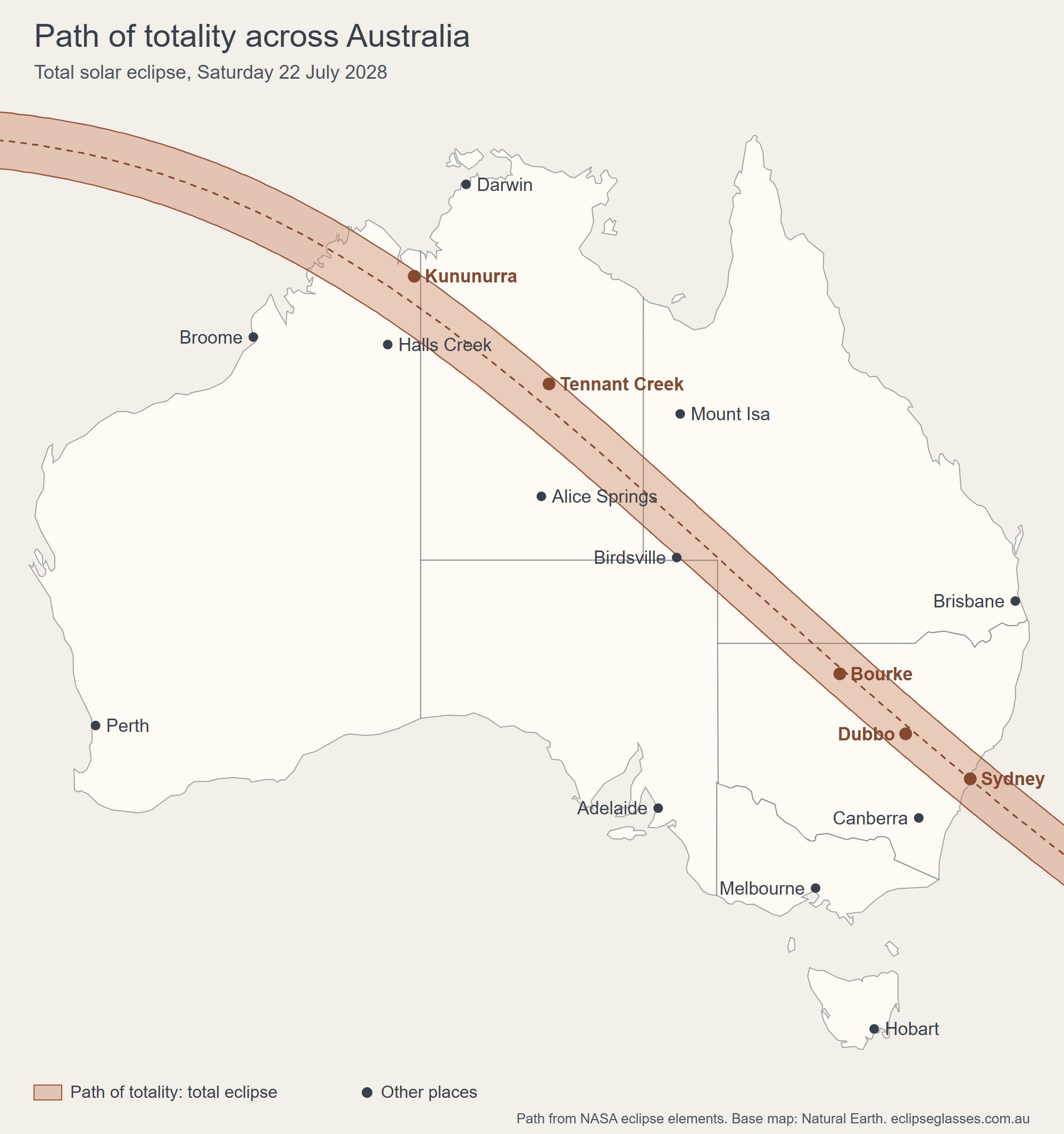
2028 eclipse path map for Australia
Is Melbourne in the path of totality?
No. The Moon covers at most 81.3% of the Sun over Melbourne, and the sky stays daylight bright. Totality, when the Sun is fully covered for a few minutes, happens only inside a band about 200 km wide that crosses Western Australia, the Northern Territory, Queensland and New South Wales.
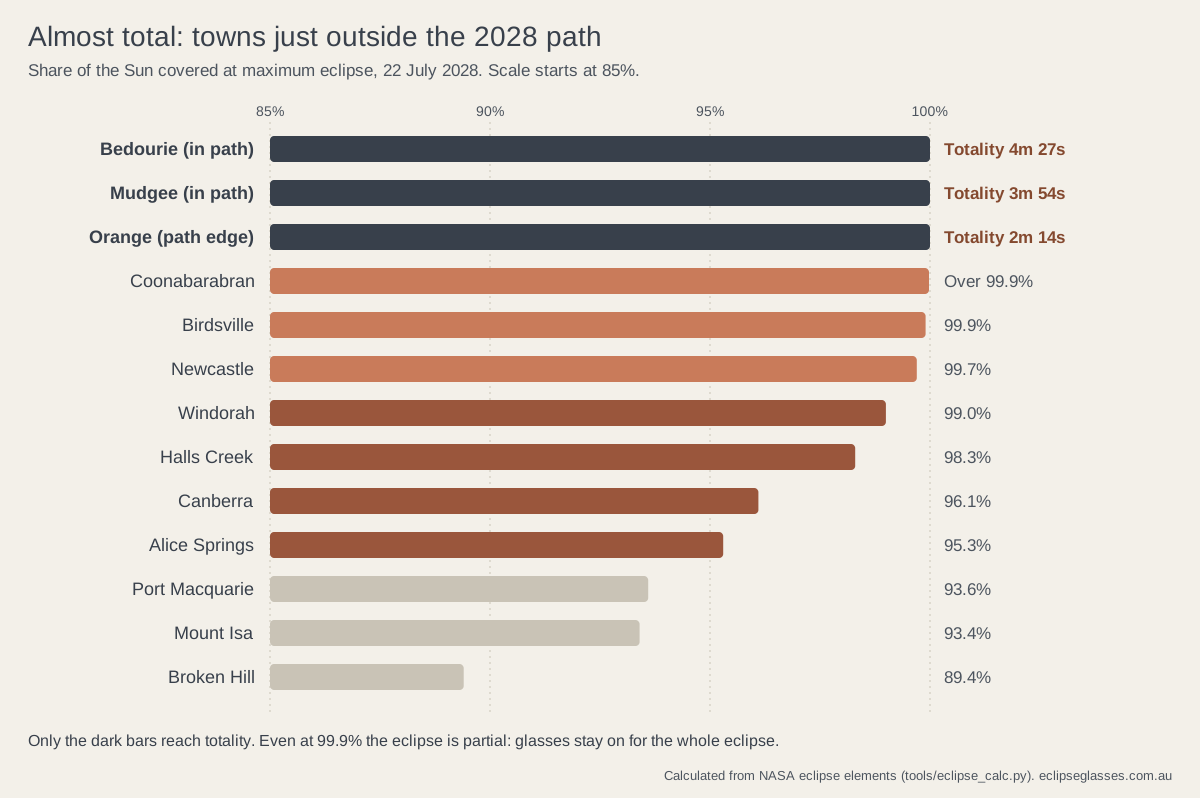
From Melbourne, the nearest totality is about 615 km north-east in a straight line, around Orange, Blayney and Millthorpe inland, or Kiama and Gerringong on the south coast. Sydney is the nearest capital city in the path. See the times for Orange, Bathurst and Wollongong, or check any address on our 2028 eclipse map.
Do you need eclipse glasses in Melbourne?
Yes, for the whole eclipse. In a partial eclipse the Moon never covers the whole Sun, so the glasses stay on from the first contact to the last. Even with 81% covered, the part that is left is bright enough to burn the retina, and the retina has no pain sensors, so there is no warning. Ordinary sunglasses are never safe.
Our certified eclipse glasses are A$5.45 a pair, delivered Australia-wide, and the family eclipse kit has four pairs for A$19.25. Online orders ship until 31 May 2028. Buying for a Melbourne school, club or business? See eclipse glasses for schools or bulk orders.
- Never use eclipse glasses with binoculars, a telescope, a camera or a phone. Optics need their own solar filter on the front: see solar filters for cameras, phones and binoculars.
- Check every pair before use, and throw out any that are scratched, torn or punctured.
- Supervise children closely, and fit their glasses before the eclipse starts.
When is the next total solar eclipse in Melbourne?
Melbourne's last total eclipse was on 23 October 1976, the last time totality fell on an Australian capital city (see the last solar eclipse in Australia). The next total eclipse in Victoria is on 26 December 2038, across northern Victoria from Swan Hill and Shepparton to Mallacoota; Melbourne itself gets a partial eclipse that day. Our guide to the next solar eclipse in Australia lists every eclipse to 2040.
Every solar eclipse in Melbourne to 2040
After 22 July 2028, six more solar eclipses reach Melbourne before 2040. All of them are partial. The deepest is 96% on Boxing Day 2038, when totality crosses northern Victoria.
| Date | In Melbourne | Begins | Greatest | Ends |
|---|---|---|---|---|
| Saturday 22 July 2028 | 81% of the Sun covered | 12:32pm | 1:53pm | 3:07pm AEST |
| Monday 25 November 2030 | 75% of the Sun covered | 6:19pm | 7:15pm | 8:07pm AEDT |
| Saturday 10 March 2035 | 76% of the Sun covered | 7:21am | 8:24am | 9:34am AEDT |
| Wednesday 27 February 2036 | 2% of the Sun covered | 4:14pm | 4:43pm | 5:10pm AEDT |
| Monday 13 July 2037 | 73% of the Sun covered | 11:28am | 12:56pm | 2:20pm AEST |
| Sunday 26 December 2038 | 96% of the Sun covered | 10:02am | 11:19am | 12:43pm AEDT |
| Friday 11 May 2040 | 17% of the Sun covered | 12:39pm | 1:47pm | 2:53pm AEST |
Local times, AEST in winter and AEDT in summer. On 25 November 2030 the Sun is only about 11° above the western horizon at the greatest eclipse, and on 10 March 2035 about 13° above the eastern horizon, so both need a clear, low view. The annular eclipse of 21 May 2031 cannot be seen from Melbourne. Every one is partial in Melbourne, so certified glasses stay on from start to finish. Our guide to the next solar eclipse in Australia has the same tables for every capital city.
Glasses stay on for the whole eclipse. Certified, lab-tested eclipse glasses from NSW stock, A$5.45 a pair including GST.
Shop eclipse glassesSolar eclipse in Melbourne: questions
What time is the solar eclipse in Melbourne?
On Saturday 22 July 2028 the eclipse starts at 12:32pm AEST, reaches its maximum at 1:53pm with 81.3% of the Sun covered, and ends at 3:07pm. That is 2 hours 35 minutes in all.
Is Melbourne in the path of totality in 2028?
No. Melbourne gets a partial eclipse. The nearest totality is about 615 km north-east in New South Wales, around Orange and Blayney inland or Kiama on the coast. Sydney is the nearest capital in the path.
Do I need eclipse glasses in Melbourne, and where can I buy them?
Yes, for the whole eclipse. In a partial eclipse the Moon never covers the whole Sun, so the glasses stay on from the first contact to the last. Use ISO 12312-2 certified eclipse glasses from start to finish. You can buy them online from Aura Sight: A$5.45 a pair, or A$19.25 for the four-pair family eclipse kit, delivered Australia-wide, with pre-orders shipping from NSW by 31 May 2028. Our guide to where to buy eclipse glasses in Australia lists what to check on any pair.
When is the next total solar eclipse in Melbourne?
The last total eclipse in Melbourne was on 23 October 1976. The next total eclipse in Victoria is on 26 December 2038, across northern Victoria from Swan Hill to Mallacoota; Melbourne itself gets a partial eclipse that day.
When is the next solar eclipse in Melbourne after 2028?
Monday 25 November 2030, a partial eclipse in the evening with 75% of the Sun covered at 7:15pm AEDT. The deepest before 2040 is 96% on Sunday 26 December 2038. Every one is partial in Melbourne, so glasses stay on the whole time.
How much of the Sun is covered in Geelong, Ballarat and Bendigo?
About 79% in Geelong, 80% in Ballarat and 83% in Bendigo, all at about 1:52pm AEST. Albury-Wodonga gets about 90% and Mildura about 85%.
Which way do I face for the eclipse in Melbourne?
North-north-west. At 1:53pm the eclipse is about 29 degrees above the horizon, at a bearing of about 337 degrees, so pick a spot with an open view to the north. Keep certified glasses on the whole time.
Will it get dark in Melbourne during the eclipse?
No. With at most 81.3% of the Sun covered, the sky stays daylight bright. Day only turns to dusk inside the path of totality, the nearest part about 615 km north-east in New South Wales.
Sources
All checked 16.11.2026.
- Times calculated from NASA's Besselian elements for the 22 July 2028 eclipse, Fred Espenak, NASA GSFC, with Delta T of 69.2 s, for each town centre. Coverage outside Melbourne is rounded to the nearest whole per cent.
- Distance to the path is the straight-line distance from the Melbourne CBD to the nearest town in the path.
- ARPANSA, Solar eclipse; American Astronomical Society, Solar eclipse eye safety; NASA, Eclipse safety.
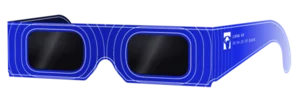
Certified eclipse glasses from Aura Sight
ISO 12312-2 certified, lab-tested and made by Rainbow Symphony, with a QR batch certificate on every pair. A$5.45 a pair from NSW stock, delivered Australia-wide (New Zealand too).