The short version. Total: Australia, the south of New Zealand's South Island, Christmas Island and the Cocos Islands. Partial: Indonesia, Timor-Leste, Singapore, Malaysia, Brunei, Papua New Guinea, the Philippines, mainland South-East Asia, Sri Lanka and the Pacific as far east as Fiji and Tonga. Not visible: Samoa, the Cook Islands and Mauritius. Everyone watching needs certified eclipse glasses.
Where is the 2028 eclipse total?
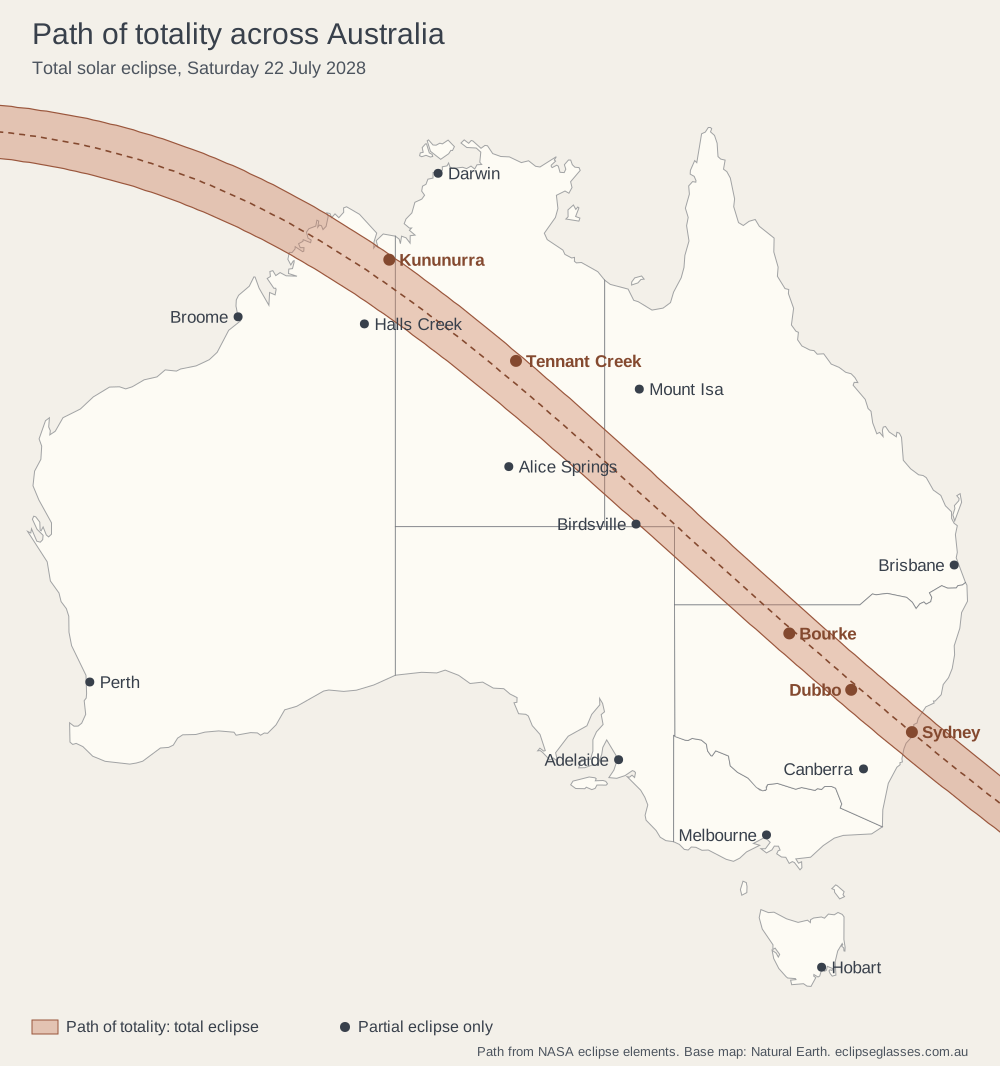
Totality happens only inside a path about 200 km wide that crosses Australia, the south of New Zealand's South Island, Christmas Island and the Cocos (Keeling) Islands.
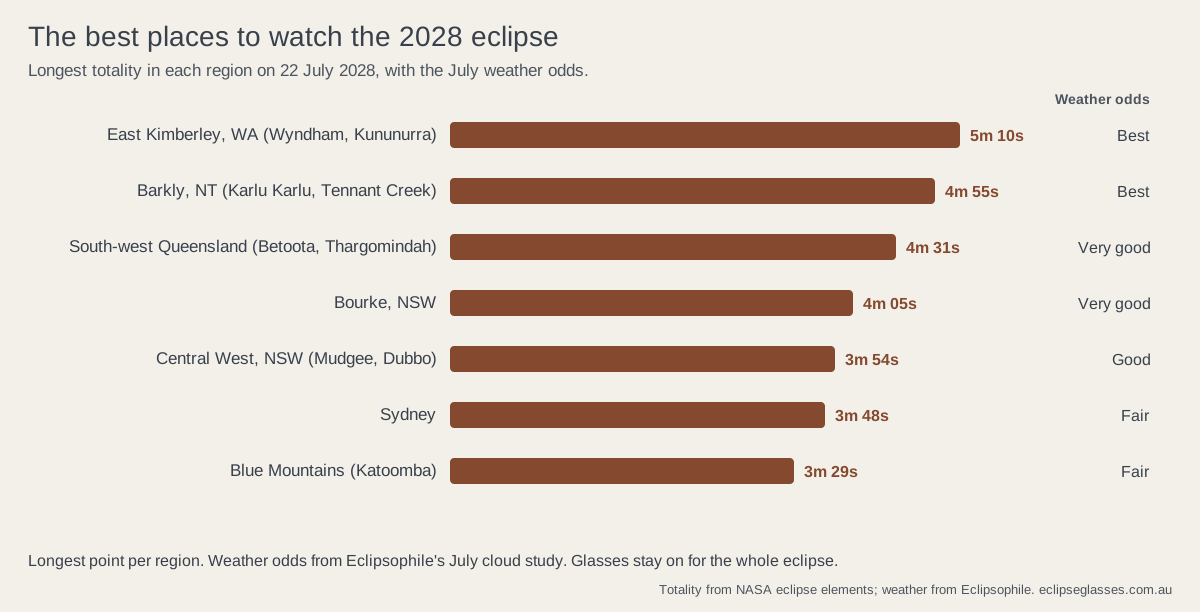
In Australia the path crosses the Kimberley in Western Australia, where totality lasts longest at 5 min 10 s, then Tennant Creek in the Northern Territory, outback south-west Queensland and New South Wales from Bourke and Dubbo to Sydney, with 3 min 48 s from 1:59pm AEST. Full path: 2028 total solar eclipse guide for Australia.
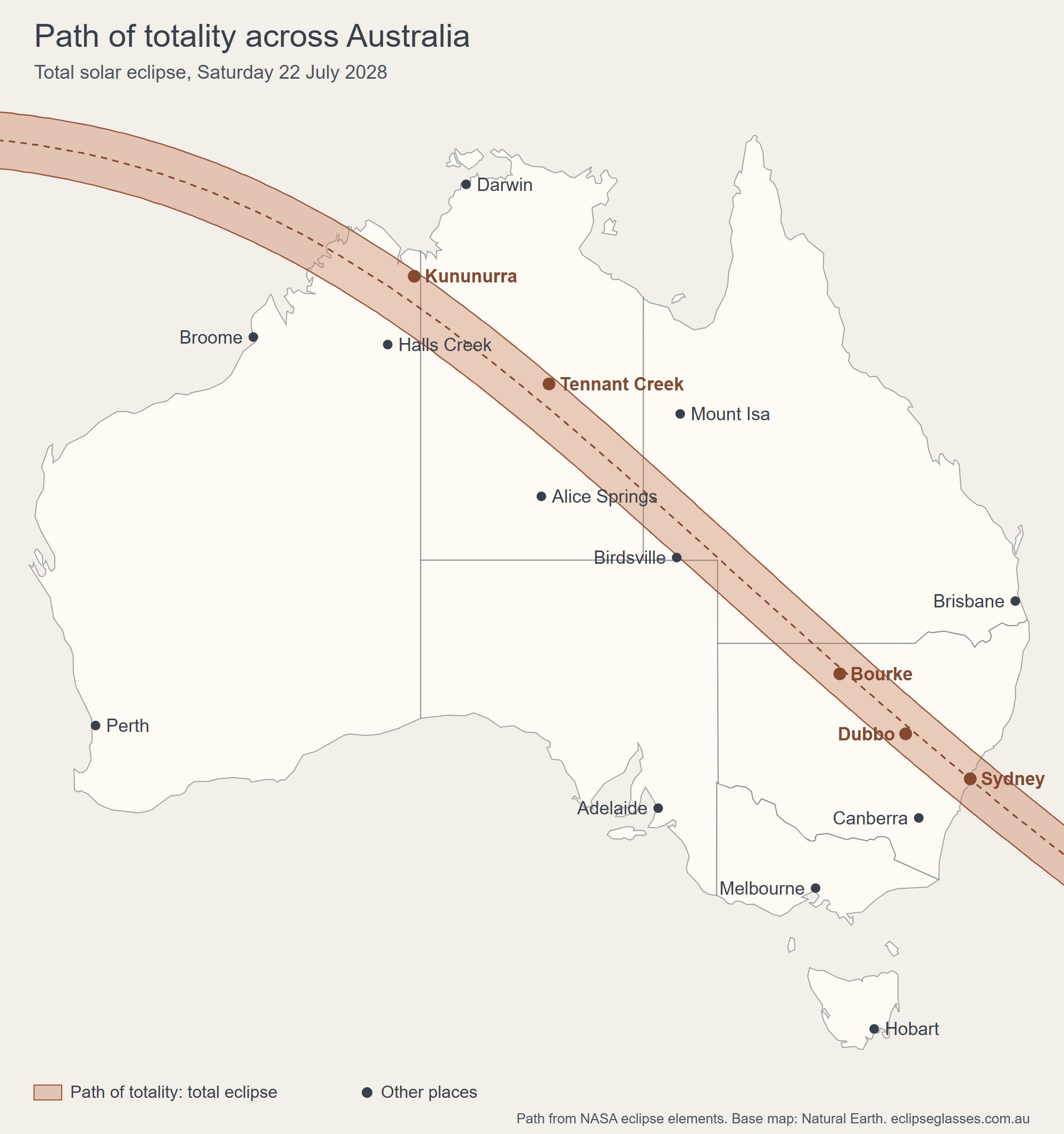
The other capitals get a partial eclipse: Canberra 96%, Darwin 88%, Brisbane and Melbourne 81%, Adelaide 76%, Hobart 73% and Perth 50%. See 2028 eclipse times for every capital city, or check any address on our 2028 eclipse map.
In New Zealand, totality reaches Queenstown at 4:15pm NZST (UTC+12) for 2 min 55 s and Dunedin at 4:16pm for 2 min 51 s. See the total eclipse in Dunedin and Queenstown.
Can you see the total eclipse on Christmas Island and the Cocos Islands?
Yes. Christmas Island gets 3 min 53 s of totality at Flying Fish Cove from 8:54am CXT (UTC+7), and the Cocos (Keeling) Islands 3 min 26 s at West Island from 8:12am CCT (UTC+6:30).
Both are Australian territories, with flights from Perth. See Christmas Island and Cocos Islands eclipse times.
Can you see the 2028 eclipse in Bali?
Yes, as a deep partial eclipse: Denpasar gets 96% of the Sun covered at 10:16am WITA (UTC+8), from 8:51am to 11:50am. Bali is not in the path of totality.
Kuta gets 96%, Ubud and Lombok 95%, Kupang 93% and Jakarta 89%. The path of totality passes about 160 km south of Bali, over the sea; the nearest land inside it is Christmas Island. See the solar eclipse in Bali.
Can you see the 2028 eclipse in Timor-Leste?
Yes, as a partial eclipse: Dili gets 85% of the Sun covered at 11:43am TLT (UTC+9), from 10:12am to 1:16pm.
The nearest totality is at Wyndham in Western Australia, about 820 km south-east. See Timor-Leste eclipse times for Dili and Atauro.
Is Lord Howe Island in the path of totality?
No. Lord Howe Island gets a partial eclipse, with 81% of the Sun covered at 2:41pm LHST (UTC+10:30).
Norfolk Island gets 54% at 3:19pm NFT (UTC+11). See Lord Howe Island eclipse times.
Is Stewart Island in the path of totality?
No, but it comes close: Oban on Stewart Island (Rakiura) gets 97% of the Sun covered at 4:15pm NZST (UTC+12), just south of the path.
See Stewart Island eclipse times, or cross to Queenstown or Dunedin for totality.
Which countries see a partial eclipse in 2028?
About 20 countries and territories beyond Australia and New Zealand get a partial eclipse on 22 July 2028, from Indonesia (up to 96%) to Fiji and Tonga (7%).
| Country | Most covered at | Covered |
|---|---|---|
| Indonesia | Denpasar, Bali: 10:16am WITA (UTC+8) | 96% |
| Indonesia | Kupang: 10:40am WITA (UTC+8) | 93% |
| Indonesia | Surabaya: 9:09am WIB (UTC+7) | 92% |
| Indonesia | Jakarta: 8:55am WIB (UTC+7) | 89% |
| Indonesia | Makassar: 10:23am WITA (UTC+8) | 81% |
| Indonesia | Jayapura: 12:12pm WIT (UTC+9) | 36% |
| Timor-Leste | Dili: 11:43am TLT (UTC+9) | 85% |
| Singapore | Singapore: 9:44am SGT (UTC+8) | 60% |
| Malaysia | Kuala Lumpur: 9:40am MYT (UTC+8) | 52% |
| Brunei | Bandar Seri Begawan: 10:02am BNT (UTC+8) | 47% |
| Vietnam | Ho Chi Minh City: 8:44am ICT (UTC+7) | 27% |
| Cambodia | Phnom Penh: 8:41am ICT (UTC+7) | 24% |
| Thailand | Bangkok: 8:35am ICT (UTC+7) | 16% |
| Philippines | Manila: 10:07am PHT (UTC+8) | 13% |
Myanmar (Yangon 6%, 8:01am MMT, UTC+6:30), Laos (Vientiane 6%, 8:38am ICT, UTC+7) and Hainan in China (Sanya 6%, 9:47am CST, UTC+8) get only a small partial eclipse.
| Country | Most covered at | Covered |
|---|---|---|
| Papua New Guinea | Port Moresby: 1:36pm PGT (UTC+10) | 41% |
| New Caledonia | Nouméa: 3:16pm NCT (UTC+11) | 36% |
| Palau | Koror: 11:44am PWT (UTC+9) | 20% |
| Vanuatu | Port Vila: 3:15pm VUT (UTC+11) | 20% |
| Solomon Islands | Honiara: 2:57pm SBT (UTC+11) | 14% |
| Fiji | Suva: 4:24pm FJT (UTC+12) | 7% |
| Tonga | Nuku'alofa: 5:28pm TOT (UTC+13) | 7% |
Sri Lanka, the Maldives and India
Here the eclipse is at sunrise, so you need a clear eastern horizon. Colombo gets 21% at 6:51am SLST (UTC+5:30), Malé in the Maldives 22% at 6:20am MVT (UTC+5), and Kochi in southern India 9% at 6:50am IST (UTC+5:30).
Where can't you see the 2028 eclipse?
Samoa, the Cook Islands, Mauritius and Réunion miss it. From Apia the Moon passes just clear of the Sun; in the Cook Islands the Sun has set; in Mauritius and Réunion the eclipse ends before sunrise.
Guam, Nauru, Kiribati, Tuvalu and the Marshall Islands also miss it.
Do you need eclipse glasses if you travel to watch it?
Yes. Certified eclipse glasses stay on for the whole eclipse, totality included. Ordinary sunglasses are never safe, and eclipse glasses never go with binoculars, a camera or a phone.
Schools, hotels, tour operators, travel agents, airlines and events outside Australia and New Zealand order by quote, freight priced per order: get a quote for bulk eclipse glasses for groups and events, see wholesale and custom-printed eclipse glasses, or read our eclipse planning guide for tourism operators.
Single pairs and family kits ship to Australian and New Zealand addresses, so order before you fly. Certified eclipse glasses are A$5.45 a pair, or A$19.25 for a family kit of four; pre-orders ship from NSW by 31 May 2028.
Where to see the 2028 eclipse: questions
Where is the July 2028 solar eclipse visible?
On Saturday 22 July 2028 the eclipse is total in Australia (Western Australia, the Northern Territory, Queensland and New South Wales, including Sydney), in New Zealand around Queenstown and Dunedin, and on Christmas Island and the Cocos (Keeling) Islands. A partial eclipse covers South-East Asia and the south-west Pacific, from Bali at 96% to Fiji and Tonga at 7%.
Which countries see the total solar eclipse in 2028?
Two: Australia, including its Indian Ocean territories of Christmas Island and the Cocos (Keeling) Islands, and New Zealand, where totality reaches Queenstown and Dunedin. Every other country gets a partial eclipse or none.
What time is the 2028 solar eclipse?
It is on Saturday 22 July 2028. Totality starts at 8:12am CCT (UTC+6:30) on the Cocos Islands, 8:54am CXT (UTC+7) on Christmas Island, 1:59pm AEST (UTC+10) in Sydney and 4:16pm NZST (UTC+12) in Dunedin. The partial eclipse peaks at 9:44am SGT (UTC+8) in Singapore and 10:16am WITA (UTC+8) in Bali.
Can you see the 2028 solar eclipse in Bali?
Yes, as a partial eclipse. Denpasar gets 96% of the Sun covered at 10:16am WITA (UTC+8), from 8:51am to 11:50am. Bali is not in the path of totality, which passes about 160 km south of the island, over the sea.
Can you see the 2028 solar eclipse in Singapore and Malaysia?
Yes, as a partial eclipse. Singapore gets 60% of the Sun covered at 9:44am SGT (UTC+8), and Kuala Lumpur 52% at 9:40am MYT (UTC+8).
Where can I buy eclipse glasses before I travel?
Online from Aura Sight: ISO 12312-2 certified eclipse glasses are A$5.45 a pair and the family eclipse kit (four pairs) is A$19.25. They ship to Australian and New Zealand addresses, so order before you fly; pre-orders ship from NSW by 31 May 2028. Schools, hotels, tour operators and events overseas order in bulk by quote, with freight priced per order.
Sources
All checked 20.11.2026.
- Times and coverage calculated from NASA's Besselian elements for the 22 July 2028 eclipse, Fred Espenak, NASA GSFC, with Delta T of 69.2 s, for each city centre, rounded to the nearest whole per cent. Sun covered is the share of the Sun's area.
- Countries in the eclipse zone cross-checked against Wikipedia, Solar eclipse of July 22, 2028. Local time zones are those in use in July 2028; none of these places uses daylight saving in July.
- Distances are straight lines from the city centre to the nearest place inside the path.
- ARPANSA, Solar eclipse; American Astronomical Society, Solar eclipse eye safety; NASA, Eclipse safety.
Aura Sight supplies schools, councils and events
Bulk cartons from NSW stock with the certification pack for your safety officer, or glasses printed with your logo from 1,000 units per design.