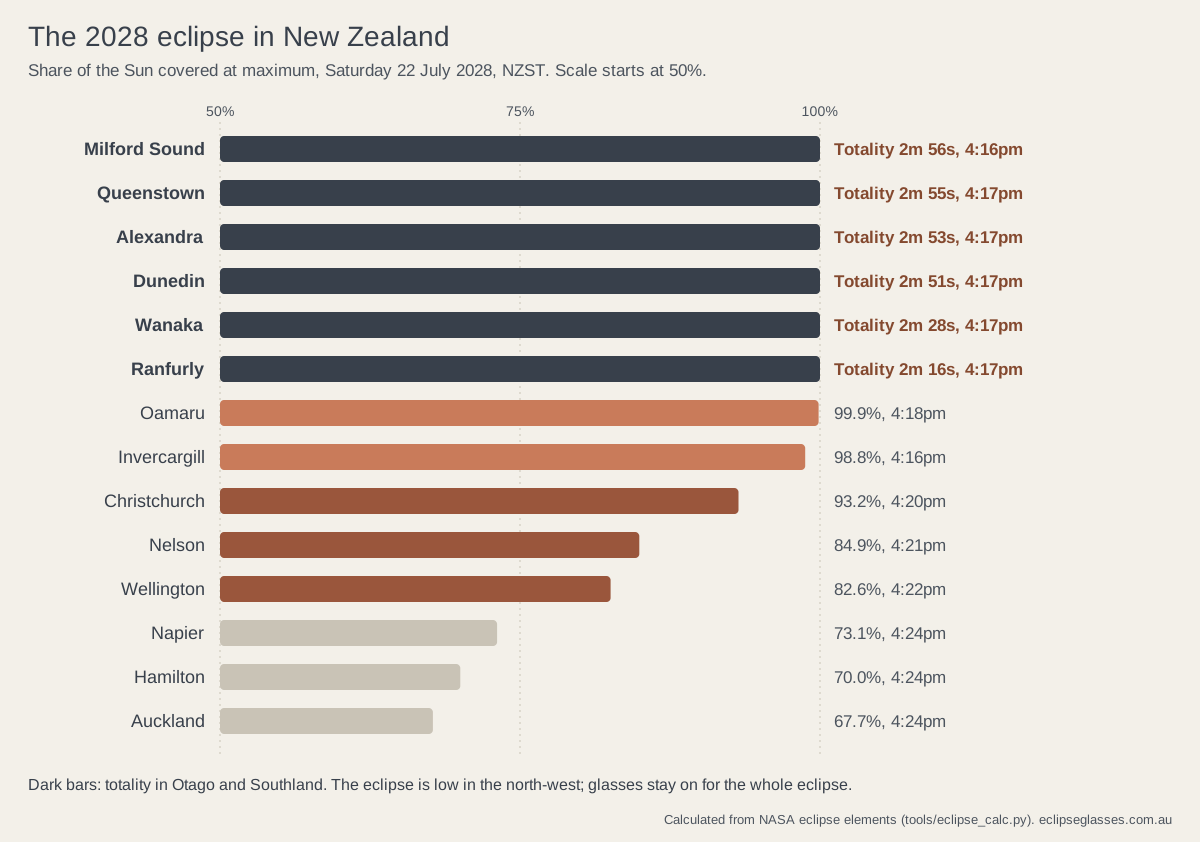
The short version. Totality crosses Fiordland, Central Otago and coastal Otago between about 4:15pm and 4:19pm NZST on Saturday 22 July 2028. Queenstown gets 2 min 55 s, Dunedin 2 min 51 s and Milford Sound 2 min 56 s. At totality the eclipse is only about 8 to 11 degrees above the horizon, in the north-west, so pick a spot with a clear, low view that way and a back-up in case of cloud. Book early, and buy certified ISO 12312-2 glasses before you travel: they stay on for the whole eclipse, totality included.
Which South Island towns are in the path of totality?
We calculated each place from NASA's eclipse elements, the same method behind our 2028 eclipse guide for New Zealand. These towns are not on our Australian eclipse map, so every figure here is our own calculation for the town centre. New Zealand is on standard time in July, so all times are NZST, two hours ahead of Sydney.
| Place | Eclipse begins | Totality or maximum | Totality lasts | Eclipse ends |
|---|---|---|---|---|
| Milford Sound | 3:07pm | 4:14:51pm to 4:17:47pm | 2 min 56 s | 5:20pm |
| Glenorchy | 3:07pm | 4:15:04pm to 4:18:00pm | 2 min 56 s | 5:20pm |
| Queenstown | 3:07pm | 4:15:10pm to 4:18:05pm | 2 min 55 s | 5:20pm |
| Arrowtown | 3:08pm | 4:15:20pm to 4:18:14pm | 2 min 54 s | 5:20pm |
| Alexandra | 3:08pm | 4:15:32pm to 4:18:25pm | 2 min 53 s | 5:20pm |
| Cromwell | 3:08pm | 4:15:32pm to 4:18:23pm | 2 min 51 s | 5:20pm |
| Dunedin | 3:09pm | 4:15:53pm to 4:18:44pm | 2 min 51 s | 5:20pm, near sunset |
| Mosgiel | 3:09pm | 4:15:47pm to 4:18:38pm | 2 min 51 s | 5:20pm, near sunset |
| Middlemarch | 3:09pm | 4:15:53pm to 4:18:41pm | 2 min 48 s | 5:20pm, near sunset |
| Roxburgh | 3:08pm | 4:15:22pm to 4:18:10pm | 2 min 48 s | 5:20pm |
| Lawrence | 3:08pm | 4:15:30pm to 4:18:04pm | 2 min 34 s | 5:20pm, near sunset |
| Wanaka | 3:08pm | 4:15:52pm to 4:18:21pm | 2 min 28 s | 5:20pm |
| Palmerston | 3:09pm | 4:16:30pm to 4:18:50pm | 2 min 20 s | 5:20pm, near sunset |
| Ranfurly | 3:09pm | 4:16:21pm to 4:18:38pm | 2 min 16 s | 5:20pm, near sunset |
| Balclutha | 3:08pm | 4:15:41pm to 4:17:35pm | 1 min 54 s | 5:20pm, near sunset |
| Te Anau | 3:06pm | Maximum 4:16pm, on the edge of the path | Not total | 5:20pm |
| Gore | 3:07pm | Maximum 4:16pm, over 99.9% covered | Not total | 5:19pm |
| Oamaru | 3:10pm | Maximum 4:18pm, 99.9% covered | Not total | 5:21pm, near sunset |
| Omarama | 3:09pm | Maximum 4:18pm, 99.7% covered | Not total | 5:21pm |
| Haast | 3:08pm | Maximum 4:17pm, 99.5% covered | Not total | 5:21pm |
| Twizel | 3:09pm | Maximum 4:18pm, 99.1% covered | Not total | 5:21pm |
| Invercargill | 3:07pm | Maximum 4:16pm, 98.8% covered | Not total | 5:19pm |
| Lake Tekapo | 3:10pm | Maximum 4:18pm, 97.9% covered | Not total | 5:21pm |
| Christchurch | 3:12pm | Maximum 4:20pm, 93.2% covered | Not total | 5:22pm, near sunset |
Calculated by Aura Sight from NASA eclipse elements for each town centre. Near the edges of the path, real durations can differ from the calculation by 10 seconds or more.
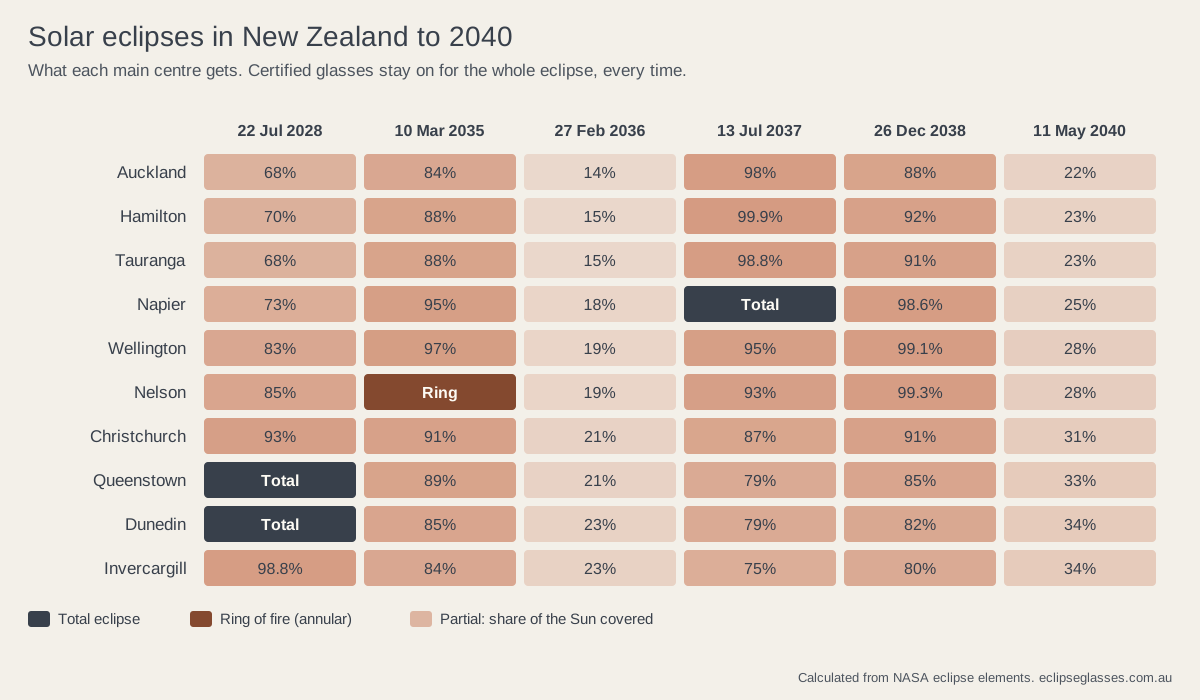
By our calculations, Dunedin and Queenstown are the only main centres in New Zealand inside the path. It runs from Fiordland south-east across the Wakatipu basin, the Cromwell and Alexandra basins and the Maniototo, and reaches the east coast between Palmerston and the mouth of the Clutha River. For the rest of the country, see the 2028 eclipse across New Zealand.
Which places are just outside the path?
Several popular bases miss totality by a few kilometres, and "almost total" is still a partial eclipse: the sky dims, but it does not go dark, and glasses stay on throughout.
- Te Anau sits right on the southern edge of the path, too close to call. Te Anau Downs, about 30 km north up the Milford Road, gets about 2 minutes of totality by our calculation.
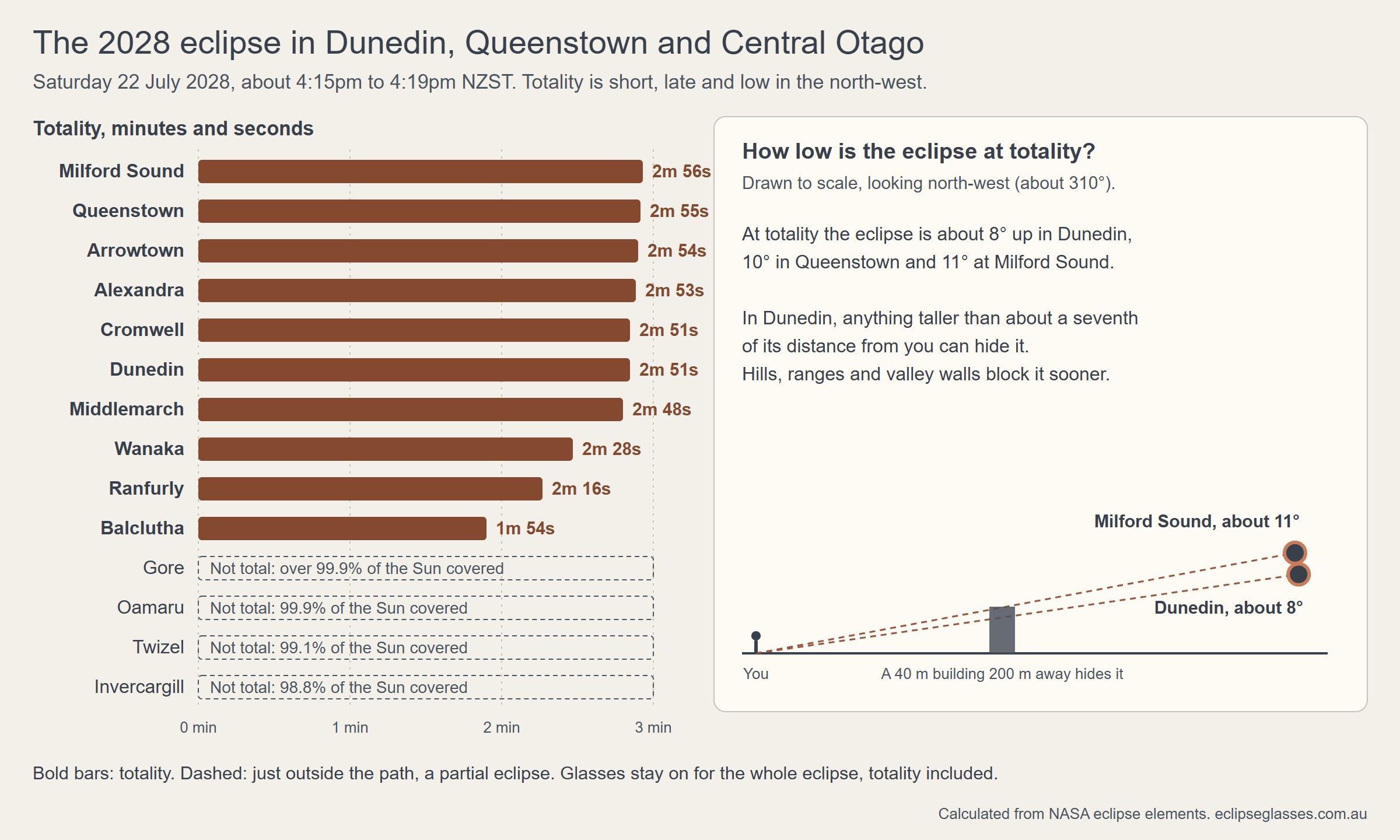
- Gore reaches over 99.9% and Invercargill 98.8%. Balclutha, to the east, is inside the path with 1 min 54 s.
- Oamaru reaches 99.9%. Palmerston, about 55 km south on State Highway 1, gets 2 min 20 s.
- Twizel, Omarama and Lake Tekapo in the Mackenzie Basin, and Haast on the West Coast, are north of the path.
Totality is longest near the centre line and shortest near the edges. Ranfurly and Wanaka, nearer the northern edge, get 2 min 16 s and 2 min 28 s; Queenstown and Milford Sound, nearer the centre, close to 3 minutes. Our guide to towns just outside the path explains why the last fraction of a percent makes all the difference.
How low is the eclipse, and how do you choose a spot?
Low. In New Zealand the eclipse happens late on a winter afternoon, and at totality it is only about 8 degrees above the horizon in Dunedin, 10 degrees in Queenstown and 11 degrees at Milford Sound, in the north-west. That is roughly the width of a fist held out at arm's length. By the time the eclipse ends, at about 5:20pm, it is on the horizon: in Dunedin, Oamaru and along the coast it ends around sunset.
- Find a clear, low view to the north-west. In Dunedin, a building or hill taller than about a seventh of its distance from you can hide the eclipse: a 40 m building 200 m away is enough. In the Wakatipu basin, around Glenorchy and at Milford Sound, mountains and valley walls block a low view far sooner.
- Check your spot at the same time of day. Visit around 4pm in the weeks before and note where the shadows fall. If your spot is in shade from a ridge to the north-west at that hour, it is likely to be in shade at totality too.
- Look for height and open ground. Hilltops, open farmland, beaches and lakeshores facing north-west give the best chance of a clear line. The Maniototo and the basins around Alexandra and Cromwell are wide, but ranges still rise on most sides.
- Have a back-up. Pick a second spot in a different direction or valley, and know how long it takes to drive there before 4pm.
However low it is, our rule does not change: certified glasses stay on from the start of the eclipse to the end, totality included. Our guide on why you need eclipse glasses explains what an eclipse can do to your eyes.
What will the weather be like in July?
Nobody can forecast 22 July 2028 yet, and we do not publish cloud odds for New Zealand. What NIWA's climate summary for Otago does say:
- Inland is usually sunnier than the coast. Sunshine generally increases with distance from the coast. Coastal Otago receives less sunshine than many other parts of New Zealand, coastal South Otago is particularly cloudy, and many inland places get over 2,000 hours of sunshine a year.
- Mountains make their own cloud. NIWA notes more cloud over some mountain areas, naming the Remarkables near Queenstown and the Pisa Range near Cromwell.
- Winter brings low cloud, fog and snow. Settled weather can bring low cloud or fog to inland Otago, chiefly from April to October, fog is recorded most often in autumn and winter, and snowfalls are relatively frequent in Otago compared with the rest of the country.
The practical answer is to stay mobile. Base yourself somewhere you can drive from, watch the forecast in the days before, and be ready to move to a clearer part of the path on the day. Leave plenty of time: roads in the path will be busy, and alpine roads can close for snow or ice in winter. For the Australian side of the eclipse, see our 2028 eclipse weather guide.
How busy will Dunedin and Queenstown be?
Busy, and bookings have already started. In June 2026 the Otago Daily Times reported that the Dunedin City Council expects about 5,000 international and 30,000 domestic visitors for the eclipse. One hotel group already had more than 150 room nights booked at its two Dunedin hotels around the eclipse, two years out, and the council had applied for government funding for an eight-day eclipse festival.
- Book accommodation early. Eclipse week falls in the ski season, when Queenstown is already busy.
- Arrive the day before. Totality is just after 4pm, so a flight or long drive on the day leaves little margin for delays, fog or snow.
- From Australia, mind the time difference: totality in Queenstown, at 4:15pm NZST, is 2:15pm in Sydney, about 12 minutes after Sydney's own totality ends. You can be in one or the other, not both.
- Plan for the drive back. The eclipse ends around sunset, so the drive back from a rural spot will be in the dark on winter roads.
Running tours, accommodation or an event in Otago? Our guide for tourism operators covers guest glasses and lead times, and wholesale eclipse glasses for New Zealand covers bulk supply. For the eclipses after this one, see the next solar eclipses in New Zealand.
Do you need eclipse glasses in Dunedin and Queenstown?
Yes, everyone does, for the whole eclipse. The partial eclipse runs for over an hour before totality and about an hour after it, and outside the path, in Invercargill or Christchurch, the whole eclipse is partial. Certified glasses stay on from the start of the eclipse to the end, totality included.
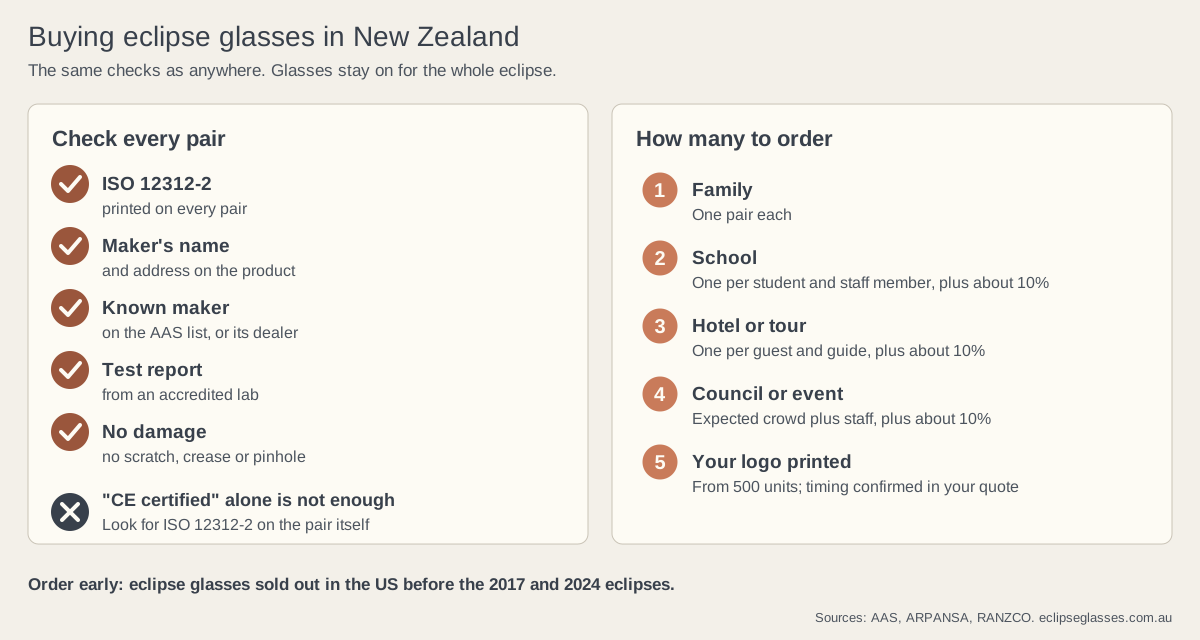
- Buy certified ISO 12312-2 glasses before you travel. Before the 2017 and 2024 eclipses in the US, stock sold out in the final weeks, and small towns in the path may have little left on the day. Our guide to where to buy eclipse glasses in New Zealand goes through the checks.
- Sunglasses are not enough, even very dark ones. Never look at the Sun without certified eclipse glasses.
- Never use eclipse glasses with binoculars, a telescope, a camera or a phone. Optics need their own solar filter on the front.
- Check every pair before use, and throw out any that are scratched, torn or punctured. Fit children's glasses before the eclipse starts, and stay beside them.
You can order our certified eclipse glasses and family eclipse kits online for delivery to New Zealand: choose New Zealand in the cart, and delivery is a flat A$19.95. They are made by Rainbow Symphony, a manufacturer on the American Astronomical Society's list of reputable vendors, carry a QR batch certificate on every pair, and ship from NSW by 31 May 2028.
Certified eclipse glasses delivered to New Zealand for A$19.95. Choose New Zealand in the cart, and pack them before you travel.
Shop the family eclipse kitFAQ
Is Dunedin in the path of totality in 2028?
Yes. Dunedin gets 2 minutes 51 seconds of totality on Saturday 22 July 2028, from 4:15:53pm to 4:18:44pm NZST, by our calculations from NASA eclipse elements. The whole eclipse runs from 3:09pm until about 5:20pm, near sunset.
What time is the eclipse in Queenstown?
The eclipse runs from 3:07pm to 5:20pm NZST on Saturday 22 July 2028, with totality from 4:15:10pm to 4:18:05pm, 2 minutes 55 seconds.
Is Te Anau or Invercargill in the path of totality?
Invercargill is not: it gets a partial eclipse, 98.8% of the Sun covered. Te Anau sits right on the southern edge of the path, too close to call; Te Anau Downs, about 30 km north, gets about 2 minutes of totality.
Are Oamaru and Christchurch in the path?
No. Oamaru reaches 99.9% and Christchurch 93.2%, both partial eclipses. The nearest totality to Oamaru is around Palmerston, with 2 minutes 20 seconds.
How high is the eclipse in the sky in New Zealand?
Low. At totality it is about 8 degrees above the horizon in Dunedin, 10 degrees in Queenstown and 11 degrees at Milford Sound, in the north-west. Pick a spot with a clear, low view in that direction.
What are the chances of clear skies in Otago in July?
Nobody can forecast the day yet, and we do not publish cloud odds for New Zealand. NIWA's climate summary for Otago says inland areas are generally sunnier than the coast, and that low cloud and fog are more common in winter, so stay mobile and have a back-up spot.
Do I need eclipse glasses in the path of totality?
Yes. The partial eclipse lasts over an hour before and after totality. Certified ISO 12312-2 glasses stay on for the whole eclipse, totality included.
Can I get Aura Sight eclipse glasses delivered to New Zealand?
Yes. Choose New Zealand in the cart and glasses and family kits are delivered for a flat A$19.95, shipping by 31 May 2028 with the other pre-orders. Buy them before you travel.
Sources
All checked 13.11.2026.
- Times calculated from NASA's Besselian elements for the 22 July 2028 eclipse, Fred Espenak, NASA GSFC, with Delta T of 69.2 s, for each town centre, in NZST. Heights above the horizon are from the same calculation, without atmospheric refraction.
- Otago Daily Times, Visitors already booking for 2028 eclipse (8 June 2026), also published as Visitors booking for 2028 eclipse (11 June 2026).
- G. R. Macara, The climate and weather of Otago, 2nd edition, NIWA Science and Technology Series 67 (2015): sunshine, low cloud, fog and snow.
- ARPANSA, Solar eclipse; American Astronomical Society, Solar eclipse eye safety and Suppliers of safe solar viewers and filters; NASA, Eclipse safety.
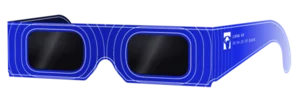
Aura Sight glasses for everyone watching
ISO 12312-2 certified and lab-tested, with a QR batch certificate on every pair. The family kit has four pairs and a printed viewing guide.