Key facts for eclipse activities in 2028
What are good solar eclipse activities for kids?
Good eclipse activities are hands-on, use things you already have and teach one idea each. Most of these work on any sunny day, so try them in the weeks before the eclipse.
Eclipse activities for preschoolers (3 to 5)
Keep it about light and shadow. Children too young to keep glasses on stay facing the ground.
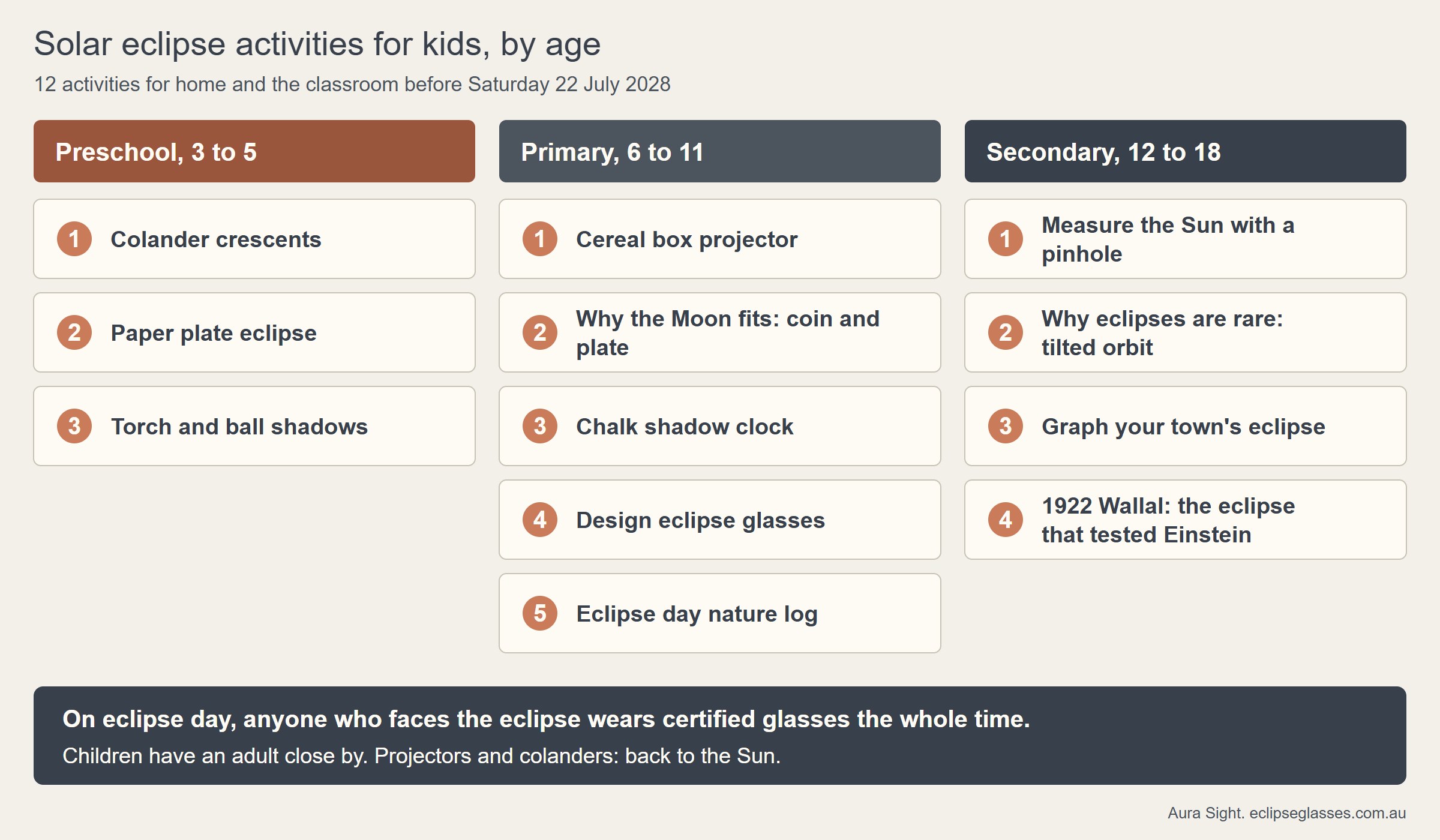
1. Colander crescents
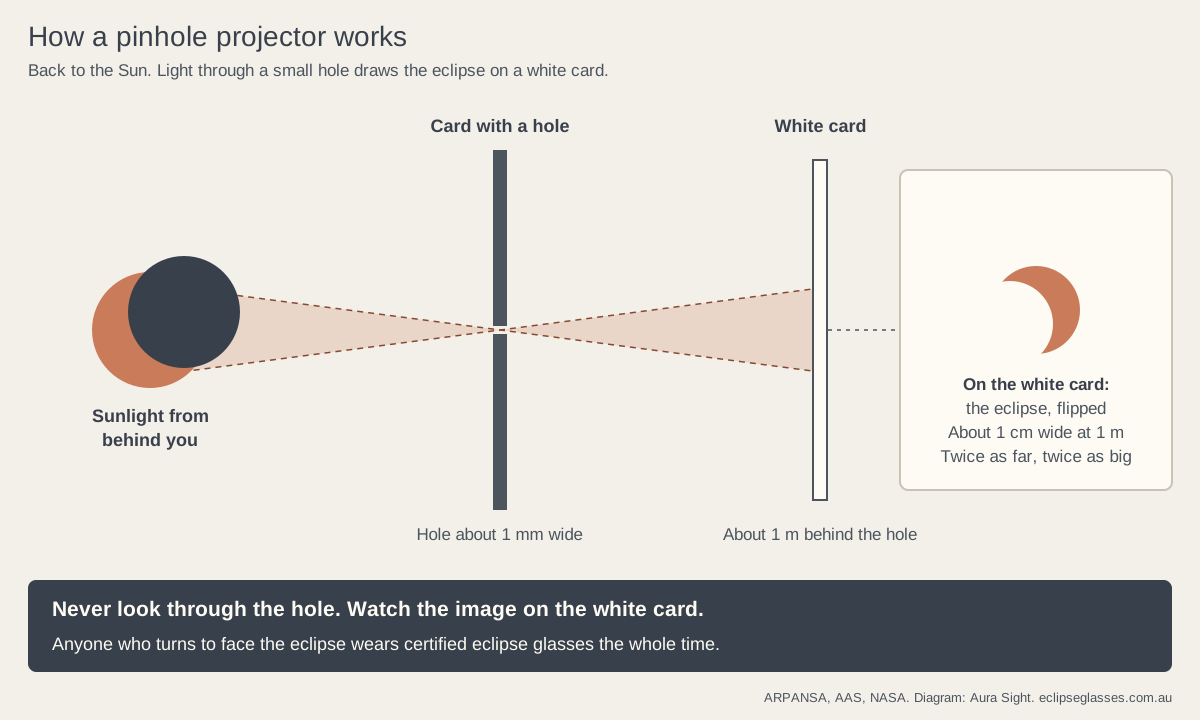
An adult holds the colander with their back to the Sun and children count the dots of light. They are round on a normal day and turn into crescents during the eclipse. See how to make a pinhole projector.
2. Paper plate eclipse
Pin the black circle near the plate's edge so it swings across: a bite, a crescent, total, then back again.
3. Torch and ball shadows
Move the ball between the torch and the toy and watch its shadow fall on the toy. Never shine the torch at anyone's eyes.
Eclipse activities for primary students (6 to 11)
4. Cereal box projector
Each student builds one from our pinhole projector guide. Teach the rule first: back to the Sun, never look through the hole.
5. Why the Moon fits: coin and plate
A student covers a plate across the room with a coin held at arm's length. The Sun is about 400 times wider than the Moon and about 400 times further away, so they look almost the same size.
6. Chalk shadow clock
Trace a partner's shadow every hour from the same spot and label each outline. Students look at the ground, not up.
7. Design eclipse glasses
Students design the artwork for a pair of glasses. A paper design is art, not a filter. NSW K-6 classes can enter our school eclipse design competition.
8. Eclipse day nature log
A family activity for the Saturday: every 10 minutes, note the temperature, the light and what birds are doing. The air cools and often goes quiet as the eclipse deepens. An adult stays close; anyone who turns to face the eclipse wears certified glasses the whole time.
Eclipse activities for secondary students (12 to 18)
9. Measure the Sun with a pinhole
Measure the projected image and its distance from the hole. That ratio equals the Sun's width over its distance, about 150 million km. An image about 9 mm wide at 1 m gives a Sun about 1.4 million km across.
10. Why eclipses are rare: tilted orbit
Tilt the hoop around the Earth ball and find the only two places where the Moon, Earth and the light line up.
11. Graph your town's eclipse
Graph the times and coverage for one place in the path and two outside it: Canberra gets about 96%, Brisbane and Melbourne 81%, Perth about half. In July WA uses AWST, the NT and SA use ACST, and the eastern states AEST.
12. 1922 Wallal: the eclipse that tested Einstein
In 1922 a Lick Observatory expedition at Wallal, WA, measured starlight bending around the Sun by the amount general relativity predicted. Start with our history of past solar eclipses in Australia.
Saturday 22 July 2028: what it means for schools
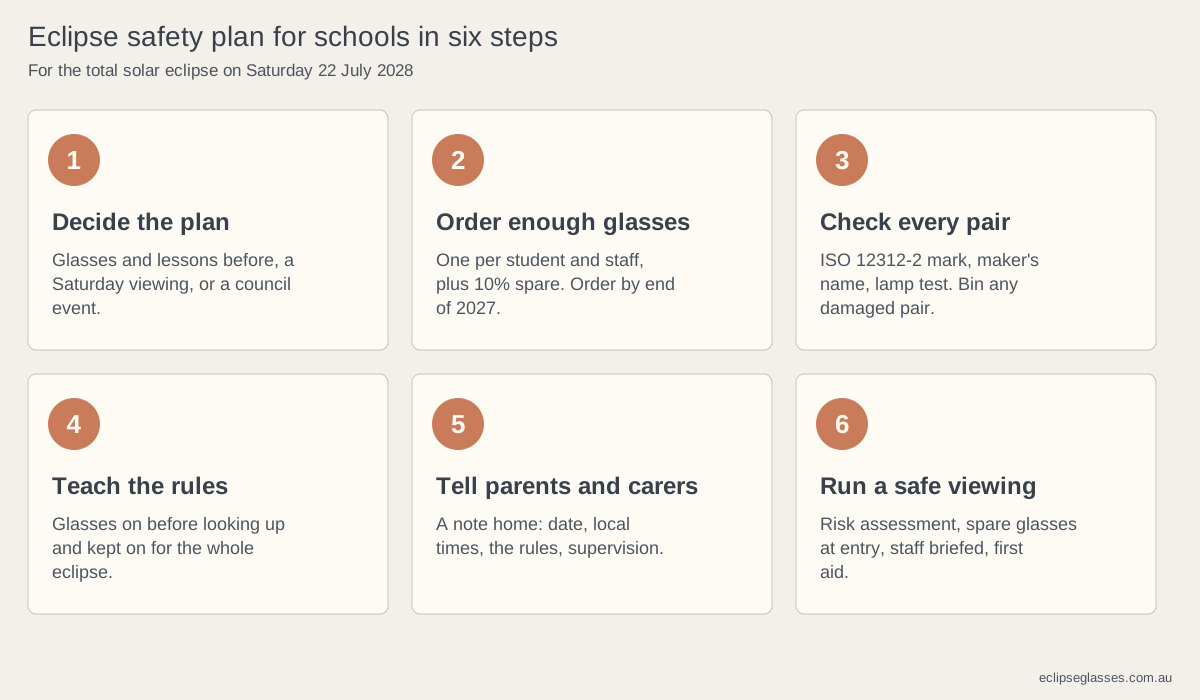
The eclipse falls on a Saturday, so it is not a school day. A school viewing is optional: some schools will host families, others will point them to a council or community event. The classroom part happens in the weeks before. Our eclipse safety plan for schools covers the planning and the note home, and eclipse glasses for schools covers a pair for every student.
Safety for every eclipse activity
- Projectors and shadow activities: back to the Sun, never look through a pinhole.
- Homemade filters are never safe, including paper designs, sunglasses and X-ray film.
- No binoculars, phones or telescopes.
- An adult stays close to every child.
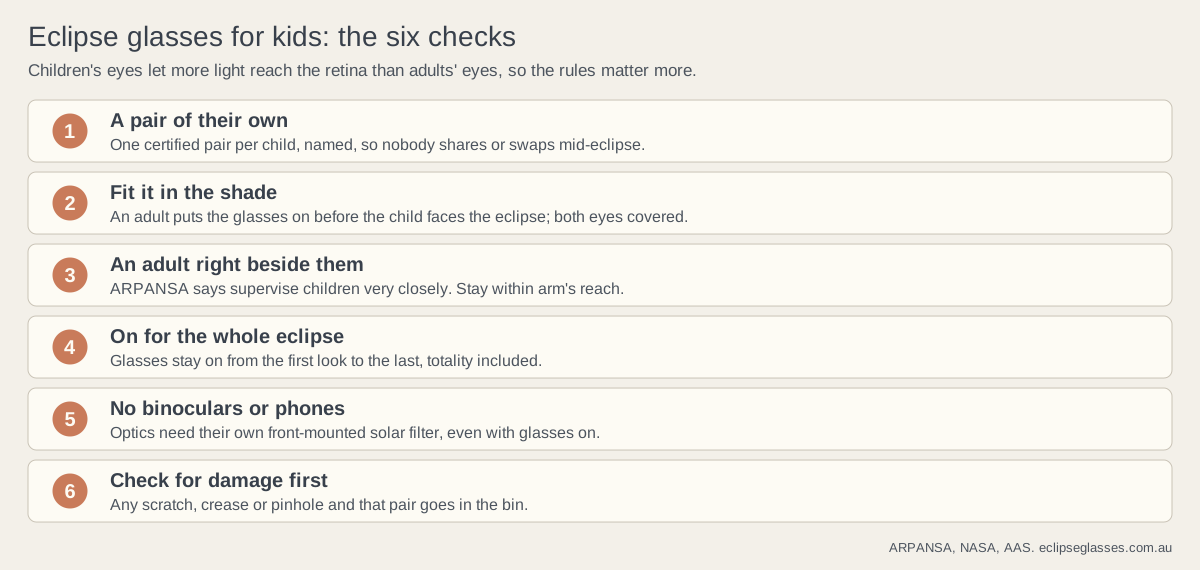
Glasses stay on for the whole eclipse, totality included. Our family eclipse kit has four certified pairs and a printed viewing guide, and eclipse glasses for kids covers fit and supervision.
Eclipse activities for kids: questions
What are good solar eclipse activities for preschoolers?
Colander crescents, a paper plate eclipse and torch and ball shadows. Children face the ground or stay indoors.
Is the 2028 eclipse on a school day?
No. Saturday 22 July 2028 is a weekend, so school viewings are optional. Classes do the activities in the weeks before.
Can kids make their own eclipse glasses?
No. Homemade filters are not safe. Kids can design the artwork, but the filter has to be ISO 12312-2 certified eclipse glasses.
How can students measure the size of the Sun?
With a pinhole. The image width over its distance from the hole equals the Sun's width over its distance, about 150 million km, which gives about 1.4 million km.
What do kids need on eclipse day?
A certified pair each, worn the whole time they face the eclipse, totality included, and an adult close by.
Sources
All checked 18.11.2026.
- ARPANSA, Solar eclipse (supervising children).
- American Astronomical Society, Pinhole projection; Astronomical Society of Australia, How to view the eclipse (homemade filters).
- NASA, Eclipse safety and Eclipse geometry (the 400 times coincidence, the 5 degree tilt).
- Eclipse times and coverage from our own calculations from NASA eclipse elements, as on the eclipse map.
Glasses for everyone watching
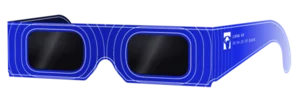
ISO 12312-2 certified and lab-tested, with a QR batch certificate on every pair. The family kit has four pairs and a printed viewing guide.