The short version. 22 July 2028: Wellington, 3:15pm NZST to sunset at about 5:17pm, most covered at 4:22pm (83%), low in the north-west. 10 March 2035: 97% in the CBD, and a ring of fire for up to about a minute from Lower Hutt, Upper Hutt, Porirua, Kāpiti and Masterton. 26 December 2038: 99% in the city, total in Paraparaumu and Palmerston North. Certified eclipse glasses stay on for every one.
What time is the eclipse in Wellington in 2028?
Times are NZST. New Zealand is on standard time in July, two hours ahead of Sydney. The figures are for the Wellington CBD and match our guide to the next solar eclipse in New Zealand.
| Stage | Time |
|---|---|
| Eclipse starts | 3:15pm |
| Most covered (83%) | 4:22pm |
| Sunset | about 5:17pm, still partly eclipsed |
At its maximum the eclipse is only about 8° above the horizon, to the north-west (a compass bearing of about 306°). Wellington's hills and buildings hide a sky that low from most streets and valleys, so pick high ground with an open view to the north-west, such as the summit of Mount Kaukau or the Mount Victoria lookout. The Sun sets about five minutes before the eclipse would have ended, so the end is not seen from Wellington. Glasses stay on until the Sun is below the horizon.
83% is the share of the Sun's area that is covered. Eclipse sites that quote "magnitude" (0.85 for Wellington) give the share of its width instead, which is why some list a different figure.
Eclipse times around Wellington, 22 July 2028
The whole region gets about the same eclipse at the same time, and everywhere the Sun sets before the eclipse ends.
| Place | Starts | Most covered | Sun covered | Ends |
|---|---|---|---|---|
| Wellington CBD | 3:15pm | 4:22pm | 83% | At sunset |
| Lower Hutt | 3:15pm | 4:22pm | about 82% | At sunset |
| Upper Hutt | 3:16pm | 4:22pm | about 82% | At sunset |
| Porirua | 3:15pm | 4:22pm | about 82% | At sunset |
| Paraparaumu | 3:16pm | 4:22pm | about 81% | At sunset |
| Masterton | 3:16pm | 4:22pm | about 80% | At sunset |
| Palmerston North | 3:17pm | 4:22pm | about 78% | At sunset |
Is Wellington in the path of totality in 2028?
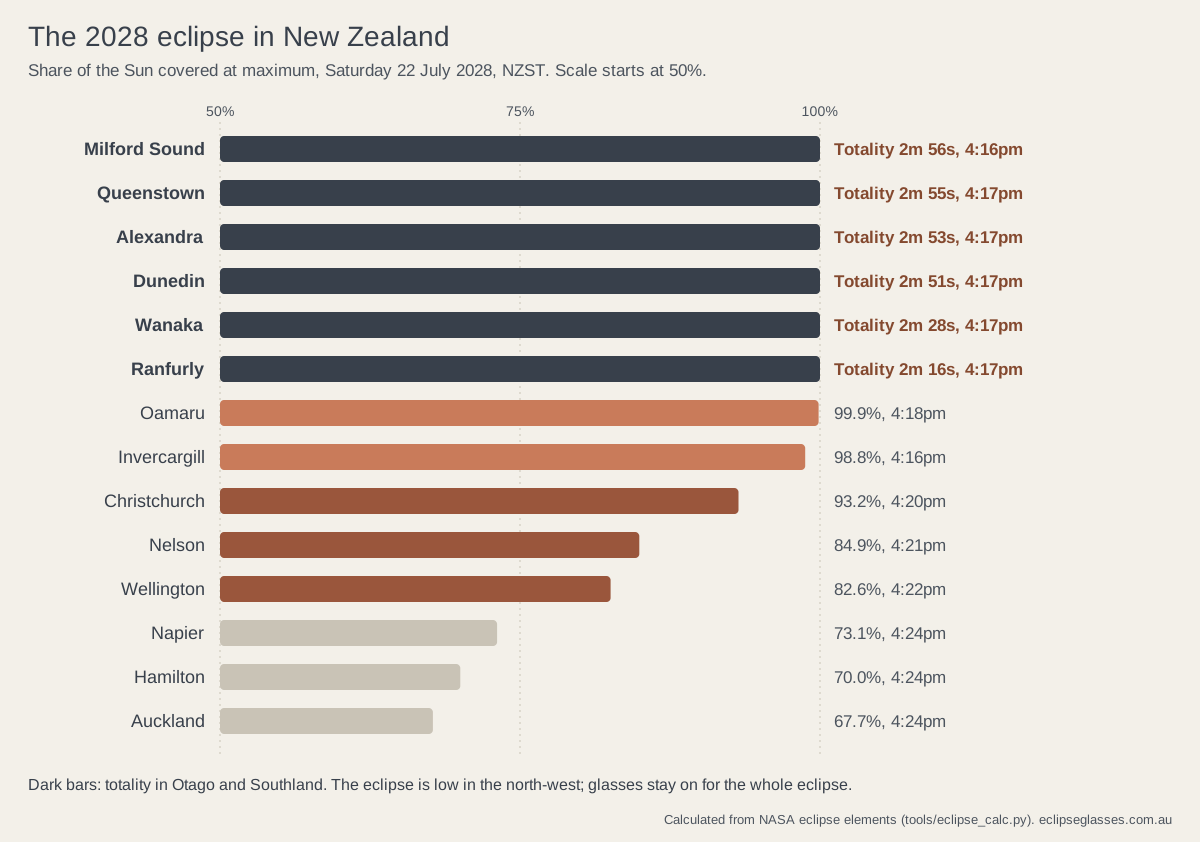
No. The Moon covers at most 83% of the Sun over Wellington, and the sky stays daylight bright. Totality crosses New Zealand only in the lower South Island, close to sunset. The nearest is about 550 km south-west in a straight line, on the North Otago coast around Hampden and Palmerston, and Queenstown, Alexandra and Dunedin are in the path too. Our guide to the 2028 eclipse in Dunedin and Queenstown has times for 24 South Island towns, and our 2028 eclipse guide for New Zealand covers where to watch across the country.
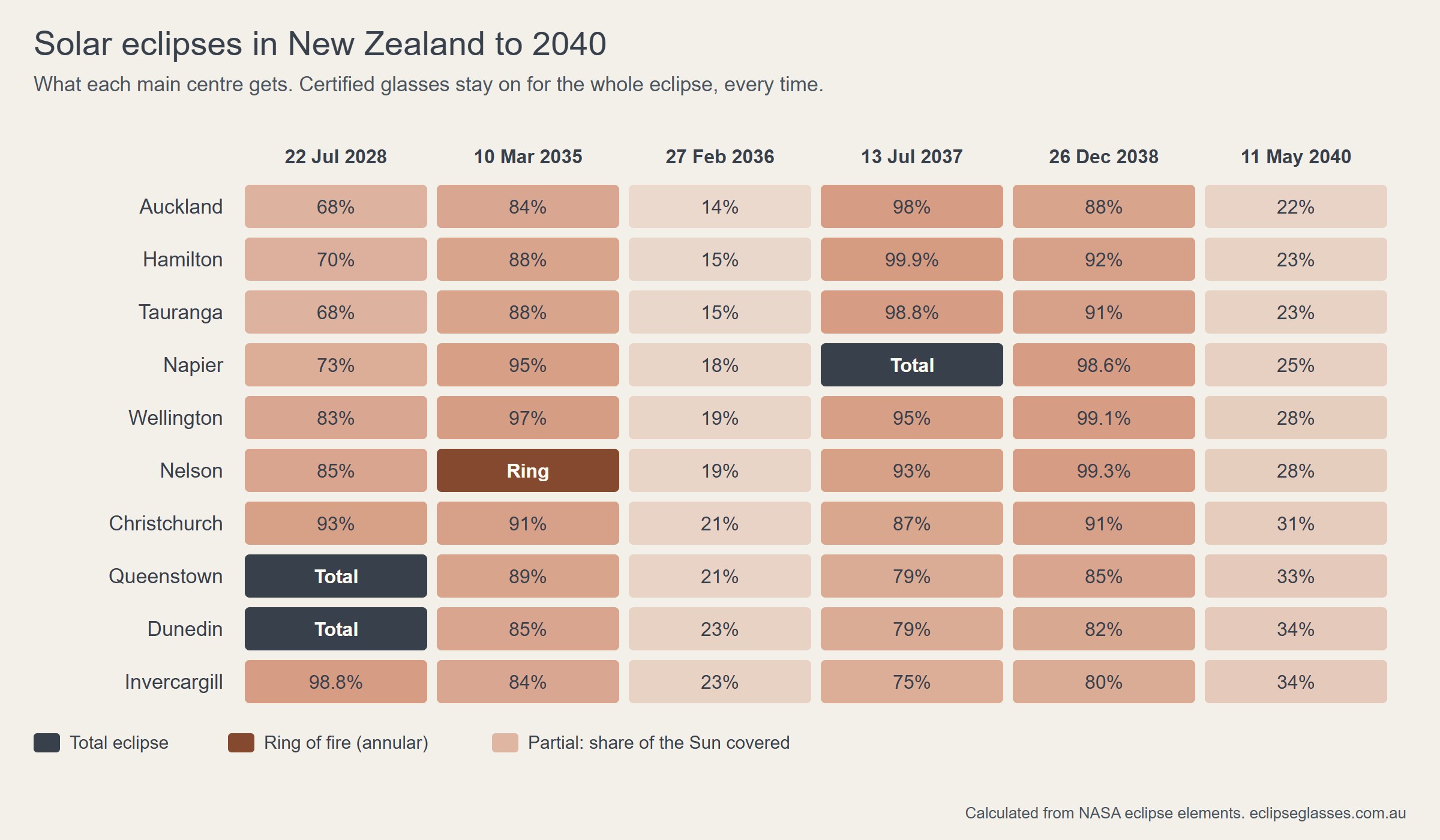
The 2035 ring of fire, just north of Wellington
On the morning of Saturday 10 March 2035 the Moon is too far from Earth to cover the Sun completely, so it leaves a bright ring around its edge: an annular eclipse, or ring of fire. The path runs from Westport and Nelson across Cook Strait to the Wairarapa, and its southern edge passes just north of the Wellington CBD.
| Place | Starts | Greatest | What you get | Ends |
|---|---|---|---|---|
| Wellington CBD | 9:36am | 10:54am | 97% covered, no ring | 12:20pm |
| Lower Hutt | 9:36am | 10:54am | Ring for about 27 s | 12:21pm |
| Upper Hutt | 9:36am | 10:54am | Ring for about 47 s | 12:21pm |
| Porirua | 9:35am | 10:54am | Ring for about 56 s | 12:21pm |
| Paraparaumu | 9:36am | 10:54am | Ring for about 63 s | 12:21pm |
| Masterton | 9:36am | 10:55am | Ring for about 55 s | 12:22pm |
Near the edge of the path a few kilometres change the length of the ring a lot, so these figures are for each town centre. The eclipse is high in the late-morning sky, so it is easy to see from almost anywhere. There is no moment of an annular eclipse when it is safe without protection: ARPANSA advises never to observe a total, partial or annular eclipse with the naked eye.
Do you need eclipse glasses in Wellington?
Yes, for the whole eclipse, in 2028 and in 2035. In a partial or annular eclipse the Moon never covers the whole Sun, so the glasses stay on from start to finish. Even with 83% or 97% covered, the part that is left is bright enough to burn the retina, and the retina has no pain sensors, so there is no warning. Ordinary sunglasses are never safe.
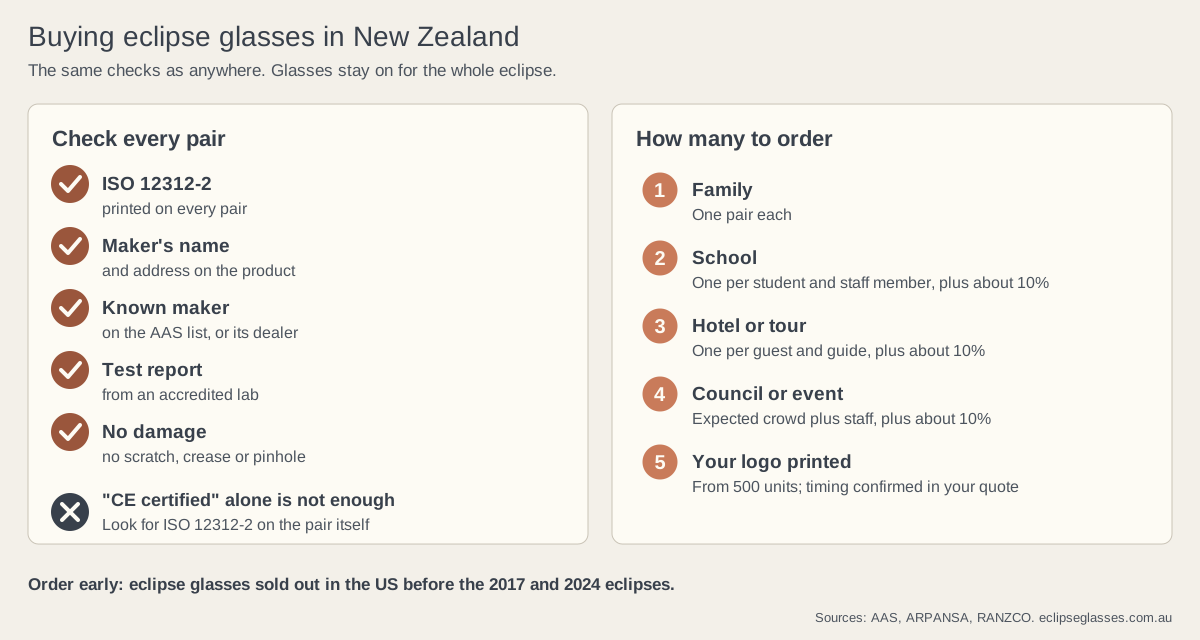
Our certified eclipse glasses are A$5.45 a pair, and the family eclipse kit has four pairs for A$19.25. Both ship from NSW and are delivered to New Zealand for A$19.95. See where to buy eclipse glasses in New Zealand for what to check on any pair, and wholesale eclipse glasses for New Zealand if you are buying for a school, business or event.
- Never use eclipse glasses with binoculars, a telescope, a camera or a phone. Optics need their own solar filter on the front: see solar filters for cameras, phones and binoculars.
- Check every pair before use, and throw out any that are scratched, torn or punctured.
- Supervise children closely, and fit their glasses before the eclipse starts.
When is the next total solar eclipse near Wellington?
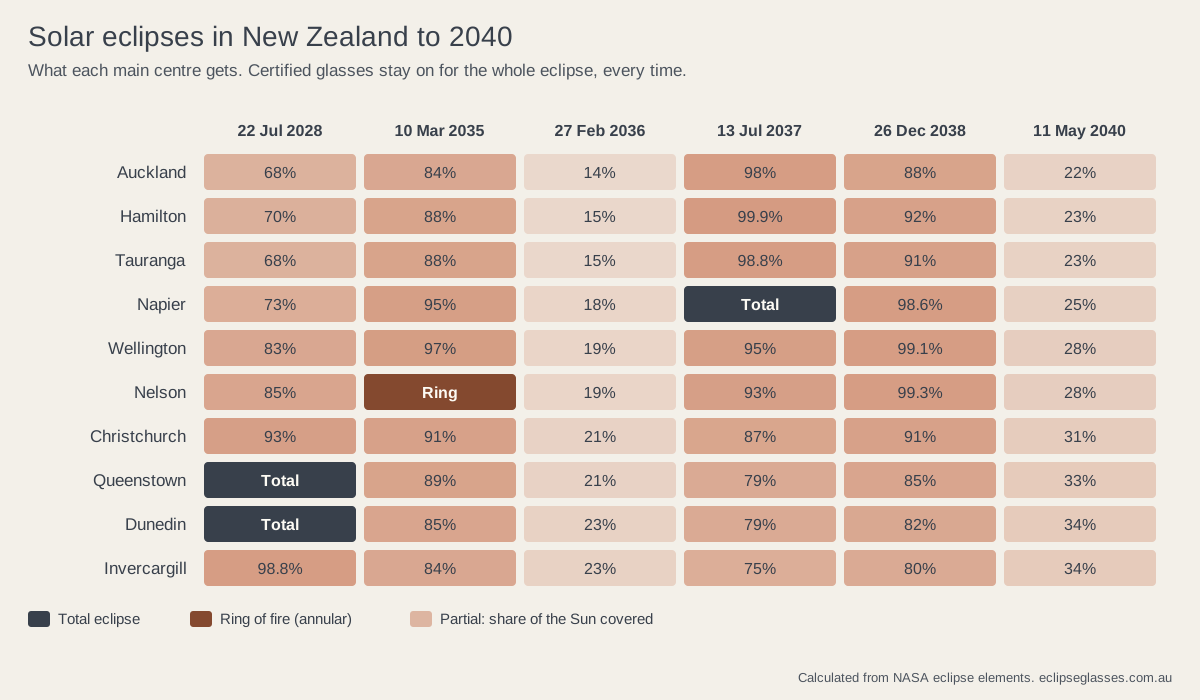
No total eclipse reaches the Wellington CBD before 2040. On Monday 13 July 2037 the city gets 95% covered while totality crosses the central North Island around Taupō and Napier. On Sunday 26 December 2038 totality crosses from Golden Bay over Cook Strait to Manawatū: about 2 minutes in Palmerston North and about 40 seconds in Paraparaumu, while Wellington city gets 99%. There are smaller partial eclipses on 27 February 2036 (19%) and 11 May 2040 (28%). Our guide to the next solar eclipse in New Zealand has the times for every one.
Solar eclipse in Wellington: questions
What time is the solar eclipse in Wellington in 2028?
On Saturday 22 July 2028 the eclipse starts at 3:15pm NZST and reaches its maximum at 4:22pm, with 83% of the Sun covered. The Sun sets at about 5:17pm while still partly eclipsed, so the end of the eclipse is not seen from Wellington.
Is Wellington in the path of totality in 2028?
No. Wellington gets a partial eclipse. Totality crosses the lower South Island. The nearest is about 550 km south-west on the North Otago coast around Hampden; Queenstown and Dunedin are also in the path.
Which way do I face for the eclipse in Wellington?
North-west. At the maximum the eclipse is only about 8 degrees above the horizon, so pick high ground with nothing tall between you and the north-west skyline, such as Mount Kaukau or the Mount Victoria lookout.
Can you see the 2035 ring of fire from Wellington?
Not from the CBD, which gets 97% covered at 10:54am NZDT on Saturday 10 March 2035. The ring is seen a few kilometres north, from about half a minute in Lower Hutt to about a minute in Porirua, Paraparaumu and Masterton.
Do I need eclipse glasses in Wellington, and where can I buy them?
Yes, for the whole eclipse. In a partial or annular eclipse the Moon never covers the whole Sun, so the glasses stay on from start to finish. Use ISO 12312-2 certified eclipse glasses the whole time. You can buy them online from Aura Sight: A$5.45 a pair, or A$19.25 for the four-pair family eclipse kit, plus A$19.95 delivery to New Zealand, with pre-orders shipping from NSW by 31 May 2028. Our guide to where to buy eclipse glasses in New Zealand lists what to check on any pair.
When is the next total solar eclipse near Wellington?
On Sunday 26 December 2038 totality crosses from Golden Bay to Manawatū, with about 2 minutes in Palmerston North and about 40 seconds in Paraparaumu. Wellington city gets 99%, a partial eclipse.
Sources
All checked 17.11.2026.
- Times calculated from NASA's Besselian elements (Fred Espenak, NASA GSFC) for each town centre, the same calculation as our New Zealand eclipse guide. Times are cut to the minute. Coverage outside Wellington is rounded to the nearest whole per cent. "At sunset" means the Sun sets before the eclipse ends.
- Distance to the path is the straight-line distance from the Wellington CBD to the nearest town in the path.
- ARPANSA, Solar eclipse; American Astronomical Society, Solar eclipse eye safety; NASA, Eclipse safety.
Certified eclipse glasses from Aura Sight
ISO 12312-2 certified, lab-tested and made by Rainbow Symphony, with a QR batch certificate on every pair. A$5.45 a pair from NSW stock, delivered Australia-wide (New Zealand too).