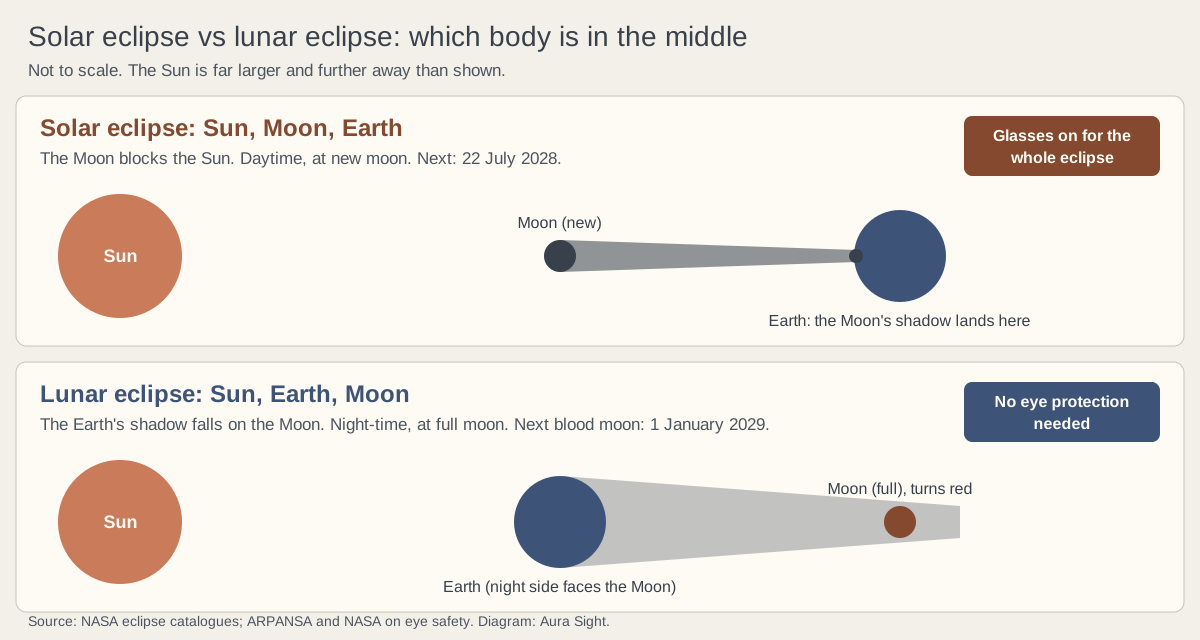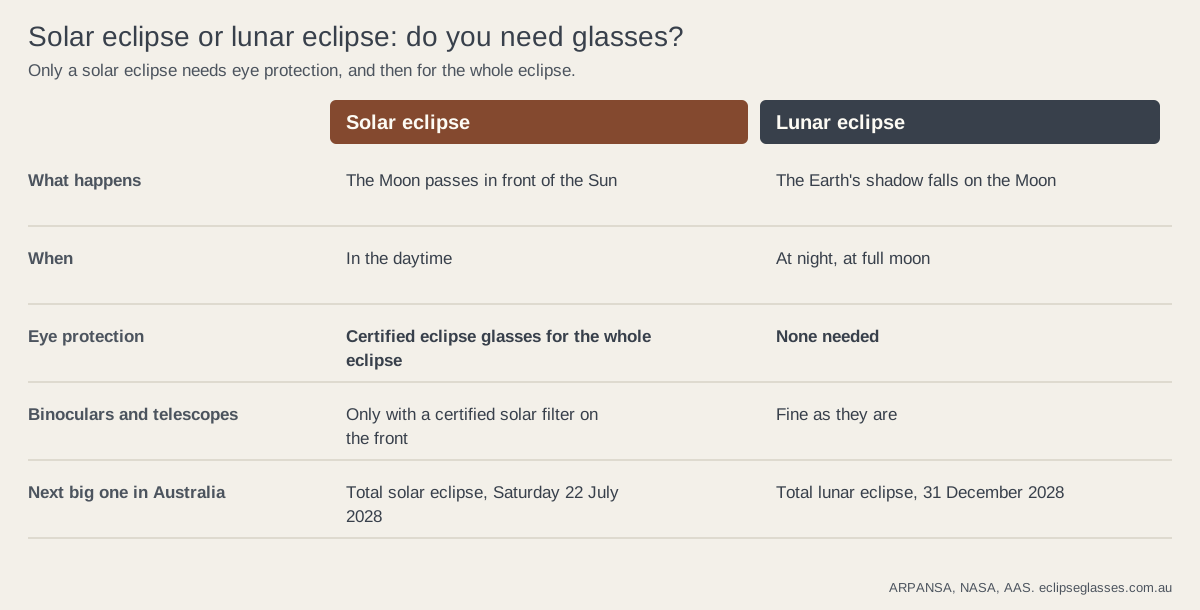
The short answer. The next blood moon (a total lunar eclipse) over Australia is on the night of Sunday 31 December 2028 into Monday 1 January 2029. Every capital city sees totality. A lunar eclipse is when the Earth passes between the Sun and the full Moon, so the Earth's shadow falls on the Moon. It needs no eye protection.
Key facts: the next blood moon in Australia
When is the next lunar eclipse in Australia?
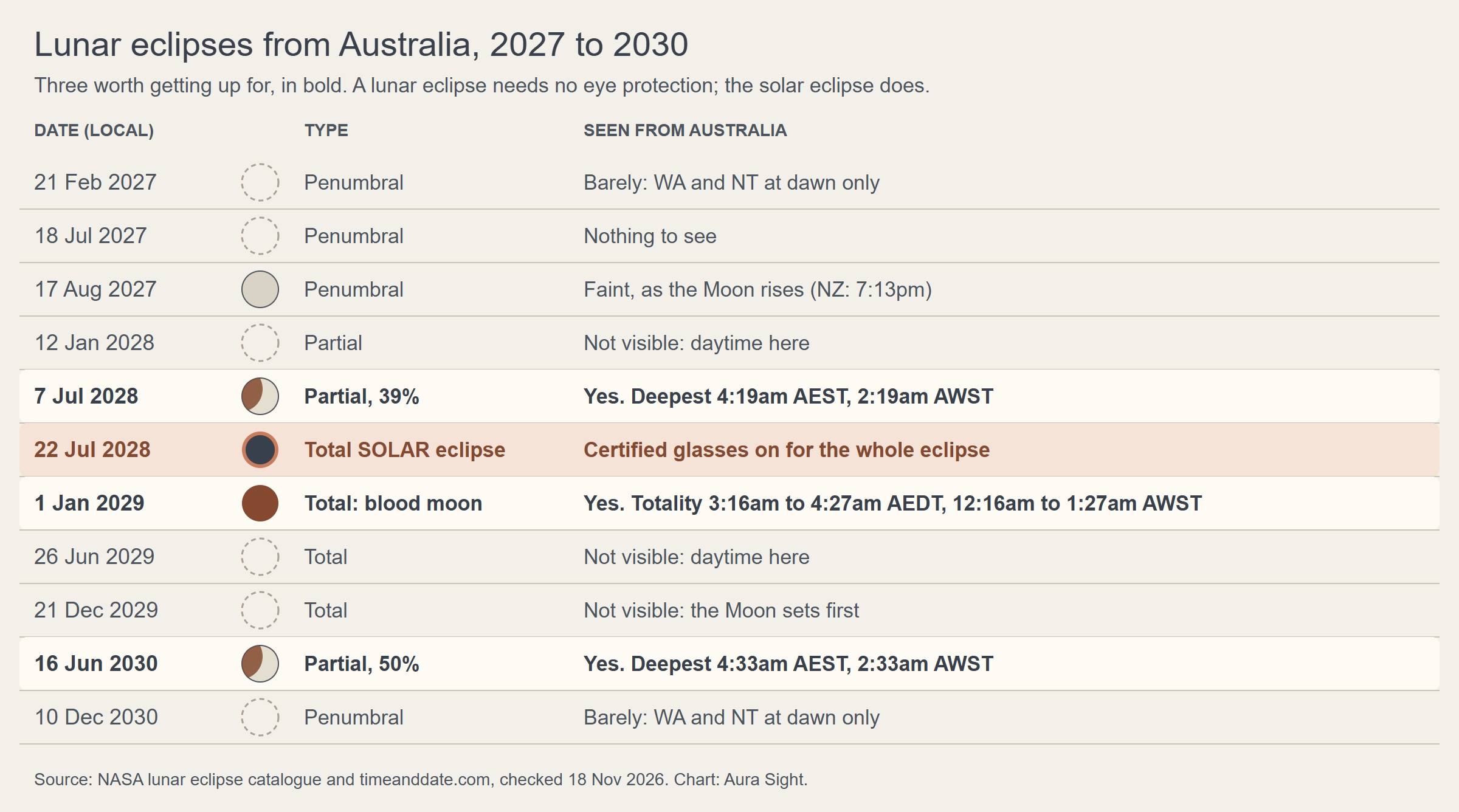
There are ten lunar eclipses between now and the end of 2030. Only three are worth getting up for in Australia: the ones in bold.
| Date (local) | Type | Australia | New Zealand |
|---|---|---|---|
| 21 Feb 2027 | Penumbral | Barely: it starts just before the Moon sets at dawn in WA and the NT | No |
| 18 Jul 2027 | Penumbral, grazing | Nothing to see | Nothing to see |
| 17 Aug 2027, evening | Penumbral | Faint, as the Moon rises in the east and south | Faint, deepest at 7:13pm NZST |
| 12 Jan 2028 | Partial | No, it is daytime | No |
| 7 Jul 2028, before dawn | Partial, 39% | Yes, everywhere | Yes, Moon low in the west |
| 1 Jan 2029, New Year's night | Total (blood moon) | Yes, everywhere | Start of totality, very low in the west |
| 26 Jun 2029 | Total | No, it is daytime | Only the last minutes, as the Moon rises |
| 21 Dec 2029 | Total | No. In WA it starts just as the Moon sets | No |
| 16 Jun 2030, before dawn | Partial, 50% | Yes, everywhere | Yes, Moon low in the west |
| 10 Dec 2030 | Penumbral | Barely: WA and the NT at dawn | No |
The percentage is how much of the Moon's width enters the Earth's dark shadow. A partial eclipse looks like a dark bite out of the full Moon. A penumbral one only dims it slightly and is hard to notice.
Blood moon times for New Year's Day 2029
Totality lasts 71 minutes, and the whole eclipse takes about three and a half hours. In Perth totality begins 16 minutes into 2029.
| City | Partial begins | Totality | Partial ends |
|---|---|---|---|
| Perth (AWST) | 11:07pm, 31 Dec | 12:16am to 1:27am | 2:36am |
| Darwin (ACST) | 12:37am | 1:46am to 2:57am | 4:06am |
| Adelaide (ACDT) | 1:37am | 2:46am to 3:57am | 5:06am |
| Brisbane (AEST) | 1:07am | 2:16am to 3:27am | 4:36am |
| Sydney, Canberra, Melbourne, Hobart (AEDT) | 2:07am | 3:16am to 4:27am | 5:36am |
| Auckland, Wellington (NZDT) | 4:07am | From 5:16am, until the Moon sets | Below the horizon |
Times are for Monday 1 January 2029 unless marked. Perth and Darwin get the Moon well up in the sky. On the east coast it sits low in the west, and in Hobart the Moon sets 8 minutes after the partial phase ends, so pick a clear western view. In New Zealand the Moon sets (6:09am Auckland, 5:54am Wellington) before totality ends.
Partial lunar eclipses: 7 July 2028 and 16 June 2030
| City | Partial eclipse | Deepest |
|---|---|---|
| Sydney, Canberra, Melbourne, Hobart, Brisbane (AEST) | 3:09am to 5:30am | 4:19am |
| Adelaide, Darwin (ACST) | 2:39am to 5:00am | 3:49am |
| Perth (AWST) | 1:09am to 3:30am | 2:19am |
| Auckland, Wellington (NZST) | 5:09am to 7:30am | 6:19am |
Two weeks later, on Saturday 22 July 2028, comes the total solar eclipse over Australia. Eclipses often come in pairs like this: see the difference between a solar and a lunar eclipse.
Sunday 16 June 2030 repeats the pattern with half the Moon's width in shadow: partial 3:21am to 5:45am AEST, 2:51am to 5:15am ACST and 1:21am to 3:45am AWST, deepest at 4:33am AEST. In New Zealand it starts at 5:21am NZST and the Moon sets before it ends.
The faint one: 17 August 2027
About half the Moon goes into the Earth's pale outer shadow, so at best you may notice slight grey shading on one side. In the eastern states the Moon rises with it under way and it ends at 7:03pm AEST (6:33pm ACST in Adelaide). New Zealand gets the whole evening, deepest at 7:13pm NZST. Perth and Darwin miss it.
Why is a blood moon red?
The Earth blocks the direct sunlight, but some light still reaches the Moon through the thin ring of air around the Earth. Blue light is scattered away, and the red light is bent into the shadow. NASA: "It's as if all the world's sunrises and sunsets are projected onto the Moon." Clean air gives an orange or copper Moon; dust or volcanic ash gives a dark brick red.
Do you need glasses for a lunar eclipse?
No. A lunar eclipse needs no eye protection: the Moon only reflects sunlight. NASA says every phase is fine with the naked eye, binoculars or a telescope. Our guide on whether you need glasses for an eclipse has the detail.
A solar eclipse is different
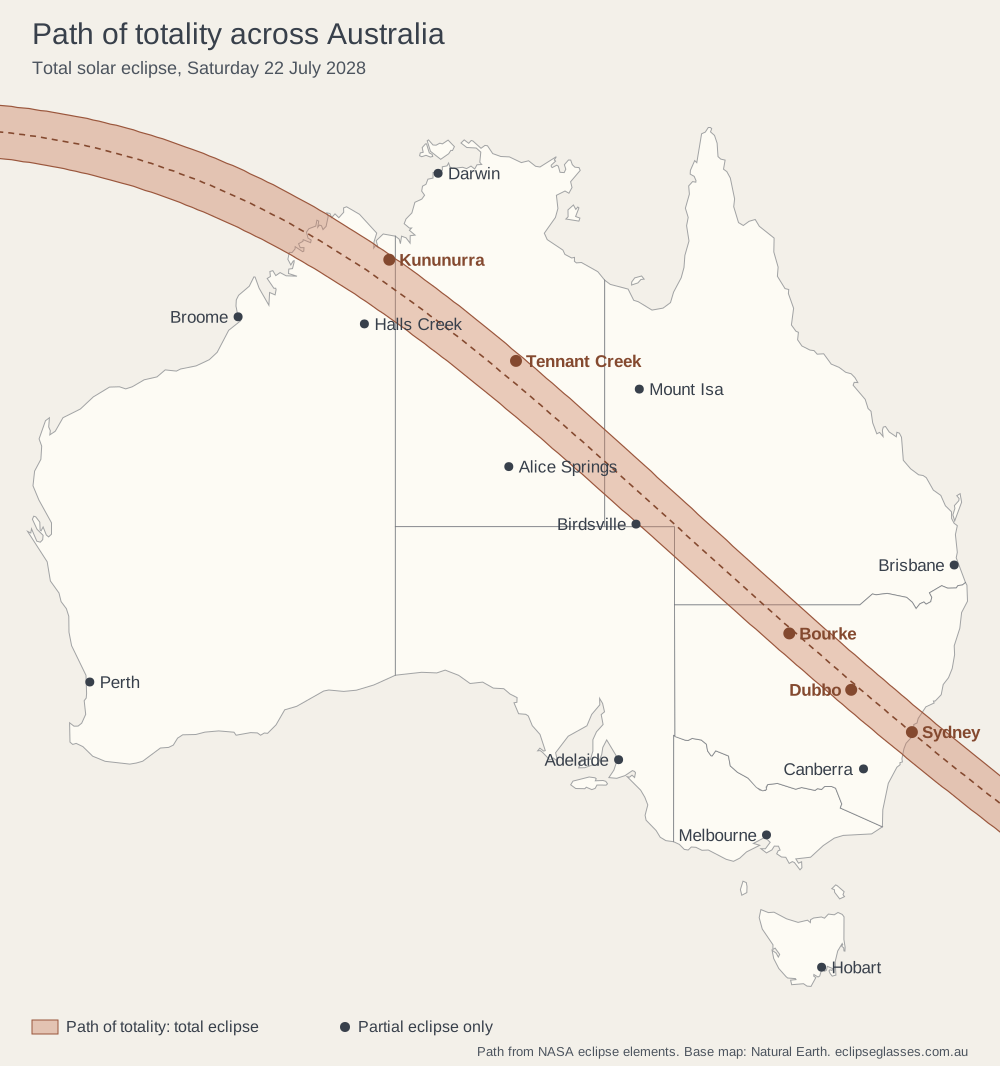
The eclipse that needs glasses comes first. On Saturday 22 July 2028 the Moon passes in front of the Sun, with totality from the Kimberley to Sydney. The uncovered part of the Sun can burn the retina in seconds, with no pain and no warning, so everyone needs certified eclipse glasses for the whole eclipse, totality included. See 2028 eclipse times in every capital city.
Our eclipse glasses are ISO 12312-2:2015 certified, made by Rainbow Symphony, a manufacturer on the American Astronomical Society list, and ship from NSW stock. A family eclipse kit covers four people.
After 2030, NASA lists Australia in the viewing area for total lunar eclipses on 25 April and 18 October 2032 (UTC dates).
FAQ
When is the next blood moon in Australia?
On the night of 31 December 2028 into 1 January 2029. Totality runs from 12:16am to 1:27am AWST in Perth and from 3:16am to 4:27am AEDT in Sydney, Melbourne, Canberra and Hobart.
When is the next lunar eclipse in New Zealand?
A faint penumbral eclipse on the evening of Tuesday 17 August 2027, deepest at 7:13pm NZST. The next partial eclipse is before dawn on Friday 7 July 2028, deepest at 6:19am NZST.
Is there a lunar eclipse in 2027?
Yes, three, all penumbral. Only the one on the evening of 17 August 2027 is visible from eastern Australia and New Zealand, and it is faint.
Do you need glasses for a lunar eclipse?
No. A lunar eclipse needs no eye protection. NASA says every phase is fine with the naked eye, binoculars or a telescope.
Why is it called a blood moon?
Because the Moon turns red during a total lunar eclipse. Sunlight bent through the Earth's atmosphere, the same light as our sunrises and sunsets, is the only light reaching it.
How long does the 2029 blood moon last?
Totality lasts 71 minutes. The whole eclipse, from the first bite of shadow to the last, takes about three and a half hours.
Sources
All checked 18.11.2026.
- NASA Goddard, Lunar eclipses 2021 to 2030, 2031 to 2040 and the catalogue of lunar eclipses 2001 to 2100 (dates, types, magnitudes, durations and times in UTC).
- timeanddate.com, eclipse pages for each city (local times, moonrise and moonset). We checked every time against the NASA catalogue; they agree to within a minute.
- NASA Science, What you need to know about the March 2025 total lunar eclipse (why the Moon turns red).
- NASA Scientific Visualization Studio, Total lunar eclipse, March 2025 (lunar eclipses need no eye protection).
- ARPANSA, Solar eclipse (solar eclipse eye safety).

Certified eclipse glasses from Aura Sight
ISO 12312-2 certified, lab-tested and made by Rainbow Symphony, with a QR batch certificate on every pair. A$5.45 a pair from NSW stock, delivered Australia-wide (New Zealand too).