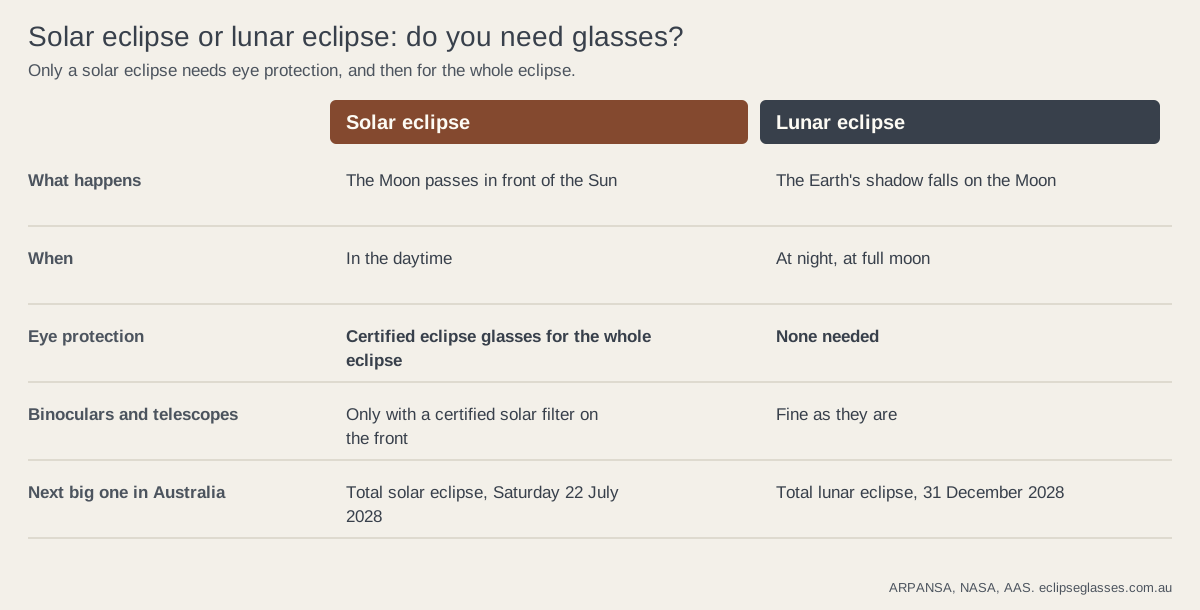
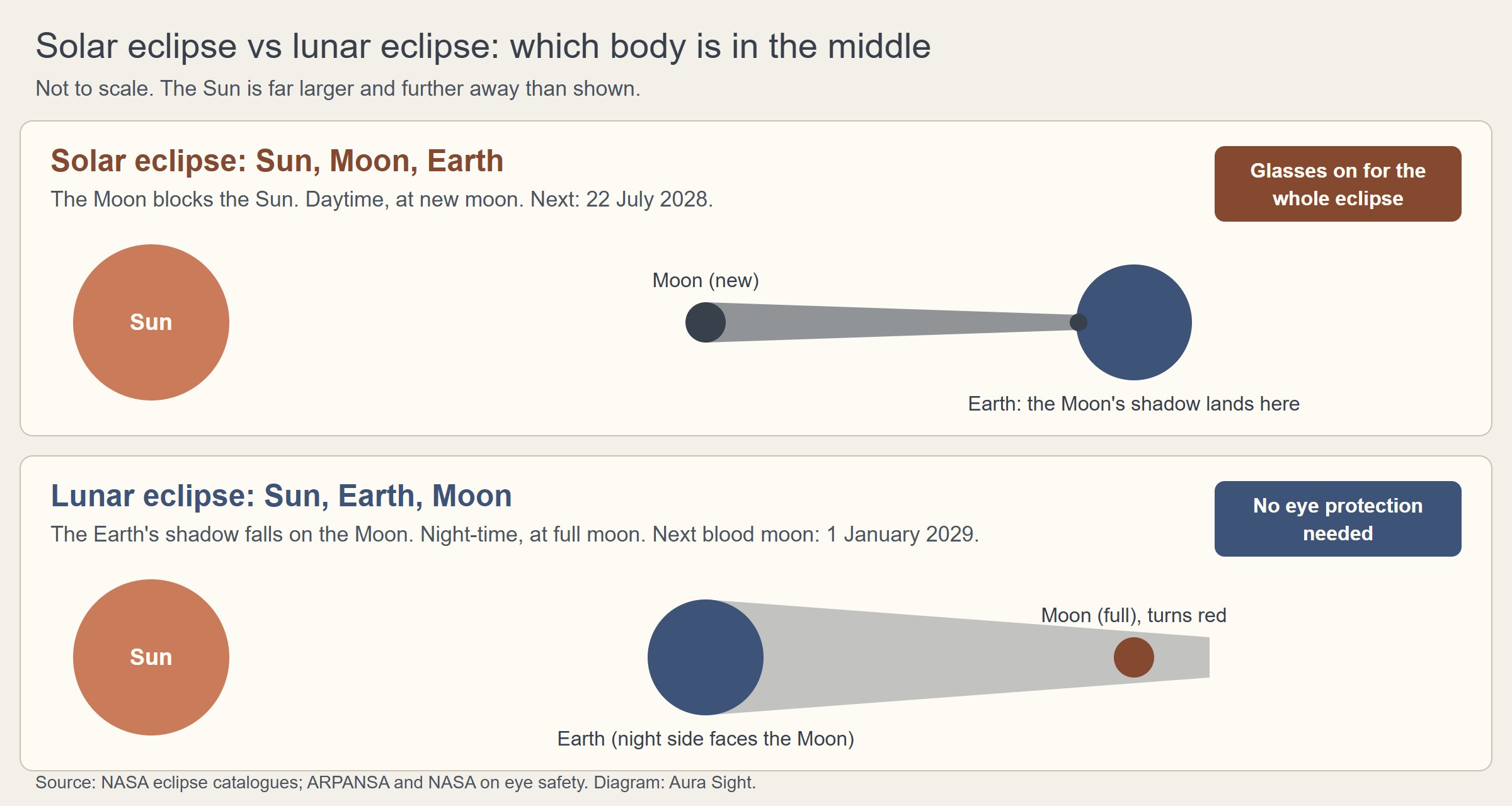
The short answer. In a solar eclipse the Moon is in the middle and its shadow falls on the Earth. In a lunar eclipse the Earth is in the middle and its shadow falls on the Moon. A solar eclipse needs certified eclipse glasses for the whole eclipse, totality included. A lunar eclipse needs no eye protection.
Key facts: solar eclipse vs lunar eclipse
What is the difference between a solar and a lunar eclipse?
Both need the Sun, the Earth and the Moon in a line. What changes is which one sits in the middle.
| Solar eclipse | Lunar eclipse | |
|---|---|---|
| What lines up | Sun, Moon, Earth: the Moon is in the middle | Sun, Earth, Moon: the Earth is in the middle |
| Whose shadow | The Moon's shadow falls on the Earth | The Earth's shadow falls on the Moon |
| Moon phase | New moon | Full moon |
| Day or night | Daytime | Night-time |
| Who can see it | Totality only inside a narrow path (about 190 km wide across NSW in 2028); a partial eclipse over a much wider area | Everyone on the night side of the Earth, wherever the Moon is above the horizon |
| How long totality lasts | Minutes: up to 5 min 10 s in the Kimberley and 3 min 48 s in the Sydney CBD in 2028 | Often over an hour: 71 minutes on 1 January 2029 |
| How often (2001 to 2100) | 224, of which 68 total | 228, of which 85 total |
| Types | Total, annular, partial, hybrid | Total, partial, penumbral |
| Eye safety | Certified eclipse glasses for the whole eclipse, totality included | No eye protection needed |
| Binoculars and cameras | Only with a proper solar filter on the front, from a supplier on the AAS list | Fine as they are |
What is a solar eclipse?
A solar eclipse is when the Moon passes in front of the Sun and its shadow falls on part of the Earth, at new moon, in the daytime. The Moon's dark shadow is small, so totality is only seen inside a narrow path; outside it people get a partial eclipse. In an annular eclipse the Moon is a little too far from the Earth to cover the Sun, and a ring of sunlight is left. A hybrid is annular in some places and total in others.
What is a lunar eclipse?
A lunar eclipse is when the Earth passes between the Sun and the full Moon, so the Earth's shadow falls on the Moon. NASA's definition: "A lunar eclipse occurs when the Sun, Earth, and Moon align so that the Moon passes into Earth's shadow." The Earth's shadow can cover the whole Moon for over an hour (71 minutes on 1 January 2029), and anyone with the Moon in their night sky can see it. In a total lunar eclipse the Moon turns red, the blood moon, because sunlight bent through the Earth's air still reaches it; NASA says "It's as if all the world's sunrises and sunsets are projected onto the Moon." A partial eclipse takes a dark bite out of the Moon, and a penumbral one is hard to notice.
Why isn't there an eclipse every month?
There is a new moon and a full moon every month, but the Moon's orbit is tilted by about 5 degrees to the Earth's orbit around the Sun. Most months the Moon passes a little above or below the line. Eclipses only happen when a new or full moon falls near the two points where the orbits cross, in eclipse seasons about twice a year. That is why solar and lunar eclipses often come in pairs, like 7 and 22 July 2028.
Examples: the 2028 solar eclipse and the 2029 blood moon
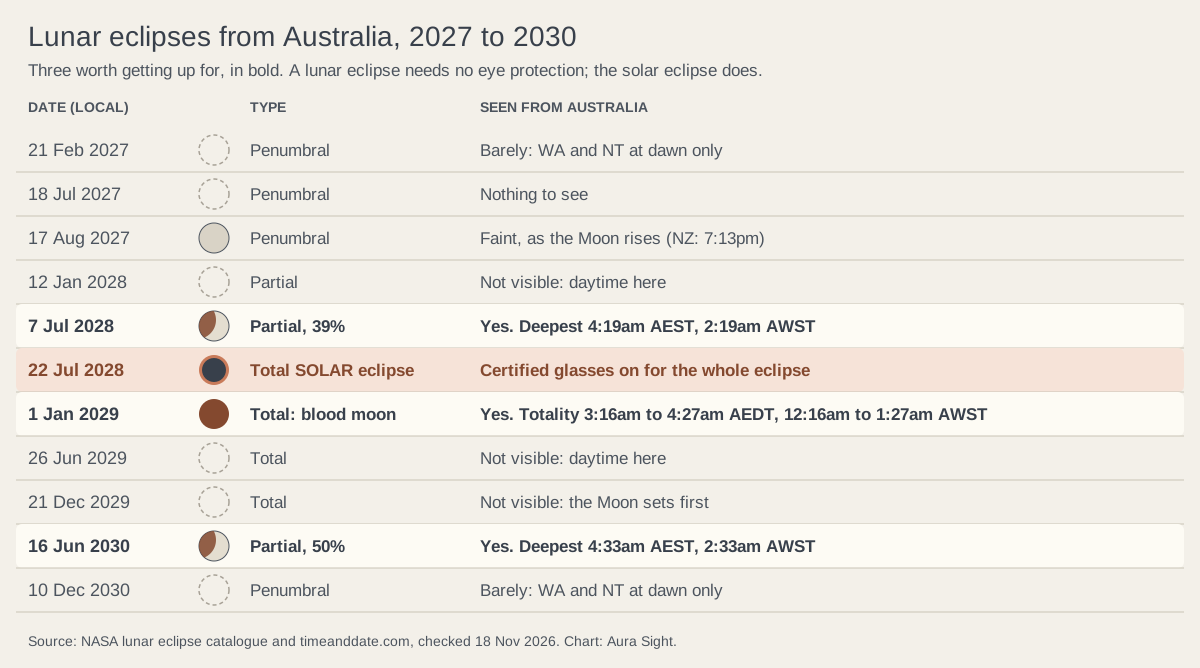
Solar: Saturday 22 July 2028. The path of totality runs from the Kimberley across the Northern Territory and the far south-west corner of Queensland, through Bourke and Dubbo and over Sydney, with 3 minutes 48 seconds of totality in the Sydney CBD from 1:59pm. Every other capital gets a partial eclipse. See the 2028 total solar eclipse guide and the eclipse map for your town.
Lunar: New Year's Day 2029. On the night of 31 December 2028 into 1 January 2029 every capital sees a blood moon, with totality from 12:16am to 1:27am in Perth and 3:16am to 4:27am in Sydney and Melbourne. See the next lunar eclipse in Australia for every capital and New Zealand.
Why does a solar eclipse need glasses and a lunar eclipse doesn't?
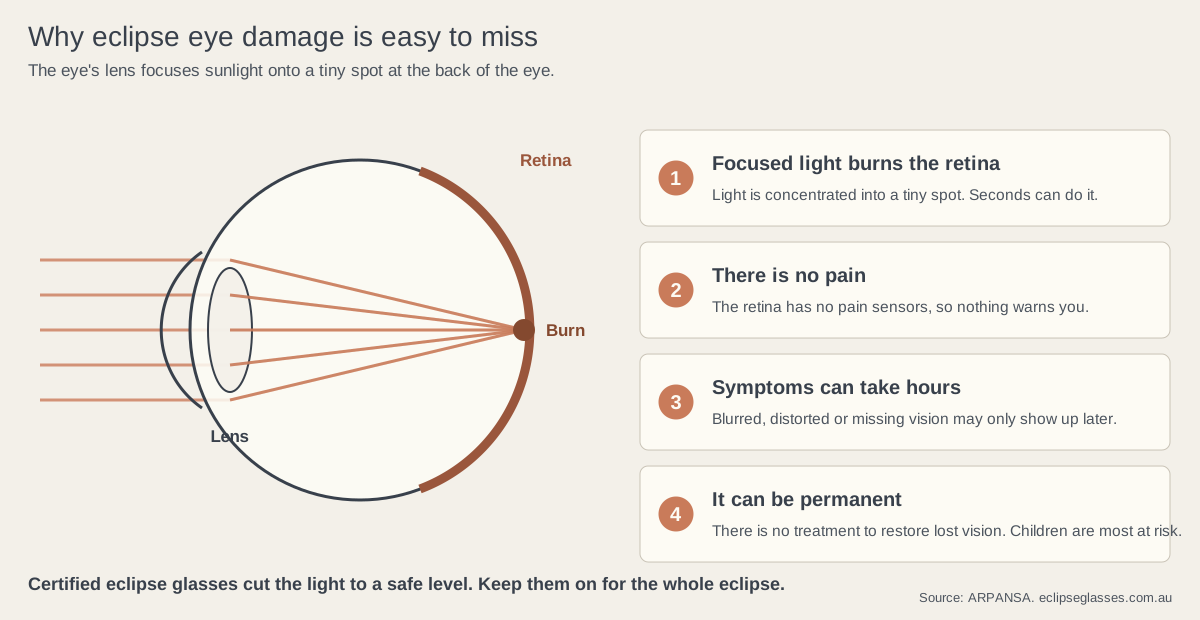
A solar eclipse happens in front of the Sun itself. Even a thin crescent of uncovered Sun can burn the retina in seconds. The retina has no pain sensors, so there is no warning, and the damage can be permanent. ARPANSA, the Australian Government's radiation safety agency, advises never to observe a total, partial or annular eclipse with the naked eye. Our advice is to keep certified eclipse glasses on for the whole eclipse, totality included.
A lunar eclipse happens at night, on the Moon, which only reflects sunlight. NASA says every phase of a lunar eclipse is fine with the naked eye, binoculars or a telescope. Our guide on whether you need glasses for an eclipse goes through both, and why you need eclipse glasses explains what happens inside the eye.
Sunglasses are never enough: even the darkest let through 3% to 8% of visible light, certified eclipse glasses about 0.003% or less. Our eclipse glasses are ISO 12312-2:2015 certified, made by Rainbow Symphony, a manufacturer on the American Astronomical Society list, and ship from NSW stock. A family eclipse kit covers four people.
FAQ
What is the main difference between a solar and a lunar eclipse?
In a solar eclipse the Moon passes between the Sun and the Earth, in the daytime. In a lunar eclipse the Earth passes between the Sun and the Moon, and its shadow falls on the full Moon at night.
Which is rarer, a solar or a lunar eclipse?
NASA lists about the same number of each this century: 224 solar and 228 lunar. But a lunar eclipse can be seen from the whole night side of the Earth, while a total solar eclipse is only total inside a narrow path, so from any one place you see lunar eclipses more often.
Which lasts longer, a solar or a lunar eclipse?
A lunar eclipse. Totality on 1 January 2029 lasts 71 minutes. Totality in the 22 July 2028 solar eclipse lasts at most 5 minutes 10 seconds.
Can a solar and a lunar eclipse happen in the same month?
Yes. They often come about two weeks apart. In 2028 a partial lunar eclipse on 7 July is followed by the total solar eclipse on 22 July.
Do you need glasses for a lunar eclipse?
No. A lunar eclipse needs no eye protection. NASA says every phase is fine with the naked eye, binoculars or a telescope.
Is the 2028 eclipse in Australia solar or lunar?
Solar. On Saturday 22 July 2028 the Moon passes in front of the Sun, with totality from the Kimberley to Sydney. Everyone needs certified eclipse glasses for the whole eclipse.
Sources
All checked 18.11.2026.
- NASA Goddard, catalogue of solar eclipses 2001 to 2100 and catalogue of lunar eclipses 2001 to 2100 (counts, types, durations).
- NASA Goddard, Eclipses and the Moon's orbit (the 5 degree tilt).
- NASA Science, What you need to know about the March 2025 total lunar eclipse (definition and why the Moon turns red); NASA Scientific Visualization Studio, Total lunar eclipse, March 2025 (no eye protection needed).
- ARPANSA, Solar eclipse (eye damage, naked eye warning).
- 2028 times and durations from NASA eclipse elements, as on our eclipse map. Lunar eclipse times from the NASA catalogue and timeanddate.com. Sunglass categories from AS/NZS 1067.1:2016.
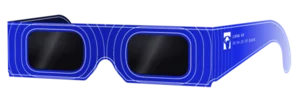
Certified eclipse glasses from Aura Sight
ISO 12312-2 certified, lab-tested and made by Rainbow Symphony, with a QR batch certificate on every pair. A$5.45 a pair from NSW stock, delivered Australia-wide (New Zealand too).