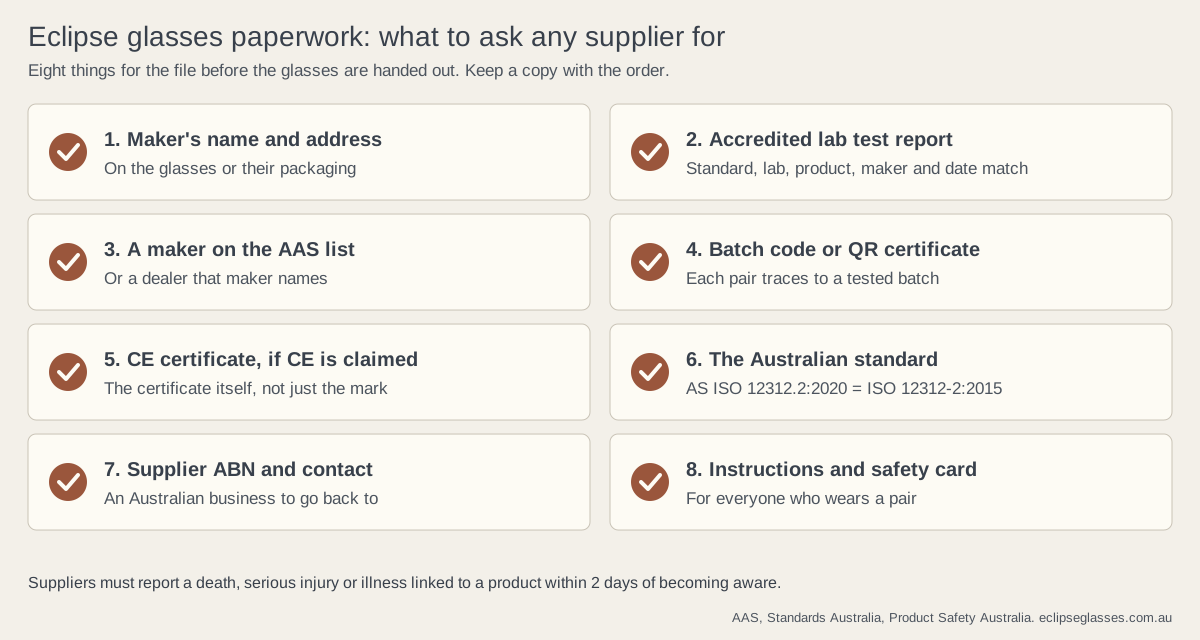
The short version. ISO 12312-2 is the international standard for solar filters for viewing the eclipse, such as eclipse glasses and handheld viewers. It caps how much visible light, ultraviolet and infrared gets through (visible light at 0.0032%), requires the filter to be evenly dark, and sets what the label must say, starting with the maker's name and address. ISO writes the standard but does not test products; an accredited laboratory does. Australia uses it unchanged as AS ISO 12312.2:2020.
What is ISO 12312-2?
Its full title is "Eye and face protection: Sunglasses and related eyewear, Part 2: Filters for direct observation of the Sun". In plain terms, it is the safety standard for solar filters for viewing the eclipse. It was adopted in 2015 and confirmed in 2020, and the American Astronomical Society (AAS) says it replaced a hodgepodge of earlier national and regional standards. The AAS also reports that proposed changes were being voted on by ISO's national member bodies in 2026. For now, ISO 12312-2:2015 is the edition to look for.
It covers only products that do not magnify or focus: eclipse glasses and handheld viewers. Ordinary sunglasses come under a different part, ISO 12312-1, and are never safe for an eclipse, however dark. Filters for cameras, binoculars and telescopes are outside it too; see our guide to solar filters for cameras and binoculars.
What does ISO 12312-2 test?
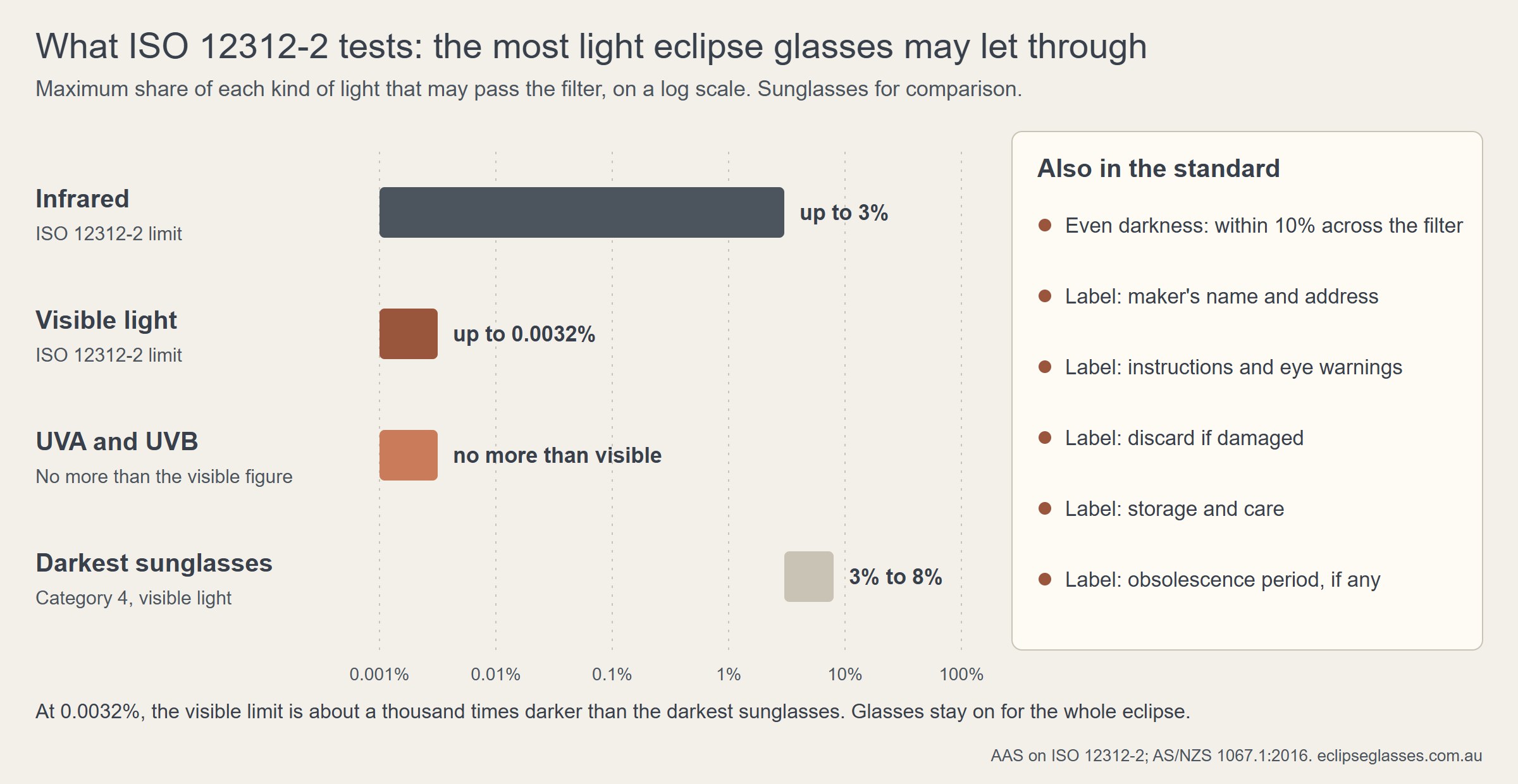
Mainly, how much light gets through the filter. The AAS summarises the limits like this:
- Visible light: no more than 0.0032%, about 0.003% or less. The AAS says that maximum corresponds to a shade 12 welding filter. There is a minimum too, which the AAS likens to a shade 15 welding filter.
- Ultraviolet (UVA and UVB): no higher than the measured visible light figure.
- Infrared: the limit is higher, at 3%.
- Even darkness: the visible light figure should be uniform across the filter, to within 10%.
For comparison, the darkest category 4 sunglasses let through 3% to 8% of visible light, about a thousand times more. The test methods themselves now sit in a separate standard, ISO 18526 parts 2 to 4 (2020).
What must be printed on eclipse glasses?
The standard says the filter and/or its packaging must carry, in the language of the country where it is sold:
- the name and address of the manufacturer;
- instructions for use;
- a warning that using no filter, or the wrong one, can cause permanent eye injury;
- advice that a damaged or separated filter should be discarded;
- advice on storage, cleaning and maintenance, as appropriate;
- an obsolescence date or period, as appropriate.
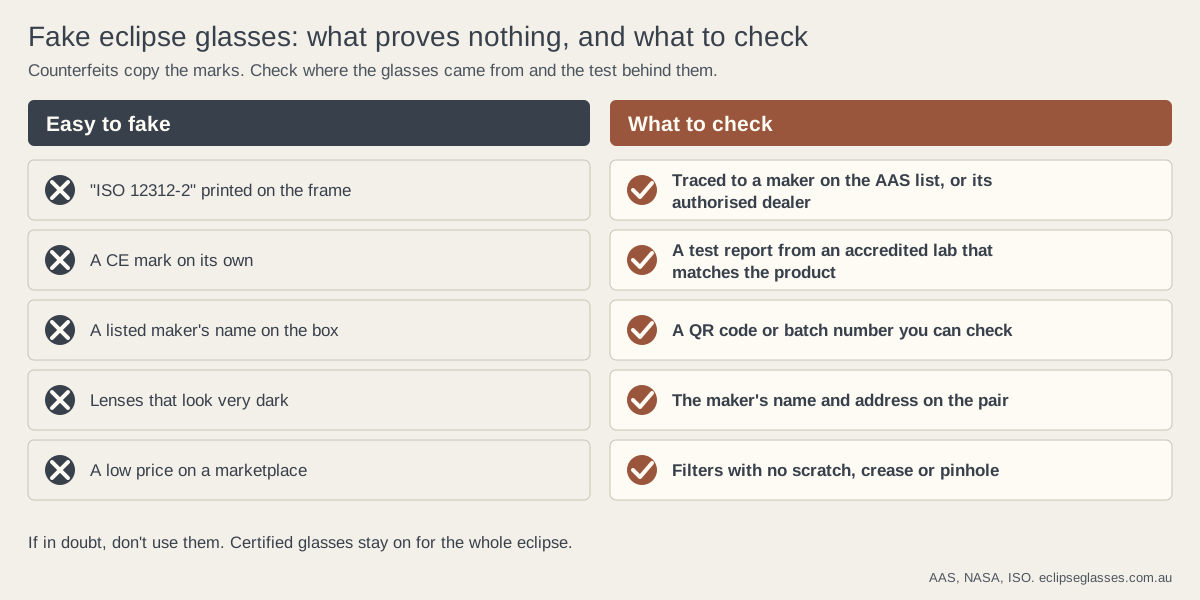
Buying guides, ours included, also tell you to look for the ISO 12312-2 reference on the pair. But anything printed can be copied, so the marking is a starting point, not proof.
Who tests eclipse glasses to ISO 12312-2?
Not ISO. ISO writes standards and does not test products. The AAS says a viewer should be tested by a laboratory accredited to ISO/IEC 17025, by an accreditation body that is a full signatory to the ILAC Mutual Recognition Arrangement (MRA), with ISO 12312-2 in its scope. In the EU, a notified body for the PPE Regulation (EU) 2016/425 can do this too.
Ours are tested to ISO 12312-2:2015 by ICS Laboratories, an A2LA-accredited laboratory, and CE-certified by Notified Body 2834. The details are on our certification page.
Do ISO 12312-2 glasses expire?
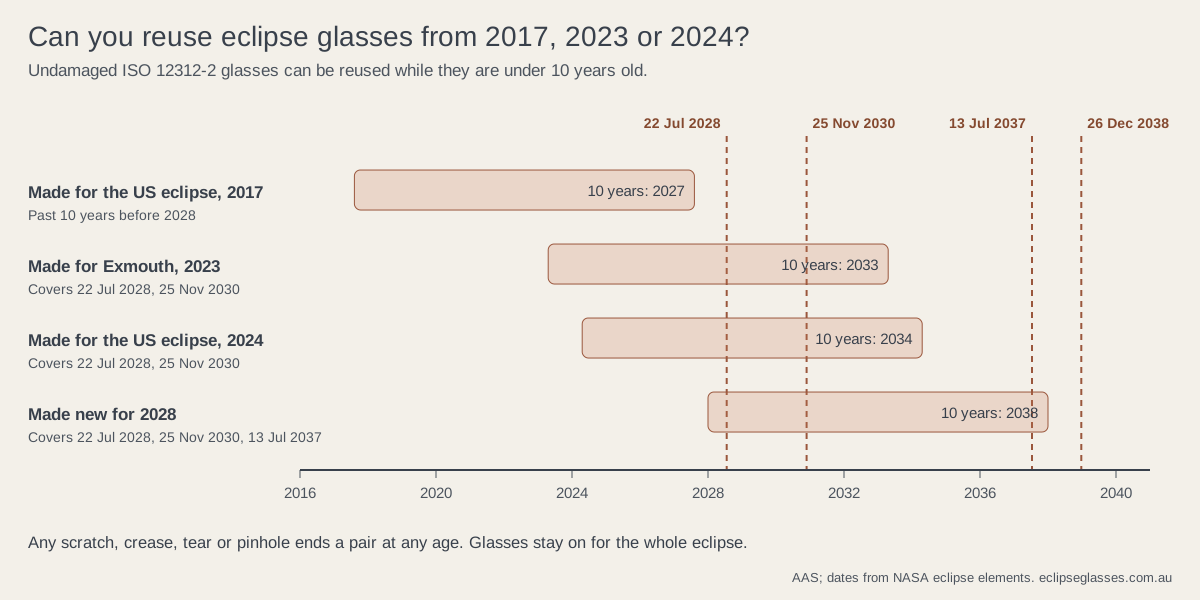
Not on a fixed date. The standard lets a maker print an obsolescence date or period where it applies, but the AAS says modern viewers last for up to 10 years if they are stored and kept in good condition. Its reuse rule: glasses under 10 years old, tested by an accredited laboratory to ISO 12312-2, can be reused if the filters are not scratched, punctured, torn or coming loose from the frame. Printed warnings to throw glasses out after a few years, or to use them for only a few minutes at a time, are outdated for recent glasses in excellent condition. Our guide to reusing old eclipse glasses has the full check.
Why doesn't the ISO mark prove a pair is safe?
Because counterfeits print it. In August 2017, before the US eclipse, Amazon pulled eclipse glasses it could not confirm were made by a recommended manufacturer and offered refunds. In March 2024 the AAS warned that some factories were printing the name of a listed maker on their own glasses. The answer is the same both times: buy from a maker on the AAS list or one of its authorised dealers, and ask for the test report. Our guide to fake eclipse glasses in Australia walks through the checks.
What is the Australian version of ISO 12312-2?
AS ISO 12312.2:2020, published on 15 May 2020 as Standards Australia's identical adoption of ISO 12312-2:2015. The requirements are the same, and Standards Australia says eclipse glasses should meet it. In New Zealand, Standards New Zealand sells ISO 12312-2:2015 itself; we found no separate New Zealand or joint AS/NZS edition.
Buying for a business? Compare an Australian supplier with importing, or ask about wholesale eclipse glasses. Families can compare sellers in our ranking of the best eclipse glasses in Australia.
Our glasses are tested to ISO 12312-2:2015 by an A2LA-accredited laboratory, made by a manufacturer on the AAS list, and carry a QR batch certificate on every pair. Certified glasses stay on for the whole eclipse, totality included.
Shop eclipse glasses See our certificationFAQ
What is ISO 12312-2?
The international standard for solar filters for viewing the eclipse, such as eclipse glasses and handheld viewers. The current edition is ISO 12312-2:2015, confirmed in 2020.
How much light can ISO 12312-2 glasses let through?
No more than 0.0032% of visible light, about 0.003% or less. Ultraviolet may be no higher than the visible figure, and the infrared limit is 3%.
Is ISO 12312-2 the same as AS ISO 12312.2:2020?
Yes. AS ISO 12312.2:2020 is Standards Australia's identical adoption of ISO 12312-2:2015, so the requirements are the same.
Does ISO certify eclipse glasses?
No. ISO writes standards and does not test products. An accredited laboratory tests glasses against ISO 12312-2 and issues the report; ours are tested by ICS Laboratories, an A2LA-accredited laboratory.
Do ISO 12312-2 eclipse glasses expire?
There is no fixed expiry. The AAS says glasses under 10 years old that were tested by an accredited laboratory can be reused if the filters are not scratched, punctured, torn or coming loose.
Does ISO 12312-2 cover sunglasses or camera filters?
No. Ordinary sunglasses come under ISO 12312-1 and are never safe for an eclipse. Filters for cameras, binoculars and telescopes are not covered by ISO 12312-2.
Sources
All checked 13.11.2026.
- American Astronomical Society, the ISO 12312-2 standard (scope, limits, labelling, accredited laboratories, "ISO certified" wording) and safe viewing (reuse under 10 years, outdated warnings).
- American Astronomical Society, warning on counterfeit eclipse glasses, 22 March 2024; Suppliers of safe solar viewers and filters.
- ISO, ISO 12312-2:2015.
- Standards Australia, Partial solar eclipse should not be a sight for sore eyes, 18 September 2025; AS ISO 12312.2:2020 (Intertek Inform).
- Standards New Zealand, ISO 12312-2:2015.
- AS/NZS 1067.1:2016, sunglass lens categories (category 4: 3% to 8%).
- PBS NewsHour, Amazon recalls potentially hazardous solar eclipse glasses, 14 August 2017.
- Aura Sight supplier and test documents, as on our certification page.
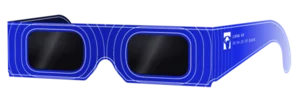
Certified eclipse glasses from Aura Sight
ISO 12312-2 certified, lab-tested and made by Rainbow Symphony, with a QR batch certificate on every pair. A$5.45 a pair from NSW stock, delivered Australia-wide (New Zealand too).