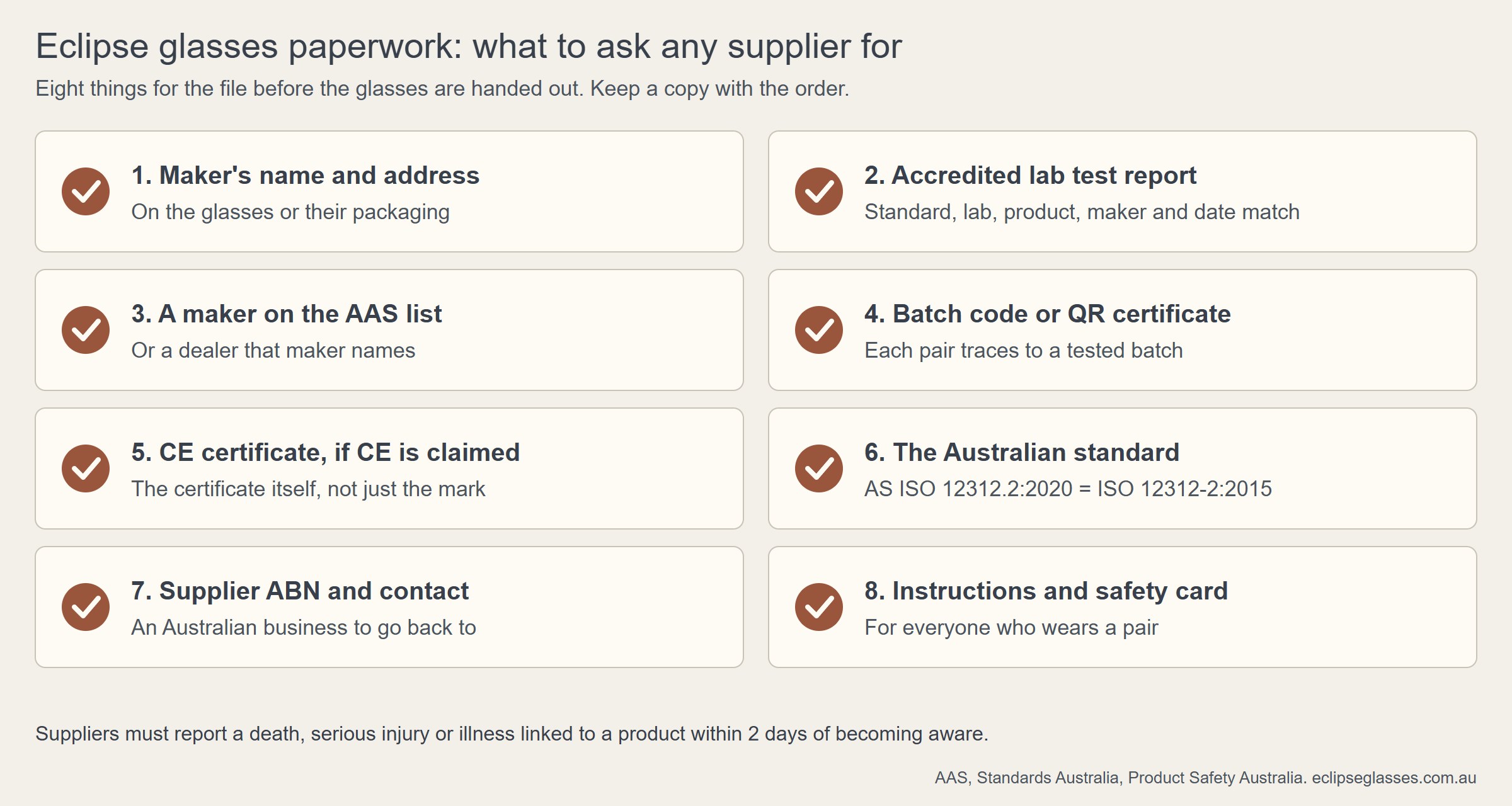
The short version. Before anyone hands out eclipse glasses, get eight things on file: the maker's name and address, a test report from an accredited laboratory that matches the product, proof the maker is on the American Astronomical Society (AAS) list, batch codes or QR certificates, the CE certificate if CE is claimed, a reference to the right standard, the supplier's ABN and Australian contact details, and the safety instructions for the people wearing them. If a supplier can't produce the test report, buy elsewhere.
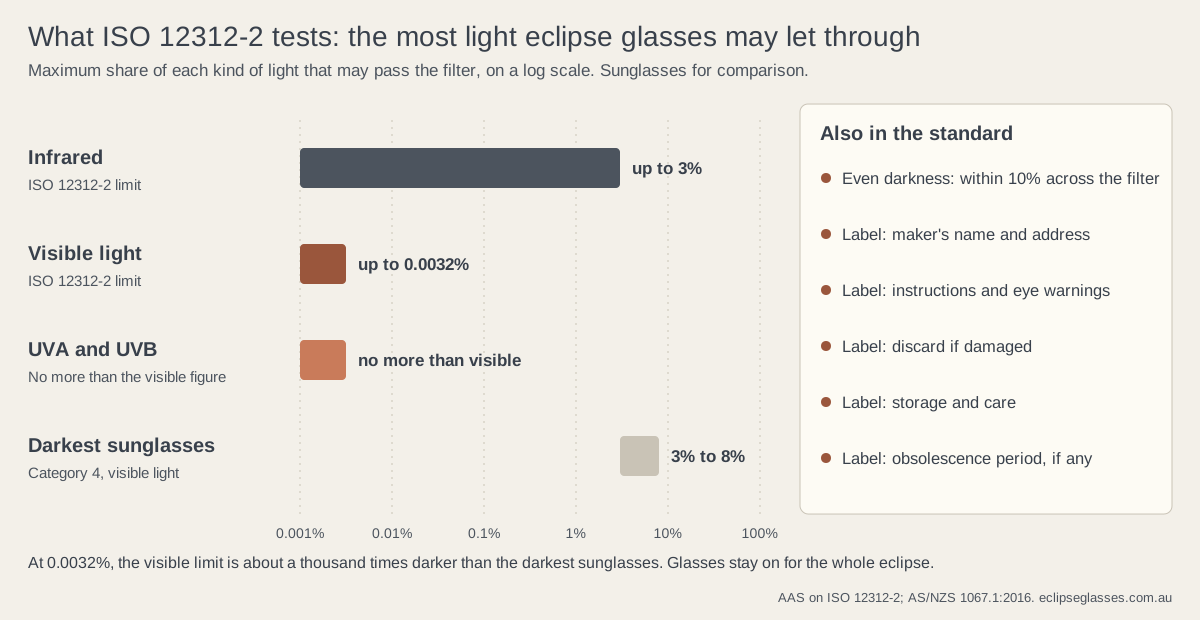
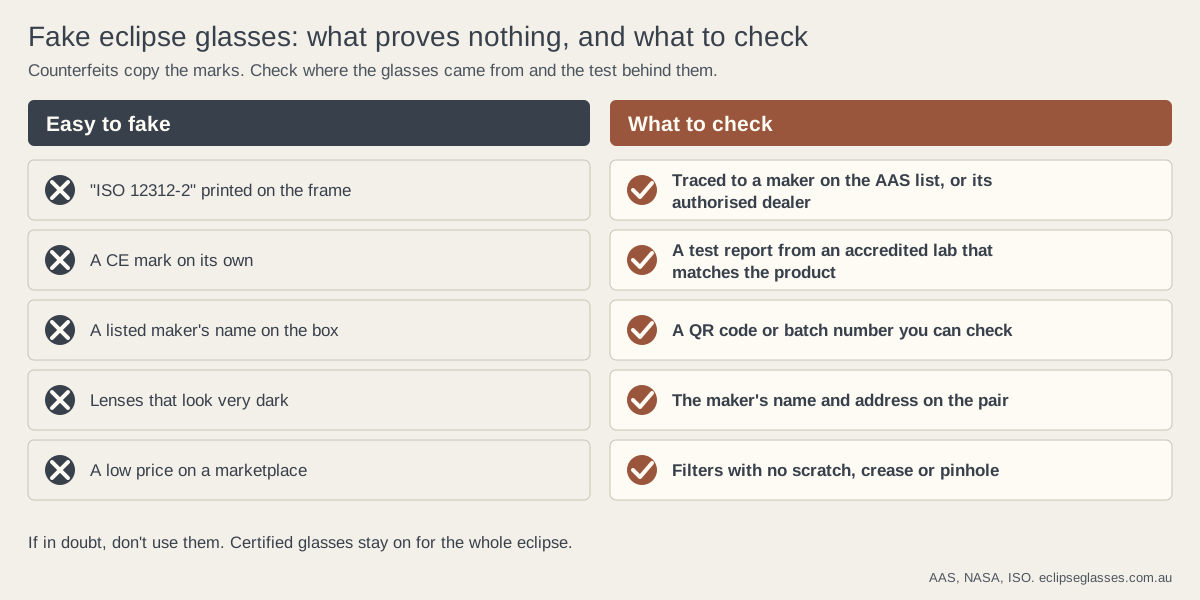
This checklist is for the people who sign off on eclipse glasses: council and school procurement, WHS officers, retailers and event organisers. It covers what to ask for and what to keep. For what the standard itself measures, see our explainer on what ISO 12312-2 tests. For checking a single pair in your hand, see how to spot fake eclipse glasses.
What should you ask any eclipse glasses supplier for?
Print this page or copy the table into your procurement file. Tick each line when the document is in hand.
| Ask for | What to check | On file |
|---|---|---|
| 1. The maker's name and address | Printed on the glasses or their packaging, and the same maker as on the test report. | ☐ |
| 2. A test report from an accredited laboratory | Names ISO 12312-2, the laboratory and its accreditation, the same product and maker, and a date. | ☐ |
| 3. The maker's place on the AAS list | The maker is on the AAS list of reputable manufacturers, and your supplier is that maker or a dealer it names. | ☐ |
| 4. Batch codes or QR certificates | Each carton or pair can be traced back to a tested batch. | ☐ |
| 5. The CE certificate, if CE is claimed | The certificate itself, naming the product and the notified body, with its validity date. Not just the mark. | ☐ |
| 6. The right standard | ISO 12312-2:2015, or Australia's identical AS ISO 12312.2:2020. | ☐ |
| 7. The supplier's ABN and Australian contact | A business you can go back to, and who imported the glasses. | ☐ |
| 8. Instructions and a safety card | How to use the glasses, the eye-injury warning, discard if damaged, storage. One for each group or site. | ☐ |
How do you read a test report?
The AAS is blunt about printed claims: anyone can print one, and the only way to know for sure is a test by an accredited laboratory. So the report is the document that matters most. Check five things on it:
- The standard. It should name ISO 12312-2. The current edition is ISO 12312-2:2015.
- The laboratory. The AAS says the lab should be accredited to ISO/IEC 17025 by a body that signs the International Laboratory Accreditation Cooperation (ILAC) arrangement, with ISO 12312-2 in its scope of accreditation. In the EU, a notified body for the PPE Regulation (EU) 2016/425 also counts.
- The product. The product and the maker on the report should match the glasses you are buying, not a different model or company.
- The date. Note when the test was done, and ask how it links to the batch you are buying.
- The source. Get the report from the supplier directly, and ask questions if anything does not match.
If a supplier cannot or will not show a report, that is your answer.
Why isn't a CE mark enough?
A CE mark on its own does not show that a filter meets ISO 12312-2. The useful document is the certificate behind it. The AAS accepts testing by an EU notified body under Regulation (EU) 2016/425 as one route to show a viewer meets the standard, so a CE certificate that names the product and the notified body is worth keeping. A mark printed on a frame, with nothing behind it, is not.
Which standard should the paperwork name in Australia?
Standards Australia says eclipse glasses should meet AS ISO 12312.2:2020. That is Australia's identical adoption of ISO 12312-2:2015, so the requirements are the same, and a test report against ISO 12312-2:2015 covers them. Our plain-language guide to ISO 12312-2 explains what the standard measures and what it requires on the label.
Why check the AAS list and batch codes?
The AAS keeps a list of reputable manufacturers and asks them to publish their own authorised dealers; it no longer vets resellers itself. Counterfeiters have printed the names of listed makers on their own products, so a listed name on the box is not enough. You need a supply chain you can trace: the maker, the dealer, the batch. A batch code or QR certificate on each pair ties the glasses in your store room to a tested batch, which also helps if a question comes up later. Our guide to fake eclipse glasses shows what counterfeits copy.
What supplier details should go on file?
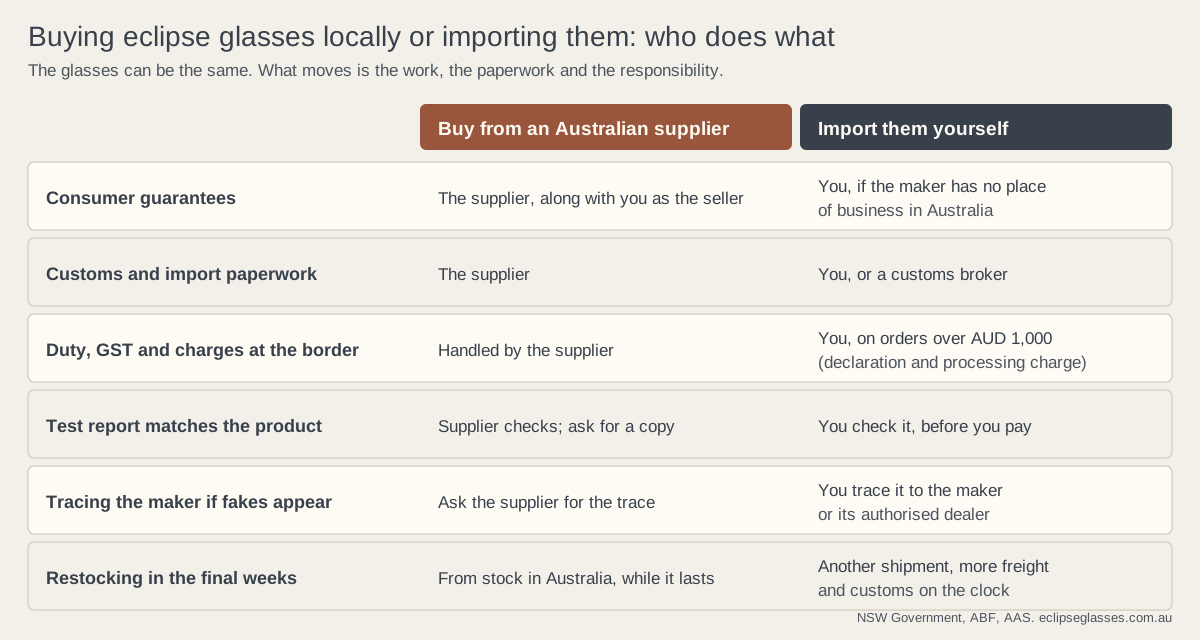
The supplier's ABN, address and a named contact, plus who imported the glasses. The NSW Government says the importer is responsible for the consumer guarantees under Australian Consumer Law if the maker has no place of business in Australia. If you buy from an Australian supplier that imports the glasses, that is them. If you import directly, it is you. Our comparison of buying from an Australian supplier or importing covers the rest. This is general information, not legal advice.
What safety information should go out with the glasses?
ISO 12312-2 asks for this information on the filter or its packaging, in the local language: the maker's name and address, instructions for use, a warning that using no filter or the wrong one can cause permanent eye injury, advice to discard damaged filters, and storage and care advice. Keep a copy, and make sure every group leader, teacher or staff member handing out glasses has the key points:
- Certified glasses stay on for the whole eclipse, totality included.
- Check every pair before use. Any scratch, puncture, tear or loose filter means that pair goes in the bin.
- Never use eclipse glasses with binoculars, a telescope or a camera.
- Supervise children very closely.
Schools can build this into an eclipse safety plan.
What are your reporting duties if something goes wrong?
Product Safety Australia says a supplier must report any death, serious injury or serious illness associated with a consumer product it supplies within 2 days of becoming aware of it. Anyone can report a product they think is unsafe with the ACCC's unsafe product report form. Keep your paperwork, batch records and distribution list together, so you can answer quickly which batch went where.
How does Aura Sight's paperwork match this checklist?
Here is what comes with ours, as set out on our certification page:
| Checklist item | Aura Sight |
|---|---|
| Certification pack | Ships with every order. |
| Test report | ISO 12312-2:2015, tested by ICS Laboratories, an A2LA-accredited laboratory, and retested every five years. The full test report is available on request. |
| The maker | Rainbow Symphony, a manufacturer on the AAS list of reputable vendors. The list names manufacturers, not resellers, so Aura Sight itself is not on it. |
| Batch traceability | A QR code on every pair links to its batch certificate. |
| CE certificate | EU PPE Regulation 2016/425, Notified Body 2834, valid to May 2031. Available on request. |
| Supplier details | AURASITE PTY LTD, ABN 42 688 792 494, Sydney NSW, with stock held in NSW. |
Comparing suppliers? Our ranking of the best eclipse glasses in Australia scores each one on paperwork as well as price.
Buying for a council, school, shop or workplace? Ask us for wholesale pricing on cartons, counter displays or your own brand, and for the test report and CE certificate for your file.
Get wholesale pricing See our certificationFAQ
What paperwork should eclipse glasses come with?
A test report from an accredited laboratory against ISO 12312-2 that names the same product and maker, the maker's name and address on the glasses or packaging, batch codes or QR certificates, the CE certificate if CE is claimed, the supplier's ABN and Australian contact, and the user instructions.
Is a CE mark enough for eclipse glasses?
No. A CE mark on its own does not show a filter meets ISO 12312-2. Ask for the certificate behind it, naming the product and the notified body, and for the ISO 12312-2 test report.
Do eclipse glasses need an Australian standard?
Standards Australia says eclipse glasses should meet AS ISO 12312.2:2020, which is identical to ISO 12312-2:2015. A test report against ISO 12312-2:2015 covers the same requirements.
How do I check a laboratory is accredited?
The AAS says the lab should be accredited to ISO/IEC 17025 by a body that is a full signatory to the ILAC Mutual Recognition Arrangement (MRA), with ISO 12312-2 in its scope, or be an EU notified body for the PPE Regulation 2016/425. Ask the supplier for the accreditation details.
Can I get Aura Sight's test report?
Yes. The ISO 12312-2:2015 test report and the CE certificate are available to any customer on request, and every order ships with a certification pack.
What if a supplier won't show a test report?
Buy elsewhere. A printed ISO 12312-2 mark is easy to copy, and the test report is how you know the filter was tested.
Sources
All checked 13.11.2026.
- American Astronomical Society, the ISO 12312-2 standard (labelling, accredited laboratories), How can you tell if your eclipse glasses are safe? and Suppliers of safe solar viewers and filters.
- NASA, Eclipse safety (maker's name and address).
- Standards Australia, Partial solar eclipse should not be a sight for sore eyes, 18 September 2025; AS ISO 12312.2:2020 (Intertek Inform).
- NSW Government, Selling directly to consumers as a manufacturer or importer.
- Product Safety Australia, When you must report an incident and Report an unsafe product.
- ARPANSA, Solar eclipse (supervise children very closely).
- Aura Sight supplier and test documents, as on our certification page.
Stock Aura Sight certified eclipse glasses
Counter displays of 50 pairs, family packs and your own brand, from NSW stock, with a certification pack on every order, full test reports on request and a QR batch certificate on every pair.