A solar filter is a film made to block almost all visible light and nearly all ultraviolet and infrared, so your eyes are protected while you watch a solar eclipse.
How eclipse glasses are made: key facts
What are eclipse glasses made of?
The filter. A 2023 technical report published by the American Astronomical Society (AAS) names two filter materials. One is aluminised polyester made specially for solar observing. It is often called "mylar", but the space blankets and aluminised film sold for gardening are not suitable. The other is "black polymer", carbon particles suspended in a resin. The view through black polymer is yellow-white and through aluminised polyester blue-white. Newer black polymer filters often add a layer of aluminised polyester on one side.
The frame. Many eclipse glasses have a paper frame: stiff paperboard printed with the design and safety wording. Some have plastic frames. Safety depends on the filter, not the frame, so paper and plastic frames with an ISO 12312-2 filter give the same protection.
How are eclipse glasses made?
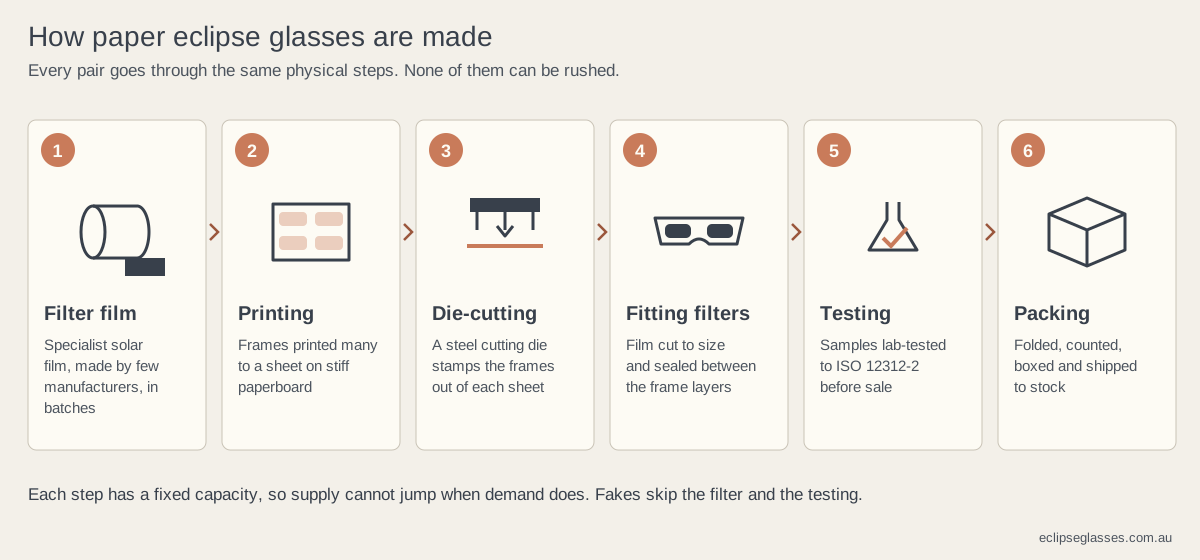
A paper pair typically goes through these physical steps:
- Filter film. Solar filter film comes from specialist makers, typically in batches.
- Printing. The frames, with their designs and safety wording, are typically printed many to a sheet on paperboard.
- Die-cutting. A cutting die, a steel blade bent to the outline of the frame and its eye holes, usually stamps the frames out of each sheet.
- Fitting the filters. The film is cut to size and fixed into each frame, often between two layers of paperboard.
- Testing. The filter is tested by a laboratory against ISO 12312-2 before the glasses can be sold as certified to it.
- Packing. The glasses are folded, counted, boxed and shipped into stock.
Each step takes time and capacity, one reason eclipse glasses ran short in the US before the 2017 and 2024 eclipses. Read what the US sell-outs mean for 2028. Branded glasses are made the same way: the artwork changes the print on the paperboard, not the filter or how it is tested (see custom printed eclipse glasses).
How are eclipse glasses tested?
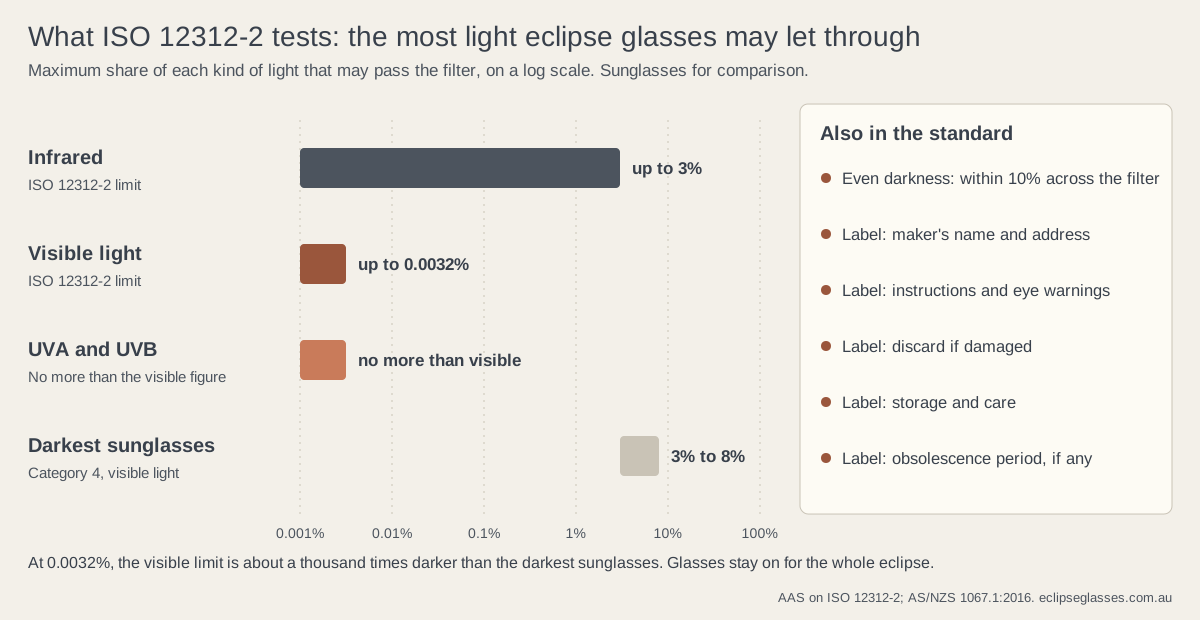
Against ISO 12312-2, the international standard for eclipse viewers that do not magnify. In short, a lab measures how much visible light, ultraviolet and infrared passes through the filter, and checks the filter is evenly dark across its area; the standard also sets labelling rules. ISO 12312-2 explained sets out each limit.
Who does the testing matters as much as the test. ISO writes standards and does not test products. The AAS says a viewer should be tested by a laboratory accredited to ISO/IEC 17025 by a body that has signed the ILAC Mutual Recognition Arrangement, with ISO 12312-2 in its scope. In the EU, a notified body under the PPE Regulation (EU) 2016/425 can do it instead. Anyone can print an ISO statement on a frame; the only way to know for sure is a test by an accredited lab.
For ours: every pair uses a filter certified to ISO 12312-2:2015, tested by ICS Laboratories, an A2LA-accredited laboratory, and the filter is retested every five years. The glasses are also CE-certified as personal protective equipment under EU Regulation 2016/425 by Notified Body 2834, with the certificate valid to May 2031. The full test report and the CE certificate are available on request. The details are on our certification page.
What do the marks on eclipse glasses mean?
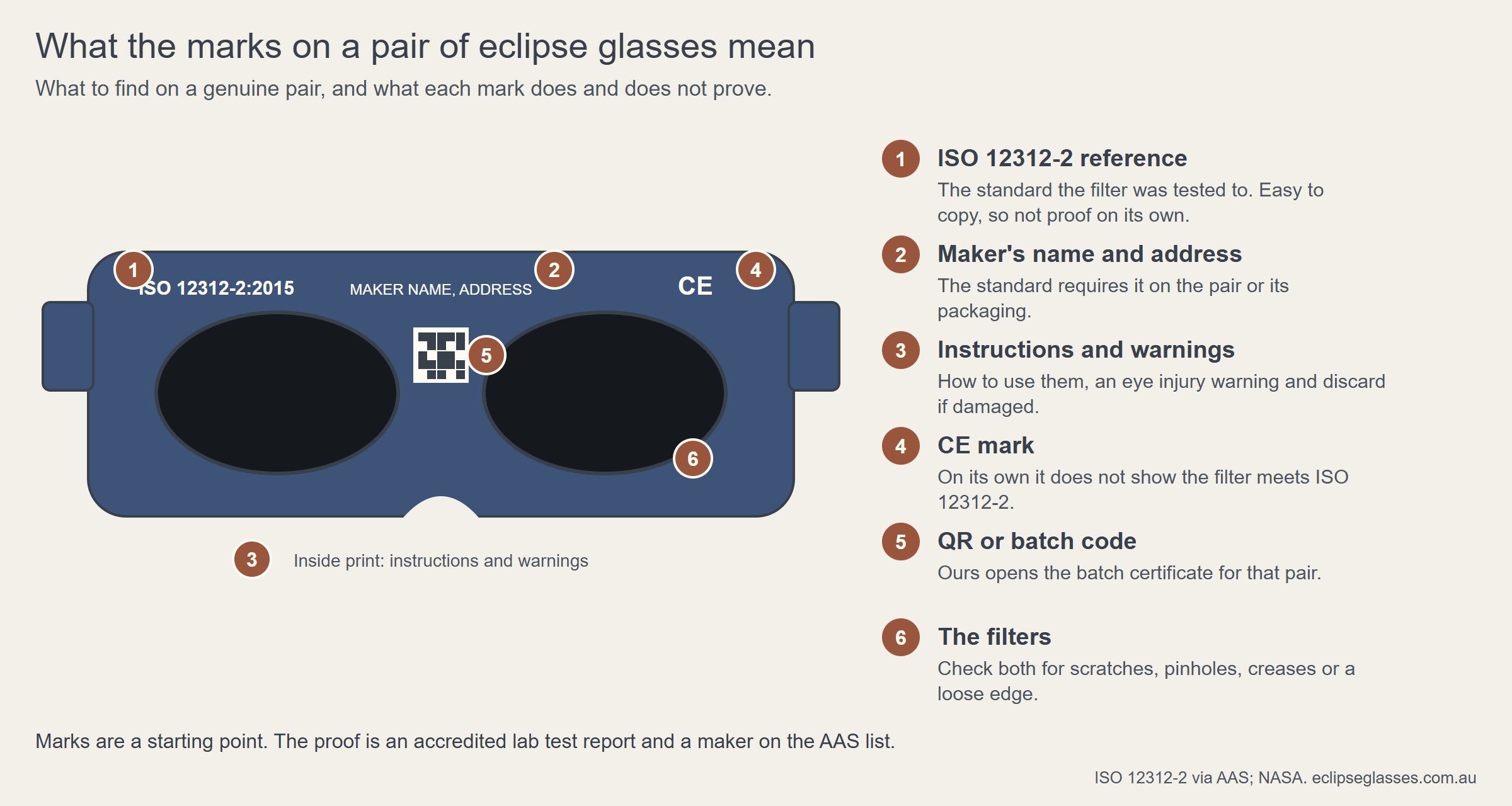
The standard says the filter or its packaging must carry, in the language of the country where it is sold, the maker's name and address, instructions for use, a warning that using no filter or the wrong one can cause permanent eye injury, and advice to discard a damaged filter. What you will usually find on a genuine pair:
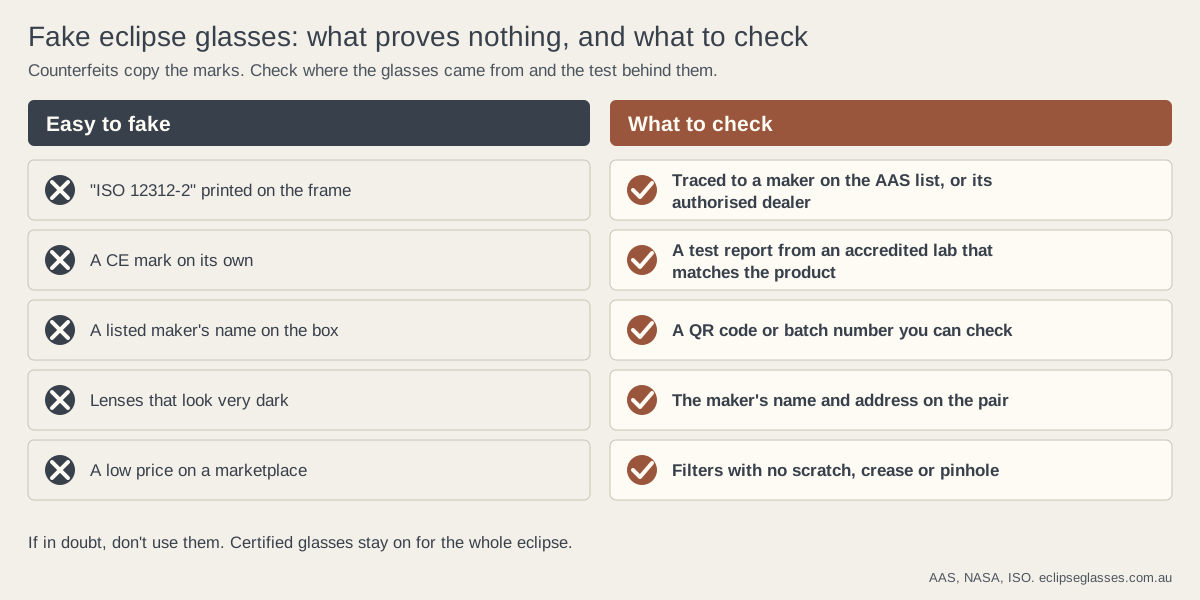
- ISO 12312-2. The standard the filter was tested to. Useful, but easy to copy, so it is not proof on its own.
- The maker's name and address. No maker's details, no use. Check the maker is on the AAS reputable vendors list.
- Instructions and warnings. How to use them, the eye injury warning and when to throw a pair out.
- A CE mark. On its own, a CE mark does not show a filter meets ISO 12312-2.
- A batch or QR code. On ours, the QR code opens the batch certificate for that pair.
- The filters themselves. Not a mark, but the part to check every time.
Watch for wording too. The AAS says no product should suggest ISO itself certified or approved it: ISO writes standards and does not test products. Saying a viewer meets ISO 12312-2 is fine when an accredited lab has tested it, which is what "certified to ISO 12312-2" means on our site.
How to check a pair of eclipse glasses
Five checks for any pair, from any seller:
- Look for ISO 12312-2 and the maker's name and address on the pair or its packaging.
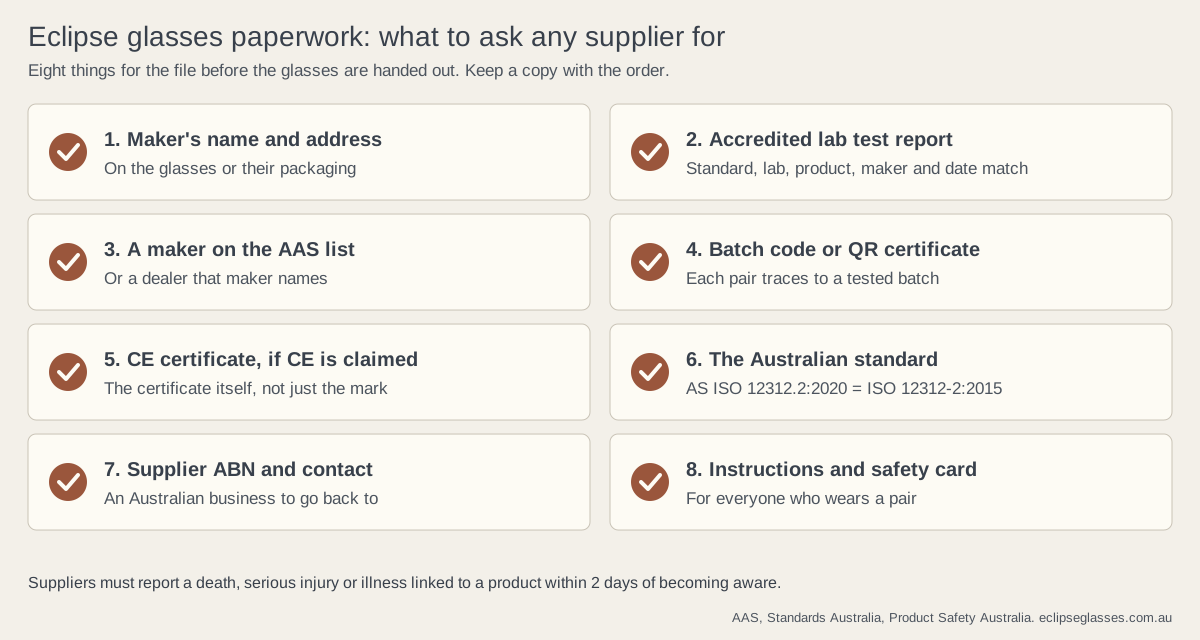
- Ask the seller for the test report from an accredited laboratory, and check the lab and product match.
- Check the maker is on the AAS reputable vendors list.
- Buy from that maker, or a dealer it names. Counterfeiters print listed makers' names on their own glasses.
- Inspect both filters before every use. Throw out any pair with a scratch, crease, pinhole, tear or a filter coming away from the frame.
Never use eclipse glasses with binoculars, a telescope or a camera; those need their own solar filter fitted to the front. For the paperwork a school or business should keep on file, see the certification paperwork checklist, and for spotting fakes, fake eclipse glasses in Australia.
Our glasses are made by Rainbow Symphony, a manufacturer on the AAS list. Every pair uses a filter certified to ISO 12312-2:2015, tested by ICS Laboratories, and carries a QR batch certificate. Certified glasses stay on for the whole eclipse, totality included.
Shop eclipse glasses See our certificationHow eclipse glasses are made and tested: questions
What are eclipse glasses made of?
A solar filter in a paper or plastic frame. The AAS names two filter materials: aluminised polyester made specially for solar observing, and black polymer, which is carbon particles suspended in a resin.
Is the filter in eclipse glasses the same as Mylar?
Not the household kind. Solar filter film is aluminised polyester made specially for solar observing; space blankets and garden film are not suitable.
Who tests eclipse glasses?
An accredited laboratory, not ISO. ISO writes the standard and does not test products. Ours use a filter certified to ISO 12312-2:2015, tested by ICS Laboratories, an A2LA-accredited laboratory, and retested every five years.
Are paper eclipse glasses as safe as plastic ones?
Yes. Safety depends on the filter, not the frame. Paper and plastic frames that use an ISO 12312-2 filter give the same protection.
Does the ISO mark prove eclipse glasses are safe?
No. Counterfeits print it. The proof is a test report from an accredited laboratory and a maker on the AAS reputable vendors list, bought from that maker or a dealer it names.
How long do eclipse glasses last?
There is no fixed expiry. The AAS says glasses that meet ISO 12312-2 and are under 10 years old can be reused if the filters are not scratched, punctured, torn or coming loose. Store them at room temperature in their packaging.
Sources
All checked 18.11.2026.
- B. Ralph Chou, Solar Eclipse Eye Safety, technical report published by the American Astronomical Society, 2023 (filter materials).
- American Astronomical Society, the ISO 12312-2 standard (scope, labelling, accredited laboratories, "ISO certified" wording), how to tell if viewers are safe and safe viewing (reuse, storage).
- NASA, eclipse safety (maker's name and address on the product).
- ISO, ISO 12312-2:2015.
- Aura Sight supplier and test documents, as on our certification page.
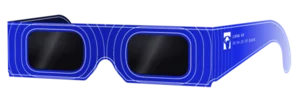
Certified eclipse glasses from Aura Sight
ISO 12312-2 certified, lab-tested and made by Rainbow Symphony, with a QR batch certificate on every pair. A$5.45 a pair from NSW stock, delivered Australia-wide (New Zealand too).