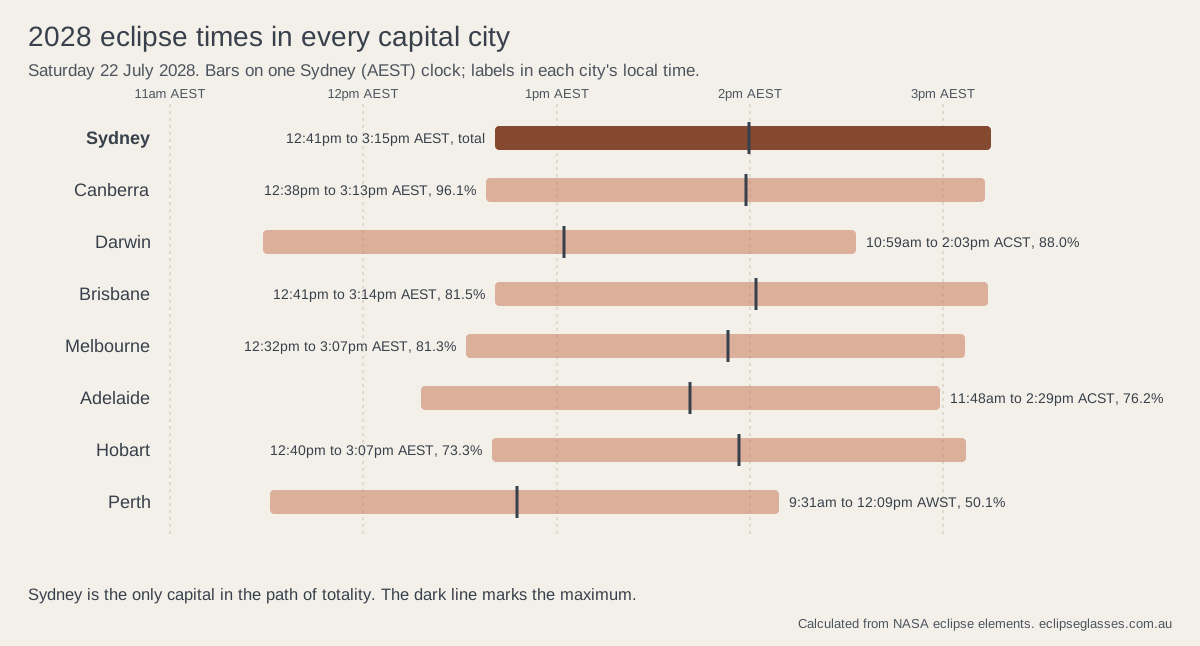
The short version. Darwin: 10:59am to 2:03pm ACST, most covered at 12:32pm (88.0%). It is a partial eclipse, the Sun never fully disappears, and everyone watching needs certified eclipse glasses from start to finish. The nearest totality is about 415 km south-west in the Kimberley.
What time is the eclipse in Darwin?
Times are ACST. The Territory has no daylight saving, so in July Darwin is half an hour behind the east coast on AEST. The figures are for the Darwin CBD and match our 2028 eclipse times for every capital city.
| Stage | Time |
|---|---|
| Eclipse starts | 10:59am |
| Most covered (88.0%) | 12:32pm |
| Eclipse ends | 2:03pm |
| Length | 3 h 04 min |
88.0% is the share of the Sun's area that is covered. Eclipse sites that quote the magnitude (about 0.9) give the share of its width instead, which is why some list a higher figure.
At its maximum the Sun is about 57° above the horizon, almost due north (bearing about 9°). That is high enough that buildings and trees rarely block it, but a verandah, a shade sail or a tree overhead can, so watch the eclipse from open ground. July is the dry season, so the sky is usually clear.
Eclipse times around Darwin and the Top End
The whole Top End gets a partial eclipse in the middle of the day. Coverage rises the further south-west you go, towards the path of totality.
| Place | Starts | Most covered | Sun covered | Ends |
|---|---|---|---|---|
| Darwin CBD | 10:59am | 12:32pm | 88.0% | 2:03pm |
| Casuarina | 10:59am | 12:32pm | about 88% | 2:03pm |
| Palmerston | 11:00am | 12:33pm | about 88% | 2:04pm |
| Howard Springs | 11:00am | 12:33pm | about 88% | 2:04pm |
| Wurrumiyanga (Tiwi Islands) | 10:58am | 12:31pm | about 86% | 2:02pm |
| Batchelor | 11:00am | 12:34pm | about 90% | 2:04pm |
| Jabiru | 11:05am | 12:38pm | about 85% | 2:07pm |
| Katherine | 11:05am | 12:39pm | about 91% | 2:09pm |
| Timber Creek | 11:02am | 12:36pm | about 98% | 2:07pm |
| Nhulunbuy | 11:15am | 12:47pm | about 74% | 2:13pm |
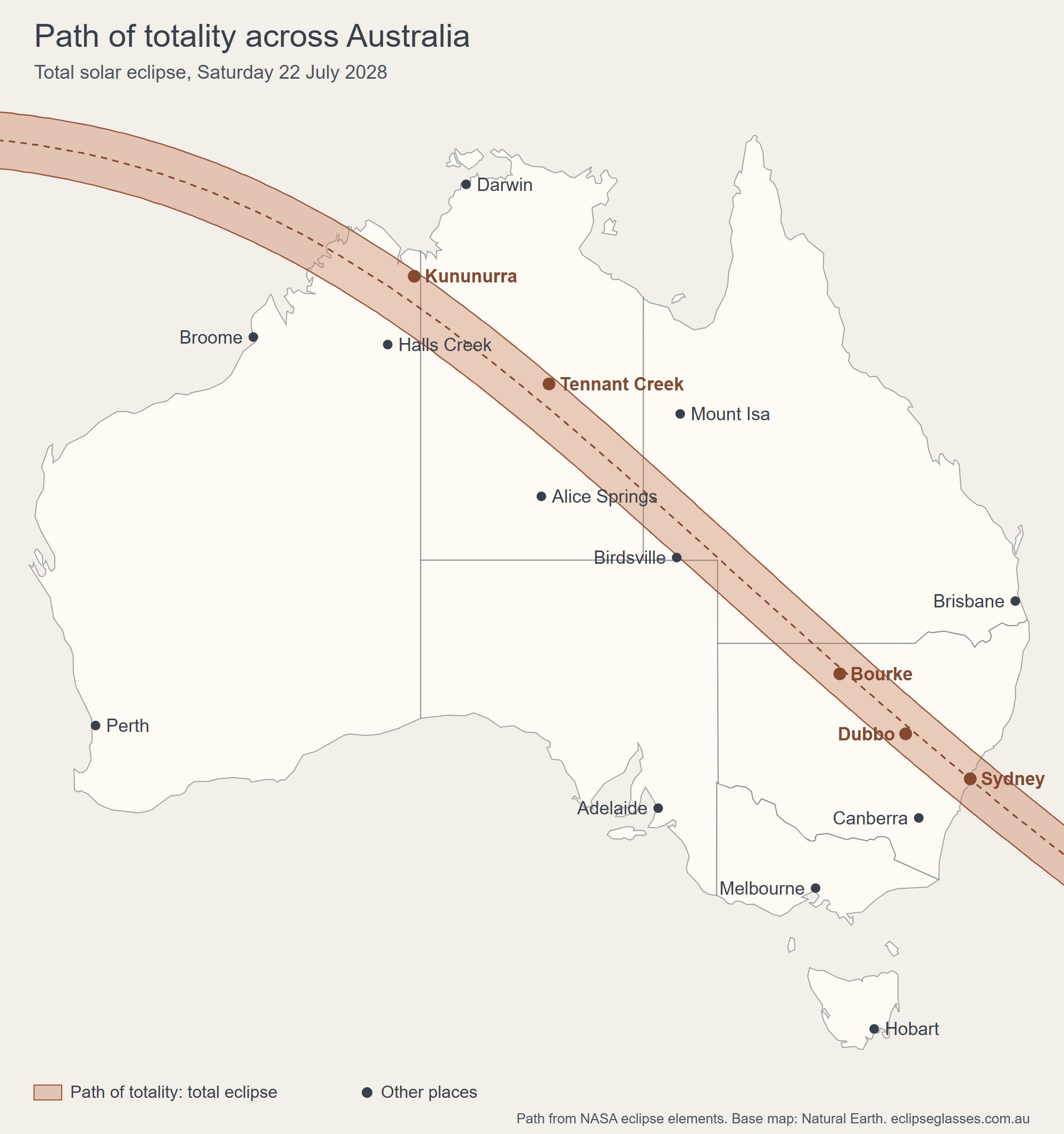
2028 eclipse path map for Australia
Is Darwin in the path of totality?
No. The Moon covers at most 88.0% of the Sun over Darwin, and the sky stays daylight bright. Totality, when the Sun is fully covered for a few minutes, happens only inside a band about 200 km wide that crosses Western Australia, the Northern Territory, Queensland and New South Wales.
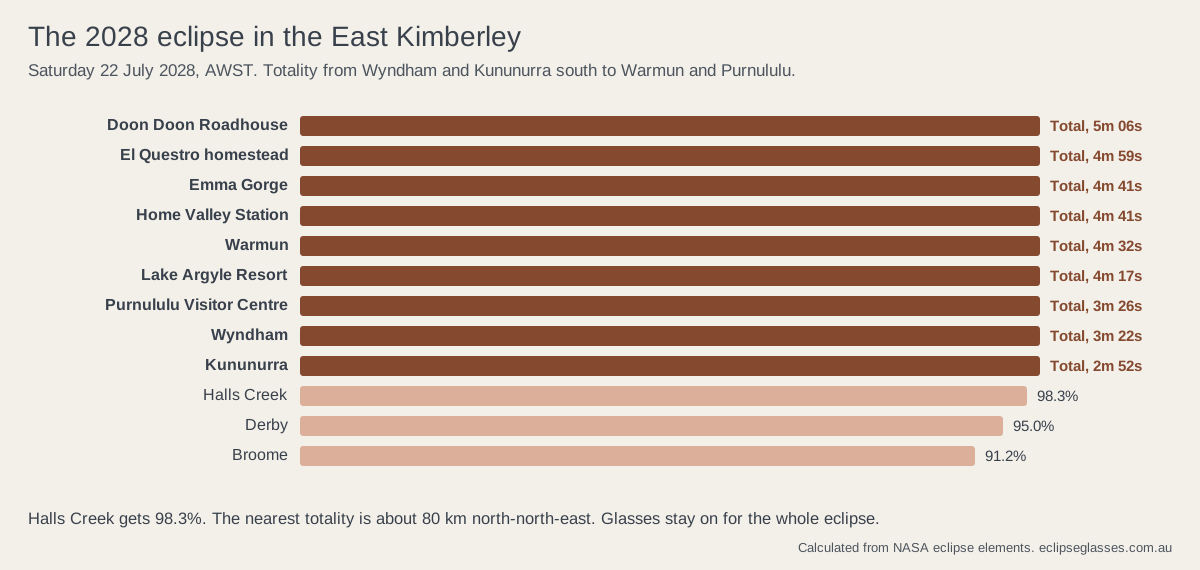
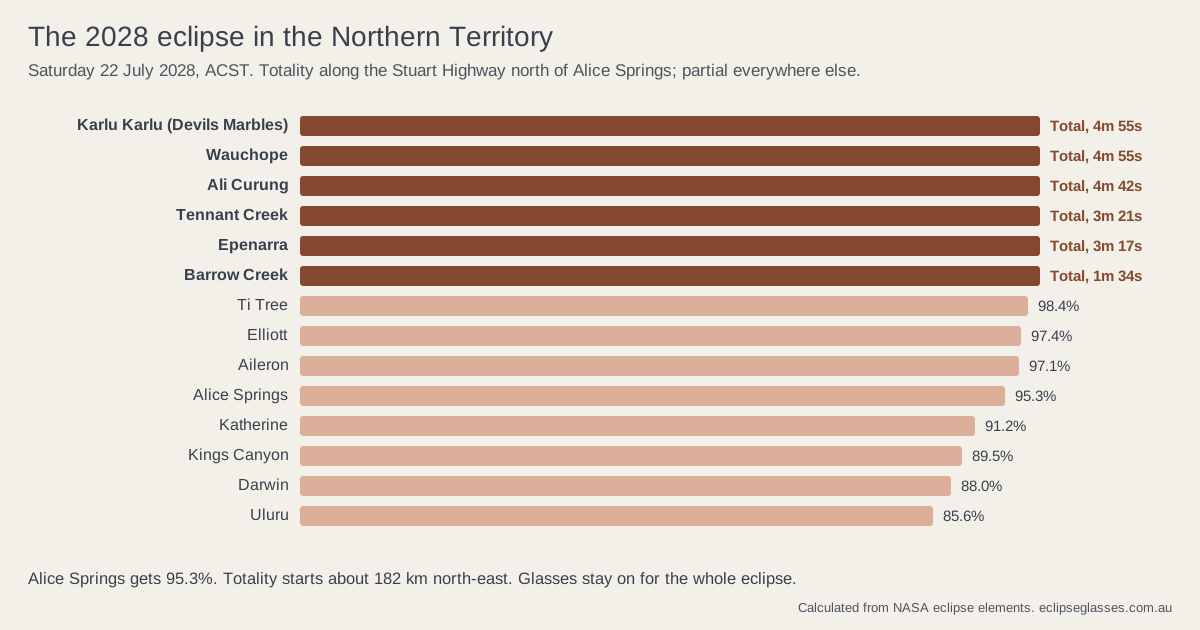
From Darwin, the edge of the path is about 415 km south-west in a straight line, in the East Kimberley in Western Australia. Kununurra gets 2 minutes 52 seconds of totality and Wyndham 3 minutes 22 seconds: see our guide to the eclipse in the Kimberley, and note that WA clocks are 1 hour 30 minutes behind Darwin. Inside the Territory, totality crosses the Stuart Highway around Tennant Creek, about 875 km south in a straight line. Timber Creek, at about 98%, is just outside the path. Check any address on our 2028 eclipse map.
Do you need eclipse glasses in Darwin?
Yes, for the whole eclipse. In a partial eclipse the Moon never covers the whole Sun, so the glasses stay on from the first contact to the last. Even with 88% covered, the part that is left is bright enough to burn the retina, and the retina has no pain sensors, so there is no warning. Ordinary sunglasses are never safe.
Our certified eclipse glasses are A$5.45 a pair, delivered Australia-wide, and the family eclipse kit has four pairs for A$19.25. Online orders ship until 31 May 2028. Buying for a Darwin school, club or business? See eclipse glasses for schools or bulk orders.
- Never use eclipse glasses with binoculars, a telescope, a camera or a phone. Optics need their own solar filter on the front: see solar filters for cameras, phones and binoculars.
- Check every pair before use, and throw out any that are scratched, torn or punctured.
- Supervise children closely, and fit their glasses before the eclipse starts.
Every solar eclipse in Darwin to 2040
No total eclipse reaches Darwin before 2040, and none of the later partial eclipses is as deep: 22 July 2028 is the one to plan for. After it, five more solar eclipses reach Darwin before 2040.
| Date | In Darwin | Begins | Greatest | Ends |
|---|---|---|---|---|
| Saturday 22 July 2028 | 88% of the Sun covered | 10:59am | 12:32pm | 2:03pm ACST |
| Monday 25 November 2030 | 29% of the Sun covered | 5:17pm | 6:06pm | 6:51pm ACST |
| Wednesday 21 May 2031 | Partial, low in the sky at sunset | 5:27pm | After sunset | At sunset ACST |
| Saturday 10 March 2035 | Partial, low in the sky at sunrise | Before sunrise | Before sunrise | 7:03am ACST |
| Monday 13 July 2037 | 64% of the Sun covered | 10:13am | 11:41am | 1:17pm ACST |
| Sunday 26 December 2038 | 44% of the Sun covered | 7:56am | 8:56am | 10:05am ACST |
Local times, ACST all year. On 21 May 2031 the Sun sets during the eclipse, and on 10 March 2035 it rises already eclipsed, with only a sliver covered; both need a clear, low horizon. Every one is partial in Darwin, so certified glasses stay on from start to finish. Our guide to the next solar eclipse in Australia maps every path to 2040.
Solar eclipse in Darwin: questions
What time is the solar eclipse in Darwin?
On Saturday 22 July 2028 the eclipse starts at 10:59am ACST, reaches its maximum at 12:32pm with 88.0% of the Sun covered, and ends at 2:03pm. That is about 3 hours in all.
Is Darwin in the path of totality in 2028?
No. Darwin gets a partial eclipse. The nearest totality is about 415 km south-west in the East Kimberley in Western Australia, where Kununurra gets 2 minutes 52 seconds and Wyndham 3 minutes 22 seconds.
Which way do I face to watch the eclipse in Darwin?
North, and high. At 12:32pm the eclipse is about 57° above the horizon, almost due north (bearing about 9°), so most open spots work. Step out from under verandahs, trees and shade sails.
Do I need eclipse glasses in Darwin?
Yes, for the whole eclipse. In a partial eclipse the Moon never covers the whole Sun, so the glasses stay on from the first contact to the last. Use ISO 12312-2 certified eclipse glasses from start to finish.
Where can I buy eclipse glasses in Darwin?
Online from Aura Sight: ISO 12312-2 certified eclipse glasses are A$5.45 a pair and the family eclipse kit (four pairs) is A$19.25, delivered Australia-wide. Pre-orders ship from NSW by 31 May 2028. Our guide to where to buy eclipse glasses in Australia lists what to check on any pair.
When is the next total solar eclipse in Darwin?
Not before 2040. The 22 July 2028 eclipse, at 88%, is also the deepest partial eclipse in Darwin until at least 2040. For totality in 2028, go to the Kimberley or down the Stuart Highway to Tennant Creek.
Sources
All checked 17.11.2026.
- Times calculated from NASA's Besselian elements for the 22 July 2028 eclipse, Fred Espenak, NASA GSFC, with Delta T of 69.2 s, for each town centre. Coverage outside Darwin is rounded to the nearest whole per cent.
- Distance to the path is the straight-line distance from the Darwin CBD to the nearest point of the path and to the nearest mapped town in it.
- ARPANSA, Solar eclipse; American Astronomical Society, Solar eclipse eye safety; NASA, Eclipse safety.
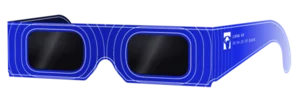
Certified eclipse glasses from Aura Sight
ISO 12312-2 certified, lab-tested and made by Rainbow Symphony, with a QR batch certificate on every pair. A$5.45 a pair from NSW stock, delivered Australia-wide (New Zealand too).