The short version. Eclipse glasses sold in Australia should meet AS ISO 12312.2:2020, which is the international standard ISO 12312-2:2015 adopted word for word. AS/NZS 1338 is a different standard, for welding filters. On its own it does not show a pair is made for the eclipse.
What standard do eclipse glasses need to meet in Australia?
AS ISO 12312.2:2020. Standards Australia says glasses that meet it are essential for anyone watching the partial eclipse directly, and ARPANSA says eclipse glasses can allow safe viewing if they meet it.
It is the same document as the international standard, ISO 12312-2:2015, so a pair tested to the ISO version meets the same requirements. Neither Standards Australia nor ARPANSA describes it as a legal requirement; both present it as the standard to look for.
What is AS ISO 12312.2:2020?
It is Standards Australia's identical adoption of ISO 12312-2:2015, published on 15 May 2020. Identical means no Australian changes: the light limits and label rules are the same.
You will see it written a few ways, including AS ISO 12312.2:2020 and AS/ISO 12312-2:2020 (ARPANSA's spelling). They are one standard. There is no joint AS/NZS edition; in New Zealand, Standards New Zealand sells the ISO standard itself.
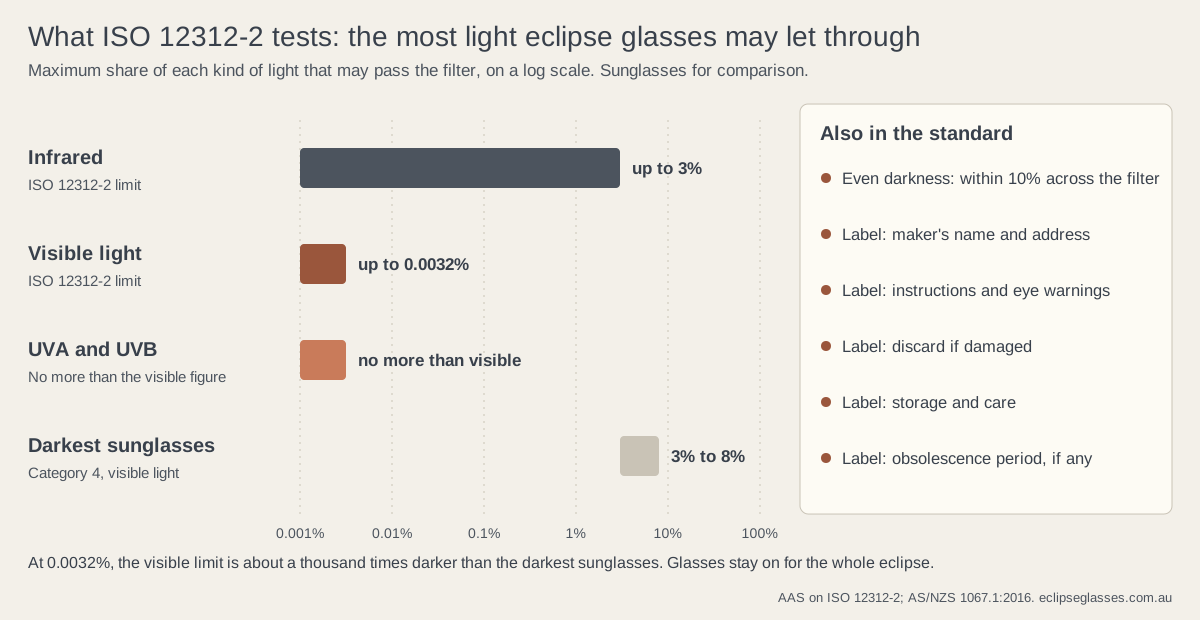
In short, it caps visible light at about 0.003% or less, keeps ultraviolet no higher than that and infrared at 3% or less, and requires the maker's name and address on the pair or packet. Our ISO 12312-2 standard explained guide covers each limit in detail.
Why do some sellers quote AS/NZS 1338?
Because it is a long-standing Australian filter standard, and some makers list its light figures as extra detail. AS/NZS 1338.1 sets shade numbers and light limits for filters in welding eye protectors. It does not mention eclipses.
It has several editions. AS/NZS 1338.1:1992 was replaced by AS/NZS 1338.1:2012. In August 2026 the 2012 edition was itself superseded by AS 16321.2:2026, a welding eye protection standard based on ISO 16321-2. None of these is the eclipse glasses standard.
Some makers on the American Astronomical Society (AAS) list print AS/NZS 1338.1 light figures next to ISO 12312-2, as extra detail. That is fine. What matters is that ISO 12312-2 is there too, backed by a test report.
Is a filter that meets AS/NZS 1338 safe for the eclipse?
Not on that label alone. A welding filter is only safe for the eclipse at shade 14 or darker, and many welding lenses are lighter than that.
The AAS says the light limit in ISO 12312-2 matches a shade 12 welding filter at its brightest and shade 15 at its darkest. Welding filters come in many shades, so "meets AS/NZS 1338" does not tell you which one you have. The AAS also says shade 13 and 14 filters are rarely stocked in welding supply stores.
Never use an adjustable or auto-darkening welding helmet for the eclipse. If you don't have a lens clearly marked shade 14 or darker, use certified eclipse glasses instead.
How do I check a pair meets the right standard?
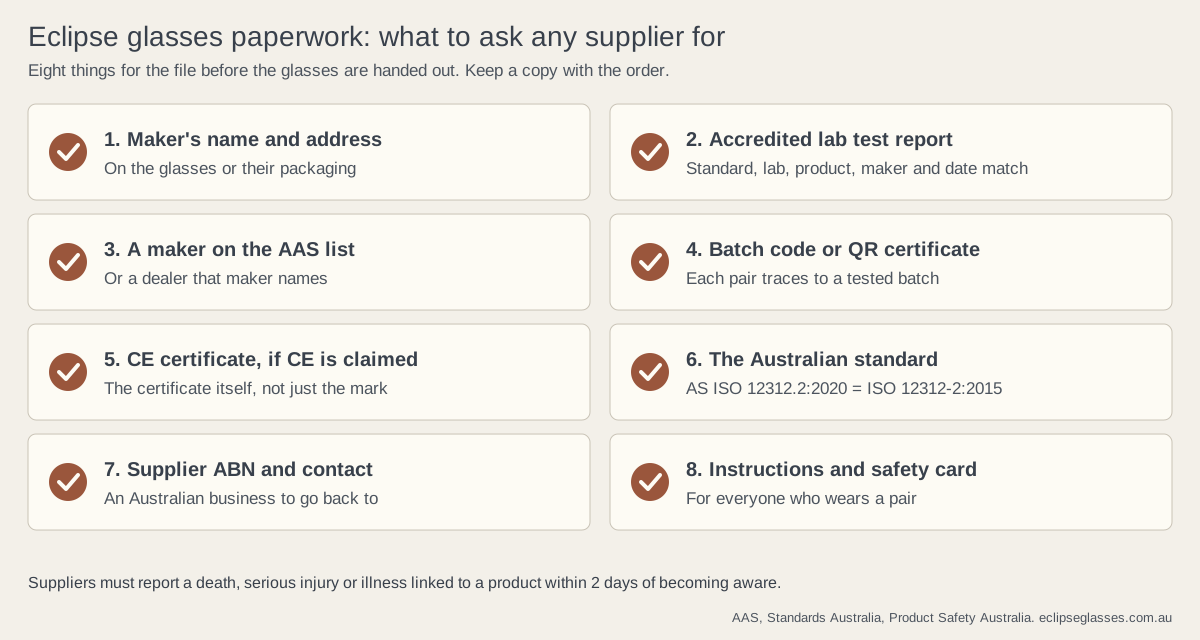
Look for ISO 12312-2 (or AS ISO 12312.2:2020) and the maker's name and address on the pair, then check the maker is on the AAS list and ask for the test report.
- The standard: ISO 12312-2 or AS ISO 12312.2:2020, not only AS/NZS 1338, EN 169 or a CE mark.
- The maker: on the AAS list of reputable manufacturers, or sold by one of its authorised dealers.
- The proof: a report from an accredited laboratory that names the maker and the product.
- The condition: no scratches, tears or pinholes. Throw out any damaged pair.
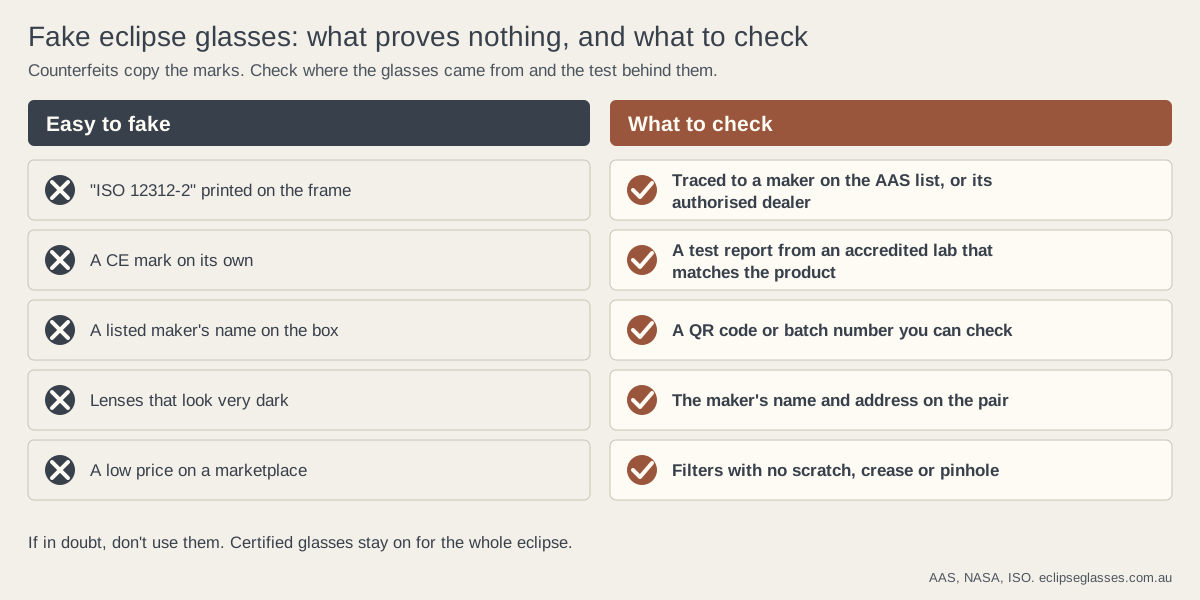
Anyone can print a standard number, so the printing is a starting point, not proof. Our guide to fake eclipse glasses in Australia shows what counterfeits copy. Whatever the label, never look at the Sun without certified glasses, and keep them on for the whole eclipse.
Our certified eclipse glasses are A$5.45 a pair: ISO 12312-2:2015 certified, tested by ICS Laboratories and made by a manufacturer on the AAS list. Pre-order now; they ship from NSW stock by 31 May 2028.
Australian standard for eclipse glasses: questions
What is the Australian standard for eclipse glasses?
AS ISO 12312.2:2020. It is Standards Australia's identical adoption of ISO 12312-2:2015, published on 15 May 2020, so the requirements are the same.
Is AS/NZS 1338.1 the eclipse glasses standard?
No. AS/NZS 1338.1 covers filters for welding eye protectors, and the 2012 edition was superseded in 2026 by AS 16321.2:2026. Look for ISO 12312-2 or AS ISO 12312.2:2020 instead.
Are eclipse glasses that only say AS/NZS 1338 safe?
You can't tell from that label alone, because welding filters come in many shades. Choose glasses that state ISO 12312-2, from a maker on the AAS list, with a test report.
Can I use welding glass for the eclipse?
Only shade 14 or darker. Never use an adjustable or auto-darkening welding helmet. If the shade isn't marked, use certified eclipse glasses.
Is there an AS/NZS version of ISO 12312-2?
No joint AS/NZS edition was found. Australia uses AS ISO 12312.2:2020, and Standards New Zealand sells ISO 12312-2:2015 itself.
Sources
All checked 20.11.2026.
- Standards Australia, Partial solar eclipse should not be a sight for sore eyes, 18 Sep 2025.
- Intertek Inform, AS ISO 12312.2:2020 (identical to ISO 12312-2:2015, published 15 May 2020).
- ARPANSA, Solar eclipse.
- Standards New Zealand, ISO 12312-2:2015; AS/NZS 1338.1:1992 (superseded by AS/NZS 1338.1:2012).
- Intertek Inform, AS/NZS 1338.1:2012, Filters for eye protectors: welding and allied operations (superseded 20 Aug 2026); AS 16321.2:2026, published 29 May 2026.
- American Astronomical Society, the ISO 12312-2 standard (shade 12 to 15 comparison); safe viewing (welding filters, auto-darkening helmets).
- American Academy of Ophthalmology, welding helmets and eclipses (shade 14 or darker).
- Rainbow Symphony, Eclipse safety (lists AS/NZS 1338.1:1992 figures alongside ISO 12312-2:2015).
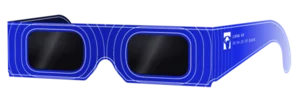
Certified eclipse glasses from Aura Sight
ISO 12312-2 certified, lab-tested and made by Rainbow Symphony, with a QR batch certificate on every pair. A$5.45 a pair from NSW stock, delivered to Australia and New Zealand.